
CHAPTER-15
EXPLORE

For the Teacher
- Act 1 = Chapter 1
- Scene 1 = Lesson 1
- Scene 2 = Lesson 2
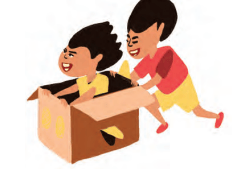
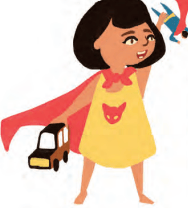
I’m sure you have created stories with your toys!


Namaste Vidusha

Awesome! Have you missed anything? Your list looks good! But, of all the things you listed, did you remember to write ‘the space around you’ and ‘the space within you’ (mind). These are the most important things you will need. Let us find out more about these …
Let us EXPLORE
ACT 1 SCENE 1—WALK OF WONDER
Activity 1
- Teacher will give you constant instructions on the speed of walking.
- Speed ‘5’ is your normal speed of walking. Speed ‘1’ is the slowest. Speed is the ‘10’ fastest (no running).
- START. Walk in the room at ‘5’, walk at '8’ and walk at ‘3’ (and so on with a gap of about 20–25 seconds).
- After this is repeated for about 4–5 minutes (or when the teacher senses that the children are in the right rhythm), include ‘freeze’ and then continue with the speeds.
Activity 2
You are in a Situation !
Teacher’s Note Start with the speed
activity as a warm-up.
After 4–5 rounds of
different speeds, introduce
simple changes in the
situation. Examples are
given already. Teacher
can add on more. 8–10
seconds gap can be given
for every new instruction
Teacher’s Note Start with the speed activity as a warm-up. After 4–5 rounds of different speeds, introduce simple changes in the situation. Examples are given already. Teacher can add on more. 8–10 seconds gap can be given for every new instruction
Imagine yourself in a situation
BASIC “Walk like you are walking on thorns”, “Walk as if the floor is slippery due to oil spillage”,“Walk like you are on soft cotton” … and so on.
ADVANCED “Walk like you are barefoot on ice … now there is
cold wind blowing … you don’t have warm clothes
except a muffler … the strong wind blows it away.”
Discussion and Feedback
- Which part of the activity did you enjoy the
most? Why?
- What was more difficult or not so interesting
part? Why?
- What were the new things you noticed during the
observation?
- What was one new thing that you learnt about
yourself? If given a chance, what situation would
you create?
- Can you associate any situation with a real-life incident that you have experienced
Teacher’s Note This is a practice that must be followed for all activities. At the end of the activity, everyone sits in a circle to share their experiences
That must have been a lot of fun! You can
play this whenever you have some free time.
How? One of you can give instructions and
the rest will follow. This is important because
or apart from all the fun you are having, it
is also making you ALERT. Since you have
to respond to instructions immediately, you
must FOCUS.
Staying alert and focused is very important
in theatre, when a show is going on. Even a few
seconds of delay can spoil the entire show.
--------------
Activity 3 : Sit — Turn — Jump
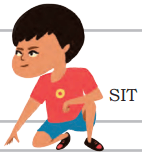
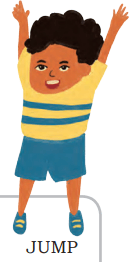
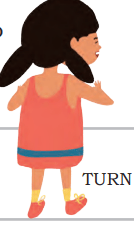
Start with the speed activity as a warm up. Be careful! Do not touch others or land on your friend’s feet after jumping. Follow the instructions from your teacher — start walking. Sit when you are asked to SIT, then continue to walk. Turn around when the teacher calls out TURN, and then continue to walk. Just hop in your place and continue to walk, when the teacher calls JUMP. This will change the speed and order of instructions. So, BE ALERT!
ADVANCED
Now let’s play
another game that
requires you to
be more alert and
focused than the
previous one.
Are you ready?
Discussion and Feedback
Discussion and Feedback • Which part of the activity did you enjoy the most? Why?
• Did inter-changing the meanings of the commands make it more challenging?
• What would you use to replace IDLI, VADA, and SAMBHAR?
--------------
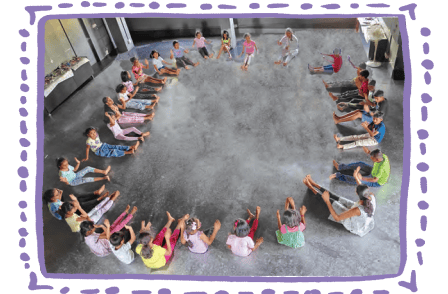
You have played well. You are ready for the next level! But I’m sure you have realised that you need more practice.Whenever you find some free time, play these games. Not only will you have fun, but also improve your skills. Want to know what we are doing next?
SCENE 2-COMMUNICATE WITHOUT TALKING
COMMUNICATION is one
of the most important
parts of our life. What is
communication? It is the
sharing of ideas, thoughts
or feelings between two or
more people.
Can you imagine a day
without talking with your
family members and friends?
But wait. Is communication only about talking? Can we stop talking but still communicate? Are we not communicating a lot of things even when we don’t say it in speech? Do you know some of us talk in sign language with hand gestures? Let’s see if it is possible. It could be more enjoyable than talking itself!
Activity 4 : Freeze and Justify
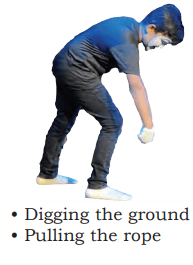
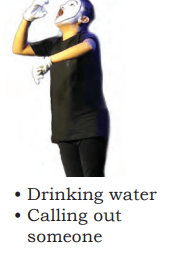
Discussion and Feedback
--------------
BASIC — Some Gestures
ADVANCED — Some Postures
DVANCED — Some Postures
Wonderful! That was fun! Whenever you see
people in different postures, at home, on the
street or anywhere you go, try to give it an
interesting meaning. In your mind, of course!
Trust me it will be a lot of fun! This ability
to give new meanings builds your creativity.
CREATIVITY is the ability to produce something
new, original and sometimes unusual. They
are ideas that help in communication, solving
problems or to just have fun. This ability to think
creatively will help you as you grow older also.
In theatre, you can use this to create different
scenes and visuals. Speaking of creating new visuals and scenes, the next activity is just that!
Activity 5 :Group Structures
Instructions: You are given a keyword. You can discuss and plan in your group for 3 mins. All in the group take different positions to depict the scene. Do not take difficult positions that might hurt you. Remember, everyone’s position is equally important to depict the whole theme. No talking is allowed while acting or depicting.
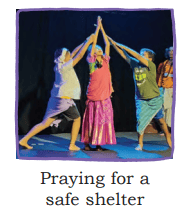
BASIC
‘Watching TV’, ‘Cricket’, ‘Bus’, etc., can be given. The students need to assume the positions to show as many details as possible.
ADVANCED
‘Market’, ‘Farming’, ‘Marriage’, etc., increase in complexity. Pay
attention to details .
Teacher’s Note : Divide children
into groups of
5–6 depending
on the strength of the class.
Guess what these structures mean
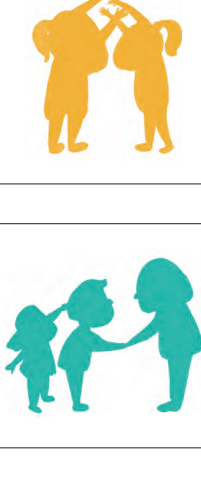
Discussion and Feedback
• Which part of the activity did you enjoy the most? Why?
• Which structure was the most difficult one to create?
• Which structure you would like to create?
• What is the one new thing you learnt about yourself?
Circle Time Note
....................................................................
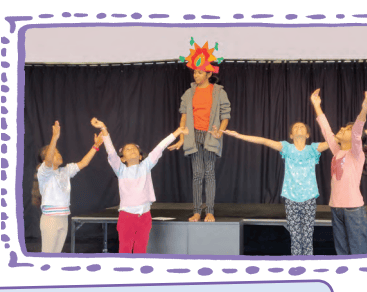
Did you see how creativity can help you in making or innovating new things! It requires a lot of creativity to present an idea without speech. You have done it well! Since you have used only your body to communicate, this is called BODY LANGUAGE. You are using your hands, legs, head and torso as words in a language. That is creativity! Discuss with your friends about creativity in each group. Observe how ‘thinking differently’ from everyone else is so wonderful. Share such instances from your home or other situations you have experienced.
Activity 6 : Magic Pit (Object)
Instructions -
Let us sit in a circle. We will now take a headcount. The teacher calls a random number. When your number is called out, you go to the centre of the circle, where the invisible magic pit is present. You pick one object from there and enact it as though you are using the object taken from the invisible pit. The other children will guess your object.
Tip: Not just your action (body language), but your expression also helps people understand better.
BASIC
Pen, book, coffee mug, etc. (actions to suggest using the object). For example, Pen – writing, book – turn the page and read, coffee mug – drink from it and react like it is hot .
ADVANCED
Hammer and nail, vegetable and knife, toothbrush and paste (students show how the two objects are used together).

Is she holding a ball or carrying a heavy rock? (In action, both are possible, but in expression, it may vary). What do you think ?
.......................................................

She is trying to
show a battlefield
with a bow and
arrow in her hand.
What do you think
can be changed in
the picture?
.......................................................
Discussion and Feedback
• How many object-actions were you able to guess?
• Which object-action was the most difficult to create?
• What are the objects you would like to get from the invisible pit?
• Share one new thing you learnt from this activity.

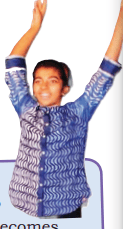
So, apart from your actions
(body language) what is equally important?
Your EXPRESSION. What is on your face becomes
very important while acting. When you put together
body language and expression, what are you doing?
You are communicating. This is very important for
creativity. If you cannot communicate your idea to
others, even the best idea could go waste!
Theatre is about creating stories and telling
them to an audience. Right? So, if you are good
with creative ideas, you will also be able to learn
how to communicate.
So being involved in theatre regularly will
not only help you grow creatively, but also
improve your communication skills. If you can express better you are better understood.
We will now take this creativity and communication to the next level.