CHAPTER-20
INTEGRATING ALL ART FORMS
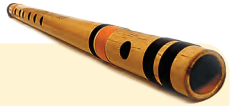
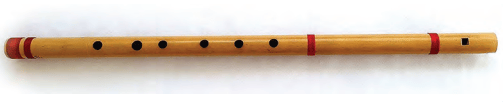
Bansuri Your textbook is named, Bansuri. This is a musical instrument with magical and melodious sound which everyone loves. Do you know bansuri is made from bamboo? You can also make it yourself and play it as well. When you go to a fair or a local mela, there is always someone selling toys and playing bansuri, and you all get attracted to the sound. The same bansuri is played in dances and used as a prop in drama. A bansuri can even be made with paper, bamboo or clay or a scene with someone playing bansuri in the jungle or fields can be drawn .
All art forms are very different from each other; at the same time they all have many common features and are connected with each other. For example, swara, laya, bhava and taala are related to all art forms—music, dance, theatre and visual arts. They all have movement, rhythm, and a language of their own to communicate. You can express your emotions through art. Here, we have some activities that bring in all art forms together you can do these activities and enjoy!
Activity 1 : Integration of Art Form
Here is an example of a four-line
verse written in Sanskrit composed by
Nandikeshwara in Abhinaya Darpana
around a thousand years ago. Usually,
artists recite this before starting their
performances. You can read it loudly
with action. You can also refer to the
videos by scanning the QR code.
Aangikam bhuvanam yasya,
Vaachikam sarva vangmayam.
Aaharyam chandra taradi
Tam vande saattvikam Shivam
Meaning
Where the physical body is the universe, speech or song is the essence of all sounds,ornamentation is the Moon and the stars. I bow down to that supreme divinity .It brings together all the four art forms you are learning—
Angika — Physical performance with movement, action and expression
Vaachika — Speech, dialogue, songs and lyrics
Aahaarya — Costumes, jewellery, sculpture, painting
Saatvika — The deepest emotional spiritual experience for the artisteand audience.
Activity 2 : Bansuri
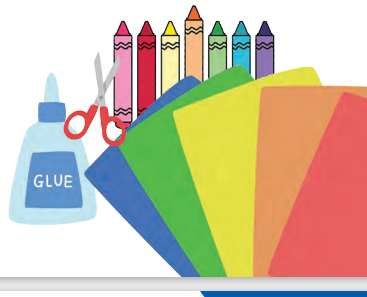
You can make a bansuri for which you will only need a thick chart paper, glue, a pair of scissors and some crayons or colour pencils.
• Draw a picture of a bansuri on a chart paper. Roll it over in the shape of a cylinder and add some glue
on the edges. Put small holes in it, and here, your bansuri is ready.
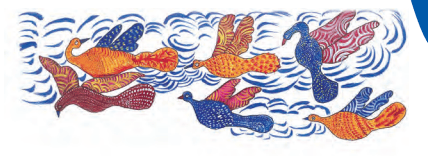
• You can make a drawing of a bansuri as well, add several things around it such as people, animals, and objects around the bansuri, draw a picture of interesting things in the forest, such as animals,flowers, etc.
• Now, create a story using bansuri as the theme and
the picture you have drawn. Show it in the class
along with some actions.
• You can also use any object around you and
improvise it as a bansuri to narrate the story. You can
also use the bansuri as a prop.
• Imagine yourself as the musical instrument—
bansuri and enact.
• You can create simple movements and steps with thesong or tune on the bansuri.
TEACHER’S NOTE
Children can be made to listen to the sound of bansuri and imagine Lord Shri Krishna playing bansuri in the fields while leading a herd of cows. They can also learn a folk song on this theme. All the activities can be divided in groups of 4–5 students and the whole class can be involved.
Activity 3 : Near Nature
We all love nature, we try to feel it and live near nature and enjoy the sounds, colours, and greenery. You all can create a forest inside your classroom as well.
• Make a flower in the centre of a sheet. Every child
in your group will add something around the
flower and create a picture of a garden or a forest .
• Create a story that involves flowers, birds, trees
and animals.
• Move around like you are walking through a
forest.
• Are you excited? Curious?
• React to what you imagine you will see (your
favourite animal, smell of flowers, big rocks etc.)
• What kinds of sounds would you hear in a
forest or garden? (birds chirping, water flowing)
Try to create their sounds.
• Feel as if you are in natural surroundings, like a forest or a park.
TEACHER’S NOTE
Children can learn a song on animals, birds, nature, etc. All the above activities
can be conducted in
groups of 4–5 students
and the whole class can be involved.
Activity 4 : Festival for Celebrations
We all celebrate various festivals. We usually get holidays
around big festivals, and they bring joy and colour in our
lives. Celebrating a festival, small or big makes us happy,
since we get new clothes, have good food, meet friends and relatives, and clean and decorate our homes.
• Pick a festival that we celebrate together.
• Discuss in your
group how you
celebrate it and
what preparations
are required, what
special dishes or
food items are
prepared, how
you decorate your
home, and which
songs and dances are related to
that festival.
• Different groups can do the following;
• Draw a rangoli or other
decorations with paper
cutouts for a particular
festival.
• Learn a song based on that festival.
• Sing it using kitchen utensils.
•Share an incident that
happened during a festival celebration.
• Share and enact a story
connected to the festival
being celebrated.
• Use simple movements and
steps for the festival song
using the same kitchen
utensils for musical sounds.
• Draw the traditional dresses
worn on the occasion.
TEACHER’S NOTE
The core idea behind this activity is to build connections between art forms. • Children can learn a festival song. • Activities can be presented in the school assembly for special occasions. Divide the classinto groups for different art forms based on a theme. This would give the children an opportunity to face the audience and build an understanding of the connections between the artforms .