
Chapter 6
Living in Harmony
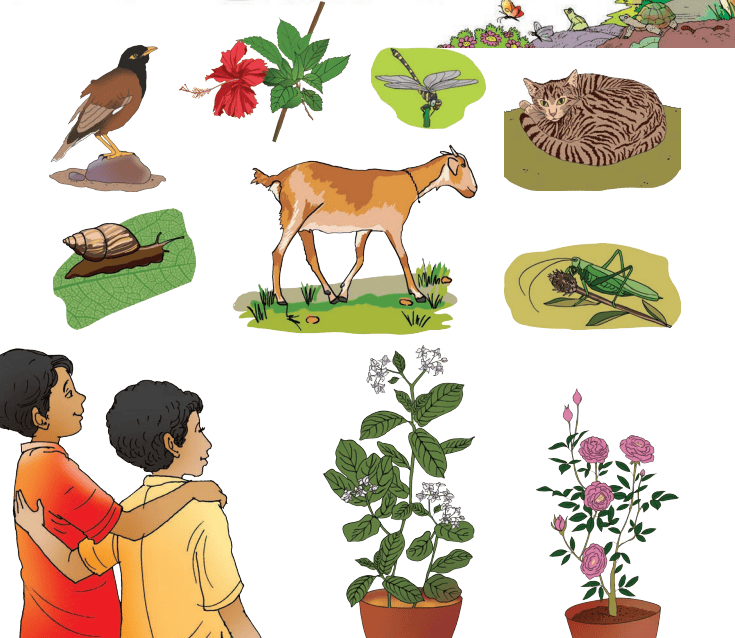
DISCUSS
- Do any of these animals, birds, insects and plants live with you in your house .
- Do you and your family take care of them .
FIND OUT
- Are there any animals, birds and insects that you have spotted that are not in the picture given on page 72 ?
- Try to find out their names and write them in the table given below. One example has been done for you.
DISCUSS
Discuss in Pairs
- Which are the uninvited animals, birds and insects that visit your home ?
- Why do you think they come to your homes?
- How do you feel about their presence in your home?
- Which of them do you like?
- What do you do when you do not like them?
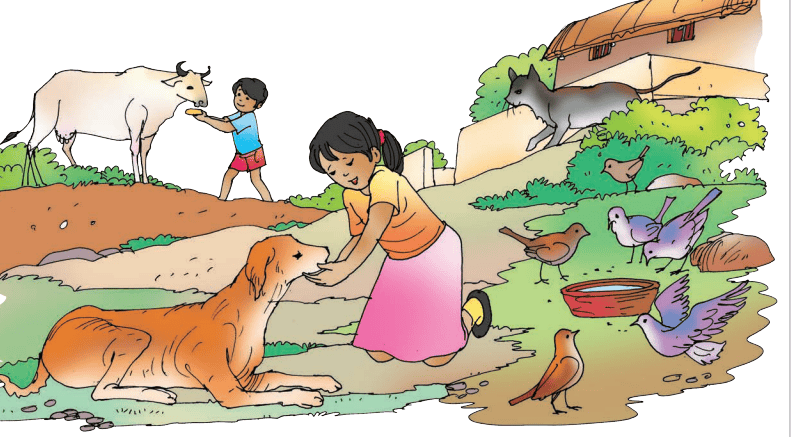
We take care of some animals and plants in our homes by giving them water, food and shelter.
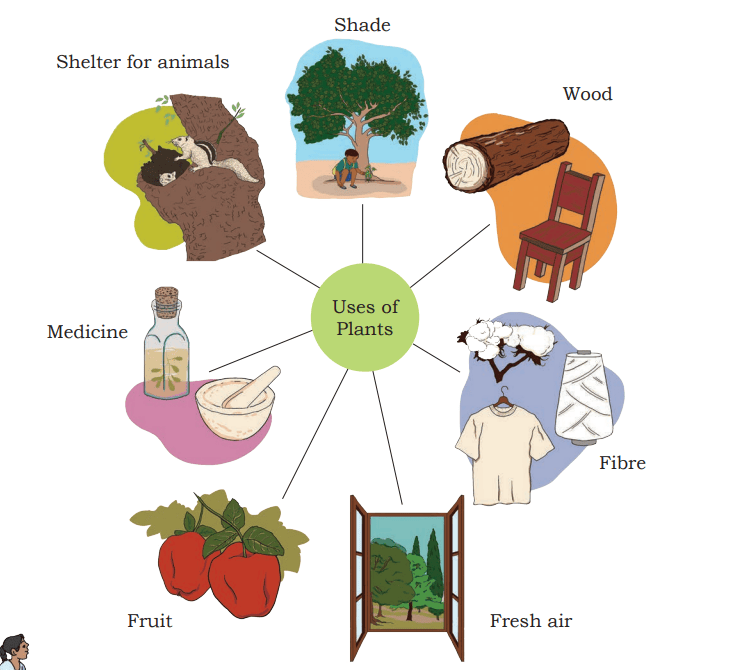
The Mango Tree
One day Shambhu, a little boy, was going through the forest with his father. They sat under the shade of a huge mango tree. The mango tree was home to birds, squirrels, monkeys and many other animals. Shambhu saw a monkey eating a mango and throwing out the seed. He told his father about it. His father said, “Shambhu, do you know that a new plant would emerge from this seed? This is how animals and plants help each other.”
Shambhu ran to pick up a mango that dropped from the tree. He said, “Look! Itoo have got a mango.” “Not only fruits, we get vegetables and many other things from plants,” said Shambhu’s father. “Oh yes, I now remember that you had told this to me earlier. We get medicines, fibre for clothes and wood for our houses from plants.”
DISCUSS
- How are we dependent on plants and animals?
- How do plants help animals?
- How do animals help plants?
- How do you look after plants and animals in your surroundings?
- How do animals and plants depend on us?
DO YOU KNOW
Thousands of trees are accidentally planted by squirrels. They bury nuts and then forget where they hid them. Like this, many animals and plants maintain harmony and balance in various ways .
We Need Each Other
Just as we provide care, protection, food and shelter to animals and plants, we get lots ofthings from them too. For example, from cows, buffaloes and goats, we get milk and loving company. That is why we respect these animals so much and we treat them with kindness, care and compassion. Animals and plants also depend oneachother for food and shelter. Animals help plants by dispersing seeds and making the soil fertile through their waste. This helps plants to grow and spread near and far. We also depend on plants and animals for food, shelter, clothing and companionship .
ACTIVITY 1
Get to Know an Animal
- Observe the animals around you
- Choose any animal that you see often, such as a goat, cow, dog, cat or bird like a crow, pigeon, sparrow, parrot or duck.
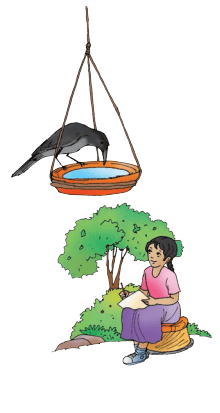
- Observe it closely whenever you get a chance. You can also keep a bowl of water and some grains for it.
WRITE
Write a short description of the animal or bird—
- Name and describe the animal or bird that you have chosen.
- When and where did you first see it?
- Was it there alone or with its friends?
- Describe its movement.
- What sounds did it make?
- Did you see it eating, sleeping,
talking to its friends or maybe
fighting sometimes?
- Did it do anything that surprised
you or made you laugh?
- Share your story with your classmates.
ACTIVITY 2
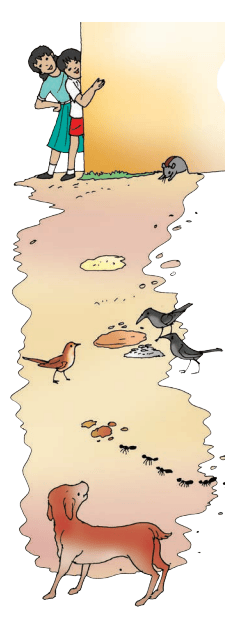
Busy, Busy, Busy and Clever Ants!
Make a Guess
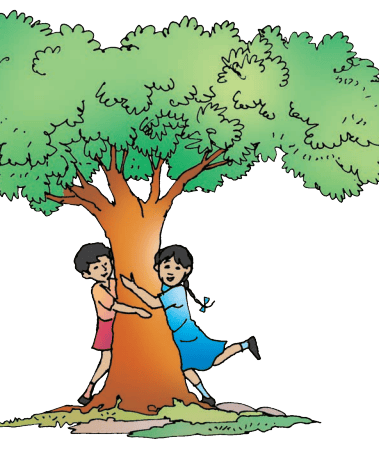
Visiting your plant friend
ACTIVITY 3
Guess Who I Am ?
Sit in pairs. One of you will think of the name of an animal, bird, insect or tree and whisper it in the ear of your partner. Make sure you don’t say it too loud! Your partner will have to act and move like the animal, bird or insect and the class will have to guess it! You can switch roles after this.
For example
• Gopa’s friend Ali whispered ‘Frog’ into his ear. What do you think Gopa did?
• Sukhiya’s friend Surya whispered ‘Peepal tree’ into her ear. What do you think Sukhiya did?
Let us reflect
A. Discuss
- How are we dependent on plants and animals?
- How should we care for plants and animals in our environment?
- How do plants and animals depend on us?
B. Write
1. Complete these sentences with the names of plants, birds, animals or insects:
a. I like looking at _____________ because _________ _____________________________________________
b. ________ make me laugh because ____________ ______________________________________________
c. My friend _________________ likes ______________ because _____________________________________
d. I would like to take care of _______________ because ____________________________________
2. a. Which is your favourite animal, bird, insect or plant among those you have named above? ______________________________
b. Why do you like it? __________________________ ______________
c. Write down the names of all the animals, birds, insects that you have seen or learned about from the smallest to the largest. __________________________________
C. Draw
1. Name and draw animals, birds and insects that have:
a. Two legs b. Four legs
c. Six legs d. Eight legs