UNIT 2
Our Games
ABOUT THE UNIT
Playing is natural and we all love to play when we are
together. Play builds the feeling of togetherness and helps
us understand each other better. While playing these
games we will make sure to treat each other sensitively
and with care.
Let’s play these games with our friends, teachers and
family members.
Chapter 5
Introduction
Local and
Traditional
Games

We all play many games with our neighbourhood
friends. Every region in our country has some games
that are specific to that region. In this chapter, we
will learn to play and enjoy some games that are
played across the country. While playing these
games and enjoying together, we will learn to treat
each other with kindness and become better human
beings.
OG 1
Seven Stones
The Seven Stones game is known by many
names in our country. For example, it is
called Satolia, Pitthu, Lagori, or Nargoloi. It
may have a different name in your region.
You need seven flat stones and a sponge
ball to play this game.
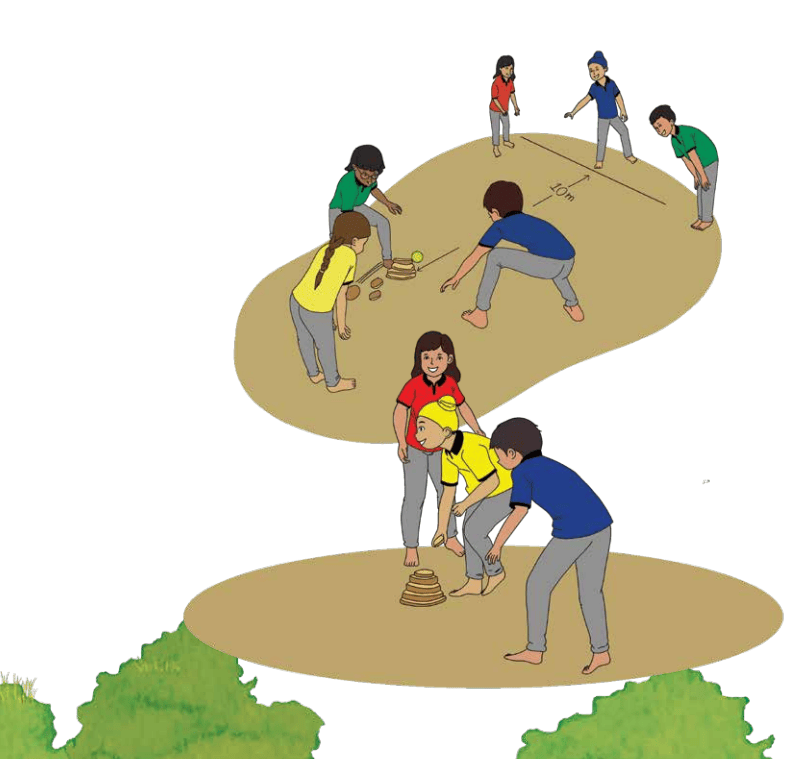
How to play
- Split the players into two teams. One team is the Throwers and the other team is the Defenders.
- Place the stones on top of each other to form a small tower, each stone smaller than the one below it.
- One player from the throwers’ team tries to knock down the stack of stones with the ball from a fixed distance.
- If the throwers’ ball misses the stones, the defender team tries to catch the ball on bounce and the player is out. Another player gets a chance to hit the stones.
- If the player knocks down the pile of stones the fun begins!
- The defender team picks up the ball and tries to hit the players of the throwing team.
- Players from the throwing team dodge the ball and try to place the stones back in the tower.
- If any player from the throwing team gets hit by the ball the whole team is out.
- If the throwing team succeeds in putting all stones back they shout ‘Satolia’ or ‘Lagori’ and get one point.
- The team then switch roles.
Note for the teacher
Purpose
Developing
concentration,
agility, accuracy,
cooperation and
patience.
|
Variations
• Decrease or increase
the number of stones in
the tower to change the
difficulty level.
|
Circle Time
Discuss what you can
do to avoid physical
injury while playing.
|
OG 2
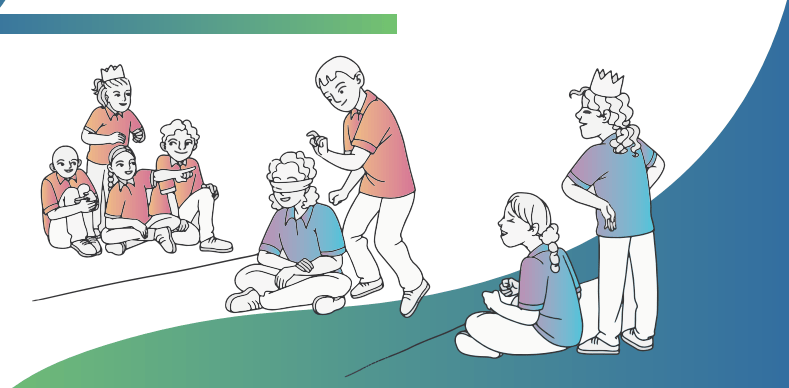
Golaap Togor
Golaap means Rose flower
and Togor means white
flower. This game can be
used for learning different
vegetables, fruits and places.
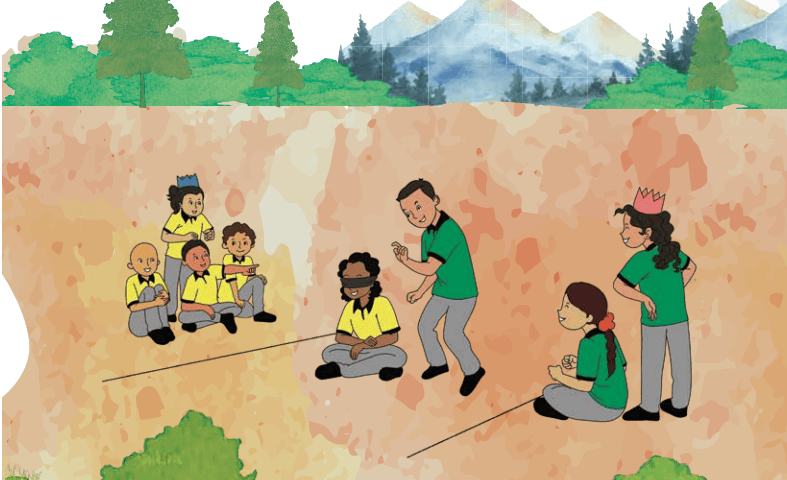
How to play
- Form two teams— Team A and Team B— and select a leader for each team.
- Draw a line in the centre of the play area. The teams stand at equal distance from the line facing each other.
- The leaders secretly assign names to their players based on fruits or vegetables.
- The leader of Team A then blindfolds one team member and calls the assigned name of a player from Team B. For example— “Please come Mango”, or “Please come Brinjal”.
- The invited player from Team B approaches and taps gently on the back of the blindfolded player from Team A.
- The blindfolded player guesses the real name of the player who tapped on the back. One point is given for every correct guess.
- The leader of Team B now does the same.
Note for the teacher
Purpose
Fostering
anticipation, team
building, emotional
understanding,
memorisation and
empathy.
|
Variations
• Allow the players to touch
the other player at multiple
parts of upper body to help
identify him/her.
|
Circle Time
Discuss the
nutritional benefits of
fruits and vegetables.
|
OG 3
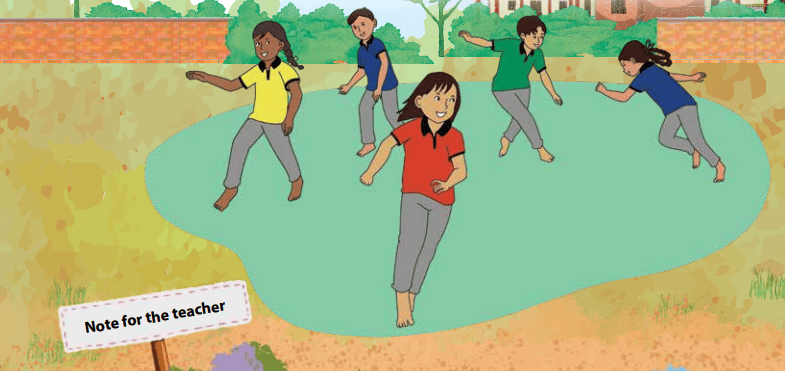
Pakdam-Pakdai
This is a very commonly
played game in all
parts of India. It may
be known by a different
name in your region.
How to play
- Select one player to be the denner (den).
The other players are the runners.
- Define the boundaries of the playing area so everyone knows till where they can run.
- The den stands in the middle of the playing area while the runners spread out within the boundaries.
- The den chases the runners and tries to touch them.
- Any runner touched by the den immediately becomes the next den and the game continues.
Note for the teacher
Purpose
Developing agility,
speed, quick
reaction time,
determination and
endurance.
|
Variations
• Instead of running, you can
hop or jump.
• Decrease or increase the
area to change the difficulty
level.
|
Circle Time
Discuss what you can
do to avoid physical
injury while playing.
|
OG 4
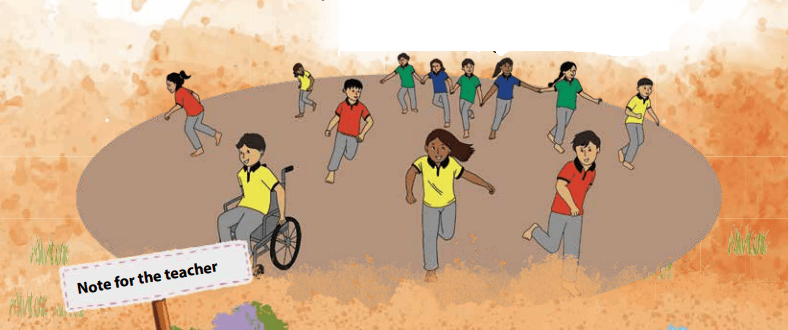
Chain (Sankali)
This is a simple
game which can be
played in various
patterns.
How to play
- Select one player to be the den. The other players are the runners.
- Define the boundaries of the playing area so everyone knows till where they can run.
- The den chases the runners and tries to touch one of them.
- When any runner is touched, that player joins hands with the denner to form a chain.
- The den and the newly joined players form a chain and chase the runners together. Gradually new members are added and the chain increases in length.
- The game continues till all runners become a part of the chain. The last runner remaining is the winner.
Purpose
Developing
agility, strength,
determination,
coordination and
unity.
|
Variations
• Decrease or increase the
size of the playing area
to reduce or enhance the
difficulty level.
|
Circle Time
Call out one good
quality of your team
member or a member
of the other team.
|
OG 5
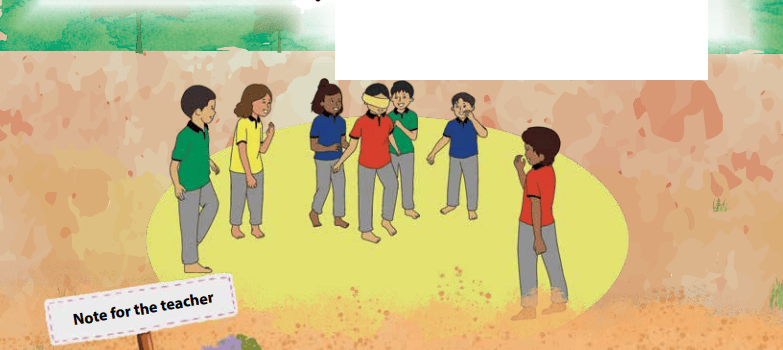
Aankh Micholi
This is very popular
game in India and
played with various
names in different
states like Bengal,
Assam, Odisha and
Tripura. Aankh means
an eye and Micholi
means closed. What is
the name of this game
in your region?
How to play
- Define the boundaries of the playing area so everyone knows where they can run and hide. Select one player to be the denner.
- One player whose eyes are covered with
the cloth is made to stand in the centre
of the play area.
- Other players spread out in the play
area and keep singing “Aao khelen
aankh micholi.”
- The denner tries to chase the other players and touch them based on the direction from which the sound is coming.
- The denner has to identify the player who is touched. If it is correct, the player becomes the new denner and the game continues.
Note for teacher
Purpose
Enriching keen
sense of hearing,
anticipation,
collaboration and
patience.
|
Variations
• Have two denners instead
of one and play
|
Circle Time
Discuss how you feel
when you all play
together and how you
feel when your friends
are missing.
|
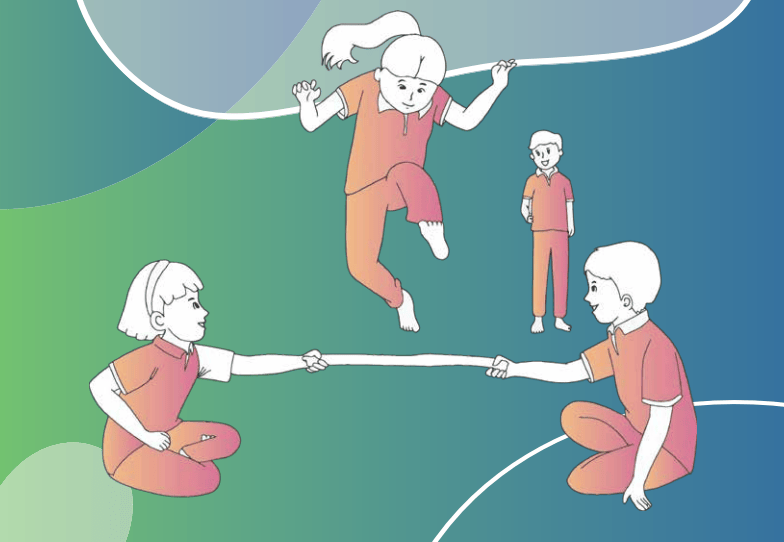
OG 6
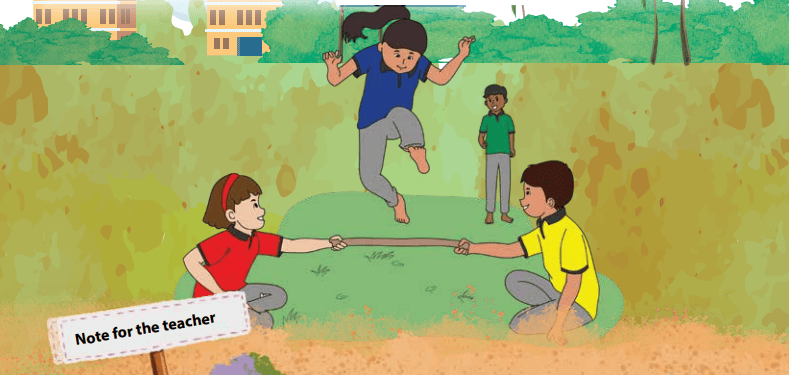
Bitta Kud
Bitta means
open strectched
palm and Kud
means jumping.
This game is
played either
with a hand or
using a cloth or
a wooden stick
as shown in the
picture below.
How to play
- Form teams of two players each.
- One pair is selected as the den. This pair sits on the ground holding a stick or a cloth as shown in the picture below.
- All the players have to jump over this stick.
- If both the players from any team fail to jump over the stick they become the new den.
- If all the teams jump over the stick
successfully the den increase the height
of the stick. The game continues till all
the players are tired.
Note for the teacher
Purpose
Nurturing
accuracy, leg
strength, stability
and courage
to overcome
obstacles.
|
Variations
• Use hands to make various
shapes of different heights.
|
Circle Time
Discuss how you can
help the players who
are unable to jump
the obstacle.
|
OG 7
Hopscotch
This game is known by various
names like Staapu, Ekhat-Dukhat,
Gutti, etc. in different parts of our
country.
How to play
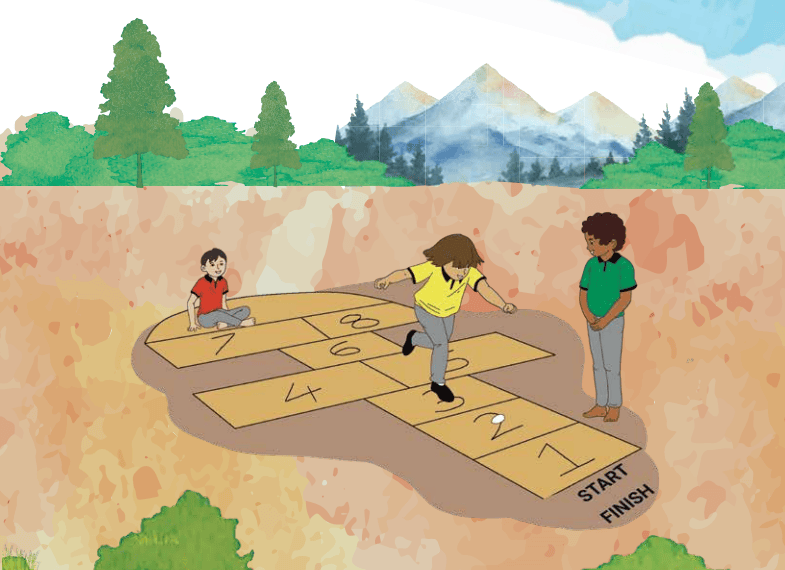
- Mark the ground with eight squares as shown in the picture on the previous page.
- The first player stands behind the starting line and throws the marker (a small flat stone) into square-1. It must land inside the square without bouncing out or touching the lines.
- The player hops from square-1 to square-8 and back, skipping the square in which the marker is placed. The player hops on one foot on a single square, and on both feet on double squares with one foot in each square.
- While hopping back, the player stops at square-2, picks up the marker, and hops over square-1 to come out. The player continues to play by throwing the marker in the 2nd, 3rd, 4th, 5th, 6th, 7th and 8th squares.
- If the marker doesn’t land in the correct square, or if a player steps on a line or hops into the wrong square, or loses balance, then their turn ends. Next time, the player starts from the square where their turn ended.
- The player who completes all the squares first wins the game.
Note for the teacher
Purpose
Fostering leg
strength, balance,
stability, patience,
and will power.
|
Variations
• Increase or decrease
the size or the number
of boxes to change the
difficulty level.
|
Circle Time
Discuss what each
player did to maintain
their balance while
playing.
|
OG 8
Cockfighting
This is a variation
of a popular game
called Langdi (one
leg-skipping).
How to play
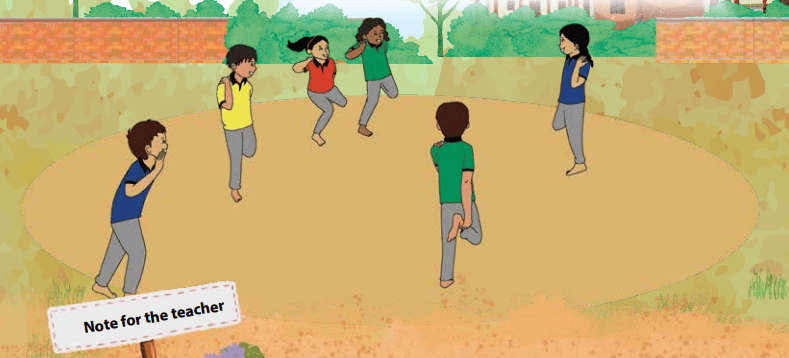
- Draw a circle on the ground depending
on the number of players.
- Every player needs to be inside the
circle.
- The purpose of the game is to push
other players out of the circle or in such
a way that they are forced to stand on
both feet.
- The competitor starts the game with one
leg to hop on and one hand resting on
their shoulder.
- The game is won by the last person to remain on one leg inside the circle.
Purpose
Developing
balance, full body
coordination,
leg, shoulder
strength and
resilience.
|
Variations
• Increase or decrease the
size of the circle
|
Circle Time
Discuss the ways to
modify the game.
|
OG 9
Kumir Denga
Kumir means crocodile
and Denga means bank
of the river. This is a
popular game in many
parts of the country
and is known by
various names.
How to play
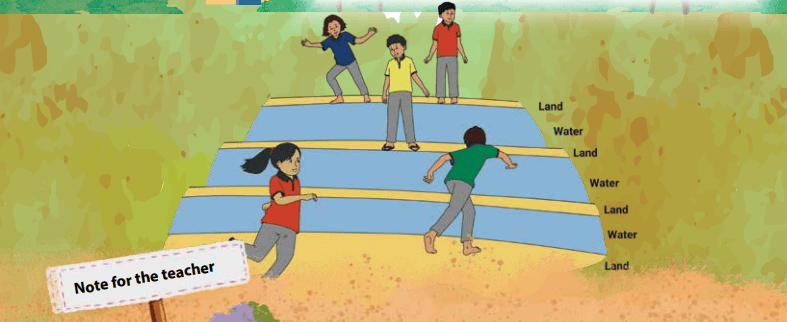
- Use chalk powder to mark the ground in multiple ‘land’ and ‘water’ areas as given in the picture below.
- One player will become the crocodile (Kumir) and the rest will be the runners.
- The runners are safe in the land areas but in water areas, the crocodile can attack.
- The runners should keep moving from one land area to the other while teasing the crocodile player.
- If the crocodile player catches any
runner in the water areas, then the
caught runner becomes the new
crocodile and the game continues.
Note for the teacher
Purpose
Nurturing leg
strength, alertness,
quick reaction time,
and dynamic and
static balance.
|
Variations
• You can try different things
like hopping or jumping
while crossing.
|
Circle Time
Discuss what you did
to dodge the Kumir
(Crocodile).
|
OG 10
Hum Phoolon
Ki Sadak Par
Chalte Hain
This game is played with
different slogans in local
languages. To make it
meaningful, new slogans may
be created for your school.
How to play
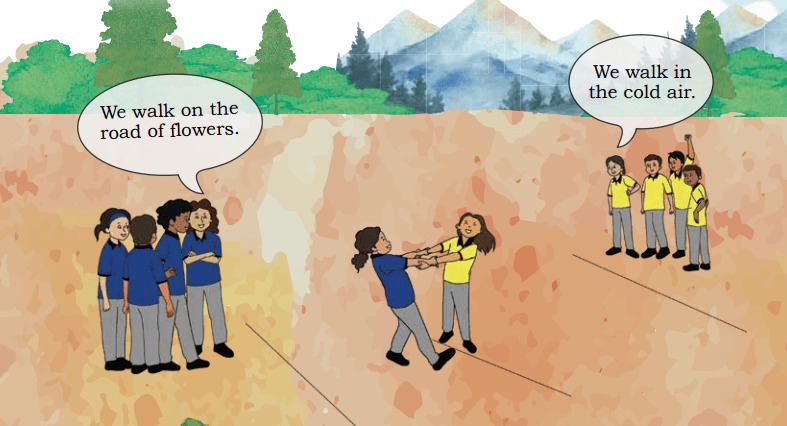
- Draw a straight line on the field.
- Form two teams that will stand on opposite sides of the line at some distance.
- The first team walks towards the line and says, “We walk on the road of flowers” (Hum phoolon ki sadak par chalte hain).
- The second team also approaches the line and replies— “We walk in the cool breeze” (Hum thandi hava me chalte hain).
- Then the first team asks— “Who do you want to take?”
- The second team responds by taking the name of a player from the first team. For example, “Gouri.”
- Then the first team again asks— “But with whom?”
- The second team then takes the name of a player from their own team. For example, “with Radha.”
- The first team accepts the challenge and responds— “Take her if you can”.
- Now these two choosen players stand on the opposite
sides of the line and try to pull each other.
- Whoever gets pulled becomes a member of the opposite
team and the game continues with two new players.
We walk on the
road of flowers.
We walk in
the cold air.
Note for the teacher
Purpose
Discovering
potential and
enriching overall
strength of the
body, and team
spirit.
|
Variations
• Two players from
each side can be
engaged in the
challenge.
|
Circle Time
Discuss why it is
important to choose
players of equal strength
as opposed to always
choosing the weakest.
|
OG 11
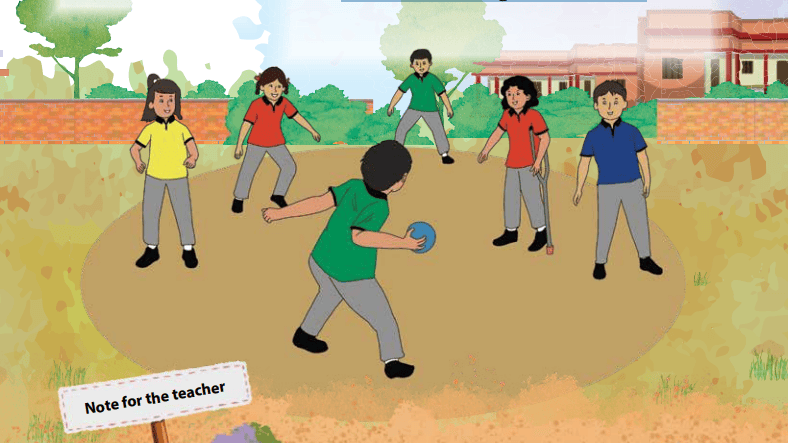
Dodge Ball
This is a popular
game played in
all regions of our
country. A softball
may be used in
the game to avoid
injury.
How to play
- Select one player to be the Den. The
other players can be the Dodgers.
- Draw a big circle on the ground. The
den will stand in the centre of the circle
while the dodgers will stand on the
boundary of the circle.
- The den tries to hit the dodgers using a
soft ball.
- The dodger who gets hit becomes the
new den and the game continues.
Note for the teacher
Purpose
Strengthening
agility,
concentration,
accuracy and
self defence.
|
Variations
• The game can be played
with two denners.
|
Circle Time
Discuss the
movements which
were more useful in
dodging the ball.
|
OG 12
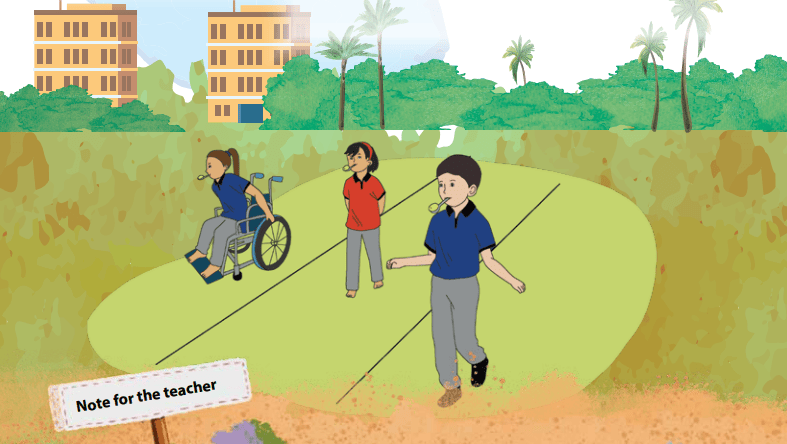
Spoon Race
This is a popular
game played by
people of all ages. It
is played with a table
spoon, and a lemon or
a marble.
How to play
- Draw a start line, a finish line and tracks for the players to run.
- All the players stand behind the start
line with the spoon (having a lemon or a
marble on it) in the mouth.
- On the blow of the whistle, players start
walking towards the finish line.
- The player who reaches the finish line
first without dropping the lemon or
marble wins.
Note for the teacher
Purpose
Enriching
concentration,
balance,
determination
and neck muscle
strength.
|
Variations
• Play it with arms
extended in front or
back.
|
Circle Time
Discuss how
concentration played a
role in the game.
Discuss what happens
when you play it with
arms in front and back.
|
OG 13
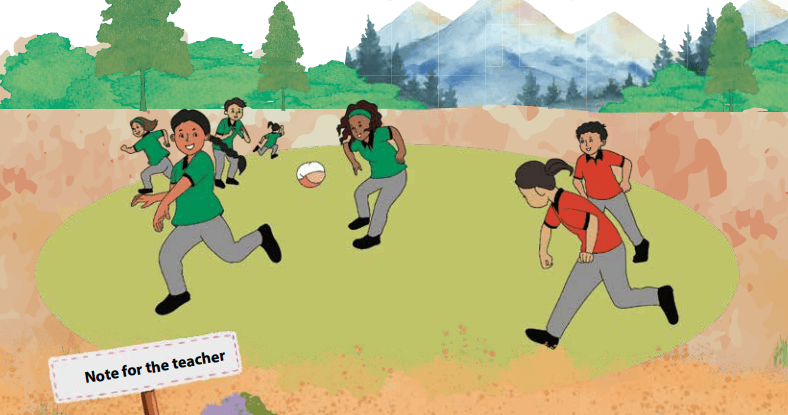
Gadda Maar
This is a popular game
played in all regions. A
softball may be used in
the game to avoid injury.
How to play
- Make a cloth ball and define the play
area.
- To start the game, one player takes
the ball in hand and asks, “Are you all
ready?”. The other players say, “Yes”
and start running around.
- The player with the soft ball tries to hit
the other players with it.
- Whoever gets the soft ball hits the
nearby players.
- This goes on till everybody is tired.
Note for the teacher
Purpose
Fostering
accuracy, focus,
agility, self
defence and quick
reaction time.
|
Variations
• Assign points to specific
areas that are hit. For
example— five points for
below the waist and two
points for the torso.
|
Circle Time
Discuss different kinds
of injuries which can
happen due to the
game and some
precautions
to avoid injuries.
|
OG 14
Tug of War
Tug of war is an
ancient game played
all over the world.
In some parts of
India it is known
as Rassa-Kashi or
Vadam-Vali. It is a
centre of attraction in
various local fairs. It
should be played with
care to avoid injuries.
How to play
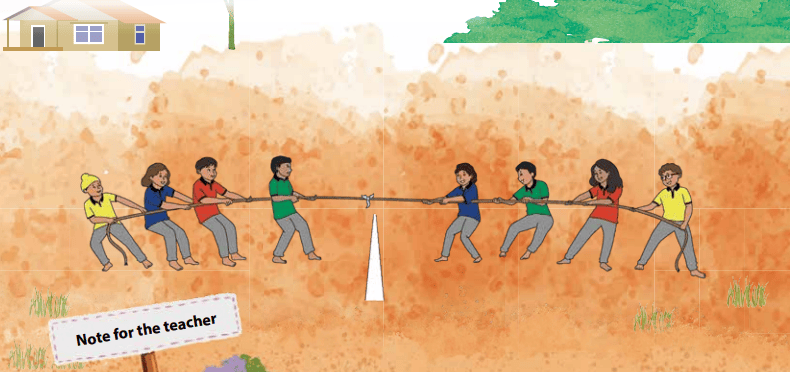
- Draw a line in the centre of the play
area and make the two teams stand on
the opposite sides of the line.
- Take a big rope and all the players hold
it firmly as shown in the picture below.
- The game starts on the blow of the
whistle. Each team pulls the rope
towards their side.
- The winner of the game is the team
that pulls the opposite team beyond the
centre line.
Note for the teacher
Purpose
Nurturing
overall strength,
determination,
strategy, and
team work.
|
Variations
• Hold the rope just behind
your waist.
|
Circle Time
Discuss what strategy
you used to place the
players.
|
OG 15
Three-legged
Race
This is a common
game played all over
the country. One of its
versions, with some
variations, is played in
paralympics.
How to play
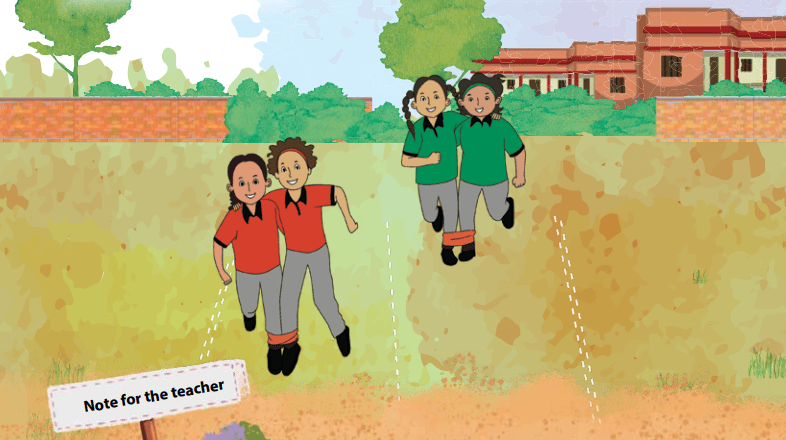
- Form teams of two players each.
- Tie the right leg of one player with the
left leg of the other using a piece of cloth
to create three legs.
- Every team runs to the finish line. The team that reaches the finish line first is the winner.
Note for the teacher
Purpose
Enriching
coordination,
balance,
determination,
respect.
|
Variations
• One player can be
blindfolded and the
wrists of both the
players are tied to
each other.
|
Circle Time
Discuss different
challenges faced while
running with others
and how to work on
coordination.
|
OG 16
In and Out
This game has
different names in
different regions
like Jal-Thal,
Talyat-Malyat,
Kullam-Kara, etc.
How to play
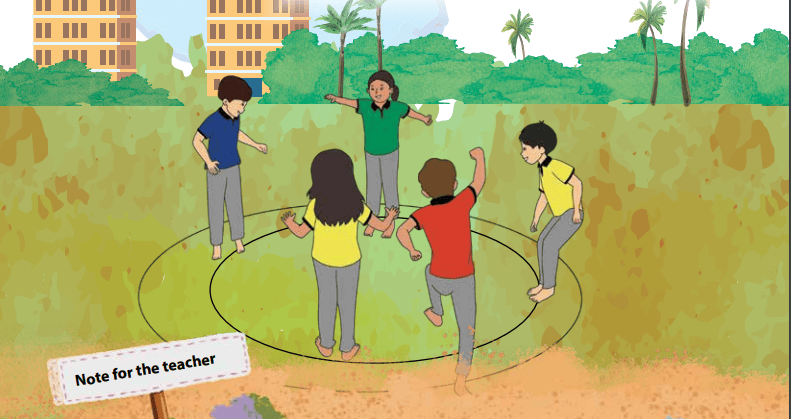
- Draw a large ring. All the players stand
just outside the ring and follow the
teacher’s instructions.
- When the teacher says Kullam (pond),
the players jump inside the ring and
when the teacher says Kara (bank), the
players jump outside the ring.
- The teacher gives random instructions
of Kullam and Kara, The players
who make a mistake in following the
instructions are declared out.
Note for the teacher
Purpose
Developing leg
strength, attention,
and quick reaction
time.
|
Variations
• The speed of
commands can
be increased or
decreased.
|
Circle Time
Discuss how to pay
keen attention to
the teacher.
|
OG 17
Light and Shade
This game is known
by various names
such as Dhoop
Chaanv, Andhiyaari
Anjori, etc.
Andhiyaari means
shade and Anjori
means light.
How to play
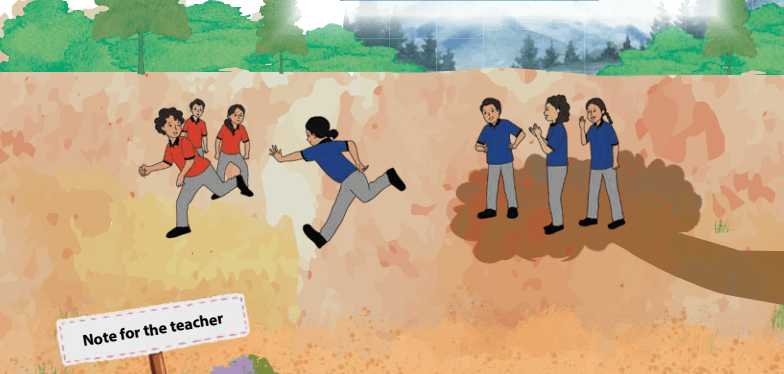
- Form two teams, a Light team and a
Shade team.
- The Shade team will take position in
shadows and the Light team will be in
light.
- Both teams will then try to move into
the opposing teams area. If a Shade
team player is touched by any player of
the Light team in light, then that player
becomes the player of the Light team
and vice versa.
- This keeps going until there are no more
players in one of the groups.
Note for the teacher
Purpose
Fostering agility,
quick reaction time,
and team work.
|
Variations
• Increase or decrease the
light and shadow points.
|
Circle Time
Discuss some ideas to
increase the difficulty
level of the game.
|
Note