4

Vacation with 4 My Nani Maa
Chirag and Nandini love their Nani Maa. She is their
best friend. They love playing and learning with her. Listening to her
stories is their favourite activity

Nani Maa shows them a “magic trick”. You hide some
marbles with your handkerchief. I shall tell you the number of marbles you
have hidden.
Can you tell what the trick is?

You have 4 under your handkerchief.

Let us Do
Perform the trick on your friends. Write the numbers of hidden seeds in the table below.
Teacher’s Note:
Say a number between 1 and 9. The child has to quickly say the number
which makes it 9. Repeat this task with other numbers like 10 and 20.
Both of them have
brought a lot of things for
their Nani Maa.
Nandini takes out Nani Maa’s favourite sweet
‘Balushahi’.
We got your
favourite sweet.
I know you love
to read, Nani
Maa! So we got
some magazines
for you.
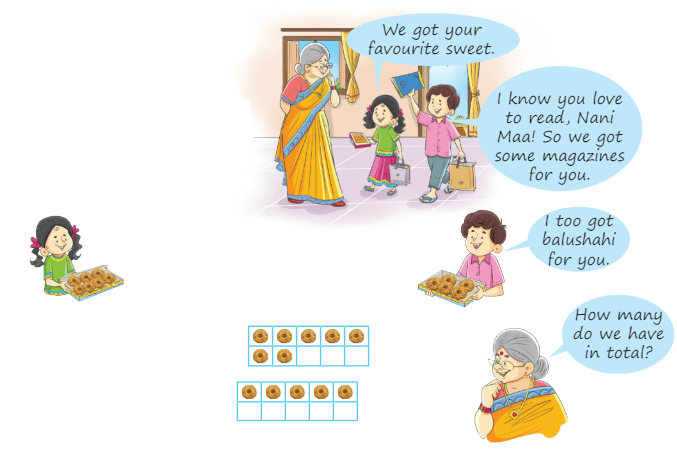
I too got
balushahi
for you.
How many
do we have
in total?
Nandini had 7 balushahi in her box
and
Chirag had 5 balushahi in his box.
Draw the number of dots.

7 Balushahi + 5 Balushahi = .......... Balushahi

We bought the same
number of balushahi from
the shop. Did you eat some
of them?
Hahahaha!
I did eat
some.
How many did he eat? .......... balushahi
7 Balushahi – 5 Balushahi = .......... Balushahi
Chirag got 9 story books for Nani Maa and Nandini got
7 puzzle books for Nani Maa. How many total books did the children get for
Nani Maa?
So many
books for me.


.......... Books + .......... Books = .......... Books
Let us Do
Use the tens frame to solve the following
(i) 6 + 8 = .............
(ii) 5 + 10 = .............
(iii) 9 – 6 = .............
(iv) 18 – 9 = .............

Let us Play
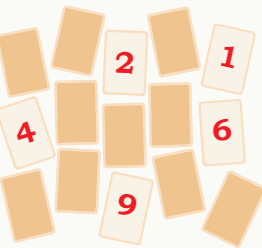
Make four sets of number cards with numbers 1 to 10.
Shuffle and spread out all cards facing down. Take turns
with your friends to open
one card at a time. When
you open, look at your
card, and the cards already opened.
If any three cards make an addition
or a subtraction statement, you can
keep all three cards. Else, put it
down opened. For example, Nandini
opens 4. The numbers 2 and 6 are
already opened. So Nandini can keep
all three cards 2, 4 and 6. The game
continues till all cards are opened.
Whoever collects the greatest number
of cards wins the game.
Nandini and Chirag have got their stamps to show to
their friends and Nani Maa.
How many stamps do they have now?
Nandini, Chirag and Nani Maa figured out the answer in
three different ways using their ginladi:

Look Nani Maa,
We have collected
15 stamps
Let me give you
some more. Here are
7 more.
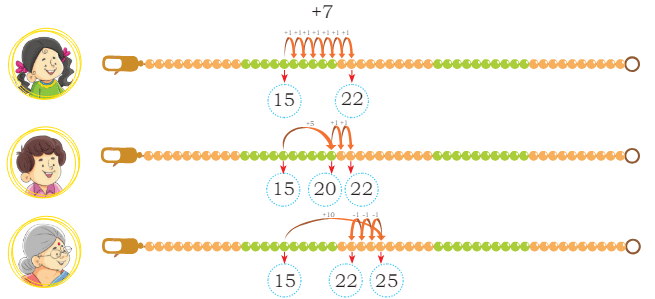
15 Stamps + 7 Stamps = 22 Stamps
Or 15 + 7 = 22
Let us Do
Nandini and Chirag have 22 stamps. Nani Maa’s brother
gives them his collection of 30 stamps. How many stamps
do they have now?
22 Stamps + ------- Stamps = -------- Stamps
Or 22 + ------- = -------
They now have 52 stamps. Nandini and Chirag count
and find that they have 37 stamps with faces of famous
persons and the remaining with pictures of
monuments.
How many stamps with pictures of
monuments do they have?

I can do it
this way.

They have 15 stamps with pictures of monuments. Can
you find other ways of doing it?

-------- Stamps - 37 Stamps = ------- Stamps
-------- - --------- = ---------
Or

37 Stamps + -------- Stamps = 52 Stamps
------- + ------- = -------
Teacher’s Note:
Different strategies of jumping on the number line for solving the problems should be encouraged throughout the
chapter. Revise skip counting for small numbers in the class.
Let us Do
1. Solve using a ginladi.
a. 34 + 6 b. 23 + 12 c. 33 – 5 d. 42 – 15

2. A frog is jumping on the ginladi. He is at 7. He wants to jump 10 beads at a time. Mark the beads that he will jump on and write the numbers.

3. The frog again jumps forward by 10 each time. Mark all the places where the frog will land.

4. The grasshopper jumps backward by 10 each time. Mark all the beads that the grasshopper will jump on and write numbers.

Some ants are carrying big leaves to their
homes. They will eat these leaves in the rainy
season. Nani Maa can tell how many ants
there are without looking under the leaves.
Can you also tell how many ants there are
under the leaves?
Fill the answers in the boxes provided.
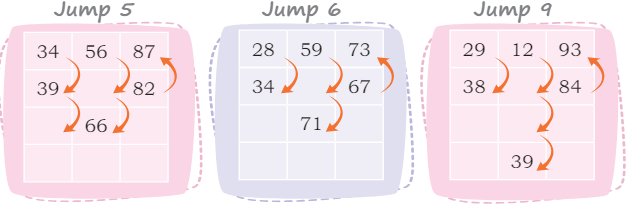
5. Fill in the tables by jumping as instructed.
Let us Play
Adding and Subtracting Smartly with the Number Grid
Let us play a grid game. Each player takes turns
rolling two dice to make a two-digit number, and moves the counter by the
number they have made. They can choose to move forward or backward. The
first to reach a number between 91 and 100 is the winner!
Teacher’s Note:
Encourage children to add two numbers on the grid by playing the game. If
you can’t go forward, move backward. If none, roll again.
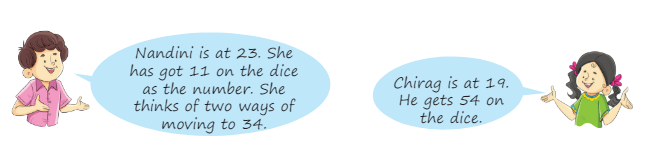
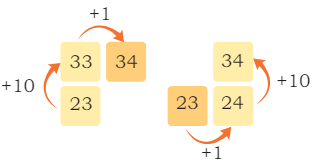
Nandini is at 23. She
has got 11 on the dice
as the number. She
thinks of two ways of
moving to 34.
Chirag is at 19.
He gets 54 on
the dice
A jump from 23 to 34 is .......... steps.
Help him move his counter to
the correct number.
A jump from 23 to 34 is ..........
steps.
1. Use the number grid to answer the following. Show your thinking by drawing arrows in the grid.
a. Nandini is at 45. She gets
34. She will land on ..........
b. Chirag is at 75. He gets
56. He will land on ..........
c. Nandini is at 30. She gets
66. She will land on ..........
d. Chirag is at 89. He gets
63. He will land on ..........
Teacher’s Note:
Introduce children to different words to express addition (more, added to,
total, sum) and subtraction (take away, difference, less, reduce). Provide
opportunities to children to make such jumps with other numbers and help
them notice the pattern in the numbers.
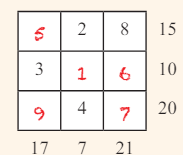
MAGIC SUMS
Nandini and Chirag find some puzzles that Nani Maa had
solved. Observe the numbers. What do you notice? Fill the boxes below. In
each puzzle, all numbers 1-9 are there. The numbers in each row add up to
the number in the box on the right. The numbers in each column add up to
the number in the box below.
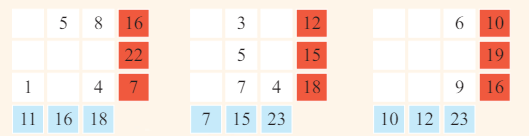
Add the numbers in the blue boxes and the numbers in
the red boxes in each of the puzzles. What do you find?
Nani Maa was doing something
in the newspaper. Nandini and
Chirag looked into what she
was doing.
Nani Maa, What is so magical about this Square?
Magic magic magic!!!
With numbers 1 to 9
Add the numbers in a line
From left to right
And from top to bottom
Did you find the magic?
Now, try from right to left
And from bottom to top
Isn’t it magical?
There is something more,
something more
Add the numbers on the diagonal
Isn’t it magical?
Fill the blanks to complete the
Magic square
Teacher’s Note:
The teacher can create similar problems and challenge children
with puzzles.
Nandini and Chirag went to their Nani Maa’s field. Nani Maa has two fields.
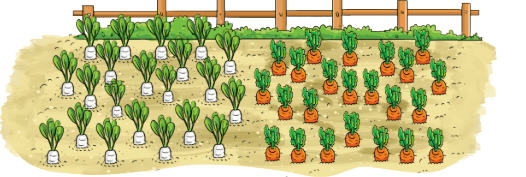
Nani Maa has plucked 25 red radishes and 36 white radishes.
How many total radishes has she plucked?
Nandini starts by drawing the problem on the ground.

red radish 25
white radish 36
Estimate the total
number of radishes.
............
25 red radishes + 36 white radishes = ------------
radishes 25 + 36 = --------
See how I do it on the number line


Find other ways of solving the same problem on the
number line.

Nani Maa puts tomatoes and carrots in a box and writes
100 on it.

I remember she had put 65 tomatoes.
We need not count the carrots
Nandini draws the given problem
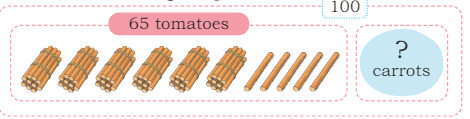
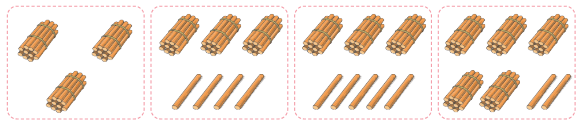
Circle the bundle of sticks that shows the correct
number of carrots.
Solve the above problem on the number line.

......... tomatoes and ......... carrots total ......... vegetables
......... + ......... = 100
.........tomatoes taken out from a box of 100 vegetables,
leaves ......... carrots
100 – ......... = .........
Teacher’s Note:
Encourage children to share their thinking
behind their estimates and answers.
Nani Maa asks Nandini and Chirag to pluck the ripe apples.
Woho! So many of them.
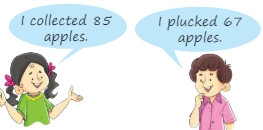
I collected 85
apples.
I plucked 67
apples.
Let us see how many total apples
we have collected.
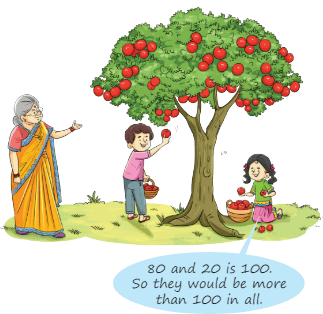
80 and 20 is 100.
So they would be more
than 100 in all.
Draw a box diagram for the problem below.
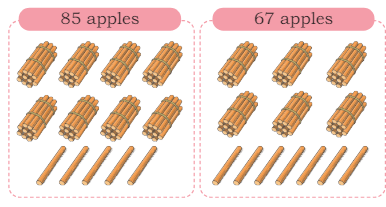
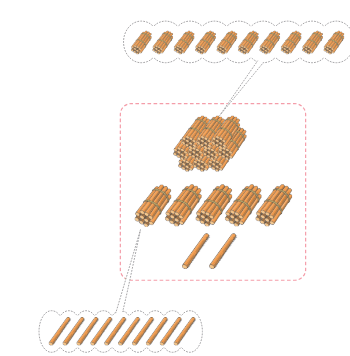
How many apples in all?
Try finding out the answer on the number line below.

85 apples + 67 apples = ----- apples 85 + 67 = -------
Who collected more, Nandini or Chirag? How much more?
Chirag draws a box diagram for the problem.

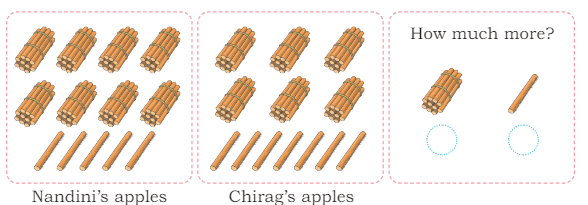
................ collected ......... apples more than
................ .
Teacher’s Note:
Create more such word problems. Allow children to draw and solve them
using locally available materials.
Solve the following problems by first drawing the box diagrams.
Use matchstick bundles or a number line to find the answer.
1. Babli didi sold 34 books on Monday and 45 books on
Tuesday. How many books did she sell in the two days?
How many more did she sell on Tuesday than on Monday?
2. In a cricket match at Rosary school, Team Red made
56 runs before lunch and 65 runs after lunch. How many
total runs did they make?
3. Rama sells vadas in the school canteen. She has sold 39
vadas the first day. She sold 12 more the next day. How
many vadas did she sell in these two days?
4. Gehu brings 56 plants for her terrace garden. Some plants
dried up. She is left with 29 plants. How many plants
dried up?
5. Choose two numbers. Make a word problem using the two
numbers. Share it with your classmates.
................................................
................................................
Let us Play
This game is to be played between two children. The
first player should say a number between 1 and 10. The second player adds
a number between 1 and 10 to the first player’s number. The first player
again adds a number between 1 and 10 to the previous sum. The player to
reach 100 first is the winner. An example is given here:
Player 1 wins this round! Play this game with your friends.
Let us Do
1. Estimate the answer and say if it will be more or
less than 100. Match with the correct one.
150 – 50 is 100.
So, 150 – 49 is more
than 100.
More than
100
134 – 56
20 + 41
150 – 49
199 – 90
70 + 30 + 1
156 – 65
Less than
100
68 – 26
95 + 10 + 5
109 – 80
63 + 26
124 + 23 + 20
2. Solve the above problems using a number line. Write
the answer next to the problem.



Teacher’s Note:
Please note that the number line can start from any number. The distance
between two numbers can be changed as required. Children can also work
with open number lines without maintaining equal distances between two
numbers. They should be asked to write the jumps they are taking on the
number line.