6

House of Hundreds - I
Ajji, Teji and Jojo have come to the mela. Guess the number
of ‘triangular torans’.
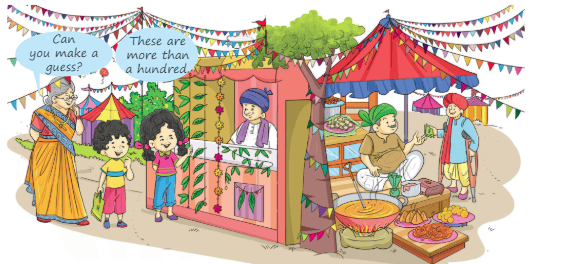
Now find out how many there are.
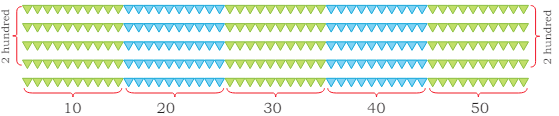
How many triangles are there in a line of triangular
toran? --------
Try counting all the triangles.
Total triangle: 50 more than 200, which is 250.
Teacher’s Note:
Help children to count objects beyond 200 and show
how the counting can be done as earlier using the same number names.
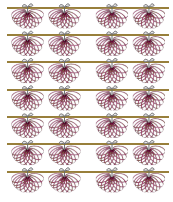
Guess how many bangles there are.-------
Try counting the total number of bangles.
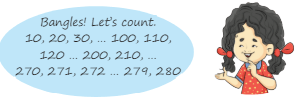
See how Teji is counting.
Total bangles: 200 and 80 more is 280.
Bangles! Let’s count.
10, 20, 30, … 100, 110,
120 … 200, 210, …
270, 271, 272 … 279, 280
Guess how many toffees there are in
the boxes.
Count and check.
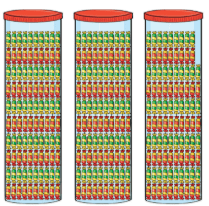
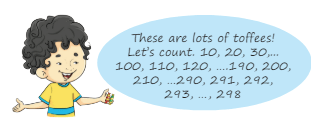
These are lots of toffees!
Let’s count. 10, 20, 30,...
100, 110, 120, ….190, 200,
210, …290, 291, 292,
293, …, 298
Jojo has 2 toffees in his hand.
How many toffees are there altogether? --------
298 and
one more is 299;
299 and one
more is 300.
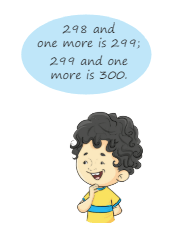
298 + 1 = 299
299 + 1 = 300
How many more triangles to make 300?------
How many bangles less than 300?------
Which is more: bangles or triangles?
Let us Do
1. Jojo is jumping on a tiled path inside the mela.
Fill in the empty tiles with numbers.

2. Fill in the blanks with the correct numbers.

3.

4.

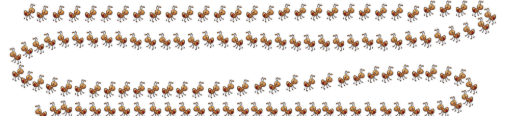
5. Ants have found food on the ground. Guess how many ants there are. Count and check
Teacher’s Note:
Ask why children got different answers and how one
can get better at counting. The differences in the answers should be used as an opportunity to show why groups of 10 are more effective in counting correctly even large numbers. Help children arrive at a strategy
to count correctly
Teji and Jojo have learnt to write numbers with the
help of matchstick bundles. They can also write
number sentences in more than one way.
6. Fill in the blanks appropriately.
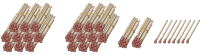
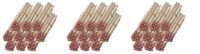
7. Place the numbers given above on the number line.

235 lies between 200 and 250.
Teacher’s Note:
Ask children to make large numbers using matchsticks or
any other readily available material at home and bring to school.
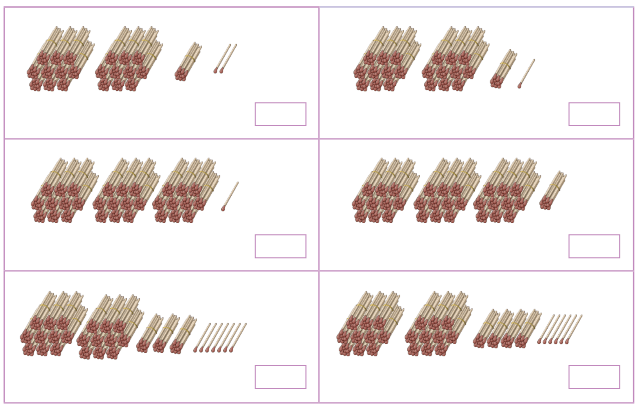
8. Look at the pictures and write the corresponding numbers.
9. Make the number slider as shown in the picture. Increase or decrease the number as given below:
a. 285 – increase the number by one ------
b. 147 – increase the number by ten -------
c. 367 – decrease the number by 2 --------
d. 289 – decrease the number by 10 --------
e. 290 – increase the number by 20 --------
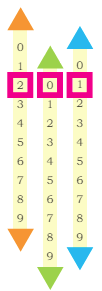
Teacher’s Note:
Teacher to make the TLM and play with children.
Let us Play
Flag game: Let us play a guessing game. Teji has thought
of a number between 200 and 210. Jojo has to guess it.
Why does the flag point to the right?
The number is more than the guess.

Why does the flag point to the left?


Now you try and play with your friends and guess the number.
Teacher’s Note:
Play this game on the board with children; later, children can play in pairs or small groups in their notebooks. The teacher can also make the game more exciting by changing the range of the numbers and restricting the number of guesses allowed.
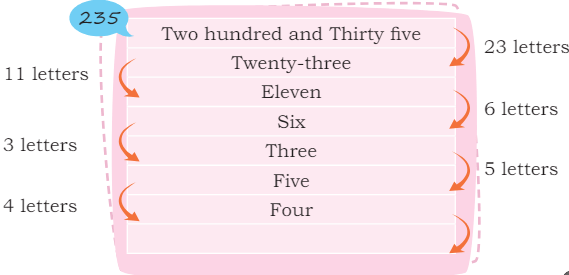
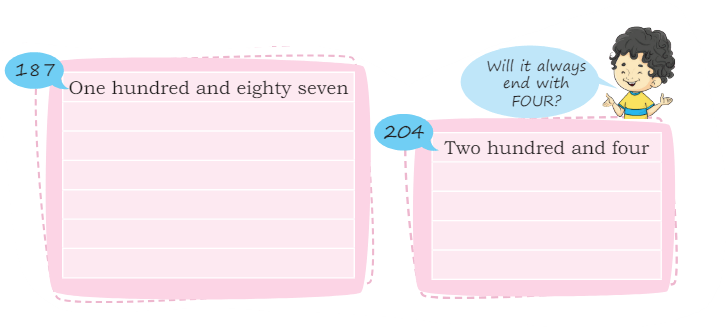
Magical count
Write down any number name. Count the number of letters
in that number name and write the name of that new
number down. Keep repeating — what happens?
Numbers on a line
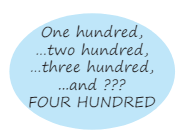
Tell Teji, Jojo and Bholu what will be the next hundred number.
Write it on the number line below.
Can you show the number using matchsticks?

Let us Do
Teji and Jojo are trying to put their numbers on the following number lines.
1. Locate 216, 243, 257 on the number line below.
following number lines.

2. Locate 329, 332, 337, 375 and 387 on the number line below.

3. Tell how far is 387 from 400: .................

4. Which is more: 393 or 400? Use a number line and
show. Fill the numbers on the number line below
and show by jumping how far 393 is from 400.

Teacher’s Note:
Support children to pay attention to the different jumps
required in the above number lines. Teacher to also support children
to understand quantities that the numbers represent using matchstick
bundles or any other similar material.
5. Teji and Jojo are hungry after all the running around.
They go to Farooq Chacha’s Sweet Shop.
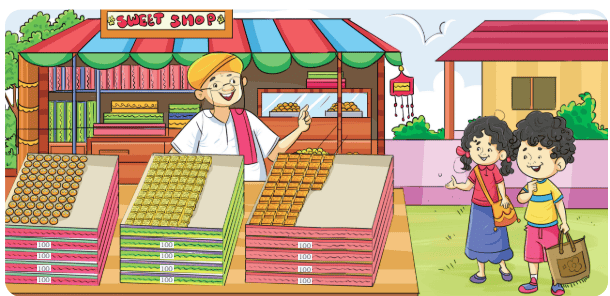
a. How many pieces of Mysore pak are in one tray? .................
b. How many pieces of Mysore pak are there in total? .................
c. How many laddoos does chacha have in the trays? .................
d. How many dhoklas does chacha have? .................
e. Chacha is going to fill the tray with more laddoos. How many
more laddoos will make the tray full? .................
f. How many total laddoos will he have after the last tray is full?
.................
g. Mark the following numbers on the number line below:
423, 487, 438, 476.
Mark Five
Hundred
(500) on this
number line!

1. Teji and Jojo saw a big apartment
Find the house numbers of the shaded houses without counting. Share your strategies.
Fill in the
shaded boxes
with the
correct house
numbers.
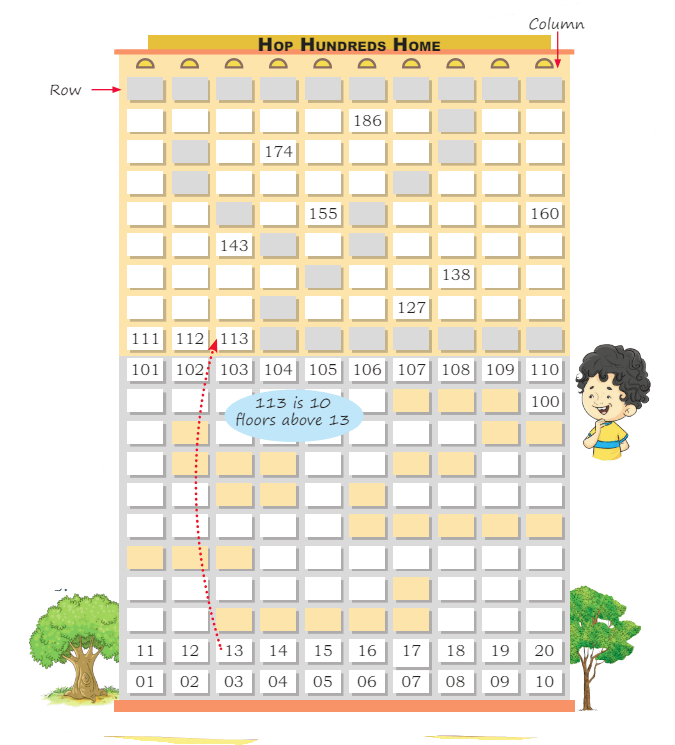
Teacher’s Note:
Let children fill the first blank cell by counting, but encourage them to look for patterns while filling in the rest.
2. Arvind Dada has to deliver sweets from Farooq chacha’s shop to different houses. Colour the houses to which he has to deliver sweets.
The house numbers are:
209, 228, 242, 258, 267, 276, 290, 315, 346, 367, 389, 395.
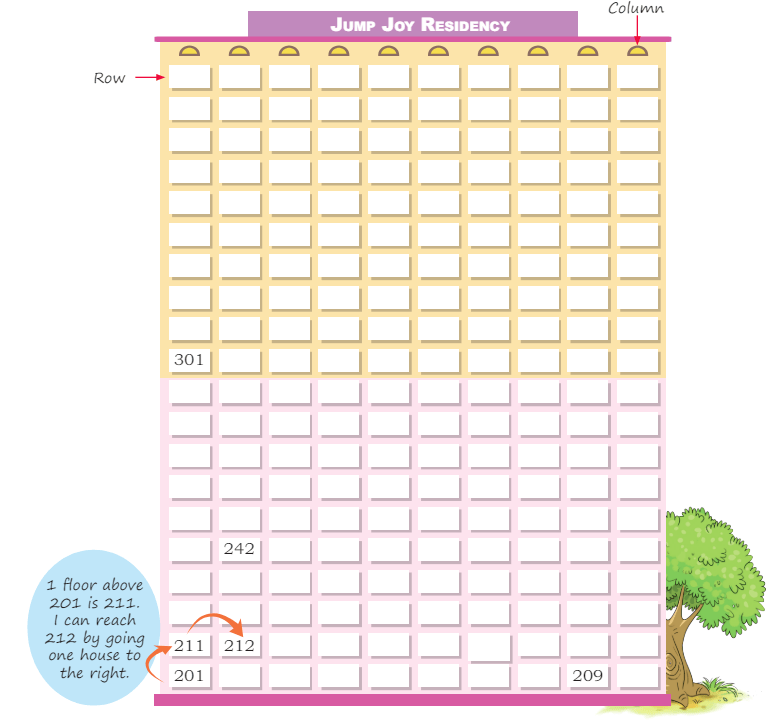
3. Write the floor and column number for each of the following houses.
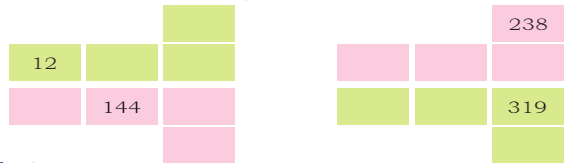
4. Find the following house numbers from the building and write the appropriate house numbers in the blank spaces. What do you
notice? Discuss how the house numbers change when moving up and down and left to right.
5. Who am I?
I have digits 9, 1
and 5.
I am less than 200.
I have 9 ones.
Which number
am I? ............
I am a 3-digit
number. I have
only digits 4 and 0.
Which number am
I? ............
I am greater than 300
but less than 400.
I have no tens.
My ones and hundreds
digits are the same.
Which number
am I? ............
Arvind Dada packs sweets in boxes of 100 (H), 10 (T) and as packets
of loose sweets (O). The number of sweets for every house is the
same as the house number.
6. Draw sweets for each of the following house numbers.
Teacher’s Note:
Children are supposed to show the sweets using Dienes
blocks. One set is provided at the end of the book. These can be easily
made using square math notebooks. Children can make a model using
Dienes blocks before drawing.
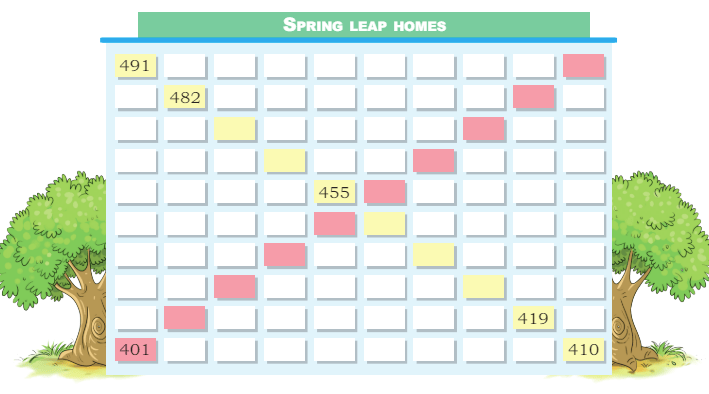
a. Write the house numbers of the yellow and pink houses.
b. Write the pattern you see in these numbers.
......................................................
.....................................................
8. Arvind dada wants to pack small boxes of 10 in a big box of 100.
a. How many boxes of 10 can he fit in a box of 100? ............
b. How many boxes of 10 can he fit in two boxes of 100? ......
c. How many boxes of 10 can he fit in four boxes of 100? .........
d. How many boxes of 10 will he find if he opens a box of 100?
................
Teacher’s Note:
Teacher can encourage children to identify patterns in the
numbers, some of the digits, how the digits change, etc. Also, help children
find the relationships among the 100’s box, 10’s box and 1’s box.9. Number hunt
Write the numbers between 200 and 300 that have 5 as a digit.
Is 245 one such number? Write the other numbers.
...................................................
Let us Play
Do you remember this game? Let us play it again.
We will record the actions in the table below. One
is done for you
Show and tell
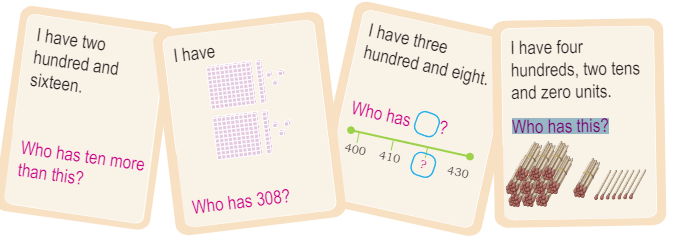
Create a chain of cards such that every next card answers the
question of the previous card. Distribute these cards among the
children in the class. A child reads aloud their card and the other
child having the answer identifies himself/herself. The game ends
when every child has answered a question using their card.
One example is given below:
I have two
hundred and
sixteen.
Who has ten more
than this?
I have
Who has 308?
I have three
hundred and eight
Who has ?
I have four
hundreds, two tens
and zero units.
Who has this?
Let us compare who has more laddoos and show it using the sign
more than (>) or less than (<) appropriately.
487 laddoos is more than 423 laddoos
423 laddoos is less than 487 laddoos
487 > 423
Open mouth points
towards the bigger
number
423 < 487

Now compare 321 and 231. 3 hundreds are more than 2 hundreds.
Do the other digits in the numbers matter here? No. So, 321 is more
than (>) 231.

Let us take another example. We are comparing 209 with 290.
Both numbers have two hundreds. But 9 ones are less than 9 tens.
So, 209 is less than (<) 290.

Let us Do
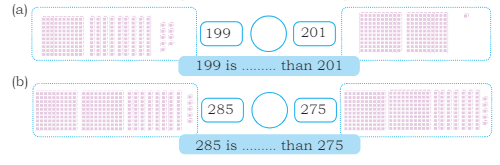
1. Compare the following numbers and use the signs >, < appropriately.
2. Think and match the following
3. Circle the smallest number in each row:
(a) 374, 473, 347, 437
(b) 239, 123, 321, 456
4. Circle the greatest number in each row:
(a) 466, 437, 439, 447, 483
(b) 464, 387, 123, 256, 348
5. Make 3-digit numbers using 3, 2, and 4 without repeating any
digit and colour the greatest number with red and smallest
number with yellow.
6. Now make more 3-digit numbers using 3, 2 and 4 where you
may repeat the digits. Colour the greatest number with red and
smallest number with yellow.
7. (a) Arrange the following numbers from smallest to biggest.
456, 389, 207, 99, 110
..............................................
(b) Arrange the following numbers from biggest to smallest.
67, 376, 294, 249, 494
...........................................
Teacher’s Note:
While comparing two numbers, help children focus on the
quantities that the numbers represent. Use Dienes block representation
to help them see that 1 H is more than 1 T and 1 O. Similarly, 1 T is more
than 1 O.