THEATRE
Dear Teacher,
Children love drama and stories. They have astonishing levels of imagination and creativity at this age. This book has been designed keeping the same in mind. The intention is to keep the process joyful without bringing in the stress of having to remember and memorise.
We introduce children to new skills and techniques in theatre using games and activities. As teachers, we provide a supportive environment to let them explore possibilities on their own, and not insist on anything specific. Let us encourage participation and free imagination. Most importantly—let us all have fun together!
Some points to keep in mind:
Vidushaka is a unique character from traditional Indian theatre. This character was used in Sanskrit theatre to connect scenes often using humour and antics. This character could assume any form as per the situation and speak about it. Here, he has been used as a friend of the children, introducing them to concepts and ideas in theatre and guiding them with information as they proceed from one activity to another. Important takeaways and lessons for children are spoken by Vidushaka.
1. A spacious empty room to be provided for theatre classes to facilitate free movement. It needs to be clean and free from obstructions or sharp objects that may cause injury.
2. Start the class with a prayer and recap of what was done in the last class. You may refer to the Grade 3 textbook for the suggested prayer.
| Structure of the class | ||
|---|---|---|
| 5 minutes Prayer and recap | 30 minutes Class activities | 5 minutes Circle time |
3. The teacher must demonstrate by doing the activities before asking the children to do them.
4. The teacher may only give examples for activities. It is important to let the child think and come up with their own ideas or situations. Numerous examples to help the teacher in activities are given in the QR code.
5. The teacher is free to repeat an activity any number of times as the class requires.
6. Encourage children to watch play performances. Suggestions could be sent to parents to take children to watch live theatre shows.
7. Invite teams to perform children’s plays in school or organise field trips to watch plays and interact with the actors would help motivate children.
Theatre Assessment
Theatre has always been a positive, enjoyable experience for children. Therefore, just like they enjoy the classes, the assessments also need to be fun-filled, and not bring in the stress or anxiety that is normally associated with tests and exams. All assessments are based on activities. Here are some basic pointers to keep in mind while assessing:
1. Competency and skill acquired should be the focus.
2. There is no correct or wrong answer here.
3. The final outcome or presentation is not the only benchmark.The effort, thought, and process behind it also needs to be considered, along with:
- Knowledge application
- Effort and participation
- Creativity and presentation
- Teamwork and collaboration
4. Encourage self-reflection and treat it as a feedback for teachers (last column in the rubrics provided)
5. Create a motivating and supportive environment specially for those who may be shy or inhibited
6. Read the section on time allocation and assessments at the beginning of the book for better clarity.
| Formative Assessments | Summative Assessments |
|---|---|
| A continuous process that goes on throughout the class duration. No separate ‘test day’. It includes: | Conducted at the end of the year, on a designated day. Completely activity-based. Question paper and written tests are to be avoided. |
| 1. Circle time (children freely share ideas. Teacher makes note of each child) | 1. Activity examples are provided at the end of the book. |
| 2. Rubric provided at the end of the chapter | 2. Scoring to be based on rubrics |
| 3. Teacher’s observations | 3. Include the child’s self-reflection in the overall score |
SWAGATAM MY LITTLE STARS!
Taking you all on a theatre journey last year was so much fun. I could not wait to return! For those of you who were not there last year, my name is Vidushaka.
I love theatre and drama and have been doing this for many, many years. I will be sharing with you many stories from my experience, as I take you on a journey to explore theatre. Today, I want to tell you a secret. With all that I have done in theatre for many years, my favourite part has been working with children. It is so much fun. That is why I was waiting to come back to you!
Before we start this year’s fun activities, I want to know what you did based on the new concepts you learnt last year. I will help you recall the concepts, and you will tell me what you did in school or at home during the holidays.
I did
Using everyday objects with new meaning (creativity and improvisation) I did
Telling stories and enacting them (storytelling and role-play) What I did
Some children may feel shy or inhibited during some activities. Gently motivate and let them try out at their convenience. While it is fine for some to take extra time, the teacher’s constant positive support is of utmost importance.

Chapter 5
EXPLORE!
We are ‘exploring’ all the time in theatre. ‘Exploring’ means ‘finding out’. We always try to find out more about a story or how the audience liked our show. We also like to find out how we can improve or what we can do to make the show better. So, let us begin!
SCENE 1
Building Individual Focus
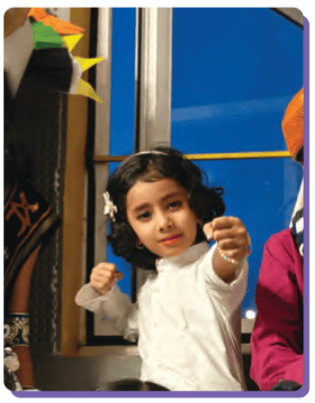
Theatre is teamwork. You always work together in a group, supporting each other. If there is a problem, everyone works towards solving it. If there is success, everyone shares the joy.
But that does not mean there is no individual effort. It is important for each member of the team to put in equal effort and hard work. Though you are working in a team, it is important to be focused and concentrate on what you should do. Do not let others’ actions distract you.
Also, keep in mind that if you are not clear on what you should do, you cannot help others in case they are in trouble. So, focus.
Activity 5.1
“Ram says …”
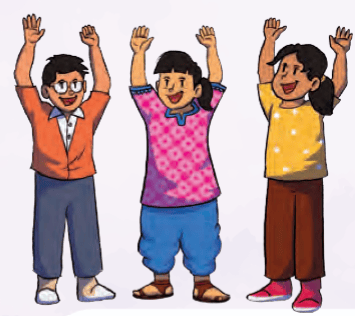
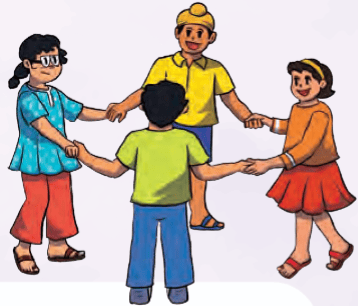
This is a fun theatre game that is played in a group, but will test your individual skills. Practising this regularly will make you alert and focused.
| Instructions and Preparatory Exercises | |
|---|---|
You have to follow only those instructions where the teacher says “Ram says …”. For example, when you hear “Ram says walk in a circle,” start walking in a circle. when you hear “Ram says hands up,” raise your hands. when you hear “Ram says look up,” tilt your head upwards. Every instruction that you follow should begin with “Ram says”. |
If you hear just the instruction, without “Ram says”, do not follow that instruction and continue doing the previous action. For example, when you hear “Ram says walk in a circle,” start walking in a circle. when you hear “Ram says hands up,” raise your hands. when you hear “look up,” do not tilt your head upwards. Keep your hands raised until you hear “Ram says …” |
The teacher will mix up instructions to keep everyone alert. You will get continuous instructions with “Ram says …” and suddenly one without it. You have to be very alert to identify it and not follow that instruction.
Basic
Different types of instructions are given, such
as “walk”, “jump”, “make a happy face”, “make
an angry face”, “walk like an elephant”, “sniff
like a dog”, and anything else that the teacher
can creatively think of.
Advanced
More complex activities like working in groups
of four, five, or six to create shapes like
rectangles, triangles, and circles, or various
alphabets of Hindi, English, and regional
languages.
Common situations in the environment like a flock of birds pecking on seeds or stories from the Panchatantra like a tortoise walking in the forest can add more fun.
Note for Teachers:
If the children are
picking up the game
well, the responsibility
of instructing can also
be given to various
students one by one.
Make note of their skills
in coordinating with
the group and their
ability to give complex
instructions.

- Share the most enjoyable and the most difficult thing that you faced while doing these activities.
- How did you manage when it was difficult?
- What new things can we add to make this game even more fun?
 Ram says, “Vidushaka, narrate a fun story.”
Many years ago, at a theatre workshop, “Ram says” was the highlight. The kids were well prepared, and everyone was determined not to get out. Sunita teacher was giving instructions. She started off easy, “Ram says touch your nose”, “Ram says jump up and down.” But then, she decided to have some fun.
“Ram says, pat your head and rub your belly at the same time.” Sunita teacher commanded with a grin. This resulted in chaos. Kids were furiously trying to pat and rub, looking like confused puppets.
Then she shouted, “Now clap your hands!” immediately, at least half the group clapped, only to realise their mistake. She hadn’t said, “Ram says stop patting and rubbing.” They groaned, but what really got everyone laughing was Raju, who had been so focused on keeping rhythm, kept patting and rubbing for a full minute after everyone else stopped.
When he finally noticed everyone staring, he threw his hands up, “Well, Ram didn’t say stop!”. He was right.

Activity 5.2
Wild Walks and Animal Antics
Do all of you love animals and birds? Have you ever imagined how it would be to live the life of your favourite animal or bird? How would it be to walk in the forest, look for your food and sleep under the branches or in a cave? This fun activity lets you do all that and more. You even get to interact with other animals in the forest!
Instructions and Preparatory Exercises
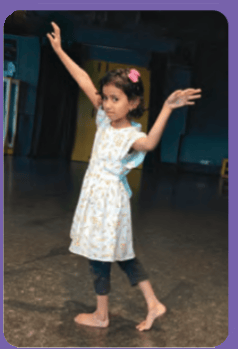
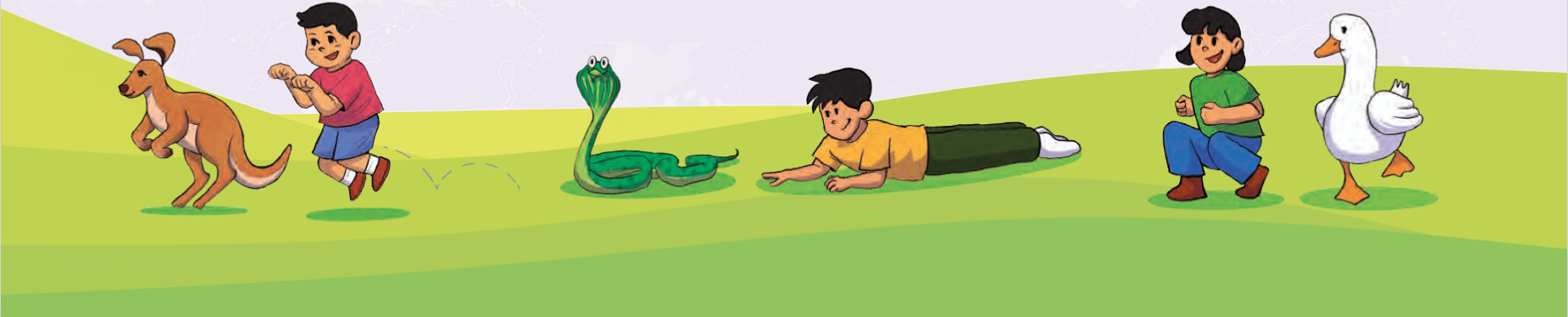
Think of your favourite animal or bird and walk randomly in the room. When the teacher claps, you freeze in the position of the animal or bird that you were thinking of. Alternatively, all of you stand with ample distance between each other. The teacher picks a chit and calls out an animal and all of you walk like that animal. Sounds fun?
Basic (Individual Activity)
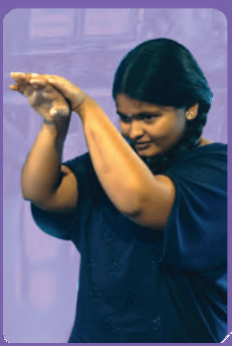
Assume that you are an animal, but do not announce it to the class. Imitate the body movements of that animal. The speed of your walk, eating style, sleeping, and other behaviours have to be similar to that animal. Your friends have to guess which animal you are. For example, a sloth is slow and a dog is relatively fast.
Panchatantra Exercise
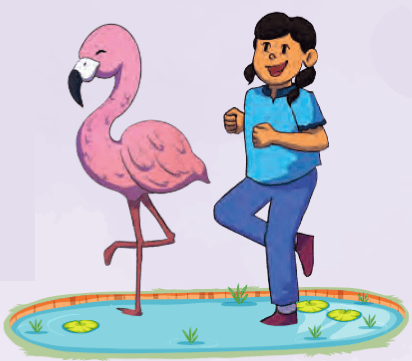
You (as the same animal) are walking near the lion’s cave, looking for food. Walk carefully so you don’t wake the lion up. Suddenly, a loud sound is heard, and the lion wakes up. Run!
Advanced (Group Activity)
You are now in groups in the jungle. You have other animals of your kind along with various other animals. How would you behave when you are in a herd or a flock? How would you interact with other animals? Some are your friends while others are not. How do you escape when in danger?
Panchatantra Exercise
Imagine you are a deer, and you are discussing a plan to escape the lion’s fury. You want to save the baby deer in your family. Enact a simple scene with other animals.
Note for Teachers:
These exercises can be utilised
to bring out short stories or
scenes from famous stories
narrated through animals. For
example, Hitopadesha and
the Lion King.
- What was your favourite animal movement? Why?
- Which animal did you not like to perform and why?
- Which animal behaved well with you and showed respect?
- Do you think it is better to have multiple limbs to walk or is it better that we have two legs?
| ASSESSMENT — Chapter 5: Explore | ||||
|---|---|---|---|---|
| Competencies C 1.1: Expresses enthusiasm to depict a variety of objects, people, situations, and experiences in drama activities. C 1.2: Discusses own thoughts and responses while working collaboratively in the Dramatic Arts. |
||||
| CG | Competencies | Learning Outcomes | Teacher | Self |
| 1 | 1.1 | Able to hold focus on one’s task in a group activity | ||
| 1.2 | Improvises and adds creatively to the scene | |||
| 1.2 | Tries activities without inhibition | |||
| 1.1, 1.2 | Alertness and attention to detail | |||
| Overall participation in class | ||||