
Chapter 7
LET’S CREATE
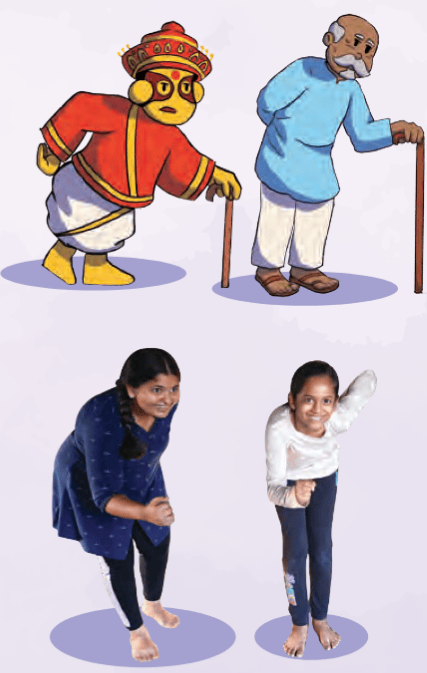
Have you tried walking like an old person with a walking stick? Or you must have tried to stand or sit like your mother holding a handbag. You also might have tried imitating an animal in the way it walks, jumps, or sniffs. Isn’t it fun to behave like someone else? Did you know that this is a very important technique in theatre! It is called IMITATION.
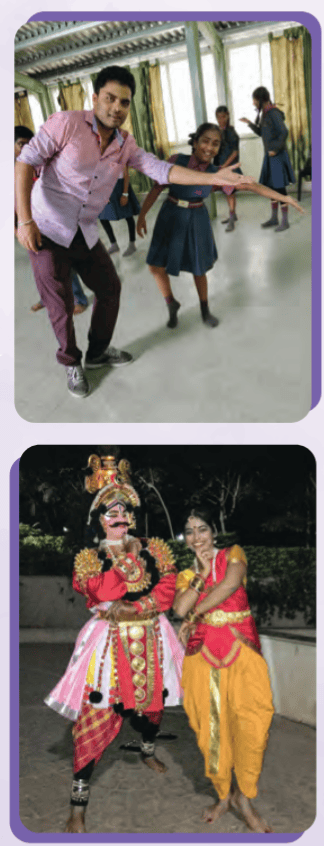
Imitation in theatre is a foundational technique where actors observe and replicate the actions, voices, or facial expressions of others to create believable characters. It requires an in-depth study of real-life people, animals, or even objects and bringing their qualities to life on stage. Let us play a simple game to understand how it feels to imitate—seriously.
Activity 7.1
Mirror Exercise
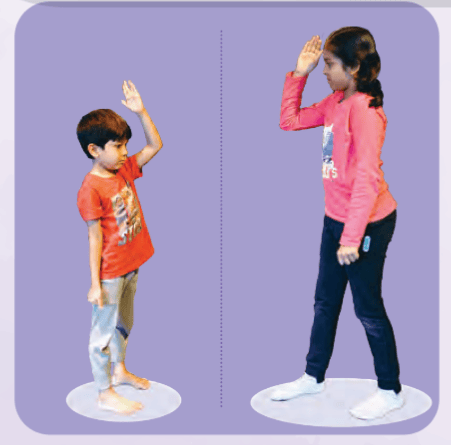
The most interesting part of this game is that there are no actual mirrors! You will become mirrors and behave like one! All of you have to stand in pairs, facing each other. One will be chosen to be a mirror; the other will be chosen to be a human. Whatever action the human does, the mirror imitates. After sometime the roles will switch.
Basic
Stand in a stationary position as per the instruction. Human can move their hands and legs, and make actions like sitting and standing. Switch roles after sometime. The mirror constantly imitates the human.
Note for Teachers: Imitation comes naturally to children. Theatre provides a structured way to creatively express through observing and mirroring. By refining these skills, we help in developing empathy and confidence.
Remember!
You cannot touch each other. All actions have to be done with one-arm distance from each other.
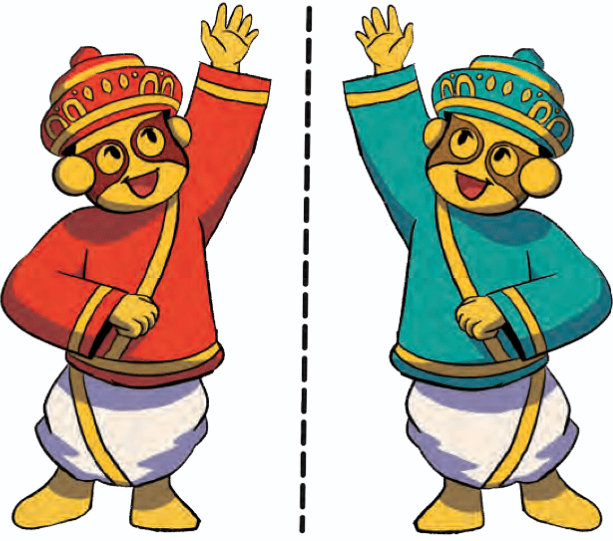 If you notice, some of you (playing
the mirror) probably made the
mistake of raising your right hand
when the human raised their right
hand. Though you are imitating
them correctly, a mirror always does
the opposite. What is your left is the
mirror’s right. This concept is called
SYMMETRY. Symmetry occurs when
both sides look the same relative to a
line drawn in the middle.
If you notice, some of you (playing
the mirror) probably made the
mistake of raising your right hand
when the human raised their right
hand. Though you are imitating
them correctly, a mirror always does
the opposite. What is your left is the
mirror’s right. This concept is called
SYMMETRY. Symmetry occurs when
both sides look the same relative to a
line drawn in the middle.
Advanced
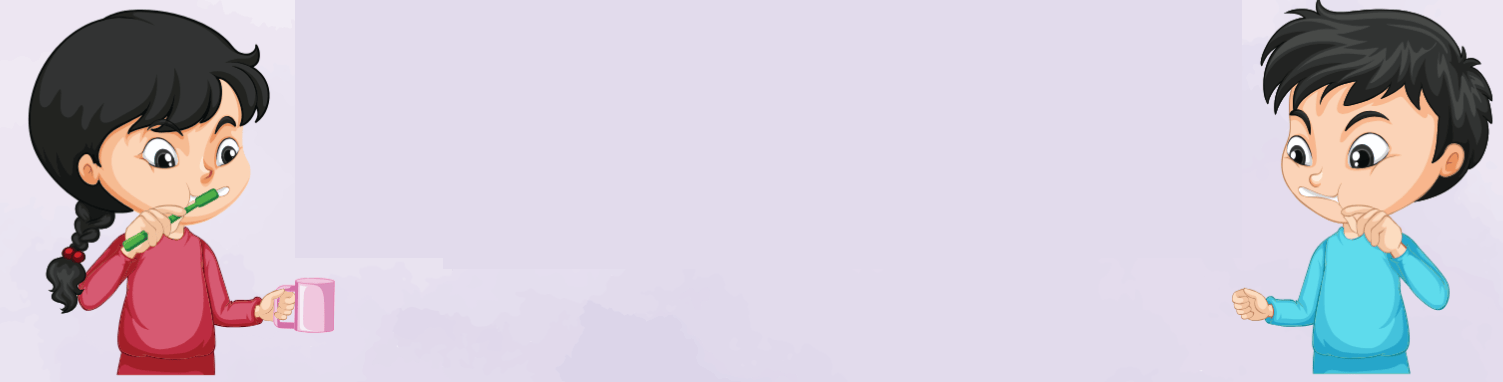
Stand in a stationary position as per instruction. Now humans now can use various facial expressions and movements. If possible, simple props can also be added. For example, actions of brushing teeth, packing schoolbag, etc.
Panchatantra Exercise
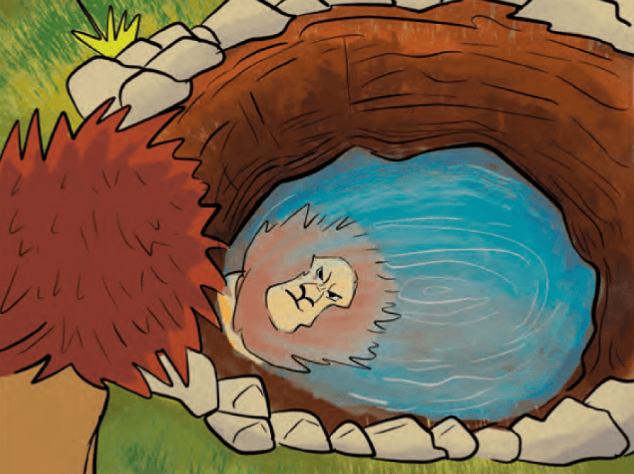
Remember the hare takes the lion to the well, and makes the lion believe that the reflection it sees is of another lion? Now, continuing your mirror exercise, one of you will be the real lion, and the other will be the reflection. You can also add the hare next to the lion. Since the whole conversation happens through the reflection, enact the scene with the mirror acting as your reflection!
- What was your experience of being a mirror?
- Was it easy to control your laughter when doing this activity?
- Which role was more fun? Playing mirror or human?
 After playing all variations
of the mirror game, you
must have got an idea
of the importance of good
OBSERVATION if you
have to imitate correctly.
In theatre, imitation is not
just copying. It is about
transforming observation
into performance with a
personal creative touch.
After playing all variations
of the mirror game, you
must have got an idea
of the importance of good
OBSERVATION if you
have to imitate correctly.
In theatre, imitation is not
just copying. It is about
transforming observation
into performance with a
personal creative touch.
Activity 7.2
Role-Play—New Challenges
In theatre, role play is the process of taking on a particular character, understanding the situation, imagining the possibilities and performing as a particular character. This is used most commonly to tell stories. It is also used to learn by doing or to solve problems.
Theatre Activity—recall (Grade 3)
Last year, you were given simple characters like police and thief or, king and minister for which you had to build a conversation. You were given some time to plan and prepare for it. You also might have tried this activity with stories like Tenali Rama.
Challenge 1: Interactive
Now, we shall start with the same role-play you are familiar with. Two of you volunteer to take on roles. The characters are given by the teacher—for example, a doctor and a patient. The two characters begin a conversation about why the patient is visiting the doctor. As they have spoken about 4–5 lines, the teacher calls ‘pause’.
Now, it is open to the audience (the other students in class) to decide what happens next. The two actors are supposed to follow whatever they are told. The audience can choose to:
- Add a new prop
- Add a new character
- Change the direction of the story
by adding a new problem
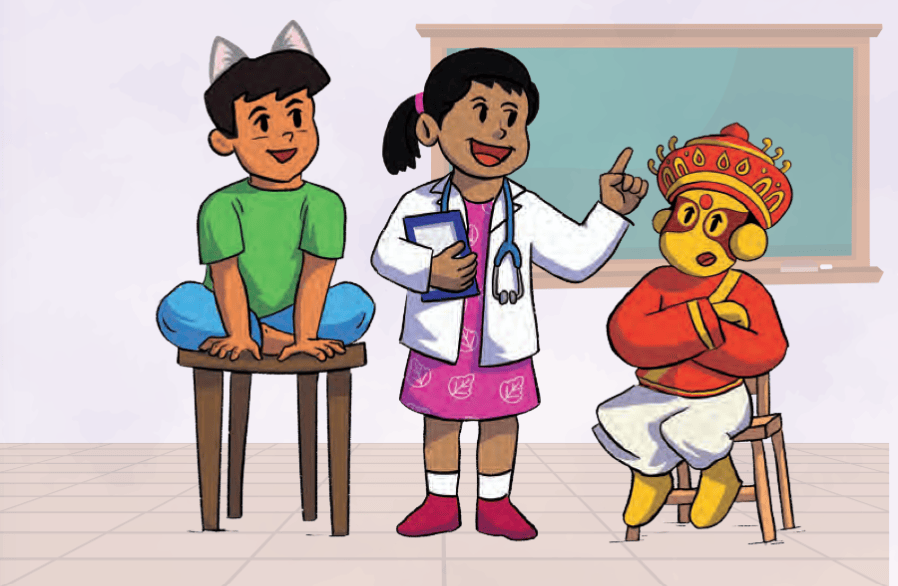
Suppose the audience says that the patient suddenly notices a cat in the doctor’s room. Now, no matter what conversation was happening previously, they have to react to the cat in the room. They do not have time for preparation — they have to be spontaneous. After it progresses a bit, the teacher again calls ‘pause!’
Now the students present something new. (Notice that they do not have time to prepare. They have to be alert and ready). Let us assume the students say —
“Another patient walks in with the same name as this patient. Upon checking, they realise the first patient was actually a policeman.” Now, a new actor is added to the scene. Why the policeman comes and what happens is what the actors have to immediately come up with.
It can go on this way until the teacher decides to change the actors and situation.
If everyone in the class has completed this challenge, get ready for the next one.
Challenge 2: Switch
The role-play starts as usual, with two students taking up the characters suggested by the teacher. Let us take the same example of the doctor and patient.
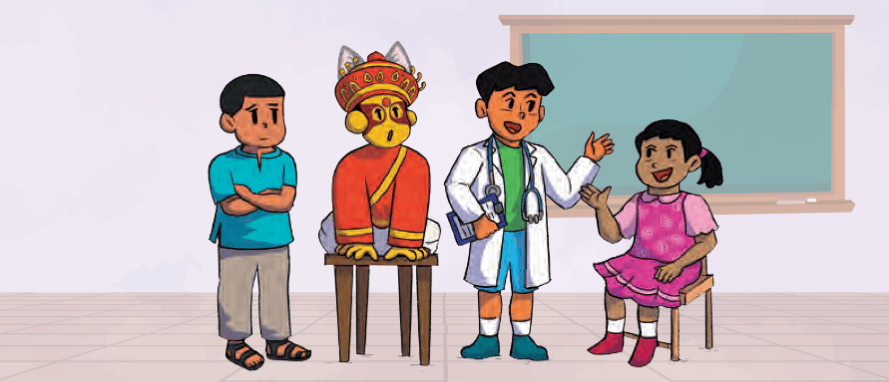
As the conversation develops between the two, when the teacher feels that they are involved in their character, at a crucial point, the teacher calls ‘switch’. Now, the child playing doctor becomes the patient, and the child playing the patient becomes the doctor. The conversation continues. There is no time gap allowed for them to think of what to speak. It has to be immediate.
Advanced
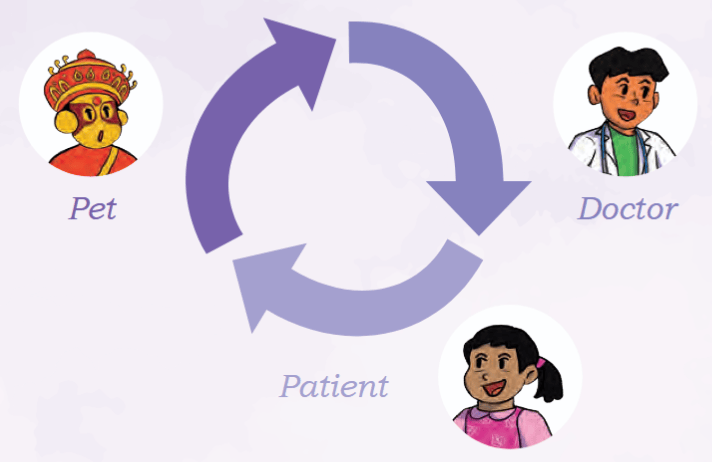
The next level of challenge is to have three or four characters. When the teacher calls ‘switch’, as in the given example, the doctor becomes Patient 1, Patient 1 becomes Patient 2, and Patient 2 becomes the doctor. When there is the second ‘switch’, they change to the third character.
This way, each child gets to play all three characters. The difficulty level can be increased further with four actors in the scene.
Note for Teachers:
Characters that are assigned can
be both familiar and unique. Some
characters could be from their
everyday life (like in the example
of the doctor given earlier). Others
could be completely imaginary
characters, like an alien from outer
space or a talking bird that flew
down from the North Pole.
This allows the children to draw from
their experience and build a quick
imagination that also helps
develop creativity.
- Which challenge was more fun and why?
- If you had to add a new challenge, what would you add?
- Would you like role-plays with or without challenges? Why?
Panchatantra Exercise
Both challenges can be tried with the Panchatantra story —
Challenge 1: Interactive—
Pick any part of the story and assign two characters.
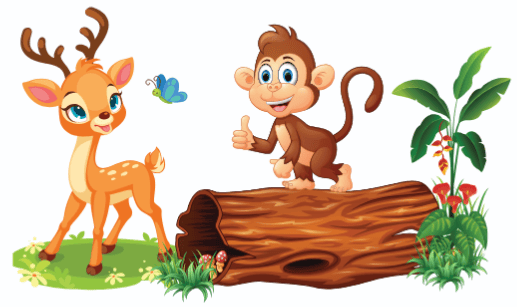
Example: A deer and a monkey are trying to find a solution to the lion problem. The audience suggests changes, adding a character or a prop for the actors to continue.
Example: What if it was a crocodile instead of a lion?
Challenge 2: Switch—
With the same example, when the teacher calls ‘switch’, the deer becomes the monkey, and the monkey talks as the deer. The hare can be added to the scene to come up with a solution.
| ASSESSMENT — Chapter 7: Let's Create | ||||
|---|---|---|---|---|
CompetenciesC-3.1: Makes choices while working with materials, tools, and techniques used in the dramatic arts. C-3.2: Practises steps of planning, execution and presentation while creating drama individually and collaboratively. |
||||
| CG | Competencies | Learning Outcomes | Teacher | Self |
| 3 | 3.1 | Explores possibilities in action and gestures | ||
| 3.1 | Pays attention to minor details when imitating/mirroring | |||
| 3.1 | Uses props, facial expressions and minor movements in mirroring | |||
| 3.1, 3.2 | Takes up new challenges without hesitation | |||
| 3.2 | Involves in the scene as audience and gives innovative suggestions | |||
| 3.2 | Spontaneously uses props, sound, etc., to make the scene realistic | |||
| Overall participation in class | ||||
Teacher’s feedback on student’s strengths
Teacher’s feedback on areas of improvement
Any other observation