
Chapter 8
LOOK AROUND
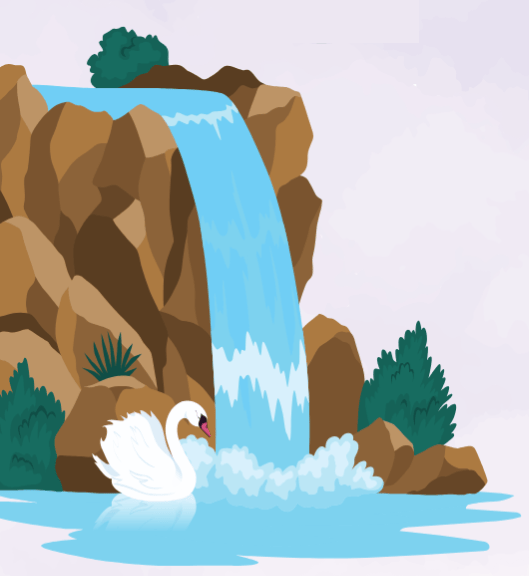
There are always many ideas and inspiration you can get from things around you. You first start with the people around you. The variety of situations and characters can help you create many interesting stories.
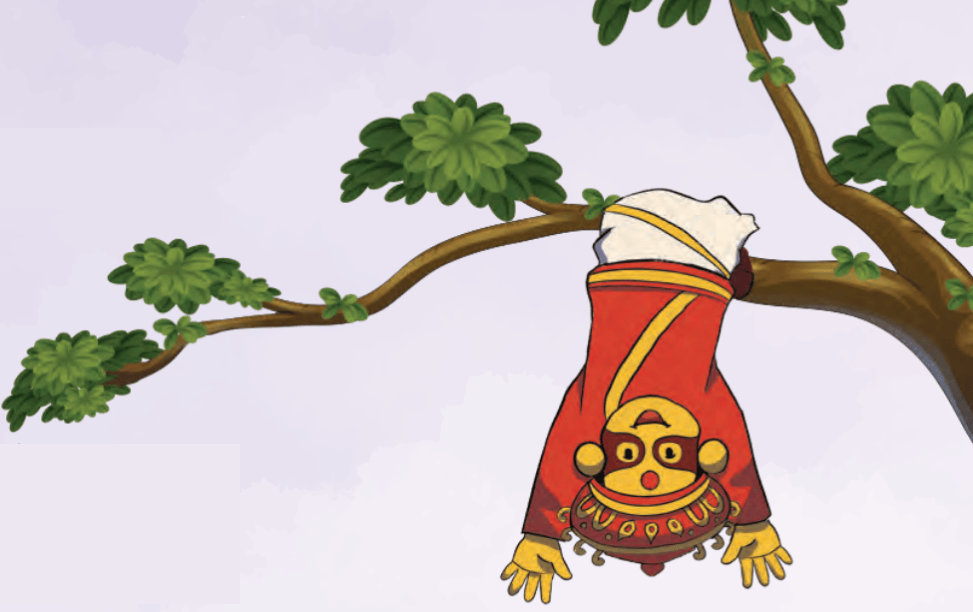
Next, you may look at animals. Their behaviour and actions are quite interesting to adapt to stories and performances, as you have already tried in Chapter 5. Is there an animal that you feel very connected to? What characteristics of the animal do you like? How would you want to create a story about it if you had to?
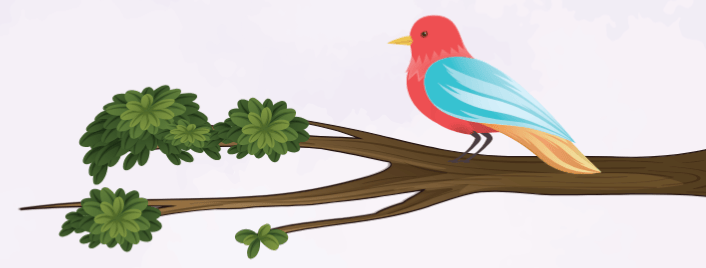
Now, let us look beyond humans and animals. What do we have? Beautiful nature! Trees, rivers, mountains, blowing winds … do they not make you feel happy and peaceful?
DO YOU KNOW?
In olden days, more than 2600 years back, before auditoriums were created, plays were performed in the open air, amidst trees and mountains. Would you prefer watching a play sitting amidst trees? Or do you like the air- conditioned auditoriums of today better?
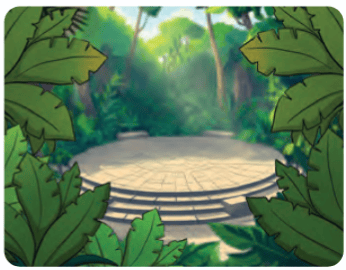
We all enjoy playing in the river or walking on the green grass. Let us now do a fun activity where we create these beautiful things, right here in class. That is the magic of theatre!
Instructions
You will be divided into teams of 4 or 5. Each team will have to come up with a story based on the theme given by the teacher. The themes will be related to nature.
They could be situations related to nature like a thunderstorm, oasis, drought, river, etc. Characters that you can use in the story include birds, fish, insects or animals.

The team develops a simple story around the given theme and enacts the scene.
For example, if the given theme is thunderstorm, the story could be about how it has been heavily raining for many days and a small puppy was stuck in the rain. A group of three young boys/girls brave the rain, save the puppy and bring it home.
Remember
The team has to create the sound effects of heavy rain and wind blowing. You can use tables/ chairs or body percussion as learnt in music classes. Try to change your voice and speak like the puppy. This is called ‘ voice modulation’.
Does this not look like a perfect setting for a Panchatantra story? Try creating one. After reading the story at the beginning of this book, I’m sure you can. The great Pandit Vishnu Sharma will bless you with happiness.
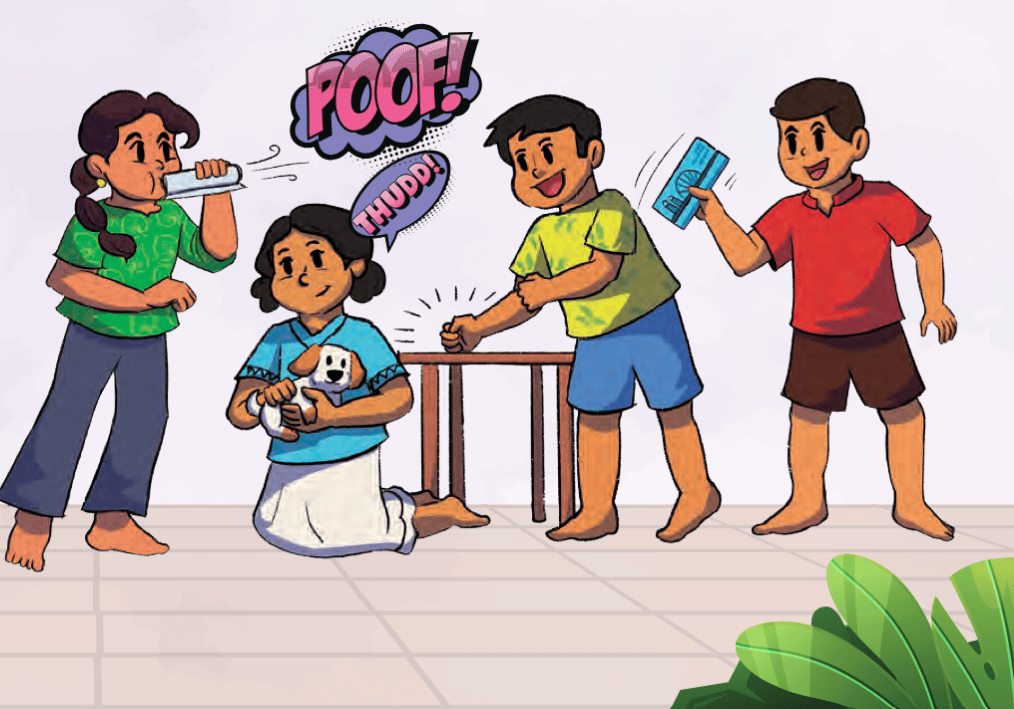
The class can then share feedback on how each team performed. The points to be reviewed could be:
Is the given theme well integrated into the story?
(Is the theme the central idea of the story, or is it just a small part of it?)
Was each character imperative to the story?
(Did each character add to the story, or were some characters just present without any contribution?)
How did the team represent the nature- related theme?
(Were the sound effects and props creatively used to bring about the effect of the given theme?)
Was the overall presentation neat?
(Was there any confusion in the entry-exit and the progression of the story among all actors?)
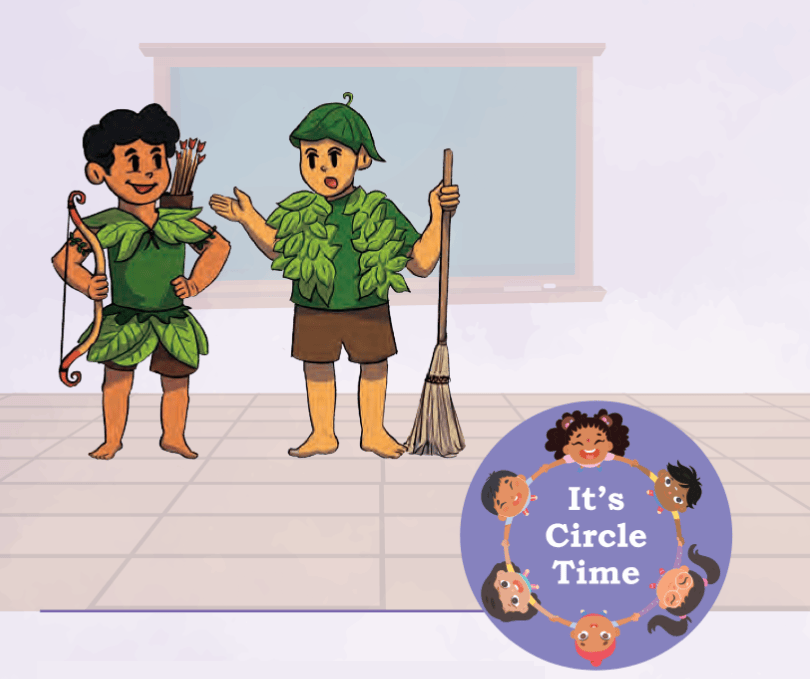
- Can we recreate nature’s glory through our stories and actions?
- Can this also be used to spread awareness about nature?
- Do you think it would be nice if nature could talk? What would you ask it?
Look Around the Country
We started this chapter by saying people, animals, and nature are all great inspirations to create art; if that is true, there must be a lot of art-forms based on nature or animals. Let us find out.
Huli Vesha/Pili Vesha
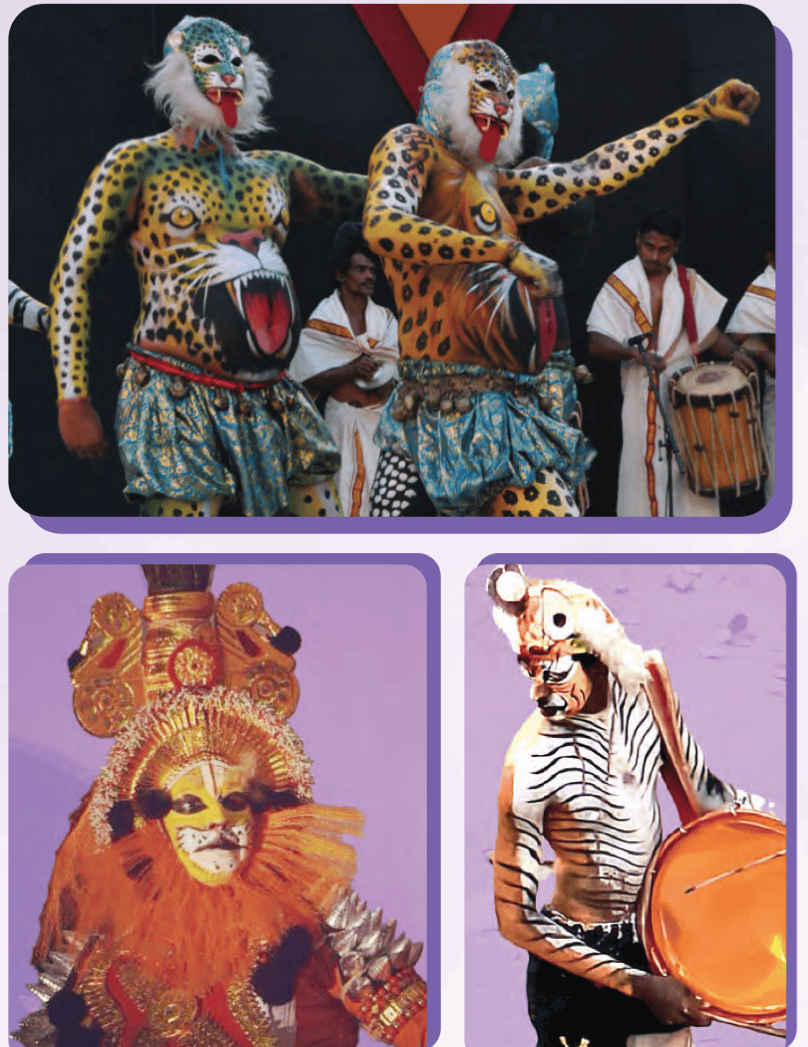
This is a dramatic performance based on the tiger and its movements. The performer’s body is painted yellow and black to resemble tiger stripes, with the face covered in a tiger mask. The entire performance is accompanied by loud drum beats and rhythmic steps. It has both solo and group performances.
This is also performed as a tribute to Goddess Durga, as she is always seen riding a tiger. The performer brings forth the energy, ferocious nature and the power of a tiger. It is truly a wonderful sight to watch. This is mostly popular in states like Karnataka and Andhra Pradesh.
Pasu Nritya/Pashu Mukha
This is also called the ‘animal mask dance’. It is usually performed on special occasions. It has two performers who dance together wearing a dramatic costume. It is a huge decorated form of the animal, which is usually very colourful and accompanied by energetic music. The size of the animal is usually very big compared to the actual animal. Different animals are represented in this form. It is also performed as a tribute to the local goddess of the forest.
This is a popular folk art form in Odisha.
Theatre Trivia — Art in Olympics!
From 1912–1948, artists participated in the Olympics. It included architecture, literature, music, painting, and sculpture competitions. Baron Pierre de Coubertin, the founder of the modern Olympics, felt that all art inspired by sport could be eligible to participate. These were legitimate medal events, and over 150 medals were awarded.
What do you think? Should it be brought back?

| ASSESSMENT — Chapter 8: Look Around | ||||
|---|---|---|---|---|
CompetenciesC-4.1: Recognises elements of drama and movement in nature and describes their artistic qualities C-4.2: Demonstrates curiosity towards local art forms and culture |
||||
| CG | Competencies | Learning Outcomes | Teacher | Self |
| 4 | 4.1 | Replicates elements observed in nature in detail | ||
| 4.1 | Relates one’s role to an unknown situation through imagination | |||
| 4.1 | Provides feedback on others’ acts based on content and technique | |||
| 4.2 | Understands the concept of animals as the core idea of a folk form | |||
| 4.2 | Relates to the story in the folk form and asks questions | |||
| 4.2 | Shares examples of other art forms involving animals or tries to create their own | |||
| Overall participation in class | ||||
Teacher’s feedback on student’s strengths
Teacher’s feedback on areas of improvement
Any other observation
Theatre Summative Assessment
| Activity for assessment (example) | Criteria for assessment | |
|---|---|---|
| Individual |
|
|
| Group |
|
|
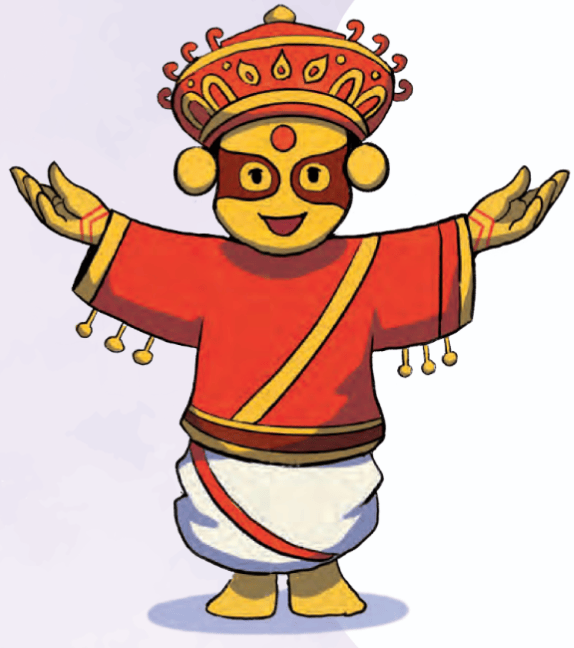
…Thus, we complete another year of playing new games, building new skills and learning new concepts. Wow! This year has been more enjoyable and fun than I had imagined it to be. The reason for that is — YOU! I think you have made every activity enjoyable. Let me know what you think about this year’s theatre activities, in a few words:
Remember to continue doing these activities and playing these games during your holidays too. It will help you go to the next level in Grade 5. The key is to have fun while you learn.
WE SHALL MEET AGAIN NEXT YEAR, LITTLE STAR, NAMASTE!