MUSIC
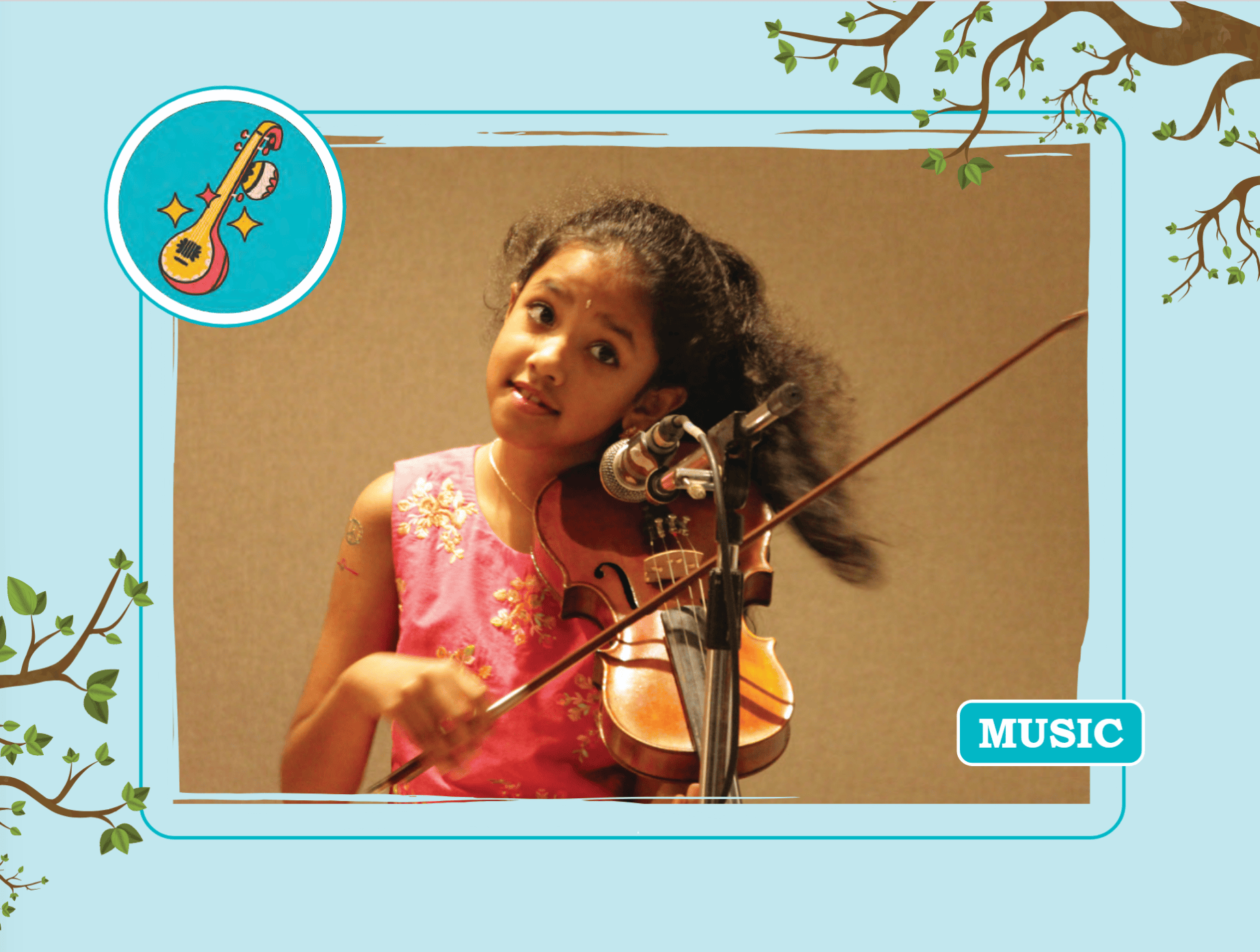
Dear Music Teacher,
As we embark on this journey of music education, we have an opportunity to help our students love music and art, and learn to express themselves freely. Every child is inherently creative, and as educators, it is our role to make the classroom a safe space for every child, where they can learn and explore without fear or judgement. This book can be a guide for you. Here are some guidelines that can help you prepare for a wonderful classroom experience.
- Start the class with a smile, a warm greeting, and warm up exercises to help children ease into learning.
- Always use a tambura (instrument, electronic or app) or a harmonium/keyboard to help children match the pitch while singing.
- Wherever possible, ensure enough space for students to move around during activities.
- Encourage students’ effort as much as possible. In addition, all children should be encouraged to participate in the activities.
- Wherever possible, encourage them to experience live music of different styles.
- Try to organise a field trip to a performance or a live music performance in school.
- Look at other resources available in your city/town to help students experience music and the arts.
- If there are talented or gifted students in the class, find ways to showcase their abilities during some class and school events.
- The audio version of the songs in this section can be found in the QR code of the chapter, or on the internet.
There are guidelines for Formative Assessments at the end of each chapter, which should be conducted in a relaxed and engaged manner, and mainly through observation in the classroom. The suggestions for Summative Assessments are provided at the end of the section, and the competencies for this stage are provided below. The aim of assessments is mainly to see whether children are able to reach the competencies laid out or whether more support is needed. Give children qualitative feedback to help them develop further.
Competencies for the Preparatory Stage:
C-1.1: Expresses enthusiasm to practice and perform music that is familiar to them.
C-1.2: Discusses own thoughts and responses while working collaboratively in music.
C-2.1: Practises and performs songs and rhythms in a variety of musical arrangements (arrangement of vocal, instrumental, solo, duet, ensemble/group).
C-2.2: Compares and contrasts musical elements (Laya, Taala, Sur, Bhaava), lyrics, and expressions in a variety of musical styles introduced in the classroom.
C-3.1: Makes choices while working with voices, instruments, and arrangements used in music.
C-3.2: Contributes ideas while selecting music for performance and participates in rehearsals.
C-4.1: Recognises musical elements in nature and describes their artistic qualities.
C-4.2: Demonstrates curiosity towards local art forms and culture.
Activities that are marked by a star symbol can be facilitated by any teacher, even in schools with limited resourses.
Chapter 9
SING AND PLAY
Hello, young artists! As we start a brand new year, it is time for some music. This year, you are going to learn new things about sounds, songs, instruments and more. So, are you ready?
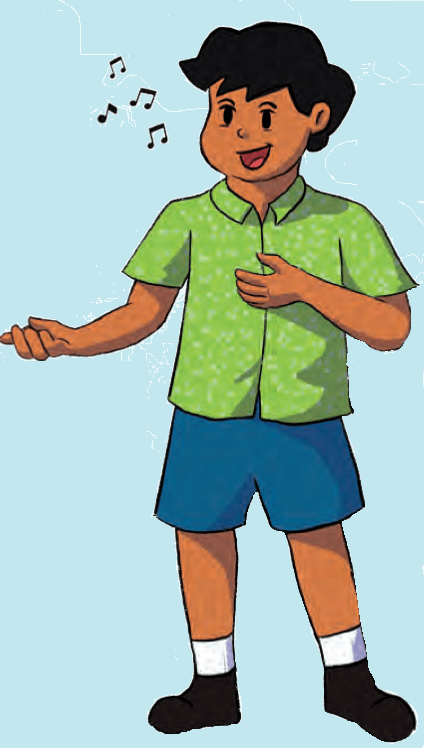
- Before we begin any singing activity, it is extremely important to warm up our voices so that we sing freely and easily.
- Here are some simple exercises to warm up your voice. Some of these sounds may be funny, but make sure to do them every day.
Activity 9.1
Vocal Warmups
1. HUM
Bring your lips together and make a ‘mmmmm’ sound on one note. Try to keep the note steady and long. You will feel a buzzing sensation on your lips.
Now make the same ‘mmmmm’ sound, but go from low to high pitch in one continuous breath, and then from high to low. Do this a few times. The humming exercise helps gently wake the vocal cords up to prepare them to sing.
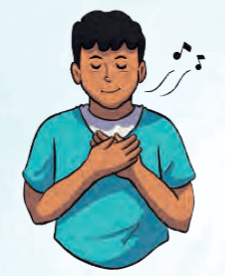
FUN ACTIVITY: Whistling
Can you whistle? Try pursing your lips and blowing air through to make a sound.
- Once you can make a whistling sound, make a long and smooth sound. This helps control the airflow, which is important for singing.
- You can also whistle from a low to high pitch, and high to low. Have fun with this activity.
2. LIP TRILLS
Purse your lips together and then blow air through them, making the sound of a motorbike. Keep the airflow and the sound as steady as possible. You can even go high and low like you did with the humming exercise. Have fun with this.
Lip trills are an important vocal exercise and a great way to develop a smooth sound.
3. Sargam Patterns
Now, you may recollect the simple Sarale Varisai or Suddha Swara Saptak you learnt last year. Here it is:
Sa Ri Ga Ma Pa Dha Ni Sa
Sa Ni Dha Pa Ma Ga Ri Sa
And it is written as:
S R G M P D N S
Sing this a few times.
If we sing each note twice, it becomes Janti Varisai, which we learnt last year.
SS RR GG MM PP DD NN SS
SS NN DD PP MM GG RR SS
You can search for more Janti Varisais online and learn to sing them.
You can even sing each note three times if you like. These exercises are also referred to as Sargam patterns.
Can you try filling the blanks following the pattern of the Swara progression?
Once you have filled in the blanks, sing the patterns.
1. SRG SRG, RGM RGM, GMP GMP, MPD MPD, PDN PDN, DNS, DNS SND SND. N_P NDP, DPM D_M, PMG P_G, M_R _GR, S GRS
2. SRGM RGMP GMPD
SNDP NDPM DPMG
Activity 9.2
Match the Pitch
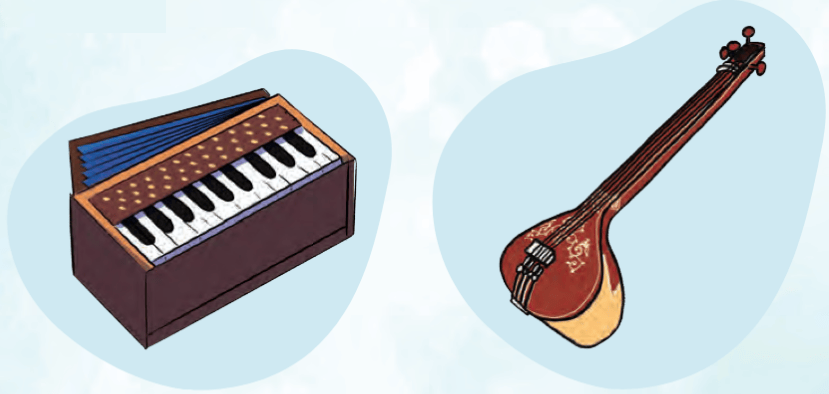
When we sing, it is helpful to match our pitch to an instrument, like the tambura, harmonium, or keyboard. If you don’t have an instrument, you can download a tambura or tanpura app on a phone or tablet.
When the tambura is playing, try to sing the same note and match it exactly. Sing an ‘aaaah’ or long note. Then sing:
Sa Ri Ga Ma Pa Dha Ni Sa
The set of notes from lower ‘Sa’ to higher ‘Sa’ is known as saptak, sthayi, or an octave.
Activity 9.3
Find Your Range
Using a tanpura, harmonium, keyboard, or similar instrument, try to see how many notes you can sing. Start with the lowest comfortable note and go to the highest comfortable note.
Write your lowest note here:
Write your highest note here:
The set of notes comfortable for you to sing is called your range.
Note for Teachers:
Help the children
identify their lowest
and highest notes
using either swara
or shruthi names,
or western notes.
Activity 9.4
Animal and Bird Sounds
Can you list out some animals and birds that make high-pitched sounds?
Can you list out some animals and birds that make low-pitched sounds?
DO YOU KNOW?
With vocal exercises like the ones listed above, you can increase your range over time. Artists like Pandit Jasraj, Dr. M. Balamuralikrishna and Parveen Sultana are known for their extensive vocal ranges.
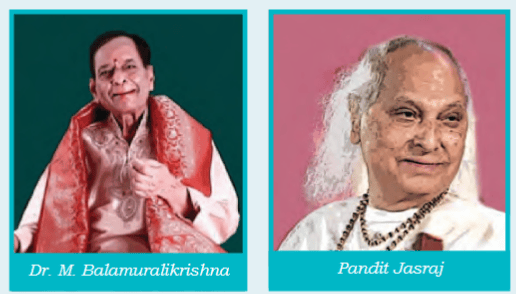
Dr. M. Balamuralikrishna
and Pandit Jasraj
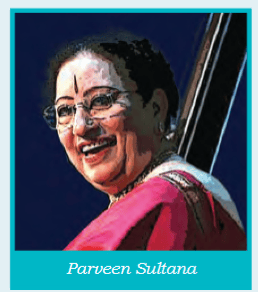
Parveen Sultana
Song: Aadona Banni Traditional Folk Song
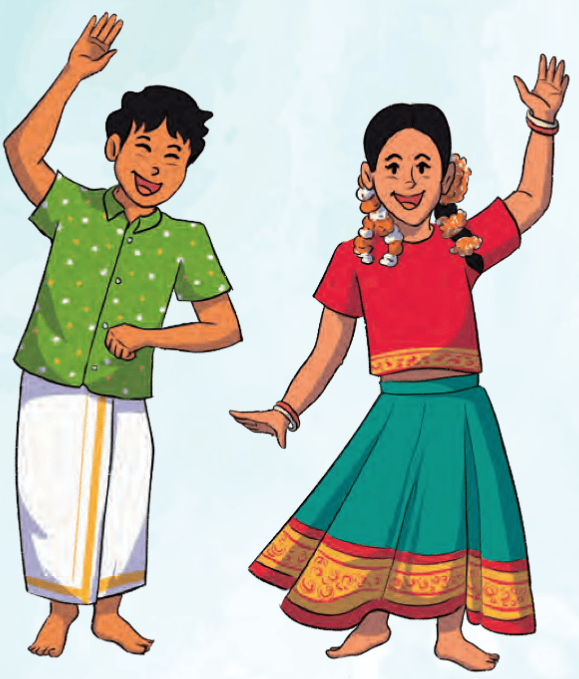
A lot of music is playful and joyful. Let us learn a song in Kannada, that invites the listener to come, dance, play, and have fun.
Song link: http://tinyurl.com/Aadona- Banni
Aadona Banni Kanna Mucchaale Thoogona Banni Uyyale Jeevanavondu Naataka Shaale Naavella Kuniyuva Narthana Shaale Uyyaale, Champaale Aadona Banni ...
Sutthalu Chellide Rangu Rangole Sutthalu Chellide Rangu Rangole Balukutha Baruvalu Vanamaale Bharadinda Bandu Paccheya Shaale Toogaadi Karedavu Tengina Saale Uyyaale, Champaale Aadona Banni ...
Hakkigalinchara Kareyole Hakkigalinchara Kareyole Kuniyutha Baruvalu Navvaale Impu Impina Gumpu Kogile Kampanu Haraduva Hoogala Maale Uyyaale, Champaale Aadona Banni ...
Uyyaale, Champaale Champaale, Uyyale
This song sounds wonderful when sung in a group.
| ASSESSMENT — Chapter 9: Sing and Play | |||
|---|---|---|---|
| Competencies | Learning Outcomes | Teacher | Self |
| C-1.1 | Is able to sing a song fluently in pitch and rhythm | ||
| C-1.2 | Can sing in a group with live music or karaoke | ||
| C-1.1 | Practises vocal warm-ups, sargam patterns, and breathing exercises | ||
| C-1.1 | Participates enthusiastically in class | ||
Teacher’s feedback on student’s strengths
Teacher’s feedback on areas of improvement
Any other observation