
Chapter 10
MAKING MUSIC

- Indian classical music is a very ancient tradition that started from the Vedas.
- Later, it developed into two main styles — Carnatic, or South Indian Classical Music, and Hindustani or North Indian Classical Music.
- Indian Classical Music is generally passed down through oral tradition where the student (shishya) would spend many years with their guru, developing a very special bond.
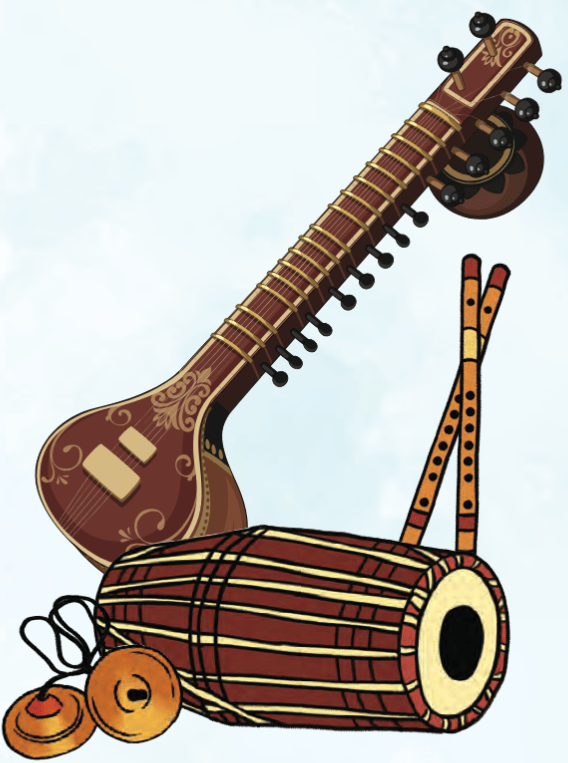
What is Raga?
Raga is a melodic form in Indian
Classical Music that is based on a set
of notes or swaras. The sequence of
swaras going up is called the Arohana
or Aroh (ascending scale), and the
sequence of swaras coming down
is called the Avarohana or Avroh
(descending scale).
What is Tala or Taal?
Tala or Taal is a rhythm cycle that
is used to measure time in Indian
Classical Music. In general, it provides
a steady pattern of rhythm throughout
the piece of music.
Both Carnatic and Hindustani music have their own ragas and taal/tala systems. When you learn an Indian Classical composition, it is very helpful to know the raga and tala. Before you start singing a composition, sing the Arohana/Aroh and Avarohana/Avroh of the raga, and keep count of the tala.
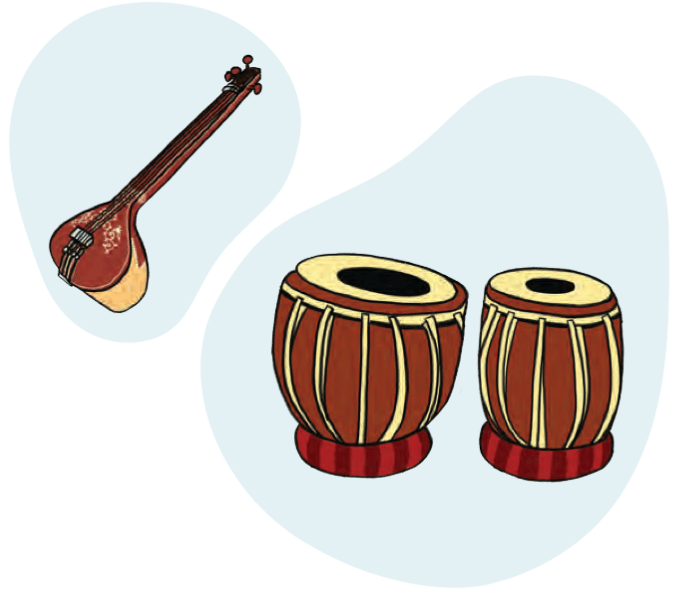
Carnatic Music
Song: Vande Meenakshi
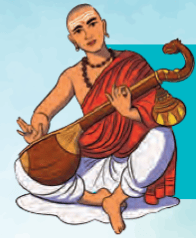
Composer: Muthuswami Dikshitar
Muthuswami Dikshitar (1775–1835) was a music composer from the Tanjavur region of Tamil Nadu and one among the Trinity of Carnatic Music. His compositions, of which around 500 are known today, are mainly in Sanskrit.
Raga: Shankarabharanam
Arohana: S R2 G3 M1 P D2 N3 S
Avarohana: S N3 D2 P M1 G3 R 2 S
Tala: Eka
DO YOU KNOW?
The popular Bengali rhyme Indi Bindi Shindi has a similar melody as Vande Meenakshi. Find this rhyme online and listen to the similarity.
S, G, S, G, S, G, M G R S ||
Van de Mee na kshi Tvaam Sa ra si ja||
N, R, N, R, N, R, G R S N ||
Vak tre par ne Dur ge Na ta su ra ||
S, G, S, G, S R G M P, , ,||
Bri nde Shak te Gu ru gu ha Paa ||
M G R S G R S N S,,, ,,,, ||
li ni Ja la ru ha Cha ra ne ||
S, N, D P, M, G, M, P, D N ||
Sun da ra Paan dyaa nan de Maa ye ||
S, N D P, M, P,,, ,,,, ||
Su ri ja na dhaa re ||
S, N D P, P M G, M M P, D,||
Sun da ra Ra ja Sa ho da ri Gau ri ||
M G R S G R S N S,,, ,,,,||
Shu bha ka ri Sa ta ta ma ham ||
Know your tala!
In this song, Eka tala has a cycle of four beats.
Song link: http://tinyurl.com/Vande-Meenakshi
Song: Sri Gana Natha
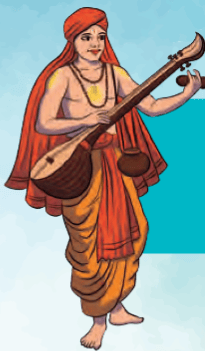
Composer: Purandara Dasa
Purandara Dasa (1470–1564) was a composer, singer and Haridasa philosopher from Karnataka. He is revered as the Father of Carnatic music.
Raga: Malahari
Arohana: S R1 M1 P D1 S
Avarohana: S D1 P M1 G3 R 1 S
Tala: Rupaka
Know your tala!
Rupaka tala in Carnatic music has a cycle of 6 beats.
M P | D S S R || R S | D P M P ||
Sri | Ga na na tha ||Sin dhu | ra varna||
R M | P D M P || D P | M G R S ||
Ka ru| na saa ga ra || Ka ri | va da na ||
S , | R M G R || S R | G R S , ||
Lam | bo da ra || La ku | mi ka ra ||
R M| P D M P || D P | M G R S ||
Am | baa Su ta || A ma | ra Vi nu ta||
S , | R M G R || S R | G R S , ||
Lam | bo da ra || La ku | mi ka ra ||
M P | D S S R || R S | D P M P ||
Si ddha| chaa ra na || Ga na | Se vi ta ||
R M | P D M P || D P | M G R S ||
Si ddhi| Vi na ya ka|| Te | Na mo Na mo||
S , | R M G R || S R | G R S , ||
Lam | bo da ra || La ku | mi ka ra ||
M P | D S S R || R S | D P M P ||
Sa ka |la Vi dya || A di | Pu ji ta ||
R M | P D M P || D P | M G R S ||
Sa r |vo tta ma || Te | Na mo Na mo||
S , | R M G R || S R | G R S , ||
Lam | bo da r a || La ku | mi ka ra ||
The Language of Rhythm
What is Konnakkol? You may remember from last year that we can use certain syllables to speak out rhythms. This language of percussion is called Konnakkol in Carnatic music. Similarly, the language of percussion in Hindustani music is referred to as Bols.
Here are three phrases of Konnakkol for you to try:
1. ta Ki Ta
2. ta Ka Dhi Mi
3. ta Ka Dhi Mi ta Ka Jhu Nu
When you repeat the phrases (like ta Ki Ta ta Ki Ta ta Ki Ta), you have a Konnakkol pattern. Which of the Konnakkol patterns match each of the songs above?
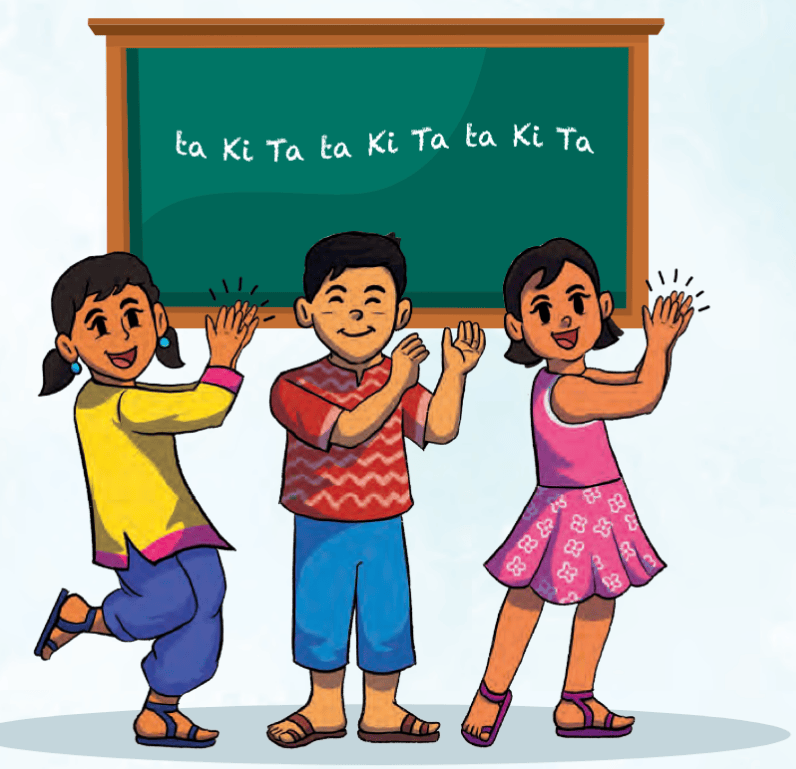
Can you try a performance in class with some students doing Konnakkol, some singing the song and some keeping tala? Don’t forget to use a tambura or an app.
Hindustani Music
Bandish
In Hindustani music, a composition set to a particular raga and a particular taal is called a Bandish.
Raga Bhupali
Let us learn a Bandish in Raga Bhupali which has five notes on the ascending scale (Aroh) and descending scale (Avroh).
First, sing the scale of Raga Bhupali.
Arohana: S R G P D S
Avroh: S D P G R S
Teen Taal
Matra: 16
Vibhag: 4
| Taal signs | Matra | Bols |
|---|---|---|
| X | 1 | dha |
| 2 | dhin | |
| 3 | dhin | |
| 4 | dha | |
| 2 | 5 | dha |
| 6 | dhin | |
| 7 | dhin | |
| 8 | dha | |
| 0 | 9 | dha |
| 10 | tin | |
| 11 | tin | |
| 12 | ta | |
| 3 | 13 | ta |
| 14 | dhin | |
| 15 | dhin | |
| 16 | dha |
The Bandish is set to Teen Taal, which is a 16-beat taal. Let us learn the Teen Taal.
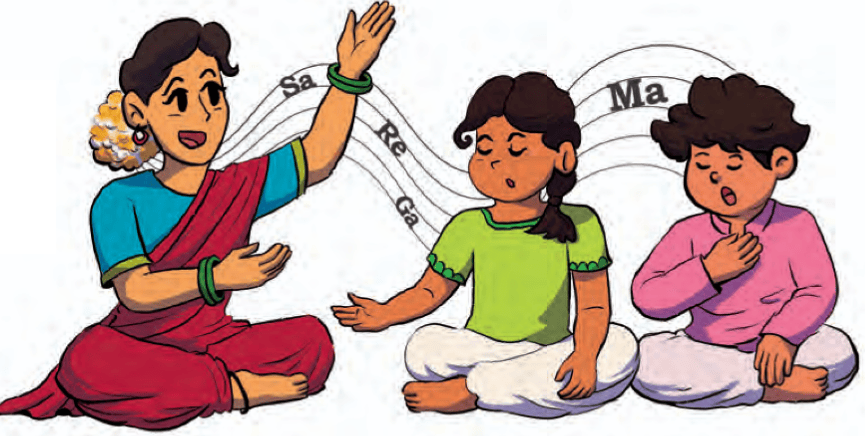
Tali: on 1, 5, 13 matra
Khali: on 9 matra
Teen Taal
Composer: Pt. Vishnu Narayan Bhatkhande
Naman kar chatur shri guru charana
Tan-man nirmal kar bhav-tarana
Jei jei dhyaavat shubh phal paavat
Janam-maran sab dukh nistarana
| Beat No. | 1 | 2 | 3 | 4 | 5 | 6 | 7 | 8 | 9 | 10 | 11 | 12 | 13 | 14 | 15 | 16 |
|---|---|---|---|---|---|---|---|---|---|---|---|---|---|---|---|---|
| Bol | dha | dhin | dhin | dha | dha | dhin | dhin | dha | dha | tin | tin | ta | ta | dhin | dhin | dha |
| Lyric | na | ma | na | ka | ra | cha | tu | ra | ||||||||
| Notation | S’ | S’ | D | P | G | R | S | R | ||||||||
| Lyric | shri | i | gu | ru | cha | ra | naa | ~ | ta | na | ma | na | ni | ra | ma | la |
| Notation | S | ‘D | S | R | G | R | G | ~| | G | G | P | D | S’ | D | S’ | S’ |
| Lyric | ka | ra | bha | va | ta | ra | naa | ~ | ||||||||
| Notation | S’ | P | D | P | G | R | S | ~| | ||||||||
| Lyric | je | i | je | i | dhya | ~ | va | ta, | ||||||||
| Notation | G | G | G | G | P | ~ | S’ | D, | ||||||||
| Lyric | shu | bha | pha | la | paa-a | aa | va | ta| | ja | na | ma | ma | ra | na | sa | ba |
| Notation | S’ | S’ | S’ | S’ | S’S’ | R’ | S’ | S’| | S’ | R’ | G’ | R’ | S’ | R’ | S’ | PD |
| Lyric | du | kha | ni | sa | ta | ra | naa | ~ | ||||||||
| Notation | S’ | P | D | P | G | R | S | ~| |
| ASSESSMENT — Chapter 10 : Making Music | |||
|---|---|---|---|
| Competencies | Learning Outcomes | Teacher | Self |
| C-2.2 | Understands musical elements, like raga, taal/tala | ||
| C-1.1 | Learns and recites simple Konnakkol patterns | ||
| C-2.2 | Is able to sing the arohana and avarohana (ascending and descending scale) of a raga | ||
| C-1.1 | Is able to keep tala/tap a rhythm when listening to a song | ||
| C-3.1 | Is eager to learn new songs and forms of music | ||
Teacher’s feedback on student’s strengths
Teacher’s feedback on areas of improvement
Any other observation