
Chapter 12
THINK, FEEL, CREATE
 Crash! Boom!
Dishoom! Hisss!
Can you imagine a scary movie or a superhero movie scene without sound effects? It would not feel the same, right.
Music and sound effects can
significantly add to the emotion
and drama of a
story.
 They can set
the mood of a scene
and add intensity
to the dialogues
and action. They
can build tension and make you
feel like you are on the edge of
your seat. They can also make
you feel relaxed and happy. That is the emotive power of
music.
They can set
the mood of a scene
and add intensity
to the dialogues
and action. They
can build tension and make you
feel like you are on the edge of
your seat. They can also make
you feel relaxed and happy. That is the emotive power of
music.
Go online and find a scene from one of your favourite movies. Press the mute button and watch the scene without sound. Now watch the same scene with sound. How did it feel in each of the cases? Share your thoughts and feelings with the class.

Activity 12.1
Aural Forest
Did you enjoy reading the Panchatantra story at the beginning of this book? It has many interesting characters. It is not only entertaining, but also has a beautiful message.
Now, can you think about conveying the essence of the story through music and sound?
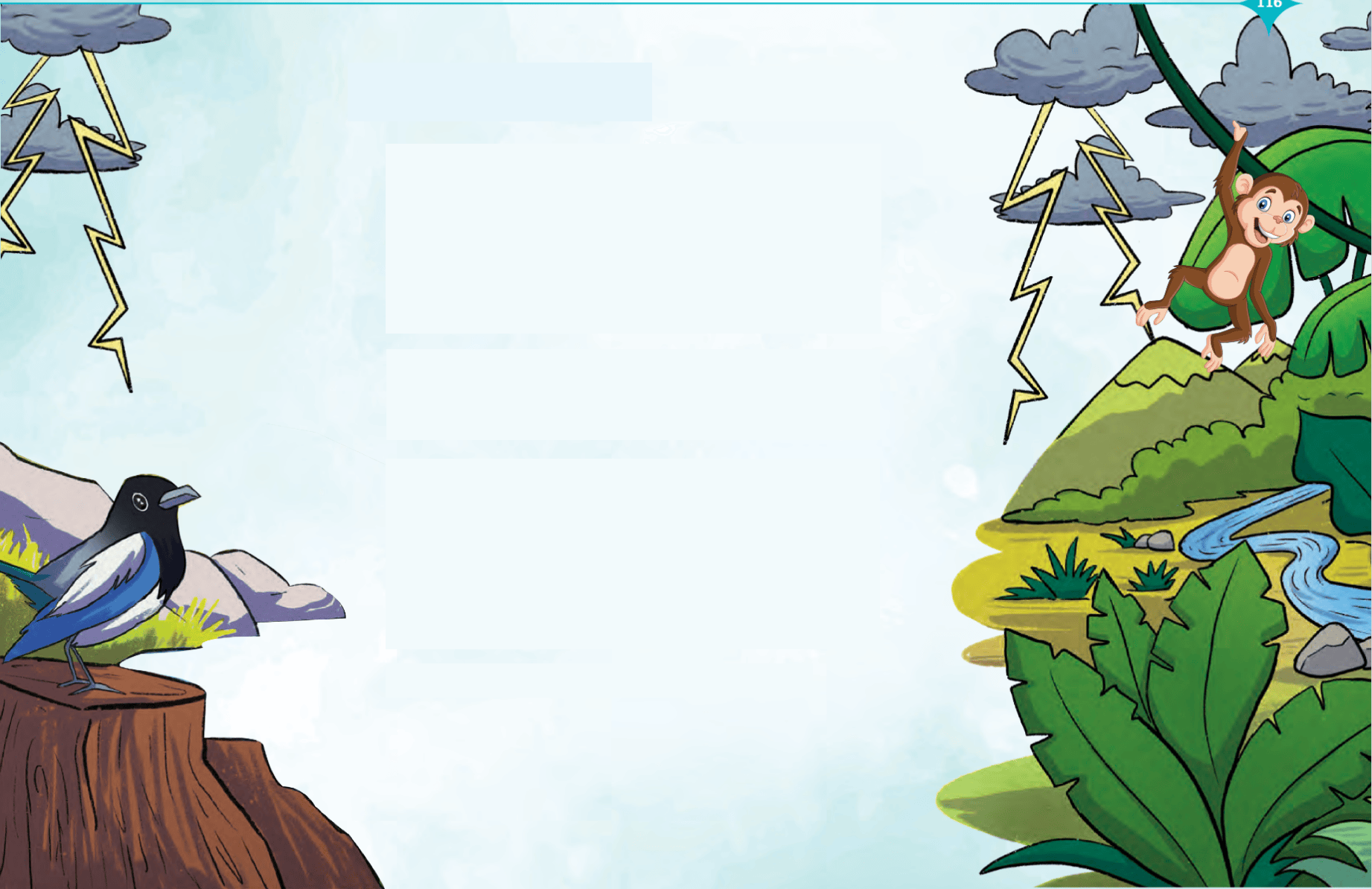
The story is set in a forest. Can we create the sounds of a forest using our bodies and objects around us? Which animals and birds make sounds in a high pitch? Which ones make sounds in a low pitch?
Now, let us read another story.
Activity 12.2
The Four Friends
 Once upon a time, four
friends lived in a jungle —
a deer, a crow, a turtle, and
a rat. They were very good
friends and spent most of
their time together. One
day, they saw a hunter
coming towards them. All
of them were terrified and
ran for their lives. The crow
flew to the highest branch
of the nearby tree, the rat
hid in a nearby hole, while the deer ran
fast and hid in the bushes. The turtle,
however, could neither hide nor run and
was eventually caught by the hunter.
The hunter put him in his sack and
went away.
Once upon a time, four
friends lived in a jungle —
a deer, a crow, a turtle, and
a rat. They were very good
friends and spent most of
their time together. One
day, they saw a hunter
coming towards them. All
of them were terrified and
ran for their lives. The crow
flew to the highest branch
of the nearby tree, the rat
hid in a nearby hole, while the deer ran
fast and hid in the bushes. The turtle,
however, could neither hide nor run and
was eventually caught by the hunter.
The hunter put him in his sack and
went away.
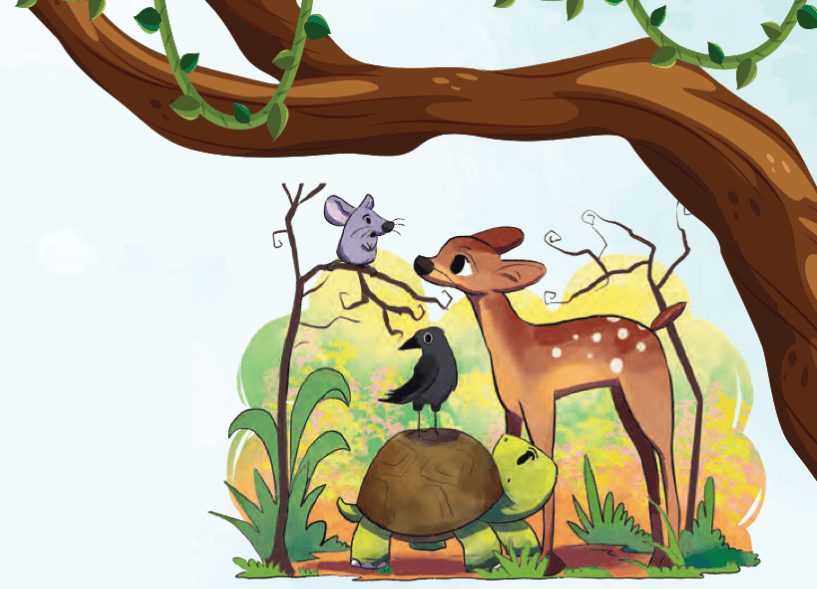
The three friends then thought of a plan to save the turtle. The crow flew high to locate the hunter, and the deer followed him. As soon as they found the hunter, the deer overtook him from a different route and lay still at some distance, pretending to be dead. The hunter saw the deer and dropped his sack to run towards it. Meanwhile, the rat came to the spot and bit the sack with his teeth to free the turtle.
On the other hand, the deer ran away in the dense forest as soon as the hunter came closer. The hunter was taken aback by what happened and returned to the place where he had dropped his sack. To his surprise, the sack was empty, and the turtle was missing. He returned home empty-handed, and the four friends celebrated their escape.
First, read the story aloud in a monotone voice — with all words and sentences in the same pitch and volume, and without emotion. How does it sound?

Now, read the story again, but add variations to the way you read it. Read some parts in a soft tone; you can even whisper some words, and some parts can be loud. Some parts of the story can be in a low voice, and some with a high pitch. You can even speed up or slow down some sentences, and add some pauses.
Now, how did that sound? Which version of your reading made the story more interesting for the listener?
Remember to use voice modulations appropriately when you are speaking or singing. It can make your audience pay more attention to you.
Note for Teachers:
Encourage and help the students to enact
the story with appropriate music and/or
sound effects.
Active Listening
Musicians need to have a keen sense of listening to understand what they hear. They need to ensure that they are singing or playing in tune and rhythm, and are reacting to the other musicians in the group. After all, just like many sports, music requires teamwork and collaboration to be a success.

All of us listen to music in some form. It may be playing in the background, or you may hear it while watching TV or a movie.
Discuss the various times and places you come across music. What purpose does music serve in these situations?
Activity 12.3
Listening to a Performance
Note for Teachers:
Children learn a lot
through active listening.
Try and arrange for a
local musician to visit the
classroom, or if possible,
take the children on a field
trip to watch a live music
performance. If this is
not feasible, play a video
of a music concert of any
style in the classroom.
Encourage the students
to actively participate
by keeping count of the
rhythm/tala, applauding
appropriately and staying
focused on the music.
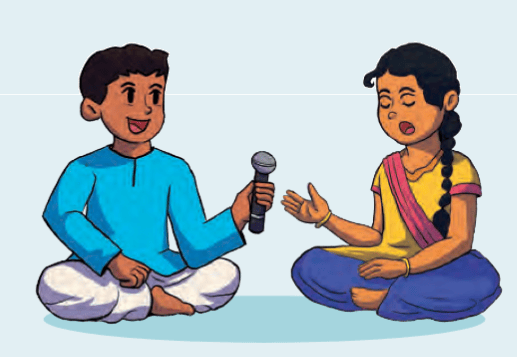
Have you ever attended a live music performance? Find a music concert to attend and complete the following activities.
Draw a picture of the concert that depicts the performers, their instruments, and the stage set-up.
Complete the following questionnaire:
What style of music was being presented?
How many musicians were on stage?
Which instruments were used?
How many people were present in the audience?
What was the occasion for which the performance was organised?
In which language were the songs presented?
Describe what you liked about the concert.
Explain how the audience reacted to the concert.
Understanding Music
When songs have words and lyrics, we can easily understand what they are trying to convey. But when the song is played only with instruments, it can be trickier to understand what it is about.
Activity 12.4
Interpreting Music
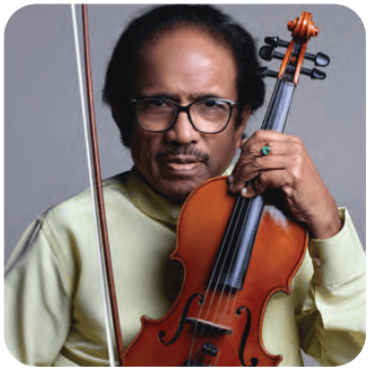
Composer: Dr. L. Subramaniam
Listen to a piece of instrumental music, or the one given in the QR code.
- Close your eyes and try to imagine a picture or a scene that is represented by the music.
- Can you describe the feeling or the mood of the music? Now, listen to the music again, and imagine a story that matches the music. Write it down and share it with your class. Ask your friends to also share their stories. Did all of you have the same story?
- What title would you give the music?
LEARNING
Music can sometimes be abstract — which means it can be understood differently by different people.
Activity 12.5
Recording Yourself and Listening Back
In many different languages there are songs that are inspired by nature. These serve as a reminder about the importance of our natural environment.
Here is a Kumauni Lok Geet about a rare flower that blooms in the high mountains. It describes the beauty of nature and the joy it brings along.
Note for Teachers:
Give the students a week’s time to prepare a
song of their choice based on nature and the
environment. On a chosen day, bring a mobile
phone or a recording device to class for the
children to sing and record themselves.
Song link: https:tinyurl.com/Kumauni
Kumauni Geet Traditional Folk Song
Buru si fuli re
Buru si fuli re
Aha Buru si, Aha Buru si, fuli re
Uncha Pahada Ma
Aaha Kat Swan, Aaha Kat Swan Lagi re
Uncha Himala Ma
Aha Buru si, Aha buru si Fuli re
Uncha Pahada Ma
Aaha Kat Swan, Aaha Kat Swan Lagi re
Uncha Himala Ma
Guru Si Ko Fula Sua ke Dana Fulela
Guru Si Ko Fula Sua Unch Nich Dana
Aha ke Dana, Aha ke Dana Fuli Re
Buru si ko Fula
Aha Buru si, Aha Buru si Fuli re
Uncha Pahada Ma
Aaha Kat Swan, Aaha Kat Swan Lagi re
Uncha Himala Ma
Aha Buru si, Aha buru si Fuli re
Uncha Pahada Ma
Aaha Kat Swan, Aaha Kat Swan Lagi re
Uncha Himala Ma
Practise it many times, both in school and at home.

Activity 12.6
A Song of Nature
Here is a traditional folk song of Mizoram about nature.
Turnipui kan dodai (Beating the scorching sun) Traditional Folk Song
Kan lenna tlang dum dur, Lenrual kim kan lenna;
Kan thlawh sawmfang hring nghial karah, Kawltu kan chawi nilen;
Mahse kan zam bil lo, Turnipui hrang hnuaia’n;
Lawm lungrual hlim thawm nui ri nen, Turnipui kan do dai.
Thangvan dumpawl riai e, Sawmfang hring no nghial e, Rambuk, Thlam sawngka dawh sanga’n;
Ka thlir ning thei dawn lo. Ka vau zotui thiangte’n, Hahchhawl dawi ang min dawm, Mimsirikut leh Thuva te’n;
Hlim zaiin min lo awi.
Meaning: Even under the heat
of the scorching sun, we are not
daunted. With a hoe in our hands,
we carry out our work in our
dark green paddy field, joyously,
making merry and laughing,
under the blazing sun until it
sets. From the comfort of the farm
hut I never get tired of enjoying
the lovely sight of our rice fields
blessed with green growth under
the dark blue sky.
Pure water runs down along the
nearby stream to quench our
thirst with the melodious voices
of the birds entertaining us.

Now, we are ready to record the song. You can choose to sing it by yourself, or in a group. Once you have recorded the song, play it and listen to it.
- How does it sound?
- Were you able to sing the song from memory and without stopping in between?
- Did you like your performance?
- How can you make it sound even better the next time?
You can also give feedback to your friends on how they sang. Remember to praise them for their good performance, and gently suggest what they can do better.
| ASSESSMENT — Chapter 12: Look Around | |||
|---|---|---|---|
| Competencies | Learning Outcomes | Teacher | Self |
| C-4.1 | Is able to convey the essence of a story through music and sound | ||
| C-2.2 | Is able to modulate voice while reading a story | ||
| C-2.1 | Actively listens to music with focus and concentration | ||
| C-2.2 | Is able to describe a piece of music in words | ||
Teacher’s feedback on student’s strengths
Teacher’s feedback on areas of improvement
Any other observation