DANCE
Guide for Teachers
1. Please provide a spacious and well-ventilated area for the children.
2. The pedagogy focuses on:
- Learning dance units according to regional practices.
- Learning about dances of various regions of the country.
- Learning to express emotions and becoming comfortable in expressing emotions.
- Understanding the use of different body parts for movement and expressing emotions.
- Understanding the importance of collaboration in movement practice.
- Creativity in putting together various elements of dance.
3. Please address the below given Curricular Goals, Competencies and Learning Outcomes for your assessments.
4. Focus on the effort put in by the children, their attitude towards learning new things, showing empathy with emotions and expressions, and willingness to share and collaborate.
Curriculum Goals and Competencies are listed below which are covered through the textbook. The Learning Outcomes for each chapter are listed in tables with assessment guidelines.
CG-1: Develops confidence to explore, depict and celebrate human experience through the arts.
C-1.1: Expresses enthusiasm to create and perform a variety of dance and movement that is familiar to them.
C-1.2: Shares ideas and responses while working collaboratively in dance and movement.
CG-2: Exercises their imagination and creativity freely in the arts.
C-2.1: Creates and practices dance, and movement sequences based on everyday actions and personal experiences.
C-2.2: Compares and contrasts movements, rhythms, postures, themes, and expressions in a variety of dance and movement styles introduced in the classroom.
CG-3: Explores basic processes, materials, and techniques in the arts.
C-3.1: Makes choices while working with movement steps, instruments, costumes, and arrangements used in dance and movement.
C-3.2: Selects a variety of dance and movement sequences during collaborative practice and participates.
CG-4: Explores beauty in their surroundings, and develops an interest in a variety of local art forms and cultural practices.
C-4.1: Recognises elements of dance and movement in nature and describes their artistic qualities.
C-4.2: Demonstrates curiosity towards local art forms and culture.
Activities that are marked by a star symbol can be facilitated by any teacher, even in schools with limited resourses.

Chapter 14
MY BODY IN DANCE
Welcome again to the world of dance!
Hope you enjoyed dancing with your friends and teachers last year and learnt about dance with body movements, hand gestures, and folk and traditional forms.
This year, you will begin with a Panchatantra story connected to all art forms. You will also dance about it. You will move like animals and fly like birds. But first, let us start dancing!
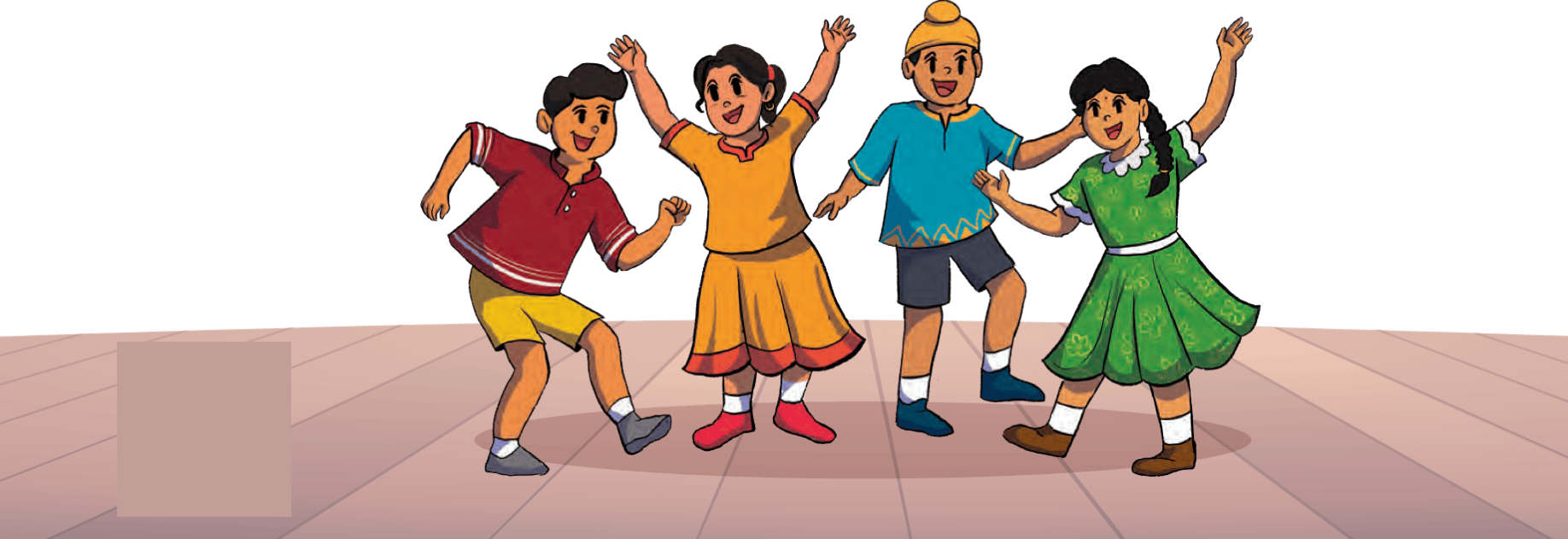
Activity 14.1
Dance to a Festival Song
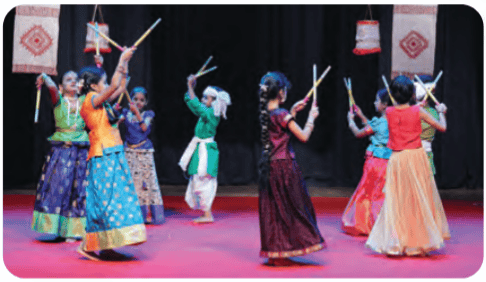
People in our country celebrate different festivals. What is your favourite festival? How do you celebrate it? Do you sing and dance for it?
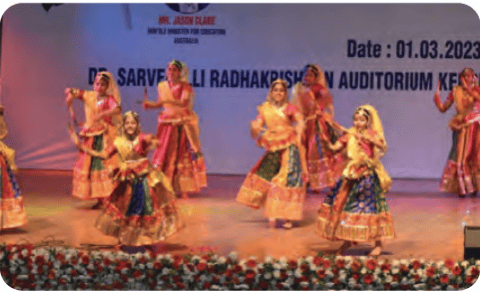
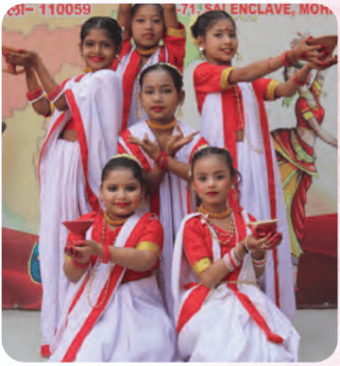
Do you know that Navratri is a festival celebrated across India? But each state has its own traditions. The most interesting part is that many states have dancing as an important part of their Navratri celebrations. Below are some examples of the varieties of dances seen in various parts of the country. Do you have a special dance for a festival?
Dance together to the rhythm of your favourite festival song.
Note for Teachers:
Pick a popular festival song
of your region and let the
students explore dancing and
creating movement.
Activity 14.2
Movements in Everyday Life
Now, focus on everyday activities and turn them into movements.
For examples
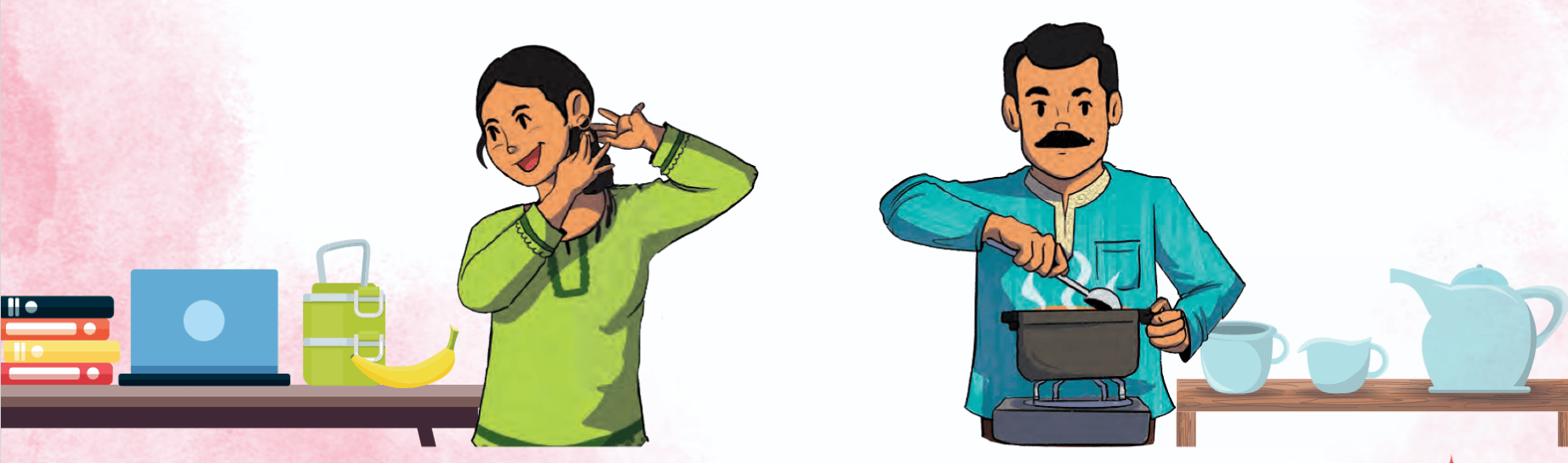
How does Srinivas’s mother get ready to go to the office? She wears her earrings and packs her lunch box.
How does Sonal’s uncle cook dinner?
Can you notice and understand how the different parts of your body move when you do such activities? Choose any situation or select one from the given examples and enact it using arm movements, hand gestures, and other body movements. Try to count the beats as you do these movements. You are now dancing to your music.
Rhythm and Beats
Do you remember the 2 or 4 beat steps done in Grade 3?
The syllables are taka dhimi taka jhunu / na dhin dhin na/ta thai thai tat. You can also use syllables, like ta ta ta ta / ta din ta din / dhi mi dhi mi.
Use the syllables or rhythm counts (1 - 2 - 3 - 4) to ensure accurate movements.
Can you now explore three beats? ta ki ta/dha dhi na?
Try to clap, stomp your feet or snap your fingers while you recite the syllables and move around.
Think of different situations with beats, movements, and hand gestures and have fun with beats.
Dance While Planting a Tree
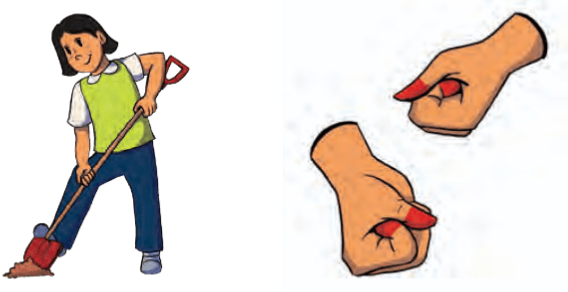
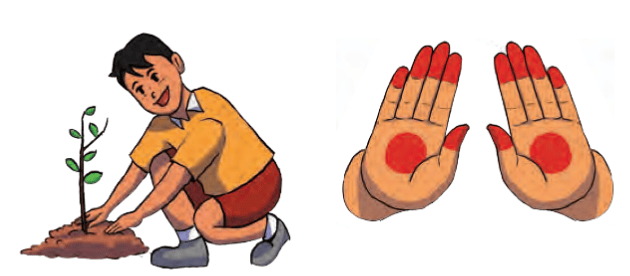
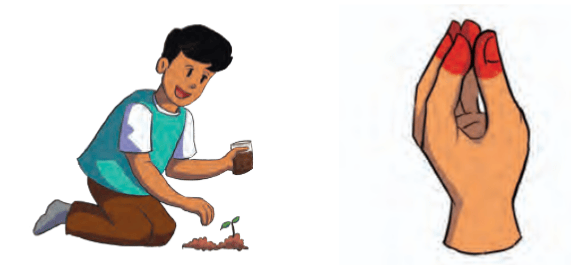
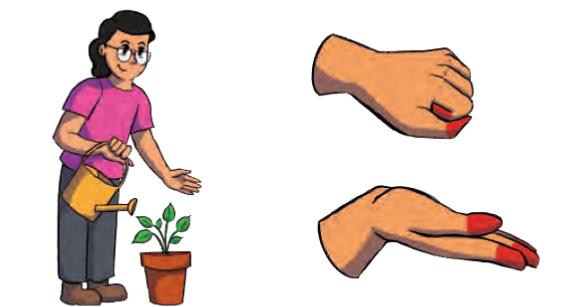
Now, explore more such movements outdoors. For example, how would you plant a sapling in the soil? Follow the pictures below, and add beats and rhythm to your own movements.
This can be an activity related to Chapter 4 of The World Around Us (TWAU) textbook.
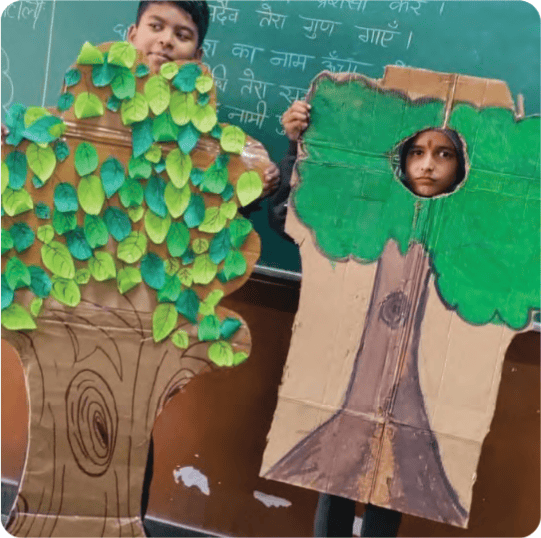
| 1. ta ta ta ta (4 beats): Dance like you are digging the soil. | 3. ta ta ta ta (4 beats): Cover the soil. |
|---|---|
 |
 |
| 2. dhi dhi dhi dhi (4 beats): Pretend to plant a seed/flower sapling. | 4. dhi dhi dhi dhi (4 beats): Water with a watering can. |
 |
 |
Activity 14.3
Head, Neck, and Eye Movements
Do you remember the small parts of the body you learnt in Grade 3? Now you will focus your movements on your head and neck in this activity.
Express Yourself with Head, Neck, and Eyes
Can you communicate with your head and neck only? Do you move your head ‘side to side’ to say no, nod ‘up and down’ to say yes, look ‘up’ in wonder at the blue sky, look ‘down’ in sadness at the plastic floating in the lake, ‘sway’ your head in anger and disgust at the garbage thrown on streets? Do animals also use their head and neck to communicate their feelings? Explore head and neck movements imaginatively and learn more wonderful uses of the body.
Stretch your head and neck to see the numerous ways in which the head and neck can move.
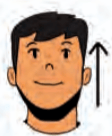 How do you
look up to
the stars in
wonder?
How do you
look up to
the stars in
wonder?
|
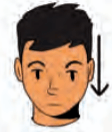 Do you put
your head
down when
you are sad?
Do you put
your head
down when
you are sad?
|
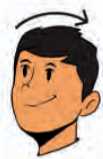 Can you follow
the path of the
rainbow that
makes you
happy?
Can you follow
the path of the
rainbow that
makes you
happy?
|
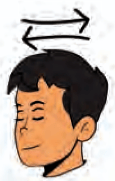 Do you ever
say no to
ice-cream?
Do you ever
say no to
ice-cream?
|
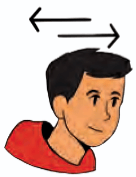 How does a
bird move its
neck?
How does a
bird move its
neck?
|
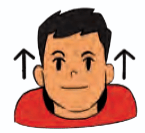 Crouch
your neck
like a lion.
Crouch
your neck
like a lion.
|
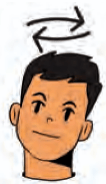 Sway your head
like a cow.
Sway your head
like a cow.
|
|
Now, let us try to match your movements and emotions with all you have learnt earlier.
Worksheet:
Match the following head and neck movements with suitable emotions.
| Head and Neck Movements | Emotions |
|---|---|
1. A lion looking at his
reflection.  |
a. Wonder 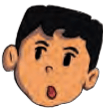 |
2. Looking up at the stars
in the clear sky.  |
b. Bravery 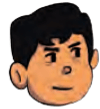 |
3. Animals not wanting to
go to the lion. 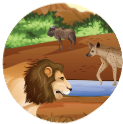 |
c. Anger 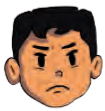 |
4. Looking at the plastic
bottles in the lake.  |
d. Fear 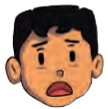 |
5. The hare going to the lion. 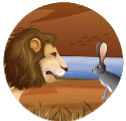 |
e. Happiness 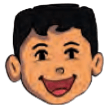 |
6. The animals rejoicing after
the lion jumps into the well.  |
f. Sadness 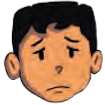 |
Activity 14.4
Animal Movements
You might have observed that different animals have distinct movement styles (such as walking, climbing, sleeping, facial movements, etc.). Similarly, the animal characters described in Panchatantra stories have unique movements. In our country, there are many dances based on animal movements; they are called animal dances for example, ‘tiger’ dance and ‘peacock’ dance.
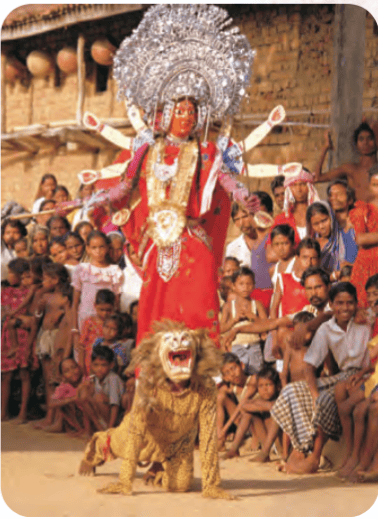
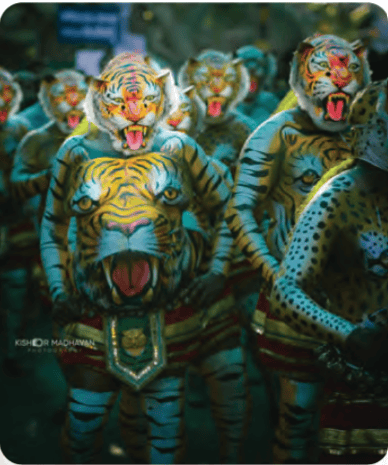
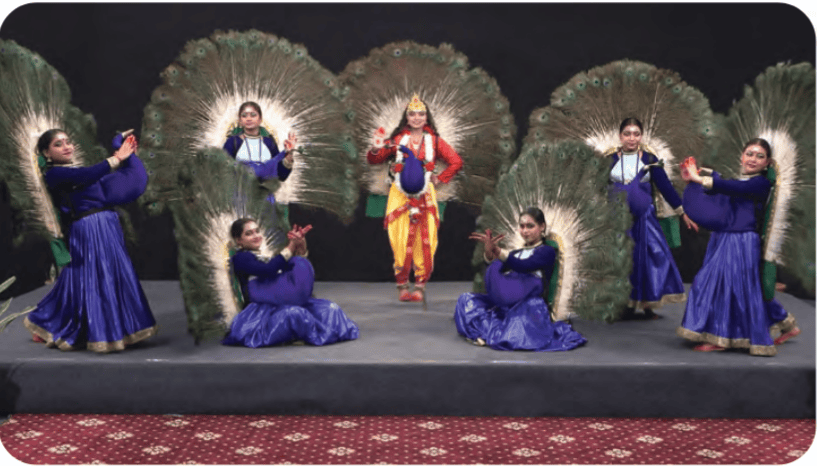
Hastas for Animals
Before starting with animal movements, do you know there are many hand gestures that represent different animals? Below are some examples of hand gestures.
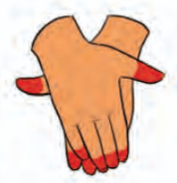
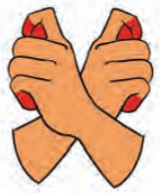
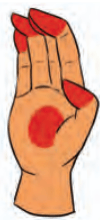
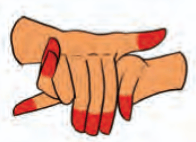
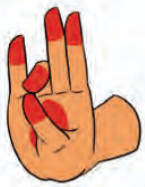
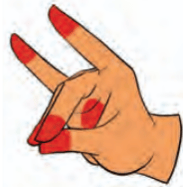
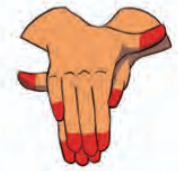
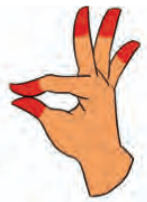
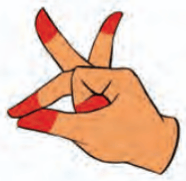
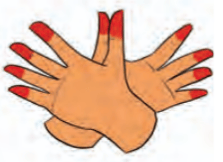
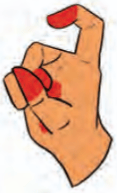
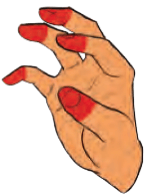
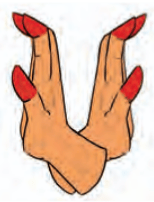
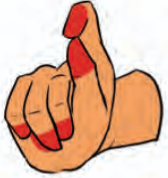
Try creating imaginative hand gestures to represent different animals. Examples of animal movements with hand gestures are listed in the table below.
Peacock Dance
Mayura Hasta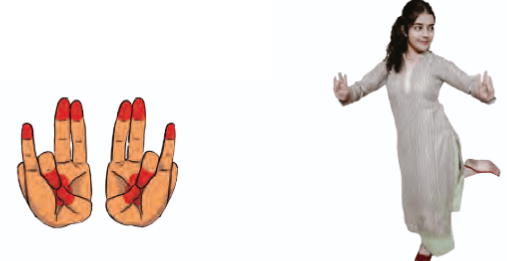
Tiger Dance
Vyaghra Hasta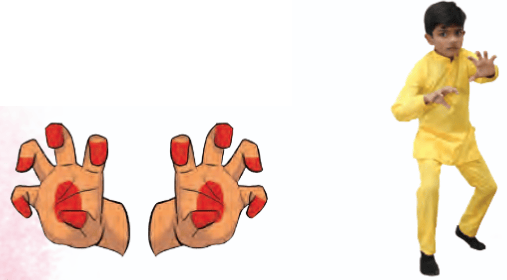
Deer Movements
Simhamukha Hasta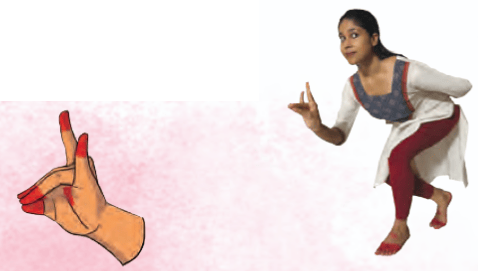
Now, it is your turn to move like your favourite animals.
Enact the movements and gestures of animals from the Panchatantra story, The Lion and the Hare. Observe how different animals behave. Imitate the same using hand gestures and head and neck movements synchronised to a 4-beat rhythm. Create a dance based on an animal story of your own. Use distinct hand gestures for each animal.
Note for Teachers:
Suggest different animal
movements to the children.
If possible, provide four
beats or music in four beats.
| ASSESSMENT — Chapter 13: Sounds and Instruments | ||
|---|---|---|
| Competencies: CG 1 – C-1.1; CG 2 – C-2.1, C-2.2 | ||
| Learning Outcomes | Teacher | Self |
| Dances thoughtfully with eagerness using rhythm | ||
| Imaginatively uses hastas for actions | ||
| Understands the use of head and neck | ||
| Is comfortable to express emotions | ||
Teacher’s feedback on student’s strengths
Teacher’s feedback on areas of improvement
Any other observation