
Unit 1
Our Community
About the Unit
We all depend on each other in some way or another. We live in our communities, sharing space and resources. Regular interactions and celebrations enrich our bonds, creating a sense of belongingness. Communities thrive on cooperation, communication, and mutual respect in their social and natural surroundings.
Students explore community institutes around them including schools, hospitals, banks and markets. They understand the role of people, tools used, and their contribution to the development of a more inclusive and sustainable society.
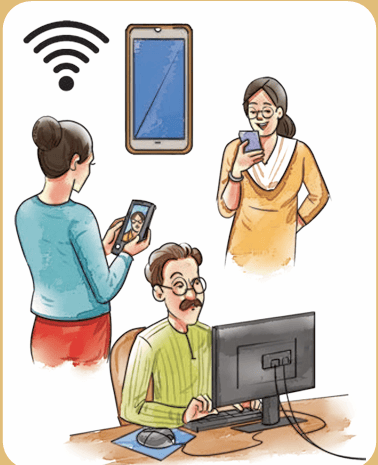
They get familiarised with how transportation helps in the movement of people and various goods. Similarly, they also learn how the communication has improved steadily. With time, both transportation and communication have improved connectivity.
They develop a sense of direction and ability to locate various places through landmarks by drawing, sketching, identifying and reading maps.
Note to the Teacher
This unit consists of Chapter 1— Living Together and Chapter 2— Exploring Our Neighbourhood. The key concepts covered in these chapters are listed below.
Chapter 1
• ‘Living Together’ helps students understand the community as a space of togetherness and interdependence. The story of Van Mahotsav helps students value their natural surroundings and public properties through mutual cooperation, and care.
• They also discover a culture of sharing and collaboration in all festivals celebrated by the different communities in the country. Students will learn to lead and work together, making a difference to their own life and the community.
Chapter 2
• Students look at various types of transports around them. They also learn about various modes of communication. They realise how transportation and communication have evolved over the years. Faster travels and communications have made significant changes to our lives, and activities in the world.
• Students will get to know the role of various community institutes. They also learn the basics of financial literacy by interacting with people in banks. They will learn to draw and read simple maps through a series of activities. They will also learn to identify landmarks and directions to navigate their surroundings.
Teacher to Facilitate
- The teacher would arrange relevant, low-cost materials like maps, charts, photographs, observation sheets and other materials for activities.
- Organise short field visits to places like post offices, banks, and parks.
- Invite local skilled personnel such as gardeners, postal workers, or bankers for interaction.
- Guide students in mapping routes, making posters, conducting interviews, and participating in community tasks like cleanliness drives and tree plantations. Help students to compare modes of communication in past, and present and find out how the changes have enhanced the speed and ease of doing various activities.
chapter-1
Living Together
A Tour Around My Village
My name is Chandan. I live in a beautiful village. There is a big playground near my house. After school, I go there with my friends to play kabaddi and other games. There is a big banyan tree at the corner of the playground, under which our elders gather to talk with each other. Come, let me show you around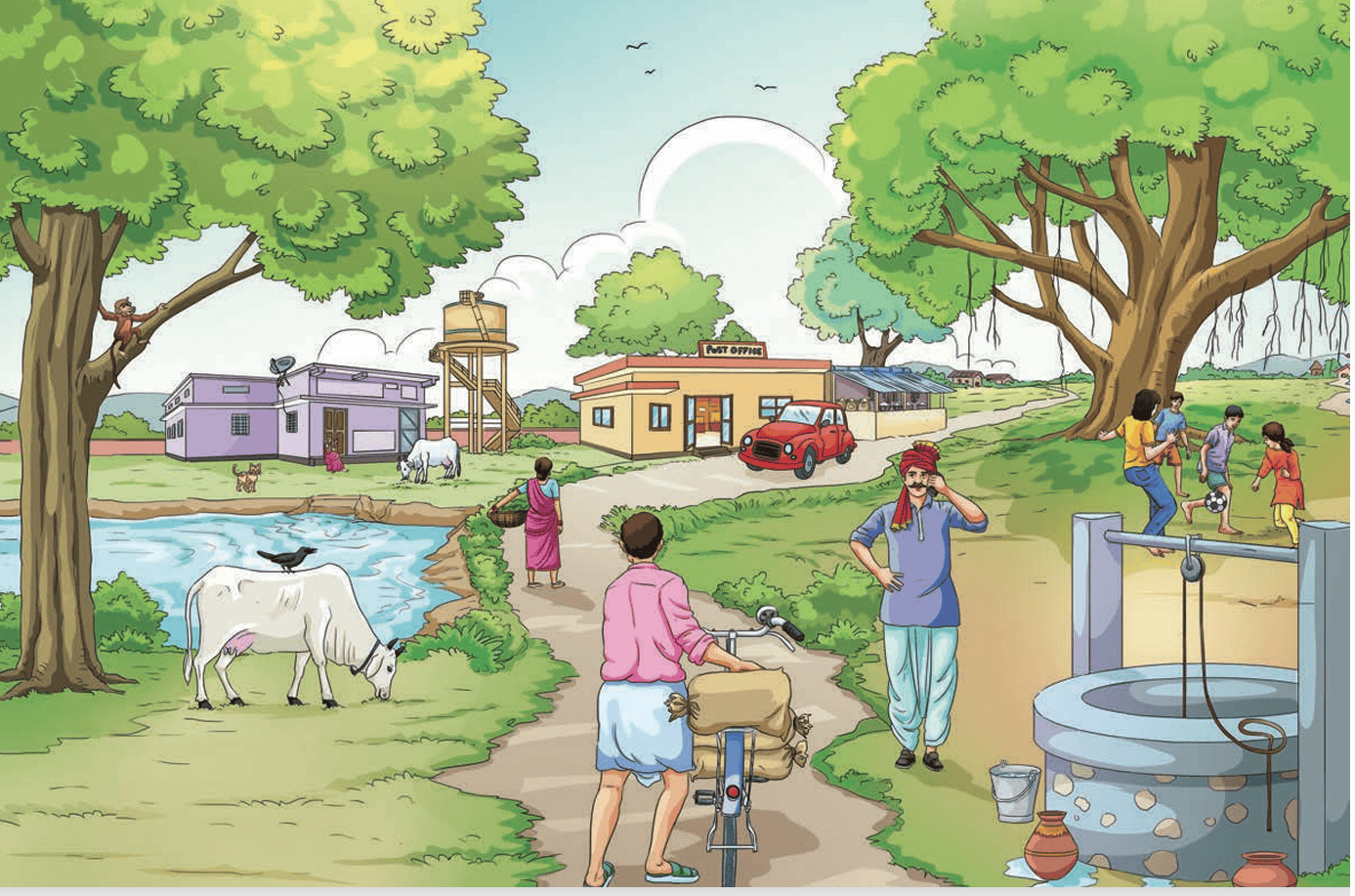

Look at the picture of Chandan’s village.
What do you see in the picture? Describe below.
——————
————————
——————

Explore your locality; observe the people and places around you. Write your observations about how the people and places you see are connected to each other in the table given below.
| place/people | Connections between people and places |
| Shopkeeper |
|
| Road |
|
| Health Centre |
|
| Police |
|
| School |

1. Why do you think it is important to have places like parks, schools, hospitals and bus stops in your locality?
2. How would life be different if one or more of these places in your locality did not exist?
3. What can you do to keep these places clean and safe?
People and places are part of our community. There are schools, markets, playgrounds and roads that everyone uses. Public places are used for various purposes like playing, relaxing and meeting others. People also come together to clean and decorate them on various occasions. These shared experiences bring us closer and create beautiful memories.
Van Mahotsav: A Festival for Planting Trees
Van Mahotsav was to be held soon and everyone was getting ready for the celebrations. Chandan and his school friends were very excited.
John : On this Van Mahotsav, we will clean the park near our school and plant trees around the park.Mallika : My grandmother comes here with her friends every day for a morning walk. If we clean up the park and plant trees, they will enjoy their walks much more and will have better air to breathe.
Chandan : Yes, let us invite our family members too for this celebration.
Do you know?
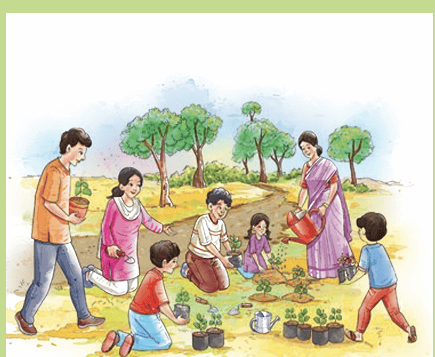
Van Mahotsav, also known as the Tree Planting Festival, is celebrated every year in India during the rainy season, from 1 July to 7 July. People plant trees to protect the environment and make the earth greener.

Let us create a colourful poster to help Chandan and his friends invite people from their neighbourhood to participate in the Van Mahotsav.
Helping Hands in the Community
Children were happy as their parents and other villagers joined in. Everyone wanted to make the celebration special. They gathered under the big banyan tree near the playground to plan out the festival. The parents decided to help too.
Sheela : The park where we plan to hold the Van Mahotsav needs repairs.
Sameer : Yes, the park has been part of our lives for years. I have some wood and nails at home. I can fix the benches in the park.
Babita : I will repair the street light next to the park.
Note to the Teacher
The teacher could provide necessary material for poster making, such as chart paper, sheets and colours, etc.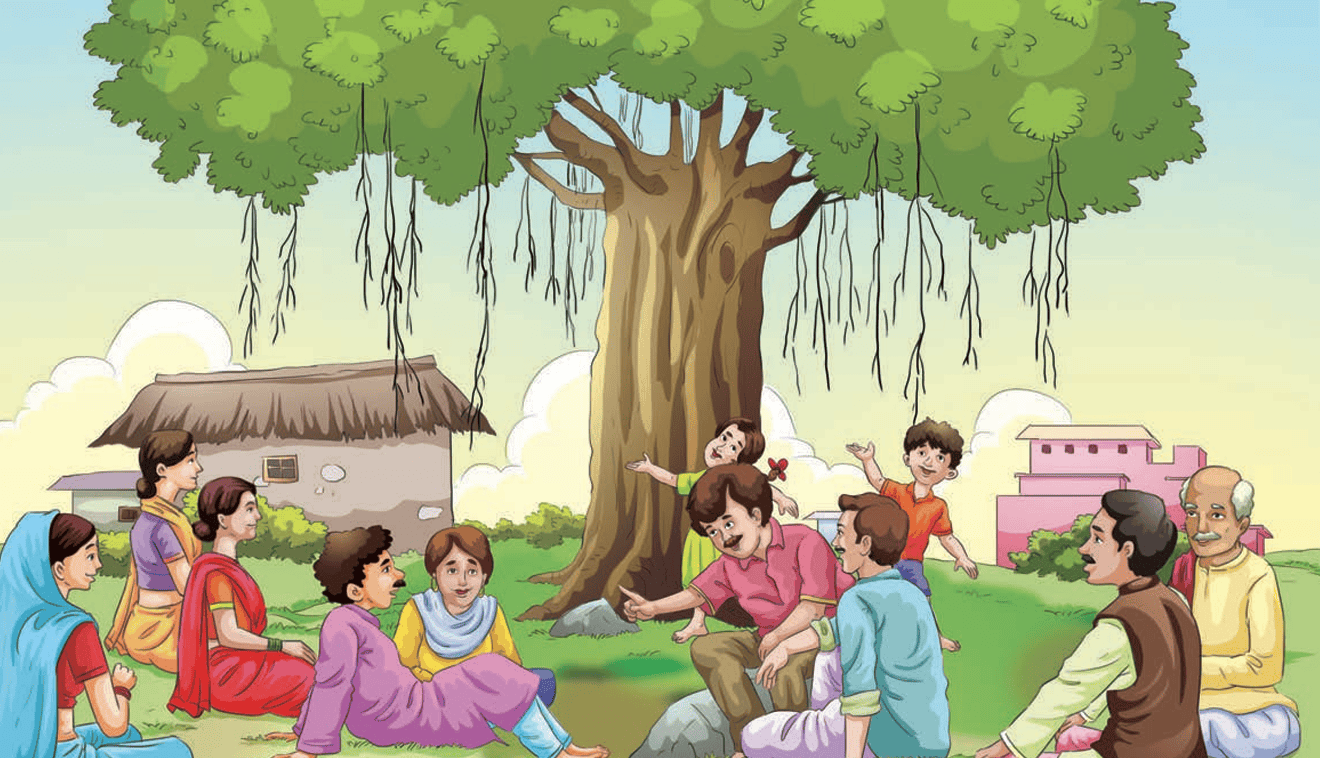
Noor : I will bring some saplings from my plant nursery. Then, we will plant them along the boundary of the park.
Babita : If we all work together, the park will be ready in no time. Van Mahotsav will be so much fun!
Every villager came forward to contribute in some way or the other.

1. Identify the people who help in maintaining your locality. What are their occupations?
_______________
_______________
_______________
2. Look at the table below. List different kinds of work required for developing and maintaining the park. Also, mention the material, tools and skills required. An example is given here.
| People at work | Occupation | What they do | Material/Tool |
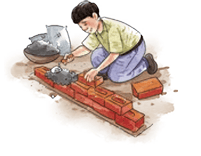 |
Mason | Mending walls using bricks and cement. | 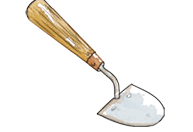 Trowel Trowel |
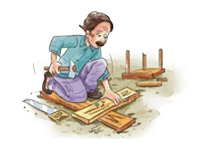 |
hd | 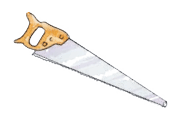 ............... ............... |
|
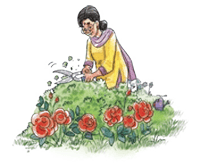 |
hdh | 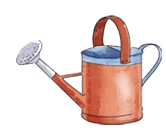 ..................... ..................... |
|
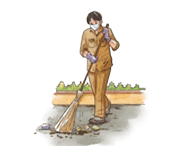 |
hdfh | 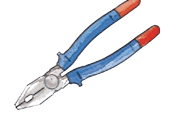 ................... ................... |
3. Find out from your family members or neighbours about their work. What questions would you ask them? Here are some examples:
(a) What do you like the most about your work?
(b) What types of tools or things do you use?
(c) What challenges do you face?
Celebrating Van Mahotsav
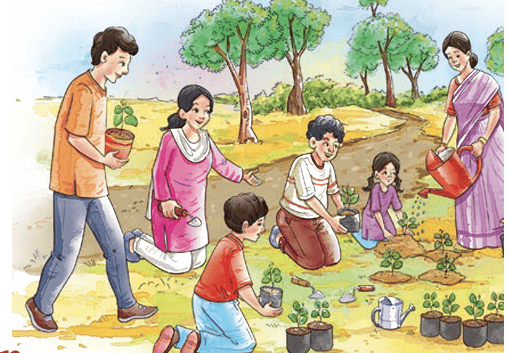
The children gathered in the park with their families to celebrate Van Mahotsav. Mallika used a microphone to make announcements. Groups were formed for cleaning, planting saplings, watering, cooking, etc.
Everyone worked together and helped each other. Now, the park looked beautiful with the newly planted saplings, clean paths and painted walls.
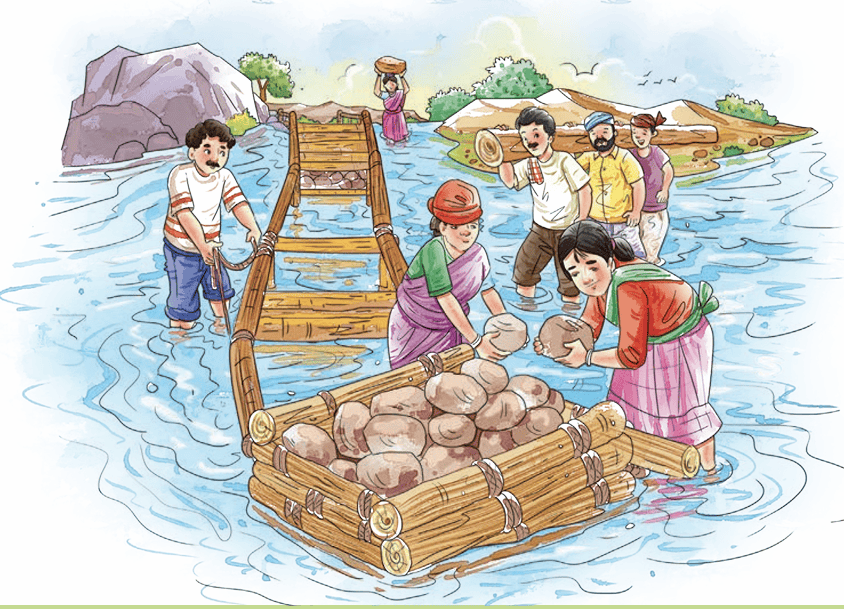
In Kanker, Chhattisgarh, the Chinar river often overflows in the rainy season. Movement of goods and vehicles becomes very difficult. Reaching schools and hospitals becomes a major challenge.
During one such rainy season in 2024, the entire community came together and built a simple yet strong bridge in just two days using bamboo, stones, and other material. Now, students can reach their schools and villagers can cross the river easily.

1. It is important for communities to come together in times of need. What do you think about this statement?
2. Do people in your locality come together and support each other? Can you remember one such occasion? Just as the people of the village came together to solve a problem, our schools and neighbourhoods also rely on people working together as a team.
An ant colony is like a big community of ants, where everyone has a special job, just like in a human community! Some ants collect food, others take care of the babies and some protect their home — just like how people in a community work together to make life better for everyone. Bees also function as a community, with each member having specific roles, such as gathering food, protecting young ones and building hives.
Sharing a Meal
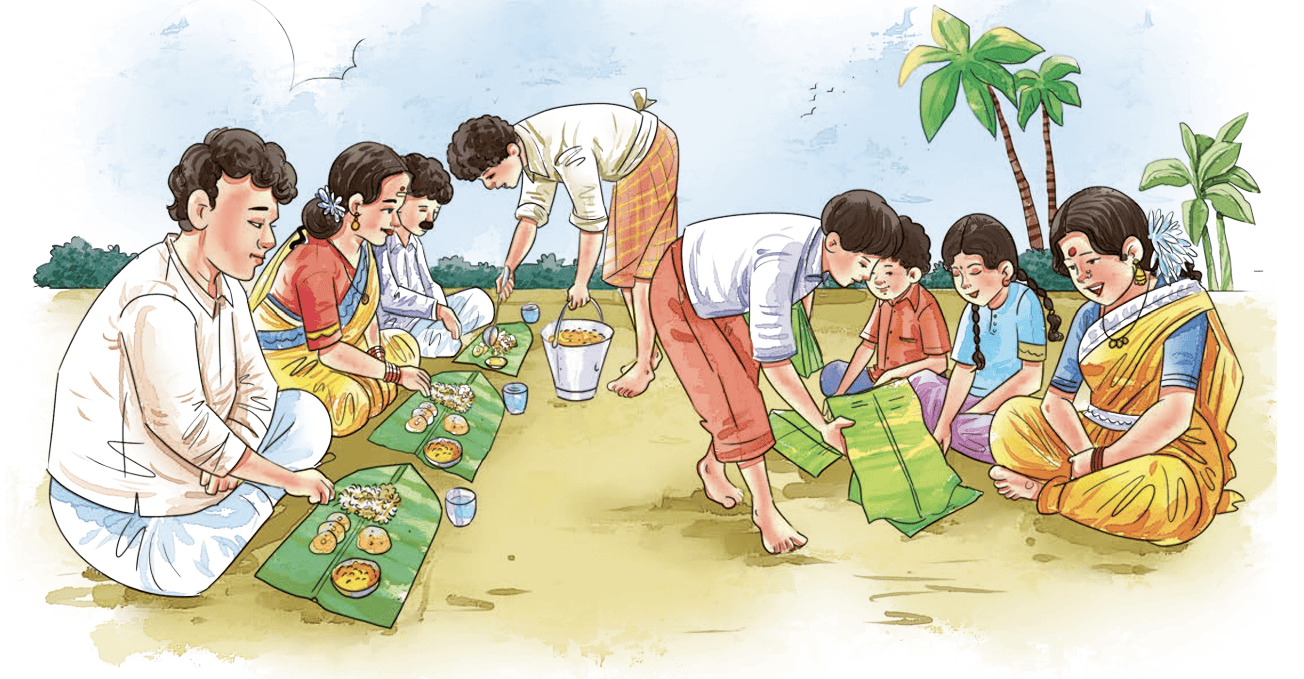
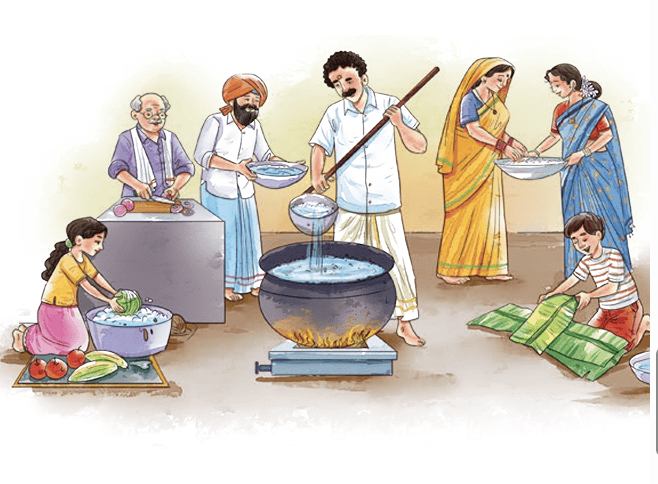
After the tree plantation, Chandan and his friends ran towards the placewhere food was being cooked. Vegetables and cereals were brought by the people of the village. The meal was a community feast to celebrate everyone’s hard work.
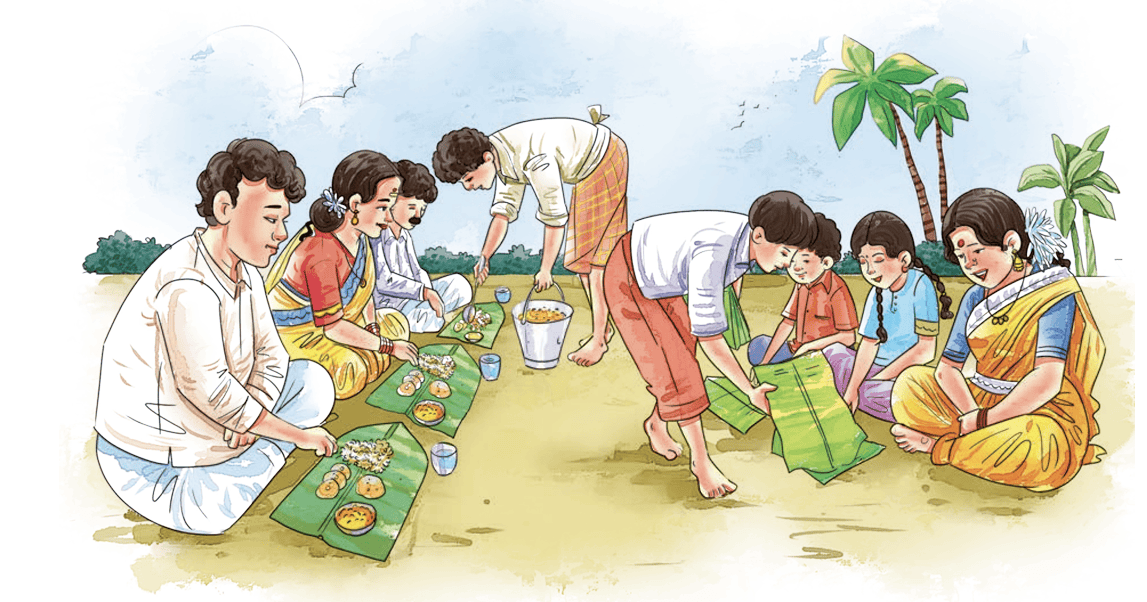
Everyone sat together to eat. Children handed out the banana leaves and the other volunteers served food. Everyone chatted in excitement. There were jokes and laughter along with delicious food. After the feast, the leaves were disposed off in a pit.
Do you know?
Leaves buried in a pit becomes manure and it improves the soil quality.
Think about your family or community. How do you work together to help each other while preparing for a festival or any other occasion?
________________
_________________
_______________
Do you know?
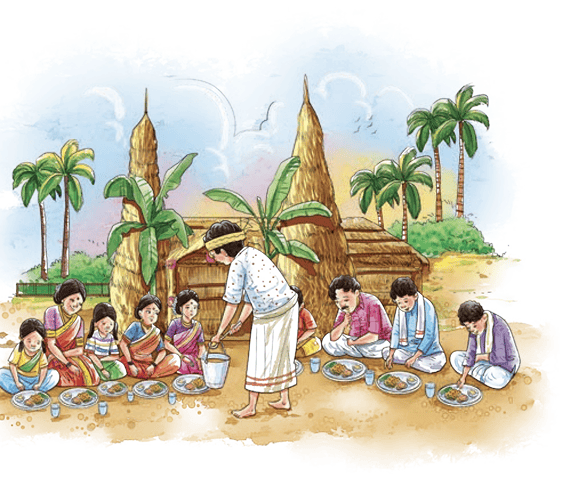
Uruka, the first day of Magh Bihu on the 14th of January, is a time of joy,feast and togetherness in Assam. On this day, people come together to build a hut using bamboo and hay called Bhela Ghar. The celebration ends with a big feast, where they cook, eat and dance together.
The Van Mahotsav celebration came to an end. Everyone was tired. Yet, they felt happy that they had worked together, and made the park beautiful and inviting. The children decided to take care of the park from then on.
Do you know?
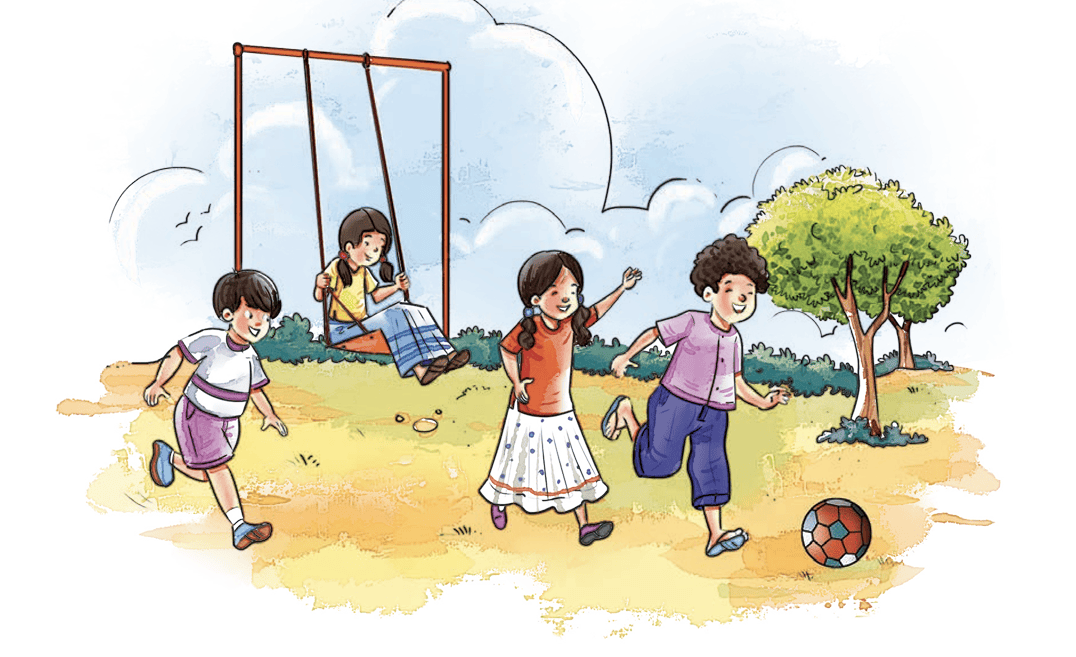
In Sikkim, when it is time to harvest the crops, people from the community come together to help each other. These people who are specialists in agriculture are called Khetala. Such practices help in harvesting crops easily and inculcate a sense of bond amongst people.
1. What are some of the ways by which we can take care of nature and our neighbourhood? List a few.
2. How does helping others and working together make our community better?
1. Write the different role people play in your school — teachers, students, caretakers, bus drivers, etc.
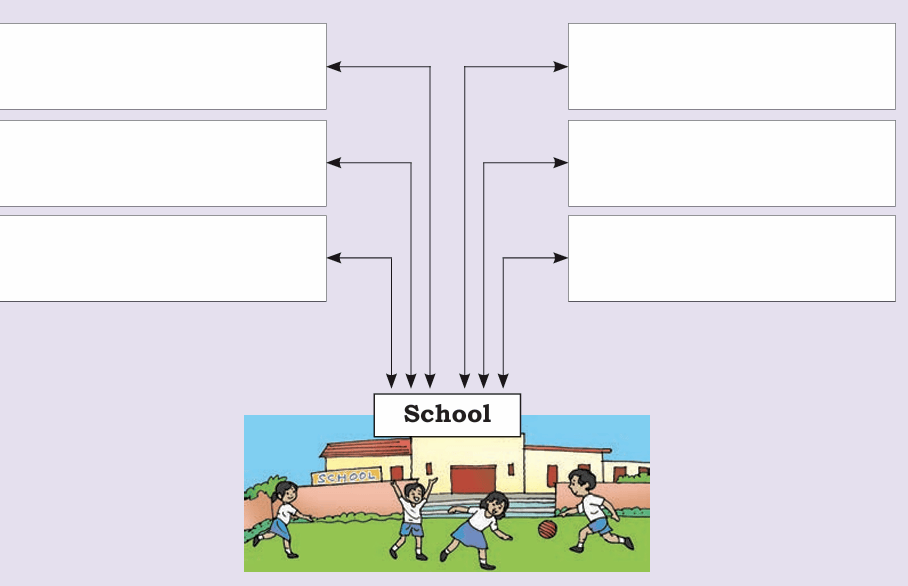
| Person | How do they help in the school? |
| Teacher | A teacher helps students learn new things. |
| School bus driver | |
(a) Why is it important for everyone to work as a team in a school?
(b) What is your role as a member of your school community?
2. Form small groups of 4 – 5 students. Choose one fun activity to perform from the list below:
(a) Tree plantation
(b) Cleanliness drive
(c) Making artefacts with materials from nature (something useful like a leaf-plate or a decorative item like a garland).
After the activity, fill out this table:
| Group name | Activity chosen | Material used | What did you learn? |
(a) I am a place where people
wait,
To catch a ride, and not be
late.
Buses come and buses go,
To places high and low.
Ans: ____________________

(b) I keep letters far and near,
With stamps and parcels
waiting here.
Write a note and drop it in,
What am I? Can you guess
and win?
Ans: ______________
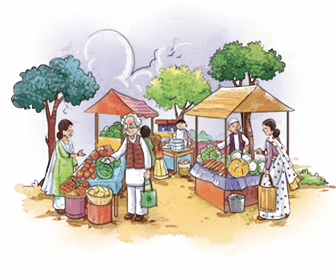
(c) I am full of colours, lights,
sounds of feet,
A place where people shop
and meet.
Fruits, vegetables and other
goods are found,
What am I, busy all around?
Ans: ____________________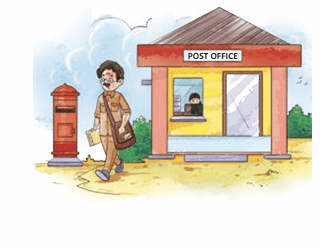
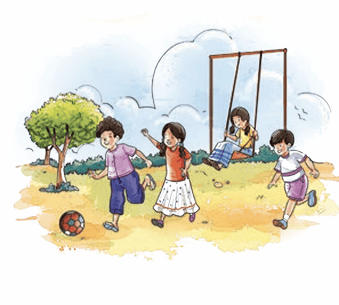
(d) I am a place where you run
and play,
With swings and slides to
enjoy your day.
Laughter here is a common
sound,
What is my name? Have you
found?
Ans: ____________________
Choose a public place of your interest, and create a similar riddle about it for your friends to solve.
________ _________
4. Create three groups in the class. Each group would think about a situation in their locality that needs to be improved. Identify activities that can make a difference to the situation. This could be related to cleaning, helping others, organising an event, etc. Complete the table below.
| Group | Situation | Activity | Your role |
|---|---|---|---|
| Group 1 | |||
| Group 2 | |||
| Group 3 |
- (a) Do you think working together can make your activities more useful? Give reasons.
- (b) How will your involvement in these activities help the community?