Unit 4-Things Around Us
chapter-7 How Things Work
About the Unit
This unit familiarises students with various things around them, how different things work and also how those things are made.
Students observe and test how things work by engaging with easily available toys, such as spinners and paper boats. They try out different possibilities with these toys and study how things work. They also test out which things sink or float by putting different things in the water.
Other than how things work, students will also learn about how different things are made. They will also learn how to prepare handmade paper and gradually learn how papers are made in large scale through machines. This unit gives them a chance to understand the properties of paper and the making of coloured papers too. In the process, students will learn sustainable practices through 5Rs of waste management and get ready to take responsible decisions. By experimenting with both traditional and modern paper-making techniques, they will develop a deeper appreciation for the materials we uses in everyday life and their connection to our environment.
Note to the Teacher
This unit consists of Chapter 7—How Things Work and Chapter 8—How Things are Made. The key concepts covered in these chapters are listed below.
Chapter 7• ‘How Things Work’ nurtures student’s natural curiosity to try out and observe common phenomena around them, including spinning, floating and sinking. Through hands-on activities with toys, papers and other materials used in day-to-day life, they will discover the patterns, and develop a sense of wonder about how things work.
• The simple experiments will enable students to observe what happens and how things work in different situations. In this process, they will discover various common patterns which gives them new learning about the materials. These new discoveries will raise their interest and curiosity in things further, and it also encourages them to know how things work.
Chapter 8• ‘How Things are Made’ provides space to students to make something with their own hands, using locally available material. They will learn how to prepare paper pulp and make handmade paper out of this. They will also learn how paper is made.
• By making recycled paper, they will discover the beauty of sustainability and innovation. They will also learn the 5Rs of waste management which are essential in today’s world.
Teacher to Facilitate
• Arrange objects, such as coins, bangles, wooden spinners, leaves, and stones for activities including spinning, floating and sinking. Keep cardboard, toothpicks and adhesive ready for students to undertake these hands-on activities.
•Organise group activities like making and testing spinners, predicting and observing floating and sinking objects, and designing boats with different materials. Encourage students to record these observations.
• Arrange needed materials for the floating and sinking activities. Encourage students to note predictions and results. Guide them to think critically about different shape and materials, etc.
• Organise an exhibition where students will be able to display their handmade boats and share their findings.
chapter7-How Things Work
Every day, we see and use different things around us, like the books we read and the toys we play with. Some of these things help us work. We use a pencil for writing, a bag to carry books, and so on.
Have you ever wondered how these things work? Do they always work the same way in all situations? What changes might be needed to make them work even better? Let us explore and find out how different things around us work.
Meera and Dhruv love exploring how things work. Every weekend, they discover something new to explore. That Sunday was no different. Meera spun a coin and observed curiously. “Watch this!”, she said.
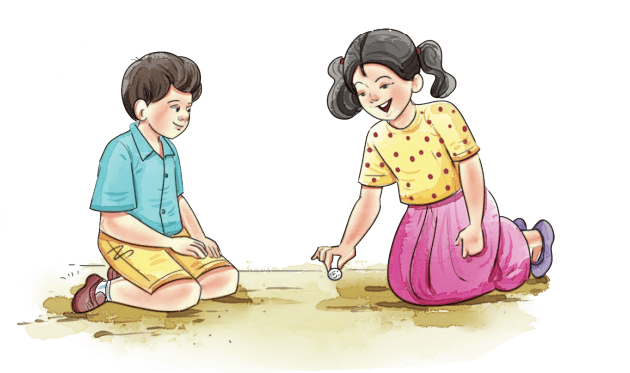
Ask the students to spin a coin and observe.

- 1. Do you think all objects can spin? Make a list of a few objects that can spin.
- 2. Collect the objects mentioned in the table given below. Spin and observe them. Then, complete the table
| Objects | I observe | I wonder | I think |
|---|---|---|---|
Coin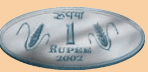 |
As it slows down, it begins to shake | Why does it start to shake as it slows down? | |
Bangle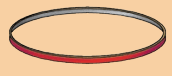 |
|||
Pencil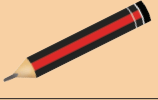
|
|||
Piece of
Stone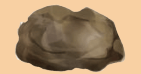 |
|||
Wooden
Spinner (Top)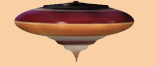
|
|||
 Eraser Eraser |
Some objects like coins and bangles spin, while some other objects like erasers do not spin properly. Meera had a question, “How does a top spin?” Let us make some spinners and explore.
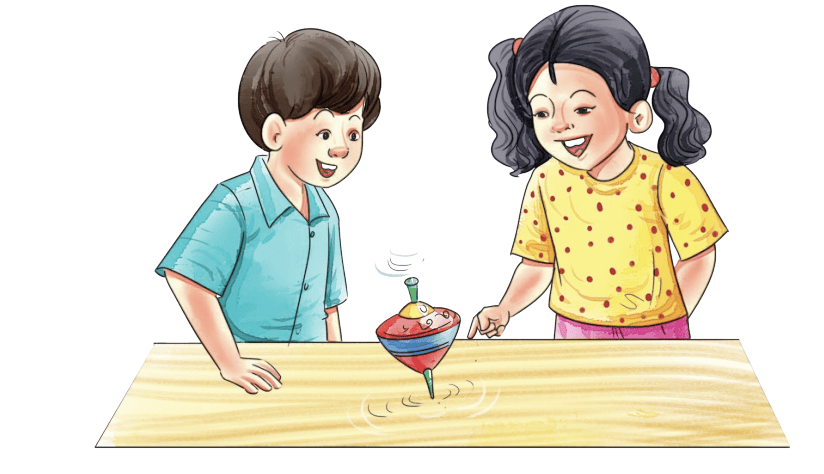
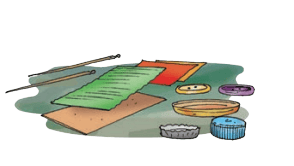
Collect things, such as pieces of cardboard, toothpicks, an empty tube of a ballpoint pen, and other small objects. Make the following spinners. Spin them and record your observations.
It is not expected that students come to correct theoretical explanations for questions like “How does a spinner work?”, “How does it balance?”, “Why does a spinner begin to shake?”. The main idea is to give them the opportunity to think and explore playing with spinners, to allow them to give possible explanations. Encourage students to collect and spin objects in addition to the list of objects given in the table on the following page.
| Change in the spinner | What do you observe? (spins/ does not spin) | Any other observations |
Toothpick at
the centre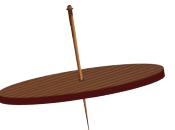 |
||
Toothpick away
from the centre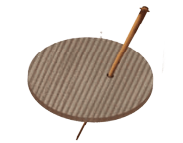 |
||
A square spinner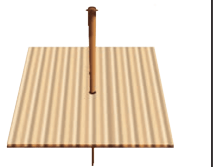 |
||
Circular spinner
with a circular
mark on its body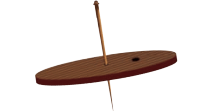 |
||
| Any other |

- 1. Which of the spinners did not spin properly? Discuss the possible reasons.
- 2. Have you noticed the position of the hole in the first two spinners? Did this difference in the position of the hole make a difference in the spinning of these spinners?
In the table of Activity 2, the first spinner with a hole at the centre appears to be the same from all sides. This spinner remains upright and spins but that is not the case with the second spinner.
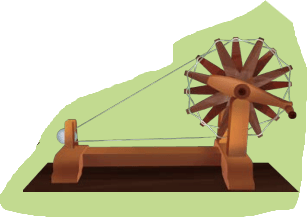 A charkha (spinning wheel) is used to twist
cotton fibre into thread. It has a large
wheel that spins when turned by
hand. Mahatma Gandhi used the
charkha to make handmade
clothes.
A charkha (spinning wheel) is used to twist
cotton fibre into thread. It has a large
wheel that spins when turned by
hand. Mahatma Gandhi used the
charkha to make handmade
clothes.
When the third spinner, a square card, is spun, it appears circular while spinning. What other shapes can you try? Make spinners using different shapes of card pieces, spin them, and observe what happens.
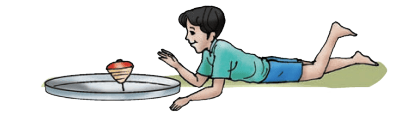
Some spinners might also not have worked. Encourage students to change different factors such as the length of the toothpick at the bottom of the cardboard, the alignment of the cardboard and other possible changes. This will help them identify what makes the spinner spin better.
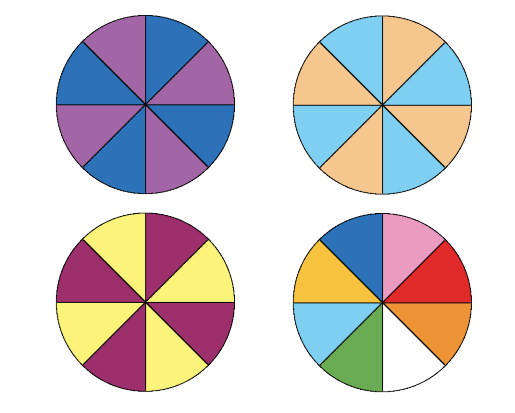 What other
changes can you
make in your
spinner? Can you
colour it? How
many different
ways can you
colour it? Some
ways are shown in
the figure. Colour
the spinners in
different ways,
spin them and observe what happens. What happens
to the colours on the spinner when it is painted with
different colours and then spun?
Many things around us spin, such as ceiling fans
and potter’s wheels. What other things have you
observed spinning?
What other
changes can you
make in your
spinner? Can you
colour it? How
many different
ways can you
colour it? Some
ways are shown in
the figure. Colour
the spinners in
different ways,
spin them and observe what happens. What happens
to the colours on the spinner when it is painted with
different colours and then spun?
Many things around us spin, such as ceiling fans
and potter’s wheels. What other things have you
observed spinning?
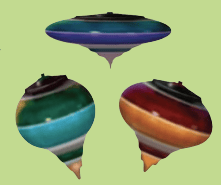 Do you know?
Spinning tops have been used in India for thousands of years. Clay was used in earlier times to make these tops. Lattu is one of the popular Indian tops which is commonly made of wood.
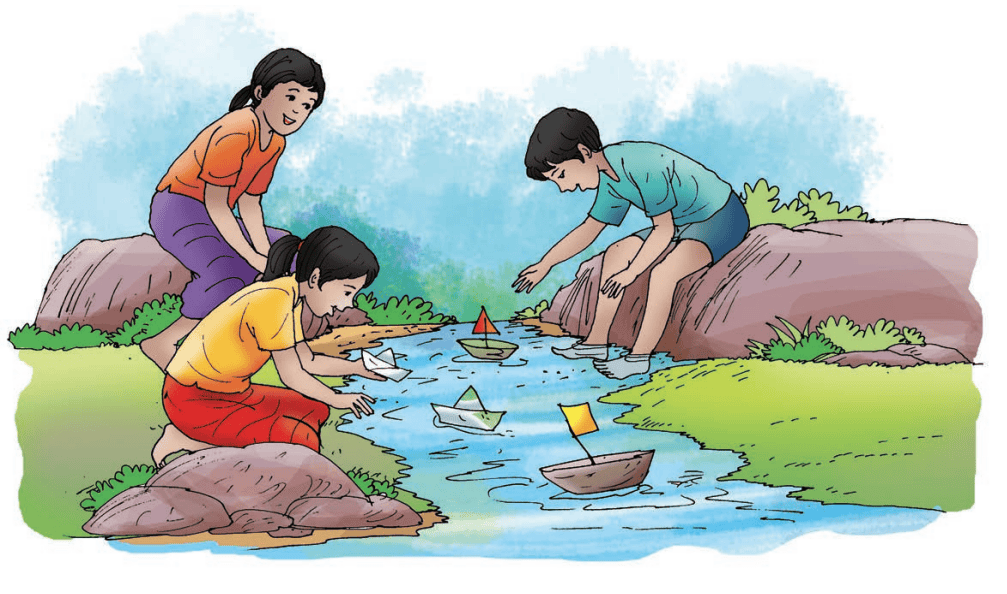
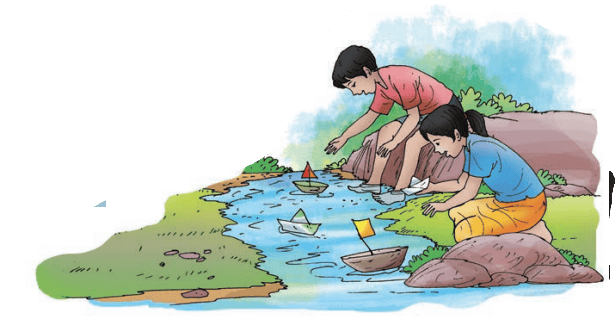
It started raining outside. Meera and Dhruv ran out
of the house and started splashing water on each
other. Rain stopped after some time.
Dhruv : Let us make paper boats. It would be fun!
Meera : Let me bring some old newspapers.
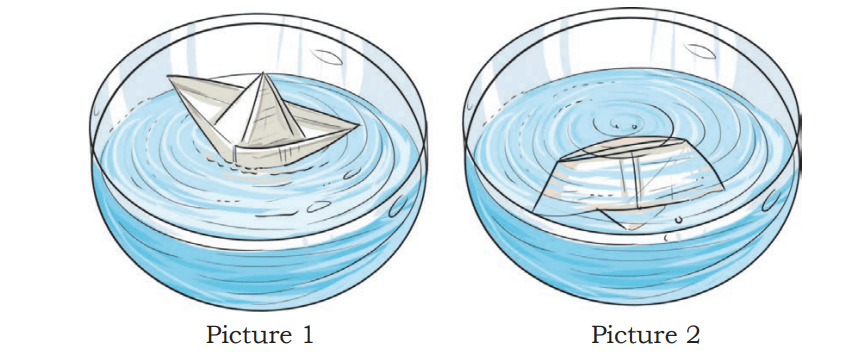
They made paper boats and then placed them in the water puddle formed by the rain. While playing, they noticed that some paper boats floated properly on the water, while others flipped.
You can try this out at home. Make a paper boat and float it in a bowl. Observe whether your boat floats properly like in Picture 1 or flips like in Picture 2?
Let us explore floating and sinking activities with Meera and Dhruv.
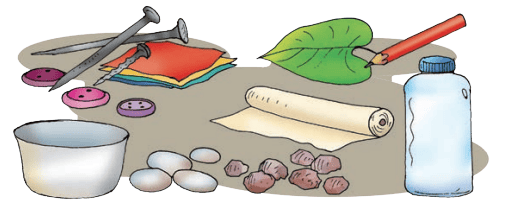
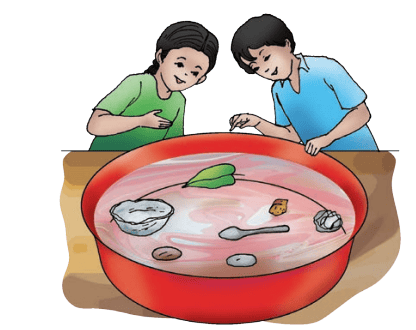
Collect objects, such as a leaf, an iron nail, an empty bowl (katori), a plastic bottle with a lid, pieces of stone, aluminium foil and other things of your choice. Fill a bucket with water. Before dropping the things listed in the table, guess whether things will float or sink. You may try other things too. Then, observe what happens when it is actually dropped in water. You can write ‘F’ for objects that float and ‘S’ for objects that sink.
| Items | Before dropping | What is your guess? | Why do you think so? | After dropping | What is your observation? | What could be the reason? | ||||
|---|---|---|---|---|---|---|---|---|---|---|
| Leaf | F | It is light | F | It is light | ||||||
| Iron nail or pin | ||||||||||
| Empty steel bowl | ||||||||||
| A piece of stone | ||||||||||
| Empty bottle with a closed lid | ||||||||||
| Bottle full of water with a closed lid | ||||||||||
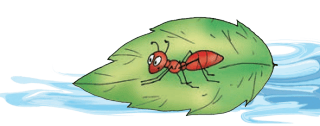
From this activity, it can be observed that some heavy objects like iron nails sink, while lighter ones like leaves, float.
Did all the light objects float and all the heavy objects sink? Name the heavy objects that floated and lighter objects that sank.
Floating or sinking of an object cannot be decided based just on whether it is heavy or light. It also depends on other factors.
Let us find out whether shape plays a role in floating and sinking.
| Aluminium foil when— | Do they float (F) or sink (S) in water? | |||
| Before dropping | ||||
| What is your guess? | Why do you think so? | After dropping | ||
| What is your observation? | What could be the reason? | |||
| spread out | ||||
| pressed tightly into a ball | ||||
| in a cup-like shape | ||||
By changing the shape, we can make an object float or sink. When aluminium foil was spread out or made in the shape of a cup, it floated. However, when it was made into a ball, it sank.
You need to help students in pressing the aluminium foil ball tightly so that it traps as little air as possible. If the ball is not pressed tightly, it might even float. If aluminium foil is not available, use any other alternative.
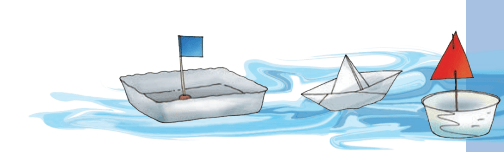

1. Let us create some boats:
- Collect some paper, cardboard boxes, ice-cream sticks, clay, adhesive tape, etc.
- Create groups of three to four students.
- Think of how you can make a boat using some of the materials that you have.
- Draw a picture.
- Prepare a boat. Try to ensure that your boat is different from boats made by other groups.
- Organise an exhibition of boats in the class. Following are some different types of boats which can be made.
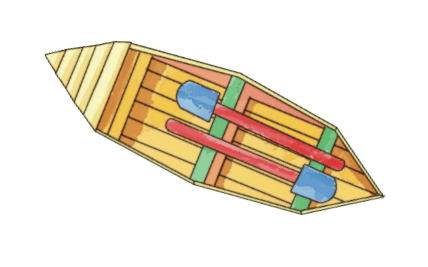 A boat made with
ice-cream sticks A boat made with
ice-cream sticks |
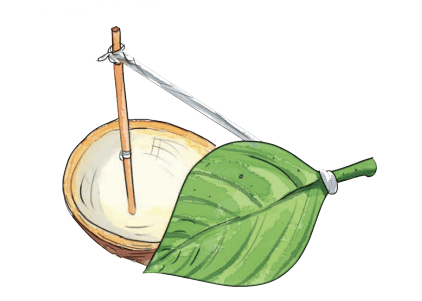 A boat made of a
coconut shell A boat made of a
coconut shell |
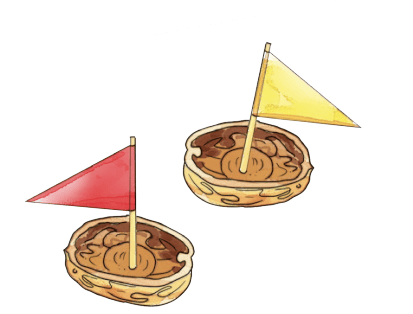 Boats made using
walnut shells Boats made using
walnut shells |
2. Compare your boat with others’ boats.
| Strengths of your boat | Challenges of your boat |
|---|---|
Some boats might be strong and difficult to break, while others might break easily. Some might tip over easily, while others might keep better balance. Think about how you can improve your boat.
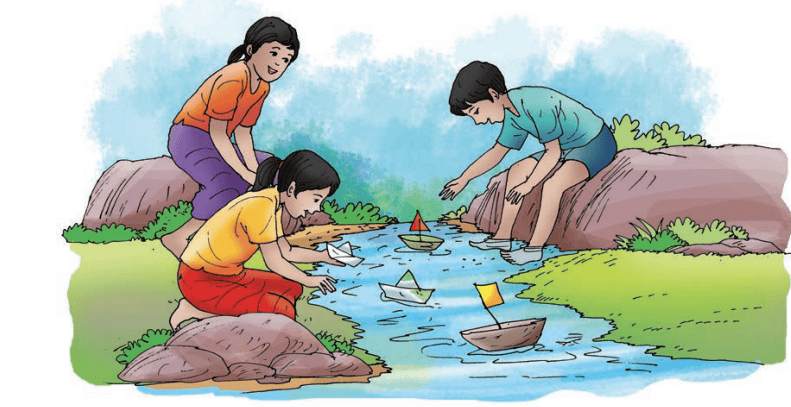
Bring the materials for making boats as mentioned. Provide some additional materials required such as bands, threads, adhesive tapes, glue, scissors, etc. Make sure that it is enough for all the groups. Supervise the groups, encourage students to try out different materials and come up with different designs. Suggest alternatives if some materials are not available.

When Ravi spins a spinner, he notices that it slows down and eventually stops. He is curious about this and asks his teacher some questions. List at least two questions that he could ask.
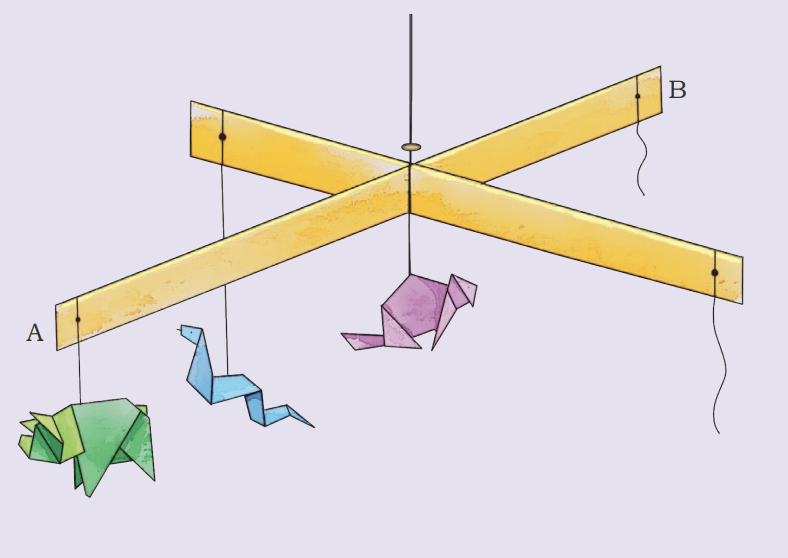
2. Figure it out(a) The following figure is bending towards the side ‘A’. What should be done to balance it?
 (b) How would you make a floating object sink and
a sinking object float?
(b) How would you make a floating object sink and
a sinking object float?
3. Do an activity
Classify the objects below based on whether they float or sink in water.
| Wax | Marble | Thermocol | Candle | Coin |
| Cork | Leaf | Eraser | Spoon | Ice-cube |
| Potato | Tomato | Pumpkin | Lemon |
——————
——————
——————
——————
——————
——————
——————
——————
——————
——————