Chapter 5
Sharing and Measuring

PARTS AND WHOLES
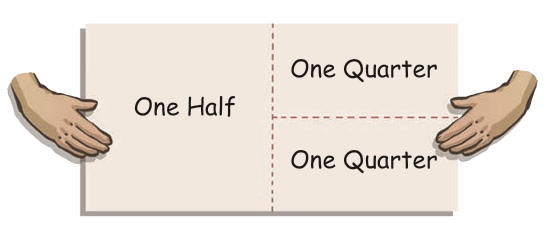
Ikra and her little sister, Samina, decide to make a drawing, but they are left with a single drawing sheet. Ikra wants to share the paper by dividing it in half, but Samina insists on having a bigger part of the paper. Ikra thought for a moment and proposed a solution.
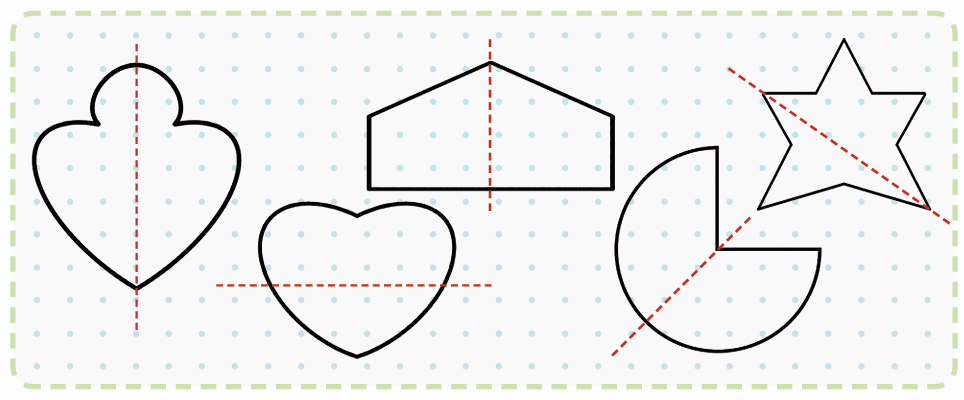
2. Divide the shapes into halves by drawing a line.
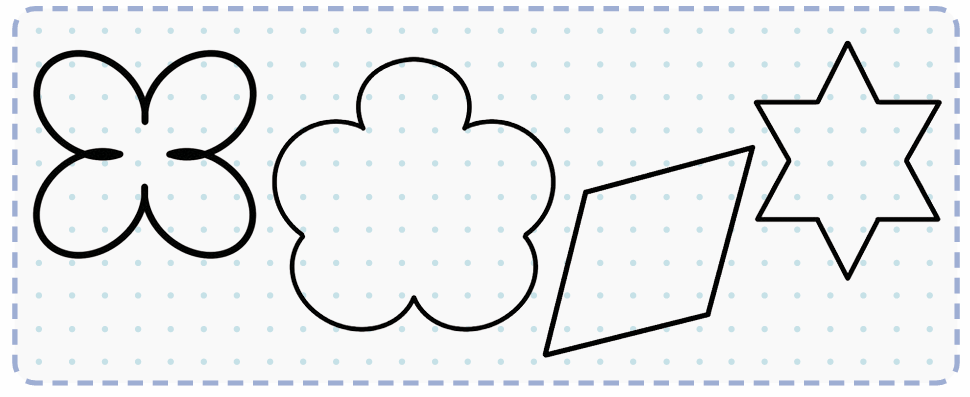
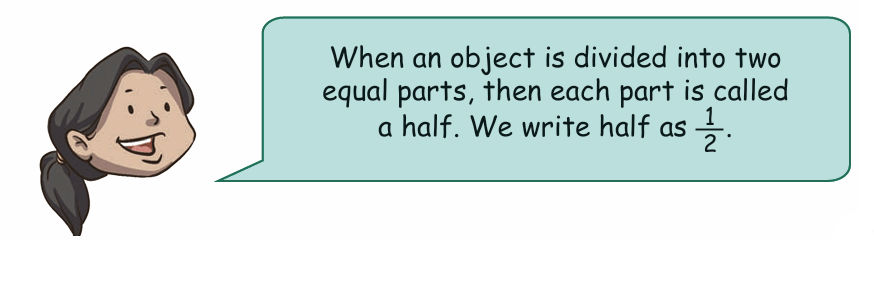
3. Divide these shapes into 4 equal parts/quarters.
 Think: How would we write the fraction for each part if we divided an object into 5 equal parts?
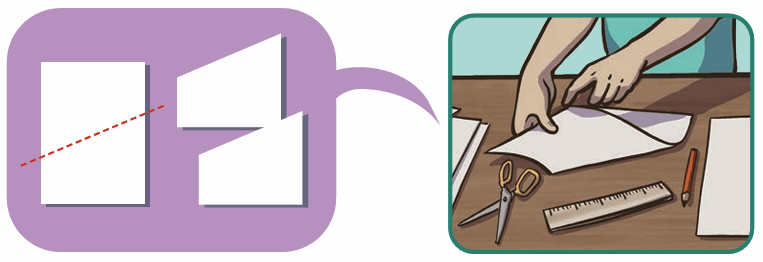
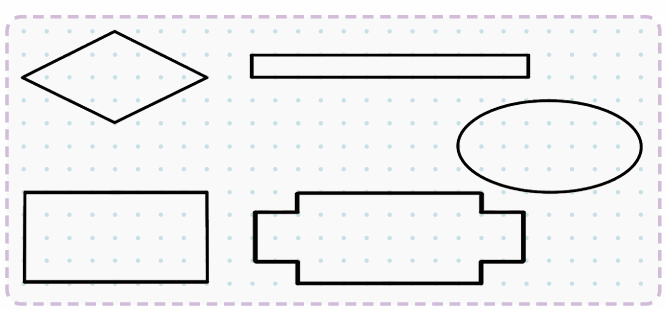
2. Now try to draw and show five different ways in which we can fold/cut a rectangle into four equal parts (1/4 or quarter).

3. Match the following parts with their corresponding wholes.
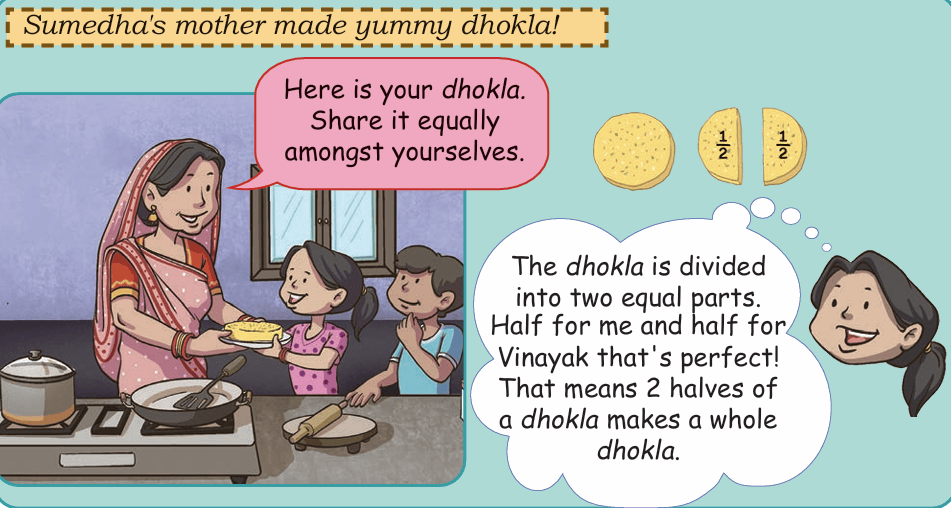 Sumedha's mother made yummy dhokla!
Here is your dhokla. Share it equally amongst yourselves.
The dhokla is divided into two equal parts. Half for me and half for Vinayak that's perfect! That means 2 halves of a dhokla makes a whole dhokla.
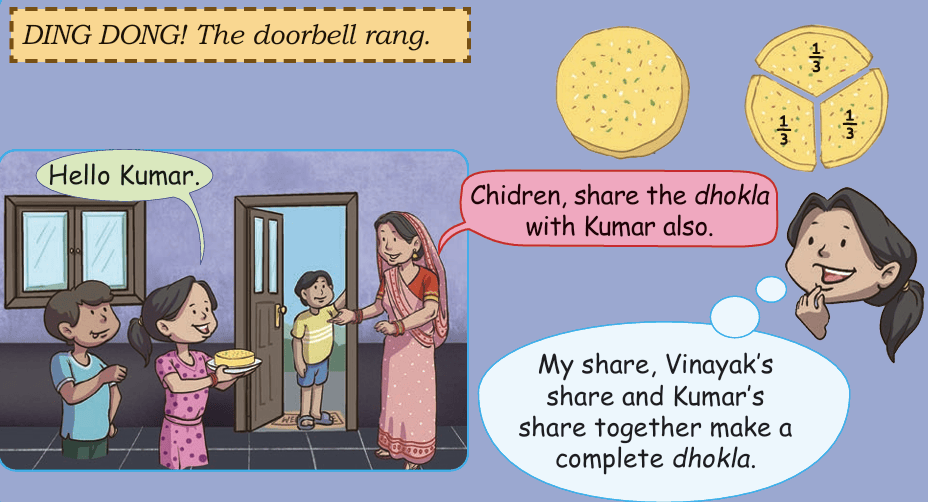 DING DONG! The doorbell rang.
Hello Kumar.
Chidren, share the dhokla with Kumar also.
My share, Vinayak’s share and Kumar’s share together make a complete dhokla.
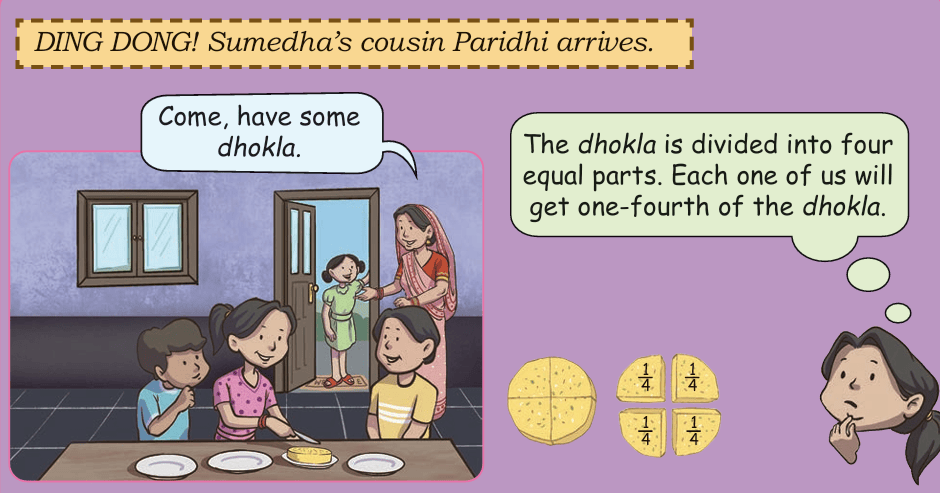 DING DONG! Sumedha’s cousin Paridhi arrives.
Come, have some dhokla.
The dhokla is divided into four equal parts. Each one of us will get one-fourth of the dhokla.
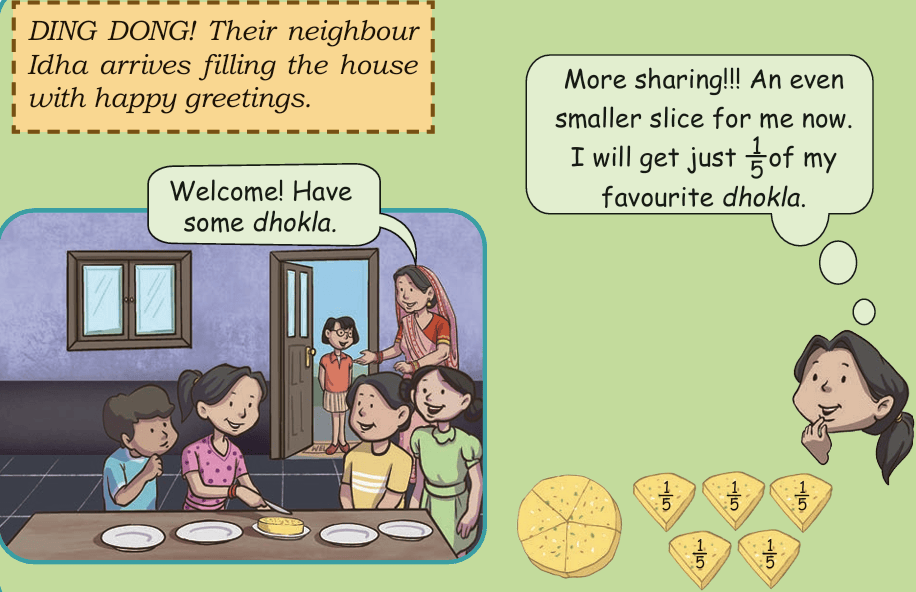 DING DONG! Their neighbour Idha arrives filling the house with happy greetings.
Welcome! Have some dhokla.
More sharing!!! An even smaller slice for me now. I will get just 1/5 of my favourite dhokla.
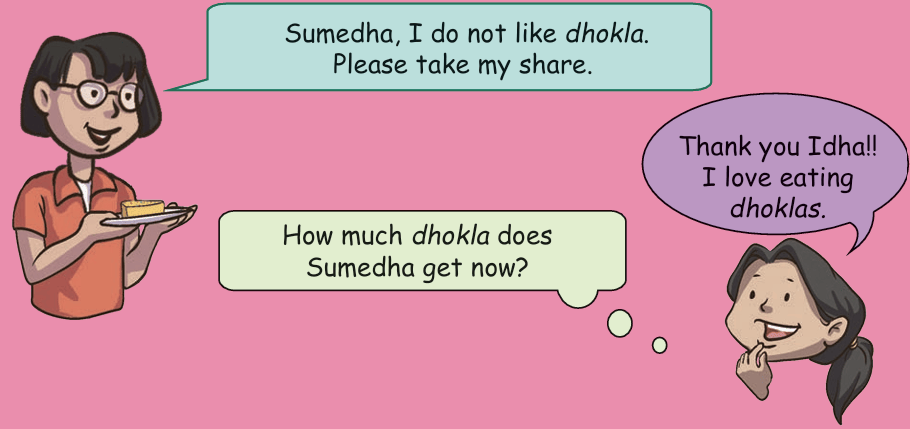 Sumedha, I do not like dhokla. Please take my share.
How much dhokla does Sumedha get now?
Thank you Idha!! I love eating dhoklas.
 I have very few Lily seeds so I will plant Roses in two parts. Her revised plan is shown here.
Look at the garden and answer the questions.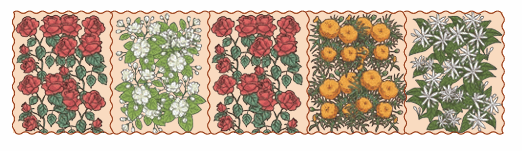
Look at the garden and answer the questions.
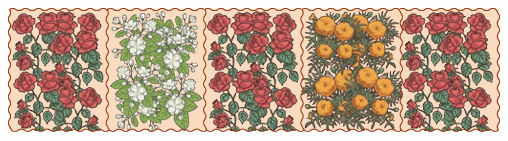
Look at the garden and answer the questions.
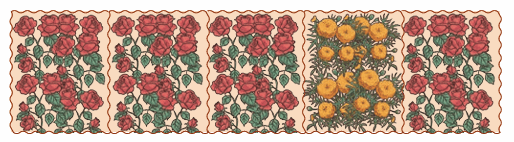
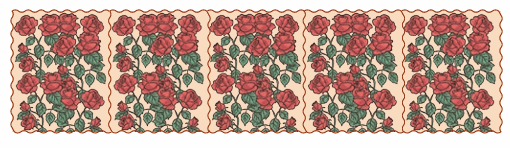
Karan makes dosas differently. He makes dosas based on the customer’s choice with various toppings on a single dosa.
 Customers can choose from the following toppings:
1. Classic potato
2. Spicy onion
3. Chilly paneer
4. Tangy tomato
Help Karan in making these special dosas.
Now you can make different dosas based on demand.
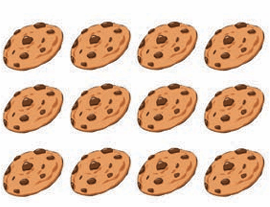
1. There are 12 cookies. What fraction of cookies will each get if the number of children are as follows:
a) 3 children
b) 6 children
c) 2 children
d) 4 children
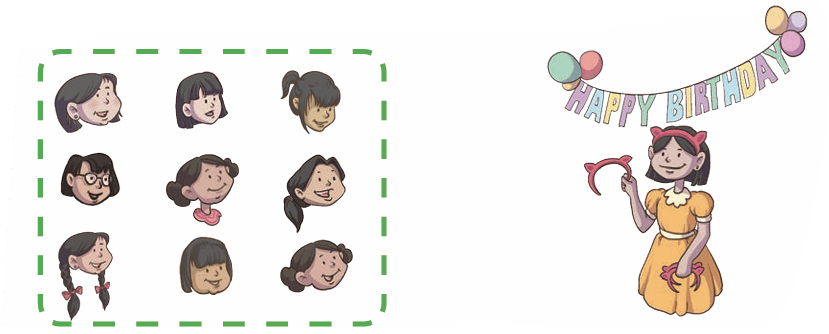
5. Simran calls her school friends for her birthday party. 1/3 of her friends receive a hairband as their return gift. Place hairbands on 1/3 of her friends.
6. Draw flowers in 1/5 of the given number of pots.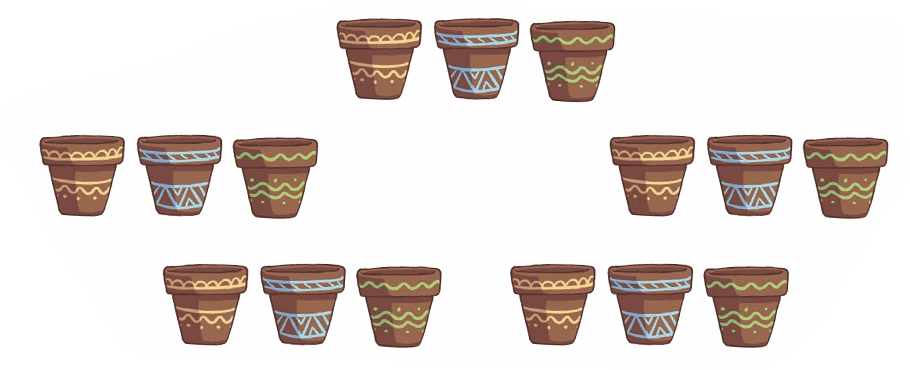
Observe your surroundings and think of situations where we use
fractions and write any two of them in the space provided below.
1._____________________________________
______________________________________
______________________________________
2. _____________________________________
______________________________________
______________________________________
1/2 = 2/4 = _____ = ______=_____
1. How many 1/4 s are equal to 1/2 ?
____________________________
2. Is 2/3 less than or greater than 1/2 ?
____________________________
3. Ten pieces of 1/10 make a complete whole.
Is this statement true?
____________________________
4. Three pieces of 1/6 are equal to two pieces of 1/8.
Is this true?
____________________________
5. How many pieces of 1/8 make 1/4 ?
____________________________
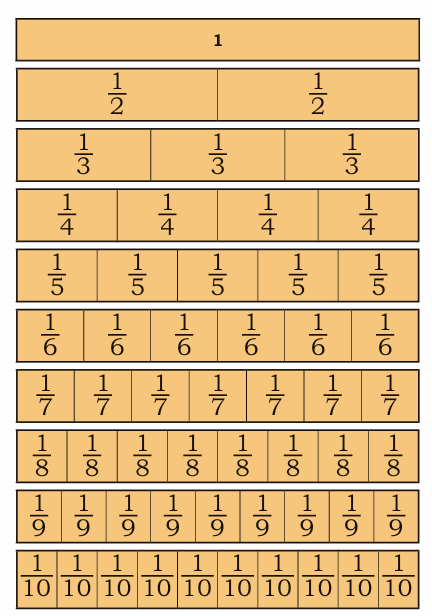
6. Find the pieces that you can put together to make another bigger
piece.
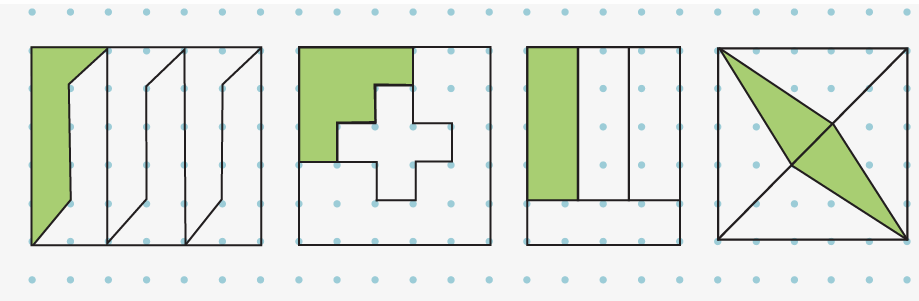
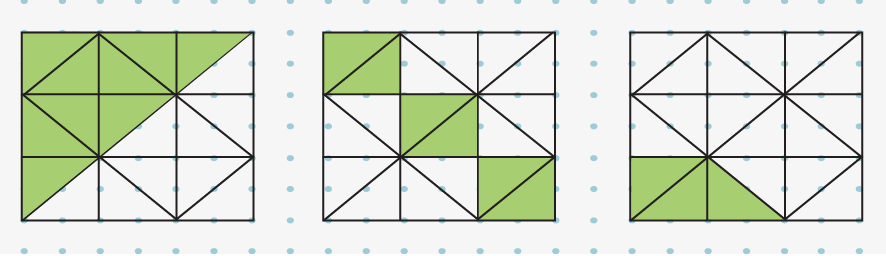
2. Check if the children’s claim below about the shaded parts of each of the pictures is correct. Circle the ones which you think are correct, cross out the ones which are not correct. You can draw additional lines to make the parts equal. Discuss your thinking.
3. Identify the fractions represented by the coloured parts in the given pictures.
4. Identify the fraction of the whole that the blue parts make in each of the pictures given below.
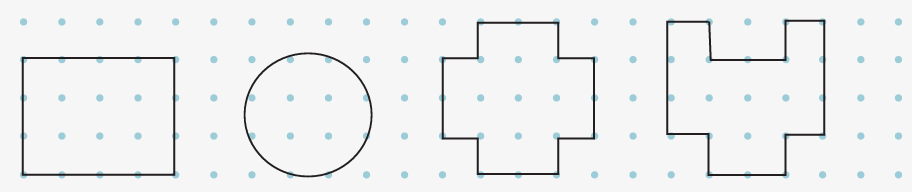
5. Divide the following into equal parts and shade the appropriate parts in each.
Would you like half of the paper to draw, or two quarters of the paper?
One half paper seems smaller, but two quarters sounds like a bigger part. I want two quarters!
| One Half | One Quarter |
| One Quarter |
Let Us Discuss
1. Which part of the paper you would have chosen—one half or two
quarters? Why?
2. Do you think Ikra shared the paper equally? Why? Try with a paper.
3. How do you know that the paper has been divided equally?
4. Why do you think Samina chose two quarters of the paper?
2. Do you think Ikra shared the paper equally? Why? Try with a paper.
3. How do you know that the paper has been divided equally?
4. Why do you think Samina chose two quarters of the paper?
Let Us Do
1. Samina has divided some figures into two parts. Colour the figures that are divided into halves correctly. How did you get the answer?
When an object is divided into two equal parts, then each part is called a half. We write half as 1/2.
Think: How would we write the fraction for each part if we divided an object into 5 equal parts?
When an object is divided into four equal parts, then each part is called a quarter. We write quarter as 1/4.
Many Ways to Make Halves and Quarters
Let Us Try
1. In how many different ways can you fold/cut a rectangular paper in two equal parts? Try it with a rectangular paper.
Note for Teachers: Guide students to write fractions using symbols. Begin with examples like 1/2 and 1/4. Provide numerous opportunities for practice with other fractions by paper folding and drawing images.
 |
I am 1/2 of |  |
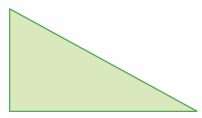 |
I am 1/2 of | 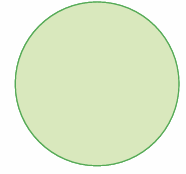 |
 |
I am 1/2 of |  |
 |
I am 1/4 of |  |
DING DONG BELL!!
Sumedha's mother made yummy dhokla! Here is your dhokla. Share it equally amongst yourselves.
The dhokla is divided into two equal parts. Half for me and half for Vinayak that's perfect! That means 2 halves of a dhokla makes a whole dhokla.
DING DONG! The doorbell rang.Hello Kumar.
Chidren, share the dhokla with Kumar also.
My share, Vinayak’s share and Kumar’s share together make a complete dhokla.
DING DONG! Sumedha’s cousin Paridhi arrives.Come, have some dhokla.
The dhokla is divided into four equal parts. Each one of us will get one-fourth of the dhokla.
DING DONG! Their neighbour Idha arrives filling the house with happy greetings.Welcome! Have some dhokla.
More sharing!!! An even smaller slice for me now. I will get just 1/5 of my favourite dhokla.
Sumedha, I do not like dhokla. Please take my share.How much dhokla does Sumedha get now?
Thank you Idha!! I love eating dhoklas.
Let Us Discuss
1. What is Sumedha observing about her share as each guest comes in?
2. In which situation will Sumedha get to eat more dhokla: when shared among 9 people or 11 people?
3. How many pieces of 1/6 would make a complete dhokla?
4. What would be Sumedha's share, if Idha and Vinayak both give their share of dhokla to her?
2. In which situation will Sumedha get to eat more dhokla: when shared among 9 people or 11 people?
3. How many pieces of 1/6 would make a complete dhokla?
4. What would be Sumedha's share, if Idha and Vinayak both give their share of dhokla to her?
Let Us Do
1. How much dhokla would each person get if it was shared equally
among 6 people? Try also with 8 people. Who will get the bigger
pieces of dhokla? Draw and explain.
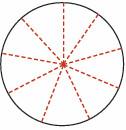
2. Shade a portion of the dhokla to represent the fraction Sumedha
would get when the dhokla is shared equally among the given number
of people. Discuss why the fractions get smaller.
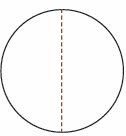 |
2 people Sumedha’s share = 1/2 Half |
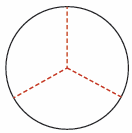 |
3 people Sumedha’s share = 1/3 One-third |
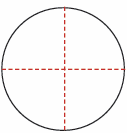 |
4 people Sumedha’s share = _____ ________ |
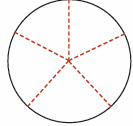 |
5 people Sumedha’s share = _____ ________ |
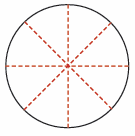 |
8 people Sumedha’s share = _____ ________ |
 |
9 people Sumedha’s share = _____ ________ |
Let Us Discuss
Use the fraction kit given at the end of your textbook and answer the following questions.
1. Share your observations about the different pieces and the whole.
2. Take any two different pieces of the fraction kit and compare them. Discuss which one is smaller and why.
3. Sumedha noticed that when a whole is equally divided in a larger number of parts, each part gets smaller. Do you agree with Sumedha?
4. Sumedha says, “When I join 5 pieces of 1/5, it makes a whole dhokla.” Try to do it yourself with your fraction kit.
5. Sumedha says that this part is one-third of the complete whole. Why is she saying so?
1. Share your observations about the different pieces and the whole.
2. Take any two different pieces of the fraction kit and compare them. Discuss which one is smaller and why.
3. Sumedha noticed that when a whole is equally divided in a larger number of parts, each part gets smaller. Do you agree with Sumedha?
4. Sumedha says, “When I join 5 pieces of 1/5, it makes a whole dhokla.” Try to do it yourself with your fraction kit.
5. Sumedha says that this part is one-third of the complete whole. Why is she saying so?
Note for Teachers: Narrate the story of dhokla using a circular paper to help students understand that sharing among a larger number of people leads to a smaller share for each person.
Let us try to fill in the blanks. Both the fractions are parts of the
same whole. Use your fraction kit, if necessary. Share your thoughts.
1. ________ is greater than ________ (1/5 , 1/4).
2. ________ > ________ (1/9 , 1/6).
3. 1/6 _____ 1/8.
4. ________ is smaller than ________ ( ____ , ____ ).
1. ________ is greater than ________ (1/5 , 1/4).
2. ________ > ________ (1/9 , 1/6).
3. 1/6 _____ 1/8.
4. ________ is smaller than ________ ( ____ , ____ ).
My Flower Garden
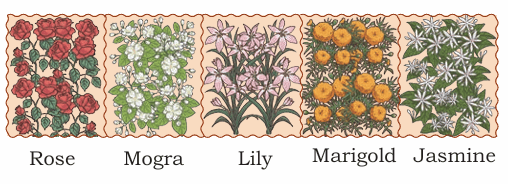
Idha has seeds of 5 different flowering plants—Rose, Mogra, Lily, Marigold, and Jasmine. She decides to plant them equally in her garden as shown in the picture.
I have very few Lily seeds so I will plant Roses in two parts. Her revised plan is shown here.Look at the garden and answer the questions.
Mogra in 1/5 or one-fifth part of the garden.
Marigold in _____________ part of the garden.
Jasmine in _____________ part of the garden.
Rose in 1/5 and 1/5 part or a total of 2/5 (two-fifths) part of the garden.
Marigold in _____________ part of the garden.
Jasmine in _____________ part of the garden.
Rose in 1/5 and 1/5 part or a total of 2/5 (two-fifths) part of the garden.
Mogra in _____________ part.
Marigold in _____________ part.
Rose in 1/5 + 1/5 + 1/5 part or a total of 3/5 (three-fifths) part.
Marigold in _____________ part.
Rose in 1/5 + 1/5 + 1/5 part or a total of 3/5 (three-fifths) part.
Marigold in _____________ part.
Rose in 1/5 + 1/5 + 1/5 + 1/5 or a total of 4/5 (four-fifths) part.
Rose in 1/5 + 1/5 + 1/5 + 1/5 or a total of 4/5 (four-fifths) part.
Rose in 5/5 part or the complete garden.
Let Us Do
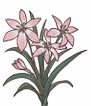
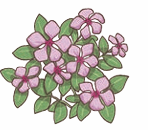
Make a flower garden with seven flowering seeds—Mogra, Marigold, Jasmine, Rose, Lily, Hibiscus, and Periwinkle? Mogra Mogra |
a) Marigold in one-seventh (1/7) and Rose and Hibiscus in three-sevenths (3/7) part each.  |
 Rose Rose |
 Marigold Marigold |
b) Lily in three-sevenths (3/7), Marigold in two-sevenths (2/7)
and Periwinkle in another two-sevenths (2/7).  |
 Lily Lily |
 Jasmine Jasmine |
c) Mogra in five-sevenths (5/7) part and Hibiscus in two-sevenths (2/7). |
 Hibiscus Hibiscus |
 Periwinkle Periwinkle |
||
DREAM DOSA DESIGNER!!
Customers can choose from the following toppings:1. Classic potato
2. Spicy onion
3. Chilly paneer
4. Tangy tomato
Help Karan in making these special dosas.
| Flavour of Dosa | Part of the Dosa | 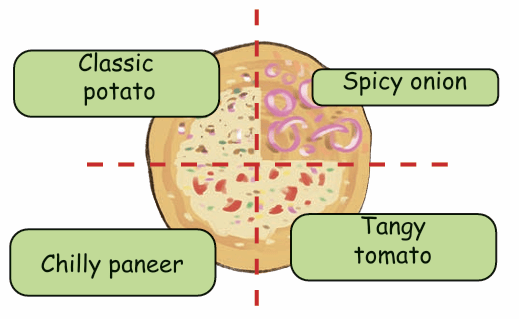 |
| Classic potato | 1/4 | |
| Spicy onion | 1/4 | |
| Chilly paneer | 1/4 | |
| Tangy tomato | 1/4 |
Do It Yourself
Write the fractions for each of the toppings in the following dosas.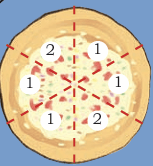 |
1) Chilli paneer =_______ |
| 2) Classic potato =_______ |
|
1) Spicy onion =_______ |
| 2) Tangy tomato =_______ |
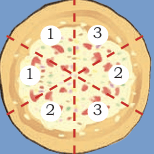 |
1) Tangy tomato =_______ |
| 2) Classic potato =_______ | |
| 3) Spicy onion =_______ |
|
1) Tangy tomato =_______ |
| 2) Classic potato =_______ | |
| 3) Spicy onion =_______ |
Make a dosa with 2/3 topping of Spicy onion, 1/3 of Classic potato.

Make a dosa with 3/8 of Classic potato, 1/8 of Chilly paneer and 4/8 of Tangy tomato mix.

Let Us Explore
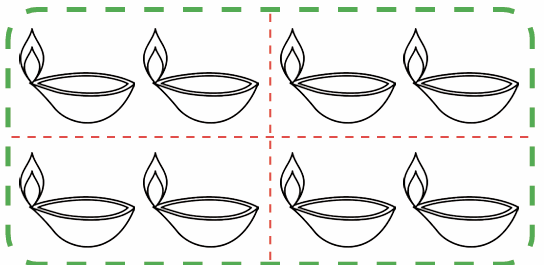
Meena has 8 diyas. Colour 1/4 of her diyas red. To find 1/4, let us divide the number of diyas into 4 equal parts. Can you see how to divide the diyas into 4 equal parts? Now colour 2 diyas red.
Let Us Do
Now let us try to find fractions for the situations given below. Circle the appropriate parts in the pictures.1. There are 12 cookies. What fraction of cookies will each get if the number of children are as follows:
a) 3 children
b) 6 children
c) 2 children
d) 4 children
5. Simran calls her school friends for her birthday party. 1/3 of her friends receive a hairband as their return gift. Place hairbands on 1/3 of her friends.
6. Draw flowers in 1/5 of the given number of pots.
Let Us Find Fractions in Our Surroundings
Kadamba is excited to know where we use fractions in daily life. She found some examples below. Help her find more examples and try to draw the images of the same in your notebook.
1. Yesterday Mummy asked to divide a box of barfis into four equal parts. There are 16 barfis in the box. Draw a picture of 16 barfis and find 1/4 of the whole. How many barfis are in each part?
2. Rohan has a piece of ribbon to decorate his notebook. Mohan’s ribbon is one-fourth as long as Rohan’s ribbon. How long will Rohan’s ribbon be? Draw it.
Mohan’s Ribbon ________________
1. Yesterday Mummy asked to divide a box of barfis into four equal parts. There are 16 barfis in the box. Draw a picture of 16 barfis and find 1/4 of the whole. How many barfis are in each part?
2. Rohan has a piece of ribbon to decorate his notebook. Mohan’s ribbon is one-fourth as long as Rohan’s ribbon. How long will Rohan’s ribbon be? Draw it.
Mohan’s Ribbon ________________
Try Yourself
1._____________________________________
______________________________________
______________________________________
2. _____________________________________
______________________________________
______________________________________
Let Us Do
| 1. Take a rectangular piece of paper and fold the paper into three equal parts and then unfold it. |  |
| 2. Colour one of the three equal parts as shown in the image. | 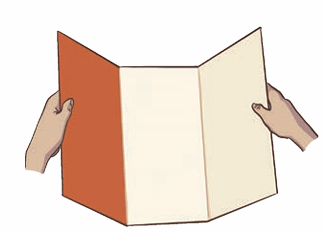 |
| 3. Fold the paper back into three equal parts like before, and then fold it in half. | 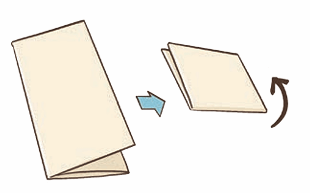 |
| 4. Observe the colored part. What is the fraction for the shaded part now? What does this mean? | 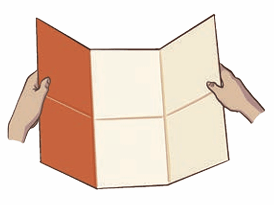 |
| 5. Fold the paper again and check how the coloured part changes. | 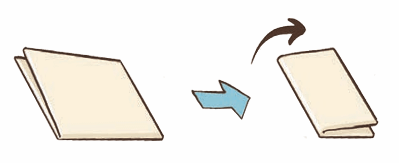 |
| 6. Write down what fraction you observe after each fold. 1/3 = 2/6 = _____ = ______=_____ |
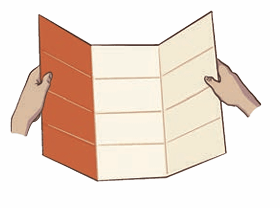 |
Let Us Try
Take another piece of paper and try the same starting with two equal parts, and halving every time. Share the findings with your friends.1/2 = 2/4 = _____ = ______=_____
Let Us Discuss
Observe the fraction chart and discuss the following questions. You may use your fraction kit also to explore the answers.1. How many 1/4 s are equal to 1/2 ?
____________________________
2. Is 2/3 less than or greater than 1/2 ?
____________________________
3. Ten pieces of 1/10 make a complete whole.
Is this statement true?
____________________________
4. Three pieces of 1/6 are equal to two pieces of 1/8.
Is this true?
____________________________
5. How many pieces of 1/8 make 1/4 ?
____________________________
Let Us Do
1. Bablu is playing with square shapes. He wants to cut them in such a way that each piece is equal in size. Circle the squares which have been cut into equal parts. Write the fraction for the shaded part, whenever possible.
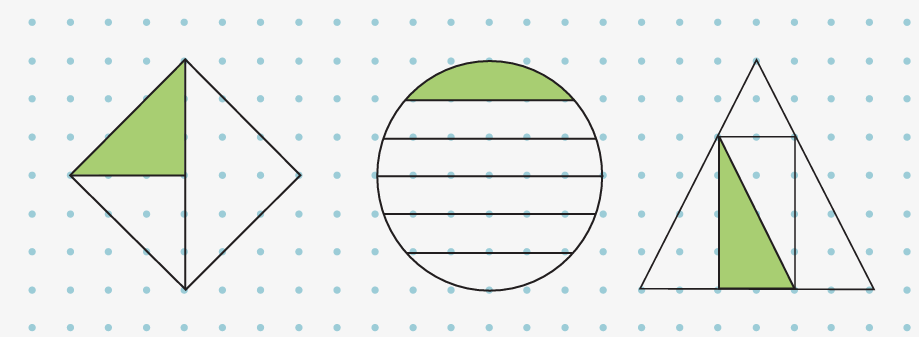 |
||
| Ameena says: 1/3 Kishore says: 1/4 |
Perry says: 1/6 Kunj says: 1/3 |
Balu says: 1/5 Gita says: 1/4 |
 |
||
| __________ | __________ | __________ |
 |
||
| __________ | __________ | __________ |
 |
|||
| Shade 2/3 | Shade 4/6 | Shade 1/4 Can you also show 1/8? |
Shade 3/4 |