Chapter 10
Elephants, Tigers, and Leopards

NIM Game (2 Player Game)
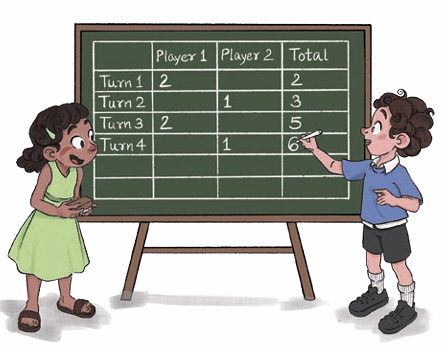
You have played a version of this game in the chapter ‘Vacation with my Nani Maa’ in Grade 3. We will add either 1 or 2 each time to reach the target number 10.
How to play?
1. Player 1 starts by choosing either 1 or 2.
2. Player 2 can also choose either 1 or 2 and add it to the number chosen by Player 1.
3. The two players continue playing by choosing either 1 or 2 and adding it to the previous total.
4. The player who reaches 10 first is the winner.
5. Play it for a few rounds.
Can you win the game if
a) the other player has reached the total of 6 and it is your turn?
b) the other player has reached the total of 7 and it is your turn?
c) the other player has reached the total of 8 and it is your turn?
Play the game to reach other target numbers (like 10, 11, or 12) by adding 1 or 2 each time.
Can you find a number in each case when you are sure that you can win?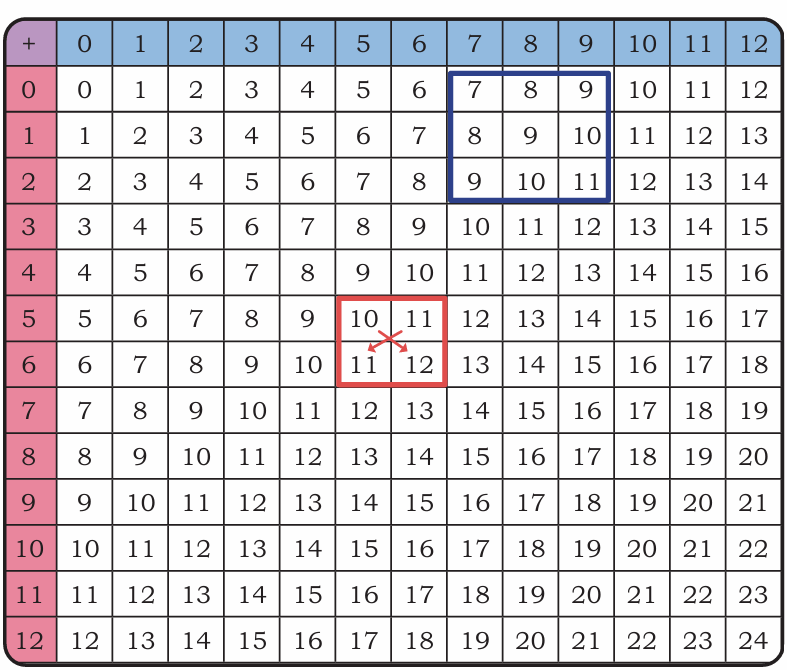

b)
c)
 3/4 of the world’s tiger population and 3/5 of the Asiatic elephant population is in India.
1. The population of elephants in Karnataka is 6049 and in Kerala is 3054. How many total elephants are there in these two states?
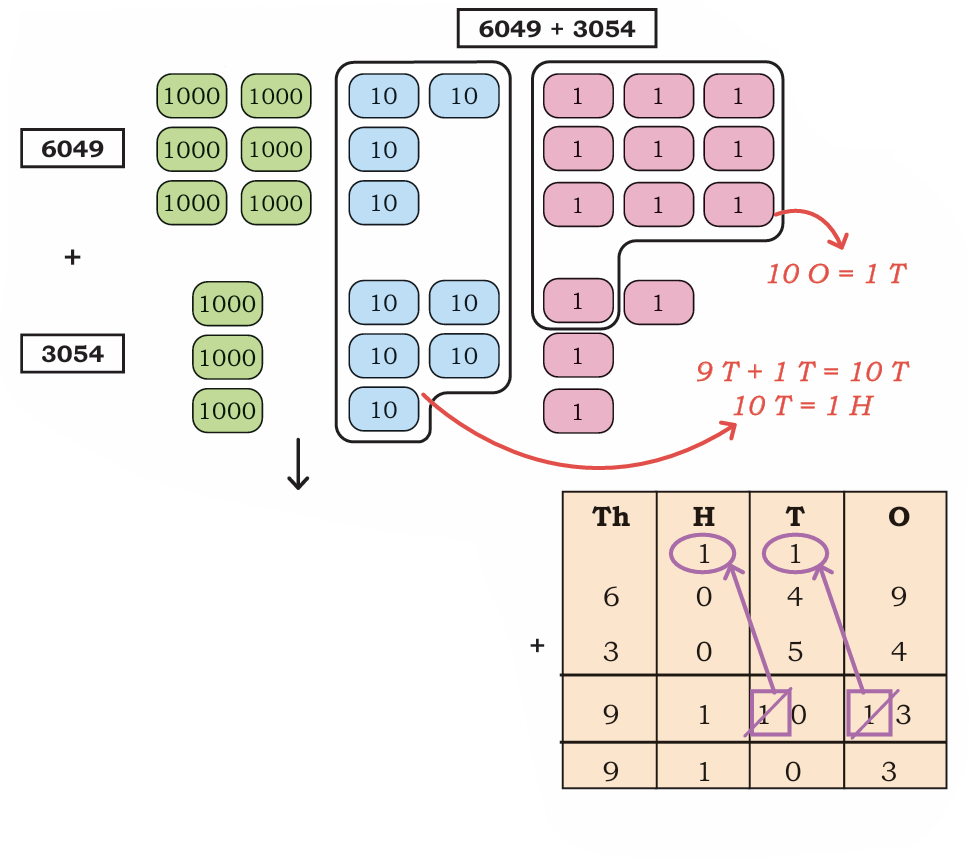 9 Th + 9 T + 13 O
= 9 Th + 1 H + 0 T + 3 O
= 9103
There are 9103 elephants in Karnataka and Kerala.
2. The highest number of leopards are found in three states. Gujarat has 1355, Karnataka has 1131 and Madhya Pradesh has 1817. How many total leopards are there in these states?
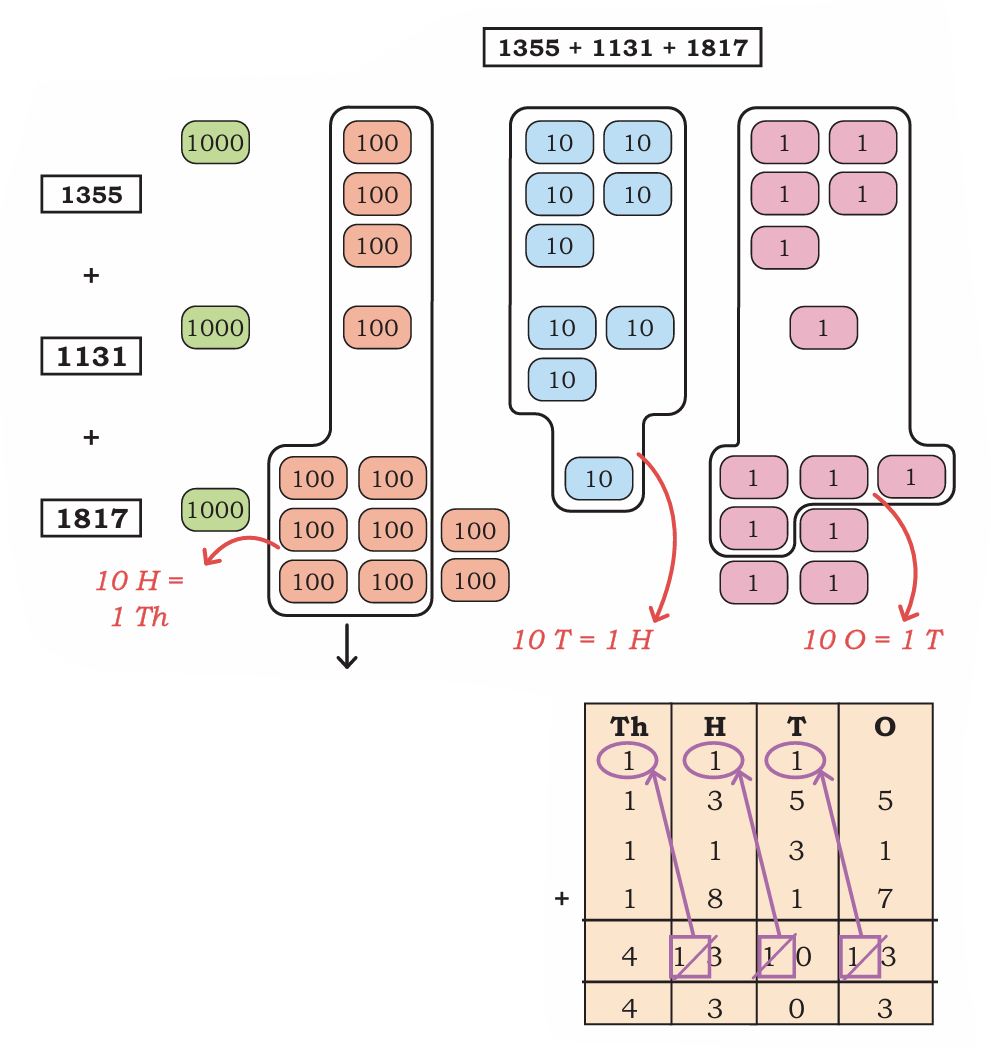 3 Th + 12 H + 9 T + 13 O
= 4 Th + 2 H + 10 T + 3 O
= 4 Th + 3 H + 0 T + 3 O
= 4303
There are 4303 leopards in these three states.
3.
a)
b)
c)
d)
2. Arrange the following in columns and solve in your notebook.
1. Add
2. Subtract
1. Player 1 starts by choosing either 1 or 2.
2. Player 2 can also choose either 1 or 2 and add it to the number chosen by Player 1.
3. The two players continue playing by choosing either 1 or 2 and adding it to the previous total.
4. The player who reaches 10 first is the winner.
5. Play it for a few rounds.
Who wins in each of these cases?
a) the other player has reached the total of 6 and it is your turn?
b) the other player has reached the total of 7 and it is your turn?
c) the other player has reached the total of 8 and it is your turn?
Note for Teachers: Encourage learners to play this game with various target
numbers. You could also help note down the sums and the results for learners
to analyse.
Can you find a number in each case when you are sure that you can win?
Addition Chart
Look at the table given below and discuss how the table is made.
1. Identify some patterns in the table.
2. Observe the cells where the number 9 appears in the table. How many times do you see number 9?
What about other numbers?
3. Are there any rows or columns that contain only even numbers or only odd numbers? Explain your observation.
4. Look at the window frame highlighted in red colour in the table.
a) Find the sum of the two numbers in each row.
b) Find the sum of the two numbers in each column. What do you notice?
c) Now, find the sum of the numbers in each of the two diagonals marked by arrows. What do you notice?
d) Now, put the red window frame in other places and find the sums as above. What do you notice?
5. Identify some patterns and relationships among the numbers in the blue window frame.
2. Observe the cells where the number 9 appears in the table. How many times do you see number 9?
What about other numbers?
3. Are there any rows or columns that contain only even numbers or only odd numbers? Explain your observation.
4. Look at the window frame highlighted in red colour in the table.
a) Find the sum of the two numbers in each row.
b) Find the sum of the two numbers in each column. What do you notice?
c) Now, find the sum of the numbers in each of the two diagonals marked by arrows. What do you notice?
d) Now, put the red window frame in other places and find the sums as above. What do you notice?
5. Identify some patterns and relationships among the numbers in the blue window frame.
Reverse and Add
a) Take a 2-digit number say, 27. Reverse its digits (72). Add them (99). Repeat for different 2-digit numbers.
b) What sums can we get when we add a 2-digit number with its reverse?
c) List down all numbers which when added to their reverse give
i) 55 ii) 88
d) Can we get a 3-digit sum? What is the smallest 3-digit sum that we can get?
b) What sums can we get when we add a 2-digit number with its reverse?
c) List down all numbers which when added to their reverse give
i) 55 ii) 88
d) Can we get a 3-digit sum? What is the smallest 3-digit sum that we can get?
Fill in the blanks with appropriate numbers.
a)
| 2540 | 2590 | ___ | ___ | ___ | ___ |
| 354 | 1354 | ___ | ___ | ___ | ___ | ___ |
| 7645 | 7670 | ___ | ___ | 7745 | ___ | ___ | ___ |
How Many Animals?
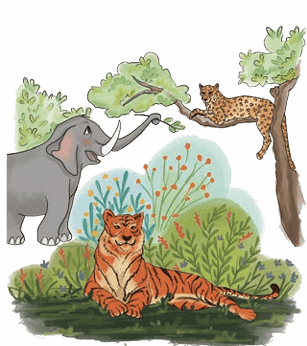
India is rich in biodiversity. It is home to some of the endangered wildlife, like elephants, tigers and leopards.
3/4 of the world’s tiger population and 3/5 of the Asiatic elephant population is in India.1. The population of elephants in Karnataka is 6049 and in Kerala is 3054. How many total elephants are there in these two states?
Estimate the answer.________
9 Th + 9 T + 13 O= 9 Th + 1 H + 0 T + 3 O
= 9103
There are 9103 elephants in Karnataka and Kerala.
Estimate the answer.________
3 Th + 12 H + 9 T + 13 O= 4 Th + 2 H + 10 T + 3 O
= 4 Th + 3 H + 0 T + 3 O
= 4303
There are 4303 leopards in these three states.
Maharashtra has 444 tigers. Madhya Pradesh has 341 more tigers than
Maharashta. Uttarakhand has 116 tigers more than Maharashtra.
a) How many tigers does Madhya Pradesh have?
b) How many tigers does Uttarakhand have?
c) How many tigers does Madhya Pradesh and Uttarakhand have?
d) How many tigers are there in total across the three states?
Remember
10 O = 1 T
10 T = 1 H
10 H = 1 Th
10 T = 1 H
10 H = 1 Th
| H | T | O | |
| 4 | 4 | 4 | |
| ___ | ___ | ___ | ___ |
| ___ | ___ | ___ |
| H | T | O | |
| 4 | 4 | 4 | |
| ___ | ___ | ___ | ___ |
| ___ | ___ | ___ |
| Th | H | T | O | |
| ___ | ___ | ___ | ___ | |
| ___ | ___ | ___ | ___ | ___ |
| ___ | ___ | ___ | ___ |
| Th | H | T | O | |
| ___ | ___ | ___ | ___ | |
| ___ | ___ | ___ | ___ | ___ |
| ___ | ___ | ___ | ___ |
Note for Teachers: Support children with multiple examples using tokens until they can independently solve various types of problems without the materials. You could also support using box diagrams for solving word problems as suggested in the previous chapter.
More or Less?
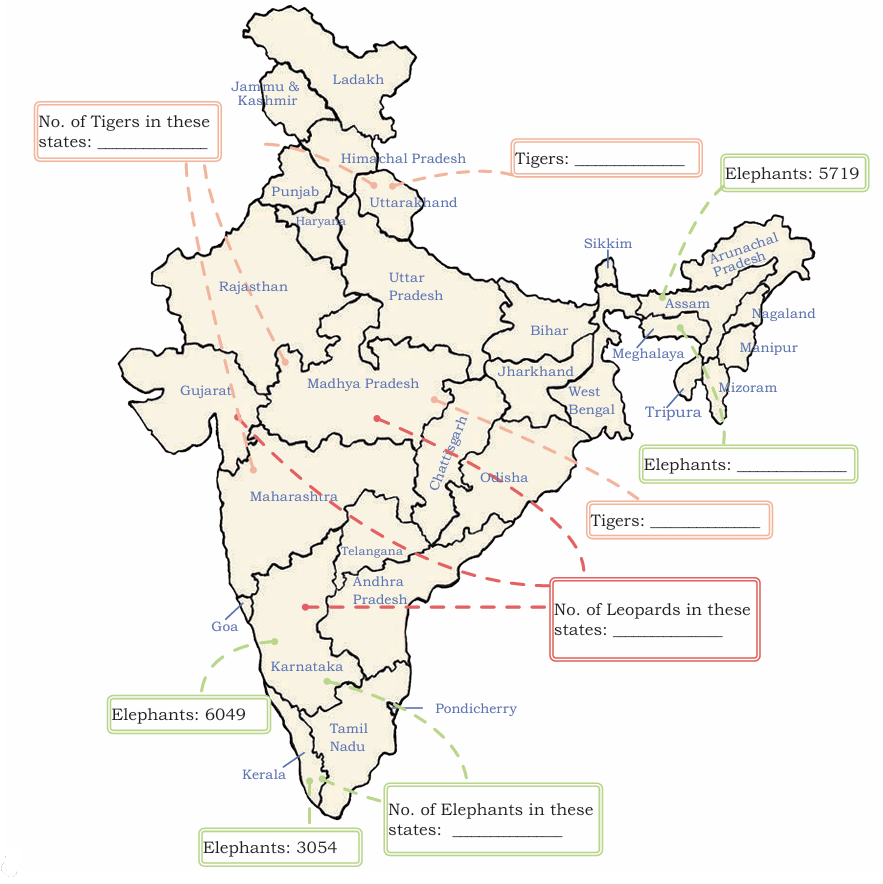
1. Assam has 5719 elephants. It has 3965 more elephants than Meghalaya. How many elephants are there in Meghalaya?
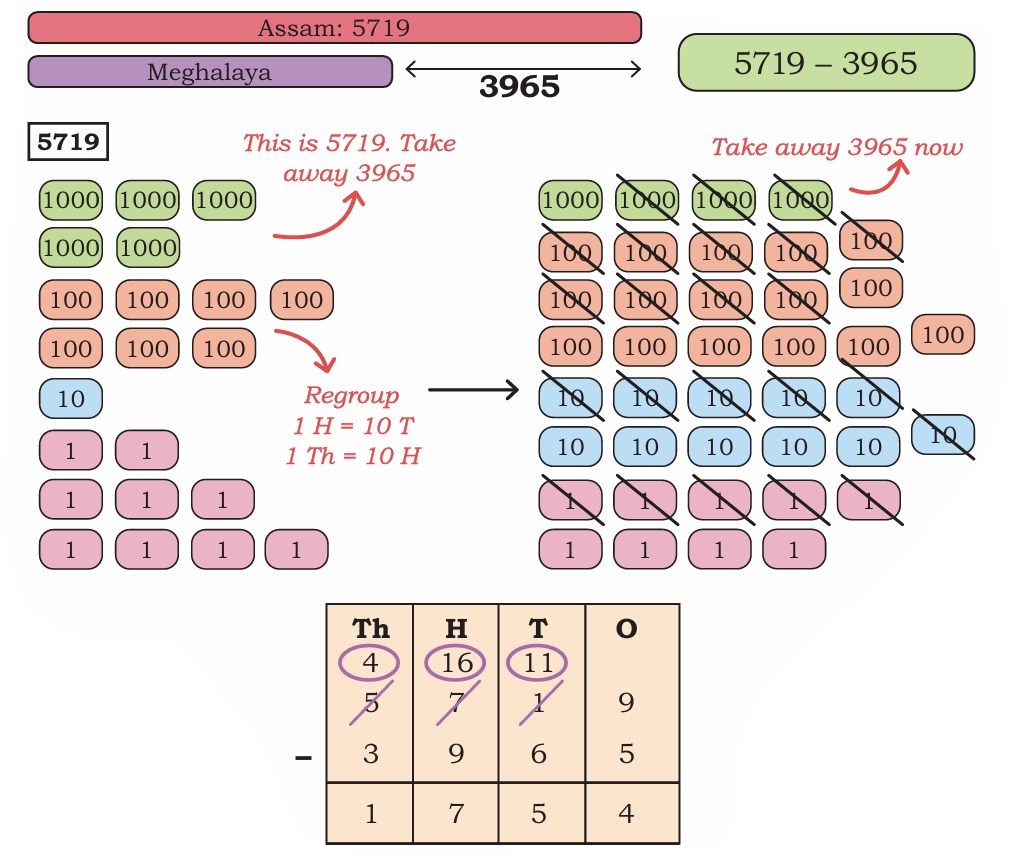
1754 elephants are there in Meghalaya.
2. The population of leopards as per the 2022 census was 8820 in the Central India and the Eastern Ghats. It had increased by 749 in comparison to the number of leopards in 2018 in the same region. How many leopards were there in 2018?
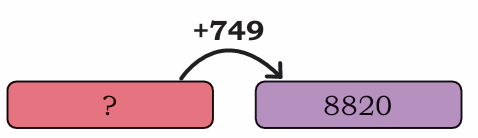 ? +749 8820
_______ leopards were there in 2018.
Write the number of animals on this map based on the data from the
problems in the previous pages.
Estimate the answer.________
Estimate the answer.________
? +749 8820
| Th | H | T | O | |
| ___ | ___ | ___ | ___ | |
| ___ | ___ | ___ | ___ | ___ |
| ___ | ___ | ___ | ___ |
Let Us Do
1. The board in the ticket office in the Kaziranga National Park shows
the following:
a) How many more visitors came in December than in November?
b) The number of visitors in November is 1587 more than October. How many visitors were there in October?
2. In a juice making factory, women make different types of juices as given below:
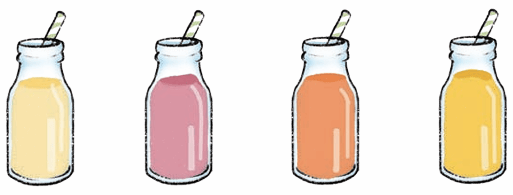
a) The number of bottles of guava juice is 759 more than the number of bottles of pineapple juice. Find the number of bottles of guava juice.
b) The number of bottles of orange juice is 1257 more than the number of bottles of guava juice and 1417 less than the number of bottles of passion fruit juice. How many bottles of orange juice are made in a month?
c) Is the total number of bottles of guava juice and orange juice more or less than the number of bottles of passion fruit juice? How much more or less?
3. In a small town, the following vehicles were registered in the year 2022. Find the number of vehicles as per the conditions given below.
a) The number of buses is 253 more than the number of jeeps. How many buses are there in the town?
b) The number of tractors is 5247 less than the number of buses. How many tractors are in the town?
c) The number of taxis is 1579 more than the number of tractors? How many taxis are there?
d) Arrange the numbers of each type of vehicle from lowest to highest.

+253 -5247 +1579
4. Solve
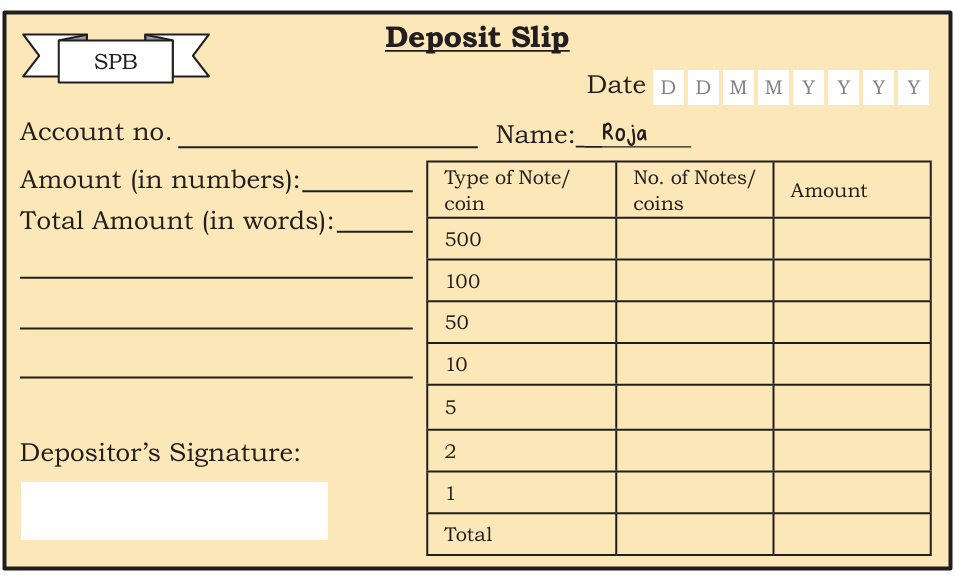
5. The children in a school in Chittoor are planning to organise a Baal Mela in their school.
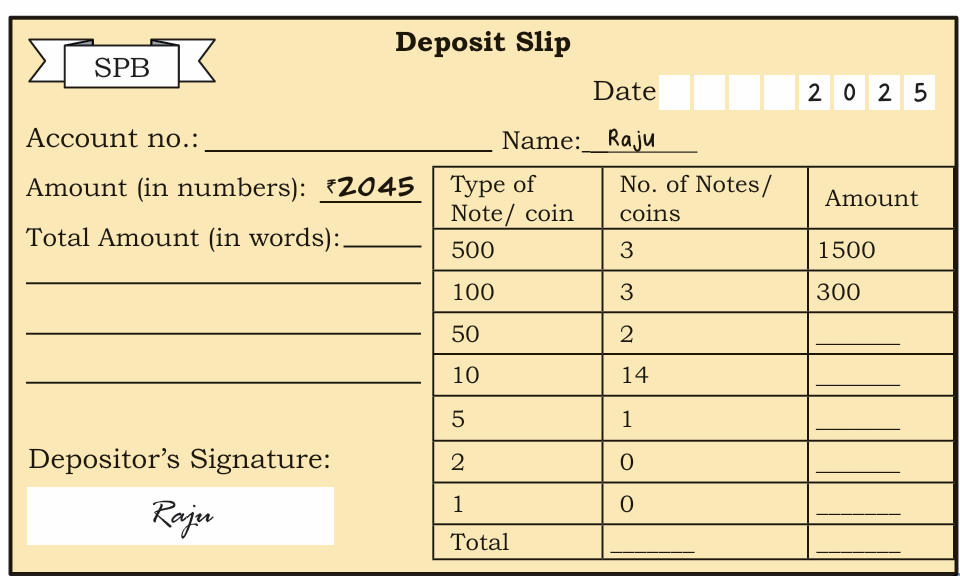
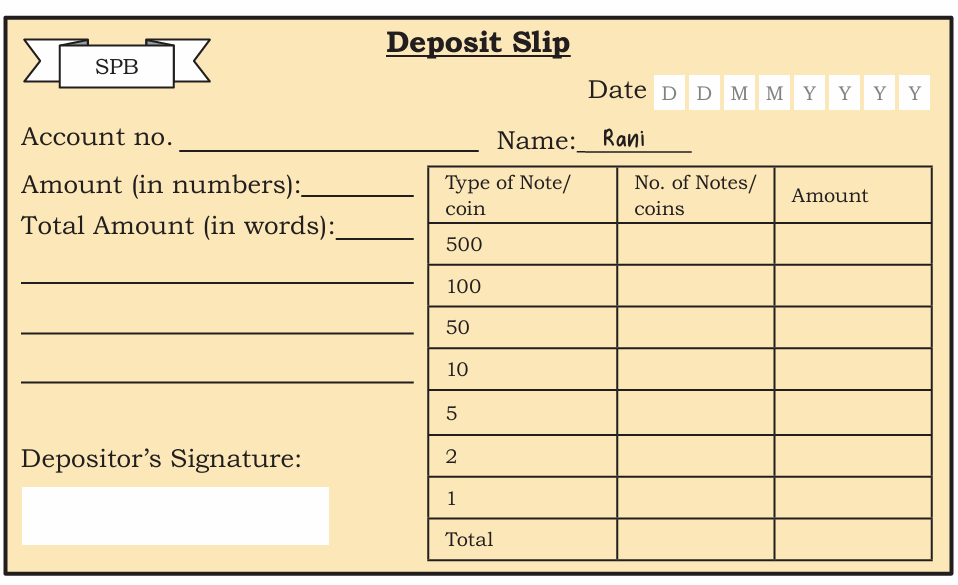
Raju, Rani and Roja decided to raise some money to make arrangements for the mela. The money is availabe in notes of 500, 100, 50, 10 and coins of 5, 2 and 1. They decide to put the money in the School Panchayat Bank.
Help each of the children fill the deposit slip given below.
Different combinations of notes can give the same amount. Can you guess a possible combination of notes they might have? Fill in the amounts appropriately.
| WELCOME TO KAZIRANGA NATIONAL PARK | |
| Month | Number of visitors |
| December | 8591 |
| November | 6415 |
| October | ? |
b) The number of visitors in November is 1587 more than October. How many visitors were there in October?
2. In a juice making factory, women make different types of juices as given below:
| Type of juice | Number of bottles packed in a month |
| Pineapple | 1348 |
| Guava | ____ |
| Orange | ____ |
| Passion Fruit | 4781 |
b) The number of bottles of orange juice is 1257 more than the number of bottles of guava juice and 1417 less than the number of bottles of passion fruit juice. How many bottles of orange juice are made in a month?
c) Is the total number of bottles of guava juice and orange juice more or less than the number of bottles of passion fruit juice? How much more or less?
3. In a small town, the following vehicles were registered in the year 2022. Find the number of vehicles as per the conditions given below.
a) The number of buses is 253 more than the number of jeeps. How many buses are there in the town?
b) The number of tractors is 5247 less than the number of buses. How many tractors are in the town?
c) The number of taxis is 1579 more than the number of tractors? How many taxis are there?
d) Arrange the numbers of each type of vehicle from lowest to highest.
| Jeeps: 6304 | Buses | Tractors | Taxis |
| a) 1459 + 476 | f) 7293 – 2819 |
| b) 3863 + 4188 | g) 3105 – 1223 |
| c) 5017 + 899 | h) 8006 – 5567 |
| d) 4285 + 2132 | i) 5000 – 4124 |
| e) 3158 + 1052 | j) 9018 – 487 |
Raju, Rani and Roja decided to raise some money to make arrangements for the mela. The money is availabe in notes of 500, 100, 50, 10 and coins of 5, 2 and 1. They decide to put the money in the School Panchayat Bank.
| Raju | Rani | Roja |
 |
 |
 |
| ₹ 2045 | ₹ 3578 | ₹ 1240 |
Different combinations of notes can give the same amount. Can you guess a possible combination of notes they might have? Fill in the amounts appropriately.
Let Us Solve
1. Solvea)
| Th | H | T | O | |
| 3 | 6 | 9 | 5 | |
| + | 4 | 2 | 0 | 8 |
| _____________ | ||||
| Th | H | T | O | |
| 2 | 5 | 0 | 7 | |
| + | 6 | 8 | 4 | 7 |
| _____________ | ||||
| Th | H | T | O | |
| 6 | 3 | 5 | 2 | |
| - | 3 | 5 | 2 | 1 |
| _____________ | ||||
| Th | H | T | O | |
| 8 | 8 | 0 | 3 | |
| - | 5 | 7 | 2 | 6 |
| _____________ | ||||
| a) 3683 – 971 | e) 1465 + 632 |
| b) 8432 – 46 | f) 3567 + 77 |
| c) 4011 – 3666 | g) 8263 + 3737 |
| d) 5203 – 2745 | h) 5429 + 3287 |
Let Us Solve
1. Find easy ways to solve the following problems. Write the answers in the given space. Share your thinking with the grade.
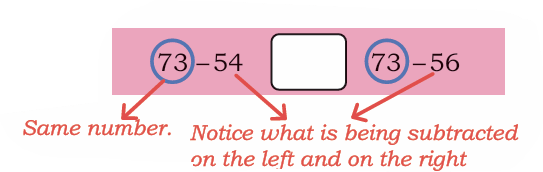
2. Use the signs <, =, > as appropriate to compare the following without actually calculating. Try to reason them out and share in grade.
3. Use the given information to find the values. Share your reasoning with the grade.
| a) 8787 – 99 =____ (Subtract 100, then add 1) |
(e) 4990 + 310 =____ |
| b) 4596 + 104=____ | (f) 7844 – 15 =____ |
| c) 3459 + 21 =____ | (h) 1575 – 125 =____ |
| d) 5010 + 95 =____ | (h) 1575 – 125 =____ |
| (i) 3999 + 290 =____ |
| 54 + 97 _____ 54 + 90 |
| 84 – 68 _____ 90 – 68 |
| 76 + 85 _____ 80 + 86 |
| 73 – 54_____ 73 – 56 |
| 139 + 175 = 314 | 845 – 394 = 451 |
| 314 – 175 = _____ | 845 – 395 = _____ |
| 354 + 167 = 521 | 456 + 209 = 665 |
| 354 + 168 = _____ | 446 + 219 = _____ |
Note for Teachers: Encourage children to solve these problems without working out the algorithm but by noticing other ways to solve them. Notice the ways the numbers on both sides increase and decrease and the results. You could model these with some materials like Dienes block or tokens. You could give more such problems to the children.
| a) 2783 + 378 | f) 3792 + 2688 |
| b) 8948 + 97 | g) 4999 + 3888 |
| c) 7006 + 367 | h) 5005 + 4895 |
| d) 8009 + 485 | i) 5768 + 4053 |
| e) 6062 + 3809 | (j) 3480 + 479 |
| a) 4456 – 2768 | f) 3400 – 897 |
| b) 5300 – 467 | g) 9382 – 4857 |
| c) 8067 – 4546 | h) 7561 – 2933 |
| d) 5302 – 1034 | i) 6478 – 5986 |
| e) 8004 – 3107 | (j) 3444 – 2555 |
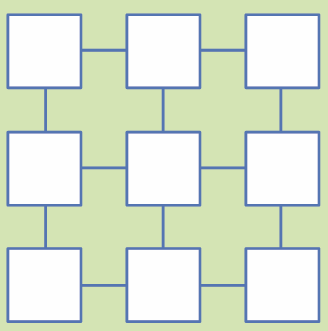
3. Fill the squares with the numbers 1– 9. The difference between any two neighbouring squares (connected by a line) must be odd.
Can you find other ways to fill the squares?
Can you do the same thing such that the difference between any two neighbouring squares is even?
Can you find other ways to fill the squares?
Can you do the same thing such that the difference between any two neighbouring squares is even?