Chapter 1
OBJECTS ON THE MOVE
Dear Teacher,
Let us take our students to a space where they can engage in visual arts and explore their ideas through hands-on activities. To create and share a joyful visual arts experience, students must be allowed to work freely and independently.
Classroom Requirements
- 1. Sufficient space and ventilation to work comfortably.
- 2. Easy access to art materials, tools, basic stationery and audio-visual facilities, and a proper storage space for the same.
- 3. Space for showcasing and exhibiting artworks periodically.
Visual Arts Pedagogy
- 1. Use storytelling and everyday examples while introducing concepts and processes.
- 2. Encourage students to freely express their original ideas, imaginations, emotions, and curiosities through artwork.
- 3. Encourage keen observation of everyday life and discourage copying images from other sources, including photos.
- 4. Allow students to explore, investigate, experiment, collaborate, and have dialogues in the classroom about their ideas.
- 5. Include outdoor activities and field trips to observe life and culture around them.
- 6. Introduce students to various artists and artworks, connecting to the themes and concepts being learnt.
- 7. Conduct art workshops in the school premises.
- 8. Invite local artists and craftsperson for interactive sessions and workshops for hands-on experience.
- 9. Inculcate simple habits, such as using art material carefully, putting materials back, and cleaning up after completing activities.
- 10. Encourage students to participate and make decisions while selecting artwork for display or exhibition.
Visual Arts Assessment
Please read the assessment note for all art forms.
- 1. Assessment should be based on the learning outcomes (LOs), which are aligned to the Competencies of the Preparatory Stage.
- 2. Each student should learn to build and maintain a portfolio of artwork. This will help the student and teacher track the learning and progress.
- 3. Formative Assessment should not be a separate
‘test day’, but integrated with the classroom
activities by:
- Giving students qualitative feedback, stating clearly their strengths and areas of improvement.
- Recording students’ participation in discussions on art in both formal and informal interactions.
- Assigning simple tasks during field trips to assess their observation skills and interest in art activities.
- 4. Summative Assessment should be conducted through project work or practical activities at the end of a semester. Some suggestive examples are provided at the end of the Visual Arts section.
Competencies for the Preparatory Stage
- C–1.1 Expresses enthusiasm to create a variety of images that depict their everyday life, emotions, and imaginations.
- C–1.2 Discusses a variety of ideas and responses while working collaboratively in Visual Arts.
- C–2.1 Creatively uses different combinations of visual elements (line, form, colour, space, texture) while depicting their everyday observations, personal experiences, and feelings.
- C–2.2 Compares and contrasts the visual elements, themes, and expressions of artwork shared in the classroom.
- C–3.1 Makes choices while working with materials, tools, and techniques used in Visual Arts.
- C–3.2 Practises steps of planning, executing, and presenting while creating visual artwork individually and collaboratively.
- C–4.1 Recognises visual elements in nature and describes their artistic qualities.
- C–4.2 Demonstrates curiosity towards local artforms and culture
| Learning Outcomes that can be assessed across chapters | ||||
|---|---|---|---|---|
| CG | C | Learning Outcomes | Teacher | Self |
| 1 | C–1.2 | Collaboratively reviews process of making and presenting artwork. | ||
| 2 | C–2.2 | Compares and contrasts the composition in various artwork to examine how they convey different ideas and emotions | ||
| 3 | C–3.1 | Demonstrates appropriate use of visual arts materials and tools. | ||
| 4 | C–4.1 | Observes and describes the visual arrangement of various natural forms. | ||
| 4 | C–4.2 | Shares their observations and interpretations of artwork and enquires about the methods and processes used by artists. | ||
Activities marked by a star symbol ★ can be facilitated by any teacher, even in schools with limited resources.
Chapter 1
OBJECTS ON THE MOVE
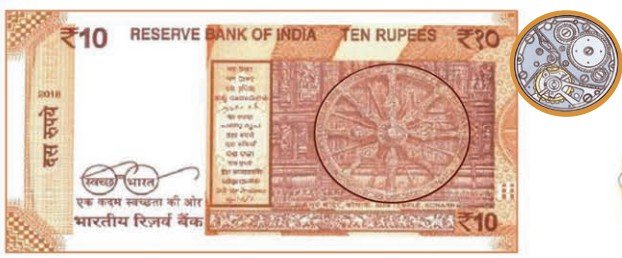
Have you ever taken a ride on a giant wheel at a fair?
The wheel is one of the most important inventions of humankind. It was invented more than 5000 years ago as a potter’s wheel. After that, it was used in carts and chariots to transport people and goods.
Think of the various objects and places where you see wheels. Can you imagine a life without wheels?
This chapter helps you explore the world of transport, where things are constantly on the move— with a few bumps and halts along the way. Through many exciting activities, you will observe vehicles and make artworks that give them new shapes, forms, colours, and functions.
ACTIVITY 1.1
Draw a Vehicle
You must have travelled with your family to visit places or meet people.
- What kinds of transport did you use?
- Did you enjoy riding in different vehicles?
- Which one did you enjoy the most? Why? Every vehicle has its own purpose, design, and character.
- Choose any vehicle you like.
- Look at the vehicle carefully. What geometrical shapes do you see? Draw them.
- Add details to your drawing.
- Draw the shadow of the vehicle.
- Colour and decorate your vehicle in your own style.
- Write a message about road safety and include it in your artwork.
ACTIVITY 1.2
Creating Patterns from Parts
Have you ever visited an automobile workshop? The mechanics there remove and repair different parts of bikes, cars, and other vehicles.
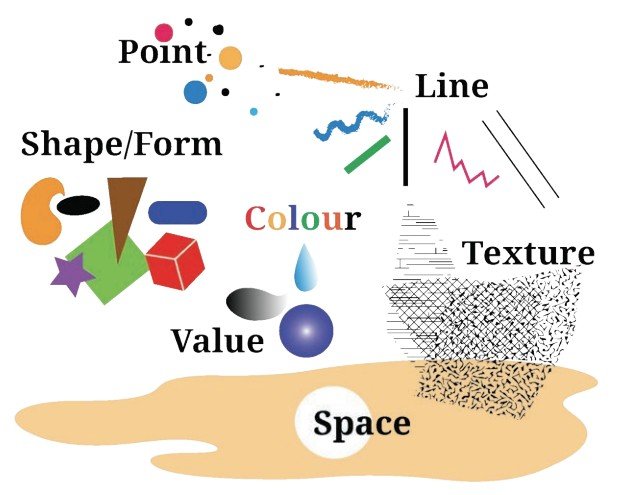
Just like vehicles have different parts, pictures and artworks also have parts. These parts are called visual elements.
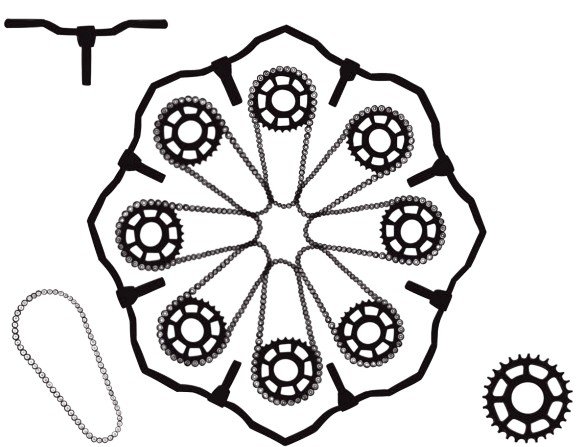
Identify the parts of a bicycle and visual elements used in the picture given.
On a separate sheet of paper, create your pattern using any two or three vehicle parts. It could be a seat, a bell, a pedal, a mirror, a handlebar, a steering wheel, or any other part of any vehicle. Make it interesting with colours.
ACTIVITY 1.3
Solve this Puzzle
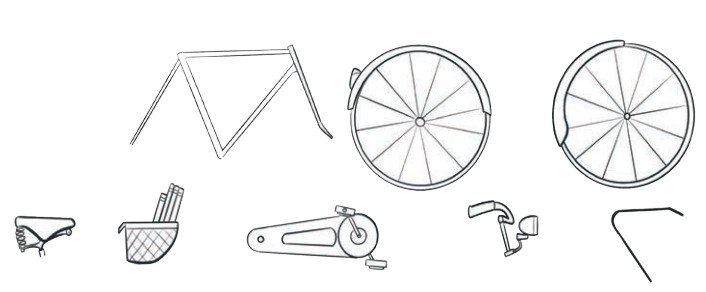
You can see many parts of a vehicle here. Can you guess which vehicle it is?
Put all the parts together in a drawing to complete the vehicle.✍
ACTIVITY 1.4
My Dream Vehicle
If you could make a vehicle of your dreams, what would it be like? Would it fly, sail, or roll? Would it carry many people or just you? Would it be suitable for children, older people, or even animals? Draw a sketch of your dream vehicle.
Build a model of your dream vehicle.
Materials: Old cardboard, matchboxes, bottle caps, discarded containers, sticks, scissors, glue, and tape.
Safety First: Be careful and ask an adult for help when using sharp tools.
Using your drawing as a reference, build a model of your dream vehicle.
- Make changes as needed while building the model.
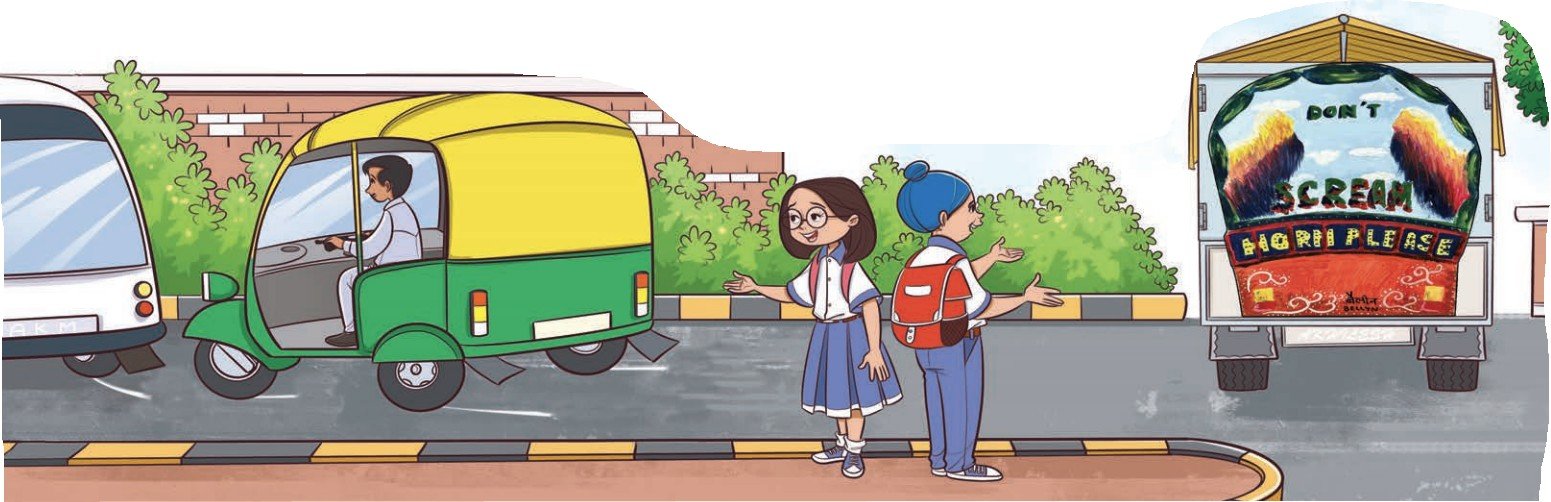
- After building the model of your dream vehicle, use paints and other materials to decorate it. You might have seen cycles, auto rickshaws, and trucks decorated to represent the identity of the driver or owner of those vehicles. Try to do something similar with your vehicle. After your vehicle is ready, decorate it as per your taste and choice.
Draw your dream vehicle on this page.✍
ACTIVITY 1.5
Halting Places
A bus stop is a place where people often
wait to catch a bus.
Form small groups and talk about your
experience of waiting at a real bus stop.
- Where is the bus stop located?
- Were there people of different age groups waiting with you?
- Did anyone face difficulty while boarding the bus?
- Was there enough space for everyone?
- Was the bus stop comfortable? (Did it have a roof, a ramp, benches, or shade?)
How would you design a better bus stop?
- What facilities would make waiting more comfortable for you?
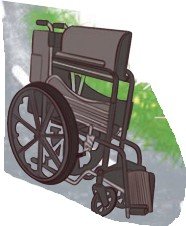
- What facilities would older people, children, or people with disabilities need at a bus stop?
- Draw your idea for a bus stop.
- Share it with your group.
Now, work together and create the sketch of a bus stop that includes ideas from all group members.
Using the sketch as a reference, build a 3D model of your bus stop.
Materials: Old cardboard, ice-cream sticks, discarded containers, broomsticks, waste fabric, old newspapers, glue, scissors, and colours.
When your bus stop model is ready, gather a few toy vehicles or make your own.
Imagine a busy day at the bus stop and narrate a short scene.
Draw your idea of a bus stop on this page.✍
Assessment
| CHAPTER 1 – OBJECTS ON THE MOVE | ||||
|---|---|---|---|---|
| CG | C | Learning Outcomes | Teacher | Self |
| 1 | C–1.1 | Depicts objects and their arrangement in a variety of contexts through two-dimensional and three-dimensional artworks. | ||
| 2 | C–2.1 | Combines parts of objects imaginatively to create patterns, new forms, and other objects. | ||
| 3 | C–3.2 | Attempts more than one iteration of visual artwork based on feedback from peers. | ||
| Overall participation in class. | ||||