Chapter 2
PEEPING OUT OF THE WINDOW
It was time for the art class, and each student was eagerly waiting for their teacher, with all the art materials neatly arranged on their desks. Their excitement was rewarded with an outdoor class, where they could freely draw plants, flowers, and butterflies while talking to the gardener.
To their disappointment, they soon heard thunder, and it started raining heavily. But just then, their teacher walked in and gently asked them to peek out of the windows.
The rain washed the earth, and everything looked fresh and clean. She pointed to the climbers— thin and fragile; they bent under the force of the rain, but their tendrils clung tightly to the plants, trees, and poles that supported them, so they did not fall.
Though they germinate in darkness underground, they overcome many obstacles, determined to rise. The delicate creepers never stop growing, just like the rivers that work their way through all kinds of geographical obstructions. At the same time, they offer us flowers, fruits, and vegetables.
Climbers and creepers teach us many lessons about being gentle, flexible, and trusting. They do not hesitate to seek support and have faith that they will be nourished by their surroundings. As they grow, they add beauty and life to every spaces they inhabit, whether indoors or outdoors.
ACTIVITY 2.1
Creepers and Climbers in Low Relief
What makes creepers and climbers
different from other plants? Their thin
and flexible stems curve, twist, spiral,
and loop as they grow.
Their flowing lines have inspired artists
to show them in sculptures, paintings,
textiles, architecture, and other art forms.
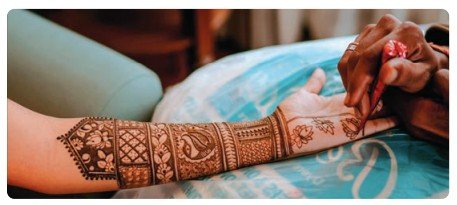
One such tradition is Mehndi, practised by people of all genders in many parts of India. It is prepared from fresh or dried henna leaves, ground into a thick paste, and filled into a cone. This is then applied mainly on the palms, arms, and feet.
When the mehndi dries, you may notice that the lines feel raised and are not flat like the rest of the skin. This is called low relief. It is also used in sculptures and carvings.
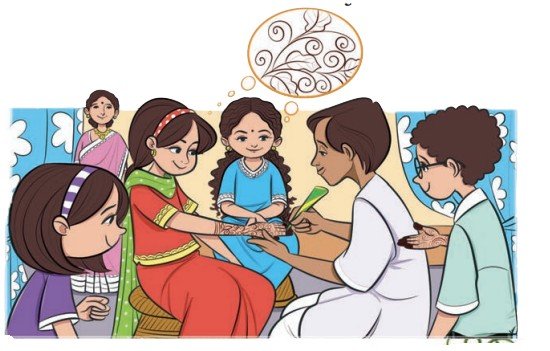
Invite your parents and local mehndi artists from the community. Work together and create designs inspired by climbers and creepers. With permission and consent, draw mehndi on the palms of your friends, family, and others around you.
Trace your hand here and draw a Mehndi pattern. ✍
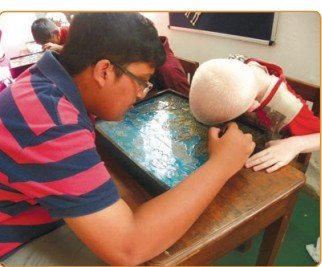
A special exercise with the visually impaired
- Fill a cone with a material of creamy consistency that can stick and solidify easily. Remember that the material must contain a binding agent, such as glue.
- Using the cone, outline your pattern on a flat surface, such as an old cardboard, paper or fabric and leave it to dry. This acts as a guiding path for your visually impaired partner. They can touch and feel the raised lines to easily navigate the low relief areas to fill in colours.
- Help them choose colours with their brushes.
- Join them in experiencing the joy of painting.
ACTIVITY 2.2
Magic with Colours
Holi is a festival of colours celebrated in
many parts of India. It is a time when
people enjoy playing with colours.
When do you enjoy playing with colours?
Have you observed how colours change
when they are mixed? It is magical.
The colour wheel is an essential tool that
helps artists create variations of colours.
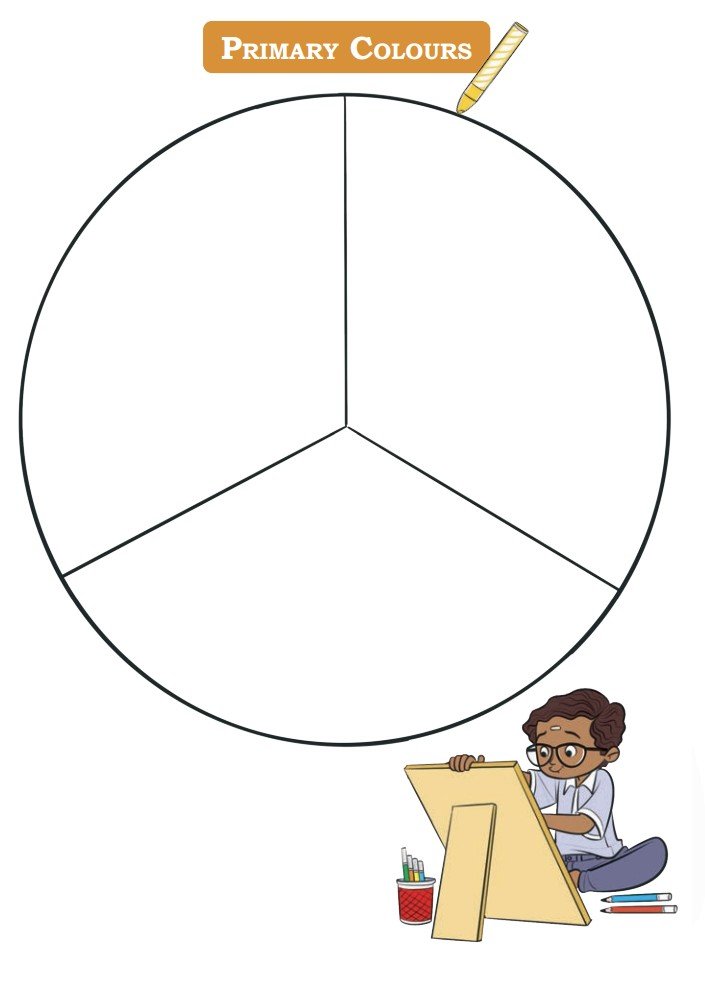
Let us learn to create a colour wheel.
Colours that cannot be obtained by mixing any other colours are called primary colours. These are red, blue, and yellow.
- Fill one primary colour inside each segment of the circle on the right.
- Write the names of the primary colours above their segments.
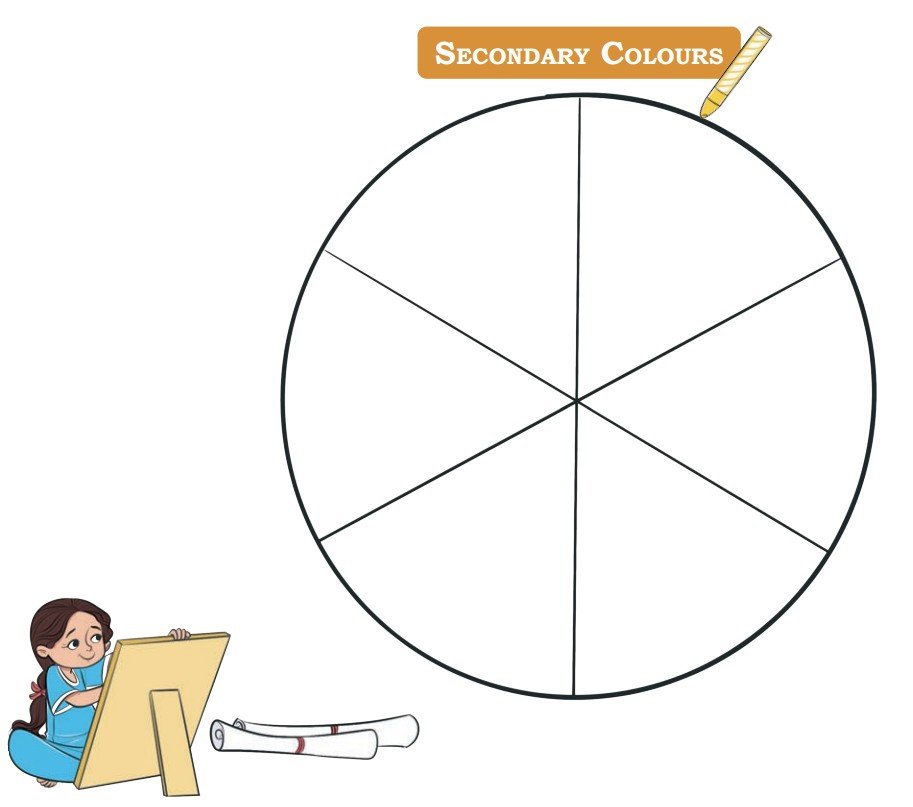
When two primary colours are mixed, they produce a secondary colour.
- Draw another circle and divide it into six segments.
- Fill the primary colours into alternate segments.
- Mix two primary colours and apply the resulting colour in the empty segment between the two.
- Add patterns to the secondary colours.
- Label the colours around the circle.
- Can you spot the colour wheel in different pages of this textbook?
Warm and Cool Colours
Warm things are usually in shades of red, yellow, and orange. Cool things are generally in shades of blue, green, and purple. Observe them in the colour wheel.
Note: If you use paints, wash your brush properly after using each colour, or use a separate brush for each colour.
ACTIVITY 2.3
Composing an Outdoor Scene
Have you ever taken part in an outdoor group photo on a picnic? The photographer often tells people where to stand, how to pose, and what they are trying to capture in the frame. It is important to know how to organise space in a photo, picture, or visual artwork. There are three kinds of spaces in a picture:
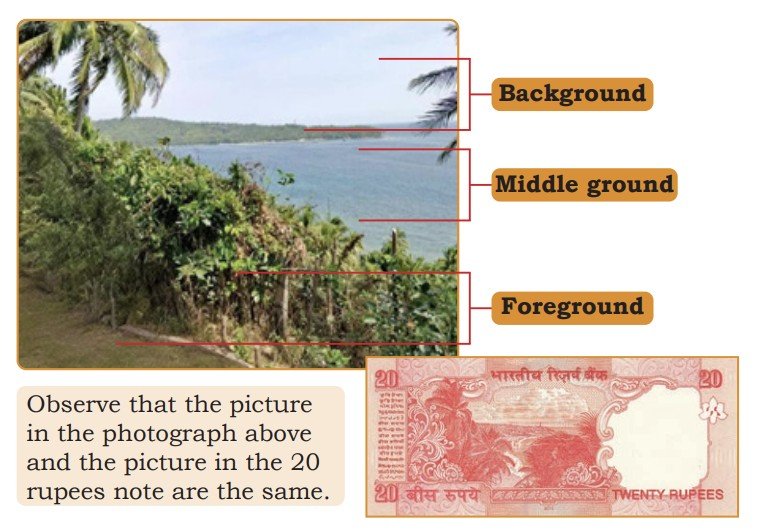
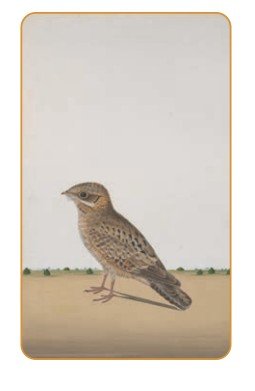
Mark the foreground, middle ground, and background in this painting.
- 1. Foreground is the space where the main subject is closest to the viewer and appears big. Its colours and details are clearly visible.
- 2. Middle ground is the space that lies behind the main subject. It has some details and gives depth to a scene.
- 3. Background is the space that is furthest away from the viewer. It has the least detail and light colours.
ACTIVITY 2.4
Colours of Time and Seasons
If colours express warmth and coolness, can they also convey time and season?
Recall your experiences and list the colours you see in nature during different seasons.
From your observation list the colours in the sky during different times of the day.
Observe shadows during the day. Write whether their lengths are short, medium or long.
- Divide a page into four equal parts.
- In the first part, plan and draw an outdoor scene you see in your surroundings.
- Decide what you will draw in the foreground, middle ground, and background.
- Repeat the drawing in other parts.
- Choose one season and one time of the day for each part. For example, Part or Square 1 can be a summer afternoon, Part or Square 2 can be a winter evening, and so on.
- Fill in the colours of the chosen season and time for each part.
- It is important to add shadows to give clues about the time.
- Mix colours to get more variety.
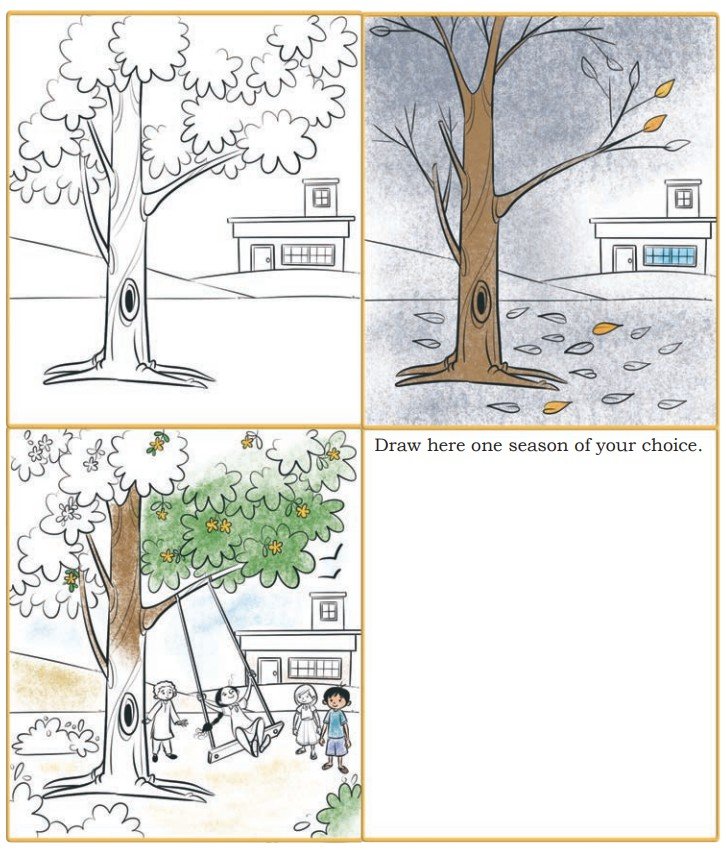
Draw your picture here and share it with others after completion.✍
Assessment
| CHAPTER 2 – PEEPING OUT OF THE WINDOW | ||||
|---|---|---|---|---|
| CG | C | Learning Outcomes | Teacher | Self |
| 1 | C–1.1 | Portrays scenes from nature as observed in different times and seasons. | ||
| 2 | C–2.1 | Imaginatively uses visual elements to create patterns seen in nature. | ||
| 2 | C–2.2 | Identifies the foreground, middle ground, and background in any given picture and uses these spatial divisions in their artwork. | ||
| 3 | C–3.2 | Creates a basic colour wheel by mixing primary colours to obtain secondary colours. | ||
| 3 | C–3.2 | Follows the steps of creating low relief artwork using a suitable medium. | ||
| Overall participation in class. | ||||