
Chapter 3
PICTURING STORIES
We interact with many people every day. Each person has a distinct style of walking, talking, laughing, speaking, and expressing their mood. You may have even noticed that each person’s shadow differs from others.
Think about your favourite people and why you like being with them.
Picture every detail about them—their face, smile, hairstyle, clothes, voice, gestures, and all their daily activities.
In this chapter, you will learn to observe people in action and things in their surroundings. Through shadow play and emojis, you will discover new ways of picturing stories of people and their lives.
ACTIVITY 3.1
Trace Shadows
You have probably observed your own shadow while walking in the sun. But have you observed how your shadow changes while walking past a streetlight at night?
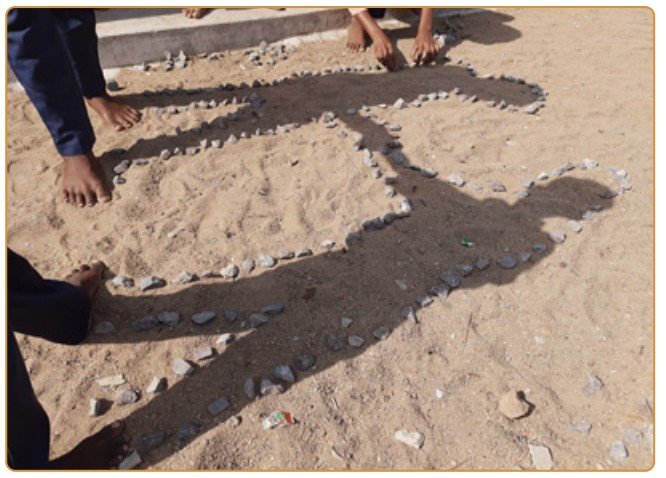
When light is blocked by an object or a living creature, it creates a shadow on the surface behind it. Sometimes, shadows look different from the things or person that made them.
Create Shadow Creatures
- Work in pairs or small groups.
- Step outside on a sunny day.
- Open your arms wide and sway like a flying bird.
- Hunch down on your knees and use your hands to create an elephant’s trunk.
- Think about how you will make a peacock or a gliding snake using your body.
- Pause when you have created a shadow you like.
- Your friends may trace along the shadow with their fingers, sticks, or stones.
ACTIVITY 3.2
Draw the Shadows
Draw the shadows you created here.
ACTIVITY 3.3
Stories in Shadows
Try these hand shadows you see on this page.
Have you ever seen shadows with many
colours?
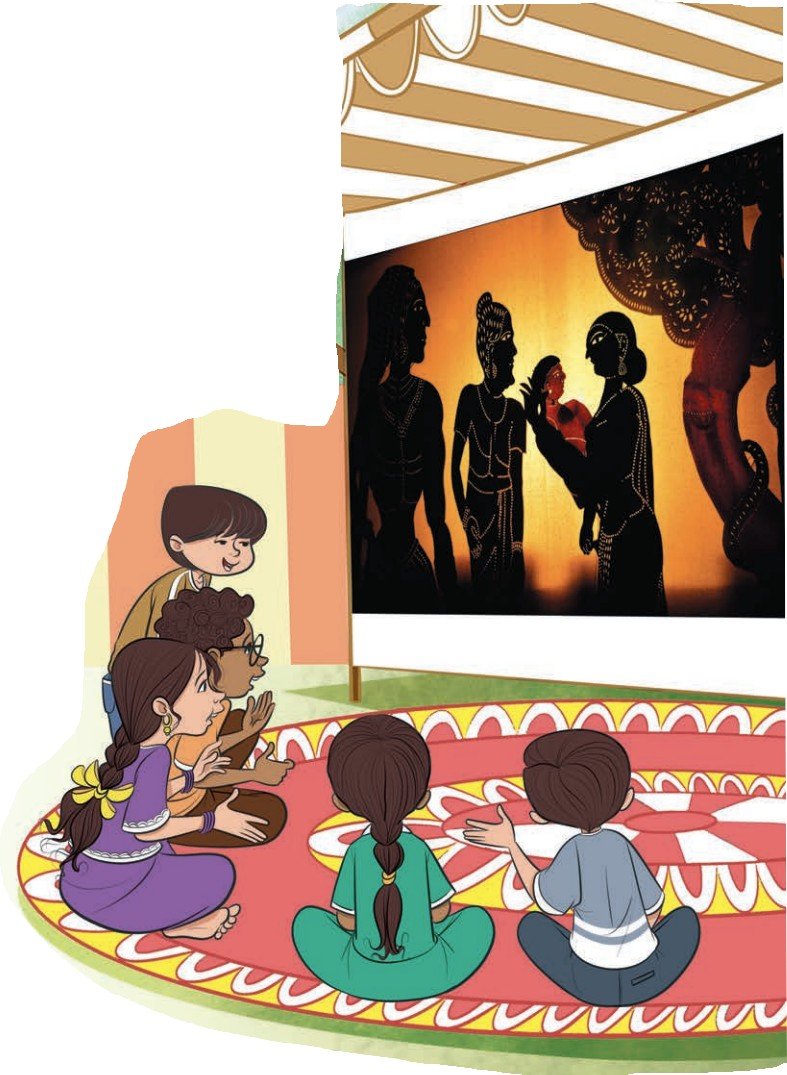
You can see this in a shadow puppet performance. This is an ancient art form that continues to be practised in Andhra Pradesh, Telangana, Odisha, Tamil Nadu, Kerala, Karnataka, and Maharashtra. The puppets are traditionally made of leather. But these days they are also made of other materials.
Light passes through the puppets during a performance, casting colourful shadows that move and tell stories.
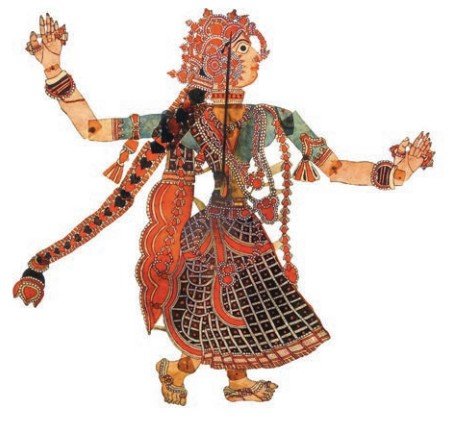
Try to watch a live performance. If not, find and watch videos of shadow puppetry online. Observe and discuss these points:
- How is the human body depicted as a shadow puppet?
- How are the different parts joined together?
- Gather the shadow drawings from the previous activity.
- Bring them alive by turning them into characters and creating a story.
- Write the story in about 100 words and share it with your friends.
In the previous activity, you observed how your body created visuals of different creatures through shadows.
Draw a scene from your story here.✍
ACTIVITY 3.4
Creating Emojis
Our face is the window to our emotions. You get a sense of someone’s mood just by looking at their face.
The smiley face is a popular symbol of happiness. You may have used it too.
Emoticons are simple pictures or icons that convey emotions. You can create these by using common punctuation symbols. For example, look at this :-) while tilting your head to the left. You will see a smiling face. Similarly,
🙁
shows a sad face,
😉
shows a winking face,
😜
shows a face with tongue sticking out,
Draw other emoticons in the circles below.
Emojis are more detailed than emoticons. They are commonly used in online communication.
Create your personal emojis
- Choose an expression that you cannot find among the existing emojis.
- It could even be a combination of expressions, such as you are angry but about to laugh, or you are crying while smiling.
- It can include a specific movement or action that you do while showing emotions.
Your personalised emojis should represent you and your style.

Draw your personalised emojis in the space below.✍
ACTIVITY 3.5
Making a Storyboard
A storyboard is used to narrate different moments in a story. It is similar to a comic and is used to plan scenes of a play, animation, advertisement, or movie shoot.
We all experience different emotions every day. Describe and compare how you feel when:
- you wake up early for school.
- you see your favourite dish for lunch.
- you are studying for an exam.
- you are playing with friends.
The daily routines of other people might be different from yours. Let us create a storyboard that depicts four activities from their day.
- Choose a person you are familiar with or someone you see on your way to school. It could be a teacher, family member, vegetable vendor, security guard, bus conductor, or anyone else.
- Imagine a day in their life through four different activities they might do. As you do this, recollect how the body expresses different emotions through dance and theatre.
Use the template given on the next page to create your storyboard.
- Write the activity and feeling for each of the four scenes.
- Develop each scene by dividing the space into foreground, middle ground, and background.
- Keep the person in focus and show their body postures, actions, and facial expressions.
- Colour your artwork.
1. Draw here
Activity:
Emotion:
2. Draw here
Activity:
Emotion:
3. Draw here
Activity:
Emotion:
4. Draw here
Activity:
Emotion:
Assessment
| CHAPTER 3 – PICTURING STORIES | ||||
|---|---|---|---|---|
| CG | C | Learning Outcomes | Teacher | Self |
| 1 | C–1.1 | Creates artwork that depicts emotions and moods through facial expressions and body postures. | ||
| 2 | C–2.1 | Creates own images and visual stories through shadow play. | ||
| 2 | C–3.2 | Creates a storyboard by sequentially developing each scene. | ||
| Overall participation in class. | ||||