
Chapter 5
SPREADING THE MESSAGE
School events are a lot of fun, but they also involve a lot of preparation and organisation. We want many people to know about the event and attend it. While speaking to others is one way of spreading the word, posters, invitation cards, and online messages are also commonly used to share event details.
A poster or invitation card should not only look attractive but also make the information easy to remember.
Posters can also be used to remind people about important topics, such as road safety, personal safety, cleanliness, nutrition and hygiene, good habits, school rules, and so on.
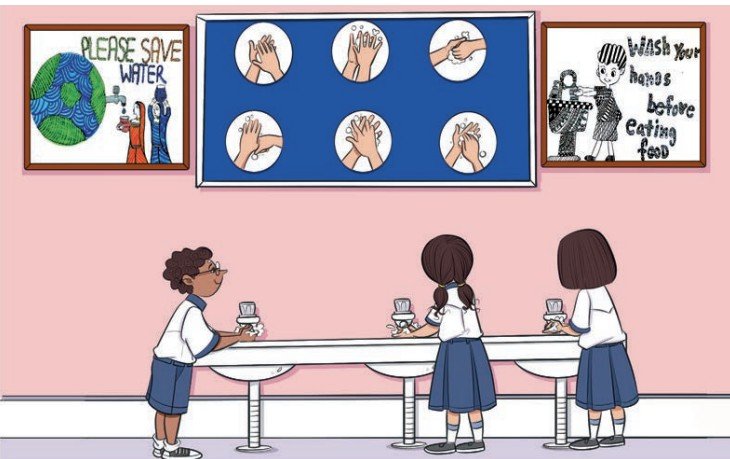
A well-designed poster can positively
influence a person’s thoughts and behaviour.
This chapter introduces you to some
basic design principles that will help
you create an effective poster on a chosen
topic. These principles will guide you in
improving the visual appeal and impact of
your design.
Basics of Poster Design
Posters carry messages that inform and create awareness. They use a mix of visuals and words to catch our attention and communicate important messages quickly and effectively.
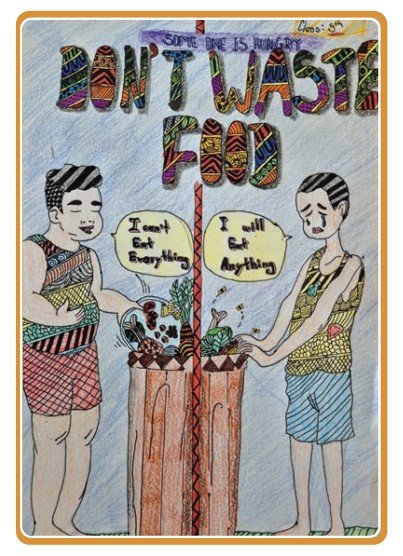
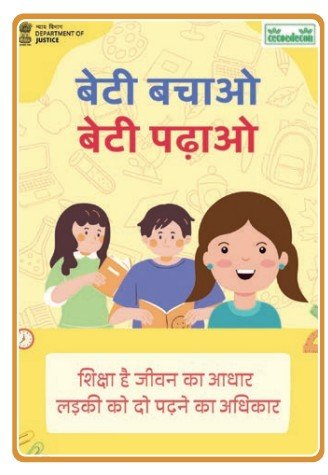
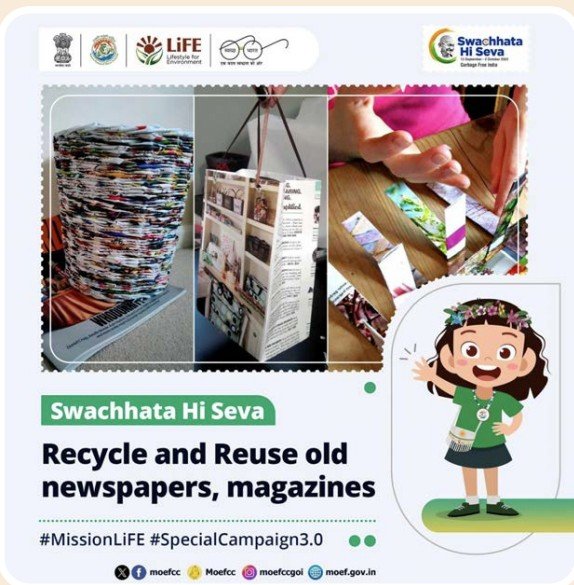
Look at the posters on this page.
- Identify the common elements used in the different posters.
- What helps you easily get the main message on each poster?
- What is the first thing that catches your attention in each poster? Why do you see it first?
Posters convey information effectively in just a few words. The arrangement of text and images in a poster is based on design principles. These principles help us make effective designing decisions.
Emphasis is a design principle that gives importance to one part more than others. It helps the viewer focus on the main message the visual and text convey.
- Identify the visual or text in the poster that is emphasised.
- How has it been emphasised?
- You may notice the following:
- Its size is big.
- Its colour is bright or attractive as compared to other parts of the poster.
- It is highlighted or underlined. How does emphasis help this poster?
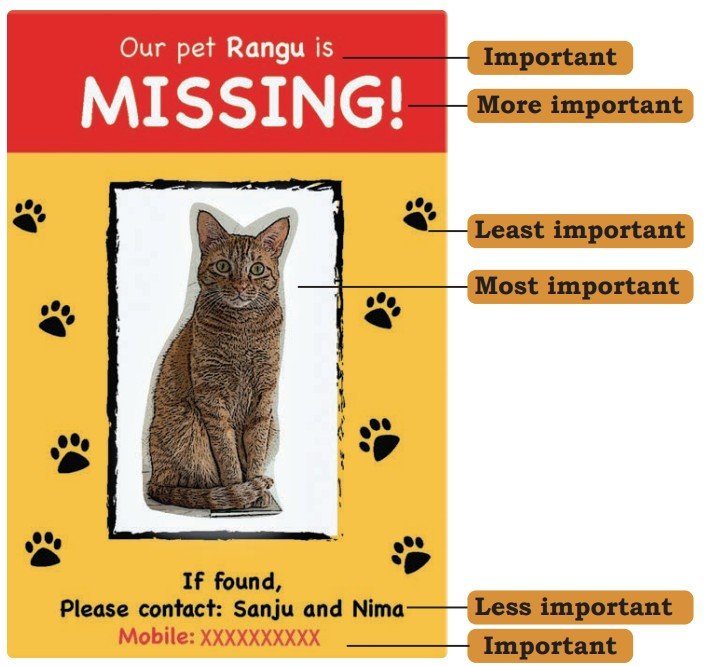
The Order of Importance is another design principle. For example, in a newspaper the text is printed in different sizes. The main headlines are large and bold so that they are read first. Less important matters are presented in smaller sizes.
In a poster about a missing pet, more space is used for the photograph of the pet. The next important detail might be the word ‘missing’. Both of these would quickly draw the viewers’ attention to the main topic. Other details like the owner’s contact information are necessary but may be given less importance and therefore less space.
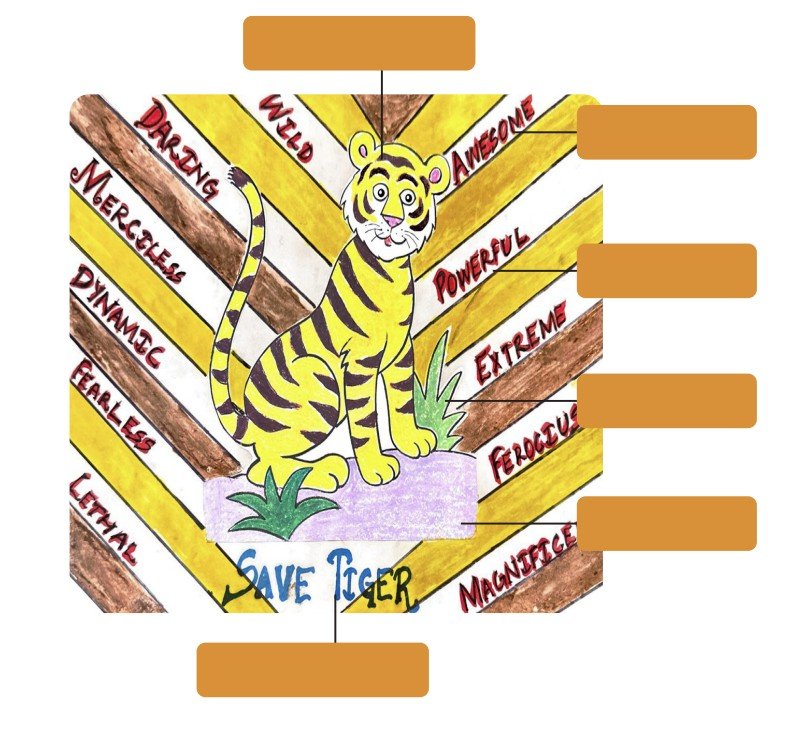
Relook at any poster carefully and identify the Order of Importance among its elements.
Identify and write the Order of Importance in the given poster.✍
ACTIVITY 5.1
Create Your Poster
Use the principles of emphasis and hierarchy to create your poster.
Choose a message you want to communicate to your friends. For example, classroom cleanliness, road safety, or everyday hygiene.
Plan the images you want to include and decide what size each one should be.
Write a phrase or sentence for your message. Ask your teacher to help you check the grammar and spelling.
Write a phrase or sentence for your message. Ask your teacher to help you check the grammar and spelling.
Plan the hierarchy (the order of priority) for the images and text. Decide the most important to the least important elements.
Create a rough layout of your plan for the poster. Decide where you will put the text and how much space it will take.
Look at your rough layout and see whether your most important element is emphasised. Is it the first thing that catches your attention? Do your eyes move across the layout in the order of priority you have planned?
Take an A3 sheet and draw a 3 cm margin on all four sides. Measure and draw parallel lines that will guide you in writing words in a straight line.
Draw the visuals, add details, and colour the poster.
Create the rough layout of your poster here.✍
Design principles are not only used in posters but also in advertisements.
✑ Gather old newspapers or magazines and cut out small advertisements and paste them here. Observe the emphasis and order of importance in the design and mark them. ✀
Assessment
| CHAPTER 5 – SPREADING THE MESSAGE | ||||
|---|---|---|---|---|
| CG | C | Learning Outcomes | Teacher | Self |
| 1 | C–1.1 | Creates posters that address issues and events in everyday life. | ||
| 2 | C–2.1 | Uses the design principles while making posters. | ||
| 2 | C–3.2 | Considers different contexts for making posters and plans work accordingly. | ||
| Overall participation in class. | ||||

Teacher’s observations:
Other comments:
Summative Assessment
| Activity for Assessment (Example) | Criteria for Assessment | |
|---|---|---|
| Individual | Create an invitation card for any family occasion, such as
a housewarming, birth ceremony, wedding, anniversary,
or any other such event.
|
|
| Group | Make groups of 4 and create a large artwork (chart paper size [8.5 × 11 inches]).
|
|