
Chapter 6
CREATE A SCENE
Dear Theatre Teacher,
This textbook for Grade 5 is designed to empower and encourage children to explore theatre as creators, collaborators and performers.
The goal is to have the children work
independently towards a final play performance.
It intends to encourage student-led learning,
where children take ownership of the process
of performance; from idea generation to final
presentation. Your role is to be a facilitator and
a supportive guide, helping them stay on track,
offering support when needed, and creating a safe,
joyful space where they can express freely.
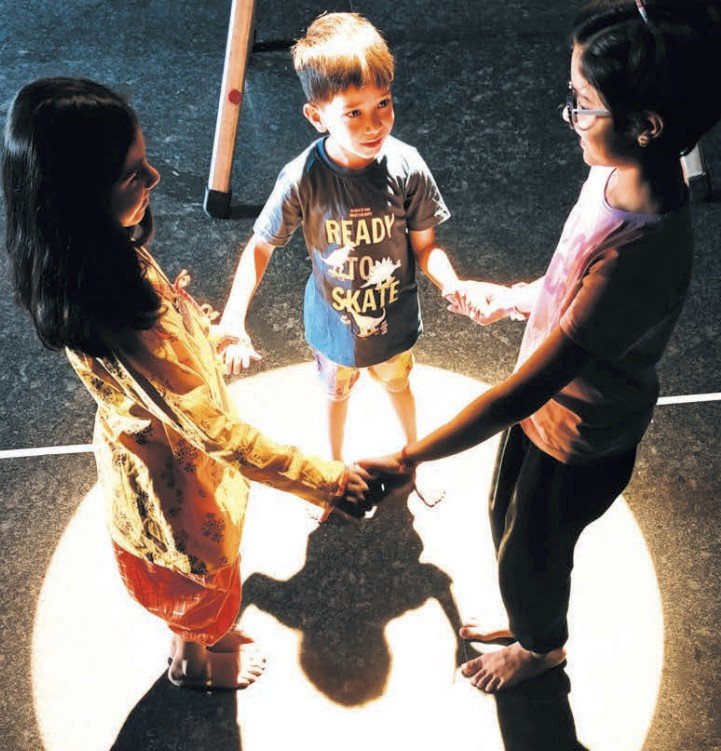
Encourage them to make decisions as a team—about the script, casting, costumes, sets, and direction. Mistakes are a part of the learning process. Let them experiment, solve problems, and discover the magic of performance on their own. It is suggested that the teacher step in when guidance is needed, but step back to let their confidence grow.
This process builds life skills in addition to theatre skills—communication, teamwork, empathy, and leadership. Let us enjoy the journey with our students and celebrate their growth at every stage!
Some points to keep in mind:
- Vidushaka is a unique character from traditional Indian theatre. The Sanskrit theatre used this character to instil the scenes with humour and antics. This character continues to be a friend for the children, supporting them with concepts and ideas in theatre, guiding them with information as they proceed from one activity to another. Vidushaka speaks about important take-aways and lessons for children. A spacious empty room is to be provided for theatre classes to facilitate free movement. It must be clean and free from obstructions or sharp objects that may cause injury.
- Start the class with a prayer and a recap of what was done in the previous class. A suggested prayer can be found in the Grade 3 textbook.

| CHAPTER 3 – PICTURING STORIES | ||
|---|---|---|
| 5 mins Prayer and Recap | 30 mins Class Activities | 5 mins Circle Time |
ASSESSMENT
Theatre has always been a positive and enjoyable experience for children. Therefore, just as they enjoy the classes, the assessments must also be fun-filled and not bring in the stress or anxiety normally associated with tests and exams.
All assessments are based on activities. Here are some basic pointers to keep in mind during assessment:
- Competency and skill acquired are the focus.
- There is no correct or wrong answer where creativity is involved.
- The final outcome or presentation is not the only benchmark. The effort, thoughts and
process behind it also need to be considered, along with —
- Knowledge application
- Effort and participation
- Creativity and presentation
- Teamwork and collaboration
- Encourage self-reflection and treat it as feedback for teachers (last column provided in the rubrics).
- Create a motivating and supportive environment, especially for those who may be shy or inhibited.
- Read the section on time allocation and assessments at the beginning of the book for better clarity.
| Formative Assessments | Summative Assessments |
|---|---|
A continuous process that goes on throughout the
class duration. No separate ‘test-day’. Includes:
|
It is completely activity-based and conducted at
the end of the year on a designated day. Question
papers and written tests are to be avoided.
|
Namaste … Suswagatam
All of us talk about scenes when we refer to a specific part of a play or a movie. We also say, “what a scene they created!” When something dramatic happens on the road, school or any other place. So, what is this scene?
A scene is a part of the play that:
- Takes the story forward.
- Happens in a specific place and time.
- Has something interesting or dramatic.
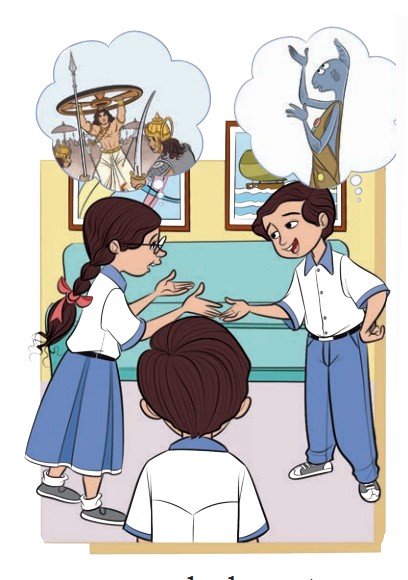
So, as Vidushaka says you will be performing a play this year and you will get to create scenes on your own! On the basis of the activities done in Grades 3 and 4, you have already learnt some parts of it. Here is a list. In case you want to re-do some activities in the first list, your teacher will help you do them based on the textbooks of Grades 3 and 4.
| What you have already learnt | What you will learn |
|---|---|
|
Role play Building conversation Visualising a scene—entry and exit |
Basic do’s and dont’s on stage Establishing place Establishing time Establishing characters |
Let us first look at the basic requirements that you must remember when you are on stage. It helps in making your show more presentable to the audience.
Things that you should do on stage
- 1. Speak clearly and loudly: This is so that everyone in the audience, including the ones in the last row, can hear you.
- 2. Stay in character: If you are on stage, you are the character you are playing. This is true even if you are not speaking. Your entry and exit should also be in accordance with your character.
- 3. Respect your fellow actors: Wait for your turn to speak and support others on stage. Be clear about the position you have to stand in and where you have to walk. This has to be done without affecting others.
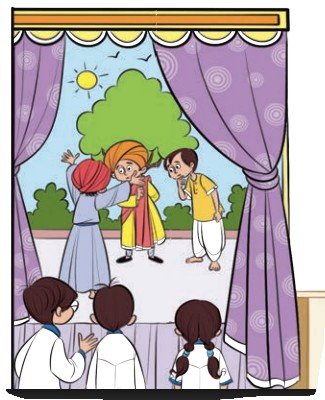
Things that you should not do on stage
- 1. Do not turn your back to the audience: While facing the audience always tilt slightly sideways. If you have to walk to a position that is behind, try to avoid speaking when your back is turned.
- 2. Do not talk backstage: If you are waiting to enter or have just completed your part, sit quietly. Talking or discussing will distract you, the other actors on stage and the audience.
- 3. Do not block others: Be aware of where you are standing. Ensure that all actors are visible to the audience. Also check if there is someone in front of you, blocking your view of the audience.
It is very important that you remember these do’s and dont’s every time you are on stage, for any performance that you do in the future. These comprise what is called ‘stage etiquette’. These are basic behavioural rules that create a pleasant experience for the actors and the audience. With this in mind, let us now look at how you can build a scene.

The basic requirement of a scene is to communicate the answers of the following questions to the audience:
scene
- 1. Where is it happening?
- 2. When is it happening?
- 3. Who are the people?
The audience would have these questions while watching a play. Let us work on how we can answer them, so that the audience can understand the story clearly.
1. Where: Establishing the place
The easiest way is to arrange your set and props in a way that depicts the location.
For example, some chairs and a centre
table would represent a house. Tables
with files, papers or laptops on it would
represent an office, and so on. Costumes
also add to it. An office will have formal
clothes, while a park will have casual
clothes. What will you do if you cannot
bring all the props? The actors and their
behaviour will have to represent it. Here are
some examples to help you understand.
A Vegetable Market
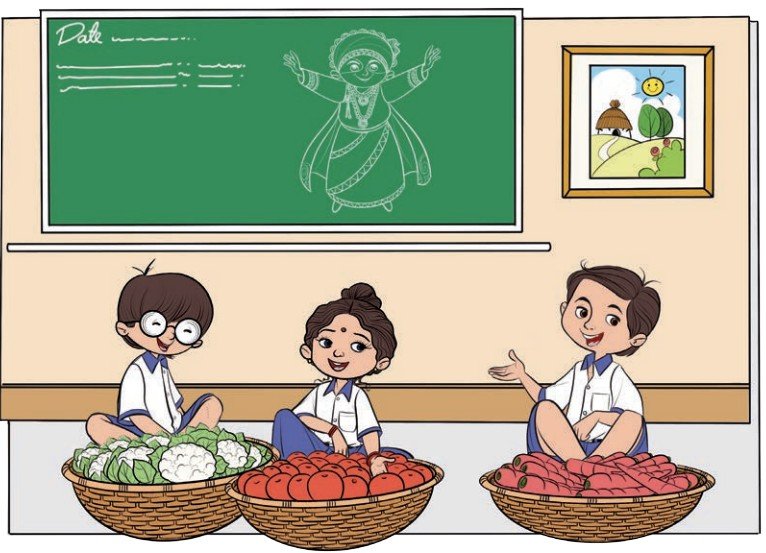
You will not be able to bring big carts and shops on the stage. So, the best way is to have actors (your friends) sit with mats and baskets, and call out names and rates of vegetables and fruits. You can also add some more actors who are buying from them and paying money. Depending on your team, you can add more people like ice-cream vendor, balloon seller, etc.
ACTIVITY 6.1
Guess Where
Instructions: Make groups of 6–7 members each. Each group is given a different place. You have to depict that place with acting and the props available in the classroom. Remember ‘object improvisation’ where you used one object to show different things? Use it here. You can make your school bag into a vegetable sack! Or use pencils to show beans and lady’s fingers! The place given to one group is not revealed to others. When one group performs, the others guess the place and discuss how it could have been better.
Basic: Familiar places like railway
station, bus stand, park, office, etc., can
be acted out.
You can use acting, simple costume
and speech to depict the place.
Advanced:
The same process has to be
repeated but this time you have to do
it without speaking! You can use body
language, expressions and props.
Unfamiliar places like forest, ocean,
etc. can be given to build imagination.
2. When: Establishing time
For the audience to correctly be involved
in a scene, details like time period become
important. Time is depicted at two levels:
Time period: Historical or present day
or futuristic. It is mainly depicted using
costumes, props and language.
Time of the day: Morning or evening or
night. Depicted through actions and speech.
Let us try an example. Tick the correct
option.
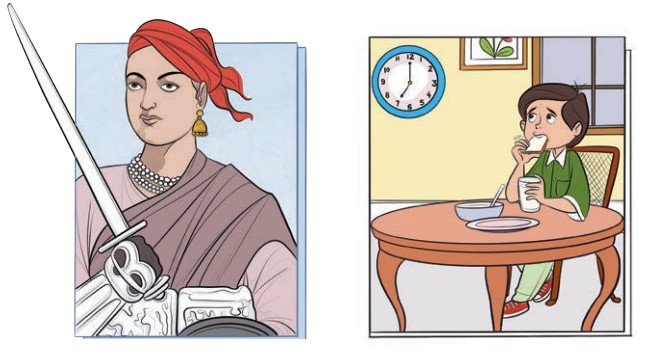
If you talk about getting late to school while eating breakfast in a hurry, the time is—morning or evening or night.
If you say you have had a very tiring day and yawn while speaking, the time is morning, evening, or night.
ACTIVITY 6.2
Time it Right
You can continue with the same groups that worked together on depicting the place. You will now be given different time options and situations to depict, and the other groups will guess the time you are showing.
Remember
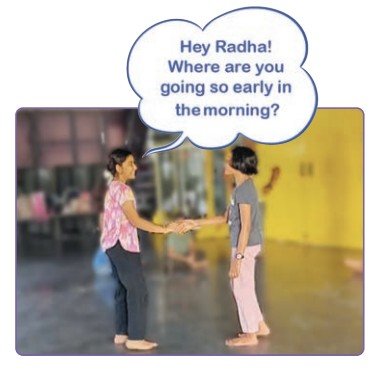
This information should not be conveyed by speaking directly to the audience or announcing, “It is a night scene” or “In the evening…”. Instead, it should be a part of the scene itself and the characters reveal it in action or through dialogues.
Ramesh: Hey Radha! Where are you going so early in the morning?
OR
Mother: Raju, it is 9 o’clock at night. Your father has not come yet.
3. Who: Establishing character
Actors on stage are the ones who get maximum attention. So, it is very important to convey the exact character. The basic appearance of a character is shown through costume and props. But it is also important to reveal more about the character, than what costumes can. Look at this character. You can easily say that it is a professional woman who works hard. It is necessary for the story to convey that she is very kind and is always willing to help, despite her busy schedule. How can you show this? This is the actual depiction of a character.
Option 1: Make two other characters talk about her in their conversation. Example: Her neighbours discussing how she helped their son for his maths examination.
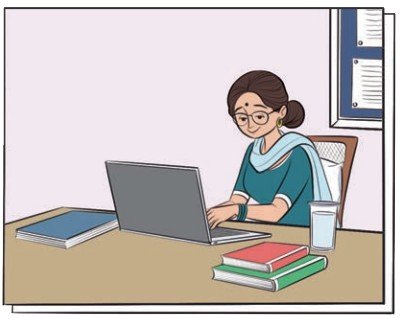
Option 2:Show a simple situation of her helping a wounded dog on the road.
Option 3:______________________________ (You can think of a unique way to depict this character.)
Pick different characters and discuss in groups about different ways of revealing them in the scene. Remember, a scene will have multiple characters. One could be short tempered, another could be very funny, and so on.
ACTIVITY 6.3
The Actual Scene!
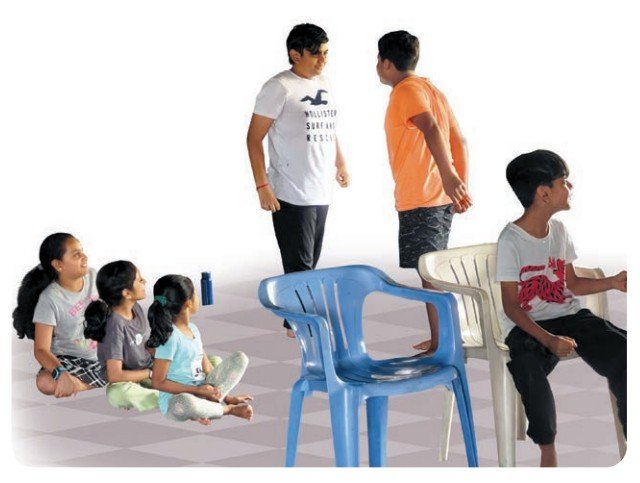
Now, let us put together everything you have learnt to get a complete scene. You can continue to work in the same groups created in the beginning of this chapter. Each team picks up a topic (could be suggested by your teacher), plans and practises, and presents it to the other groups. Make sure you have included the basic stage etiquette, establishing place, time and character in your scene.
- Which scene was the most convincing in all the four areas?
- In the parts that you were not able to depict convincingly, what was difficult?
- Can the others in the class suggest solutions on how it can be done better?
Assessment
| CHAPTER 6 – CREATE A SCENE | ||||
|---|---|---|---|---|
|
Competencies C–1.1: Expresses enthusiasm to depict a variety of objects, people, situations, and experiences in drama activities. C–1.2: Discusses own thoughts and responses while working collaboratively in the Dramatic Arts. |
||||
| CG | C | Learning Outcomes | Teacher | Self |
| 1 | 1.1 | Able to depict place, time and character in a scene. | ||
| 1.2 | Shares feedback on others’ presentations. | |||
| 1.2 | Trying activities without inhibition. | |||
| 1.1, 1.2 | Alertness and attention to detail. | |||
| 1.2 | Overall participation in class. | |||