Chapter 7
STITCH IT FOR A STORY
You must have heard the word ‘stitch’, ‘stitching’ and ‘sewing’ many times in reference to your clothes or uniform. What does it mean?
According to Collins Dictionary, stitching refers to the act of joining or attaching things, especially fabric, using stitches, which are loops or turns of thread. It can be done by hand or with a Chapter 7 machine and is used for sewing, mending and decoration.
Just like the needle connects different points, a story too, has different situations that are connected. Like a tailor who stitches different pieces of cloth together, you will be connecting different situations together to make a story.
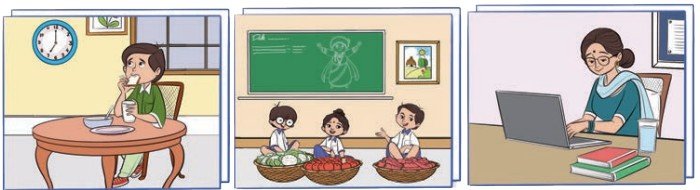
Let us start by connecting the situations you created in the previous chapter, as you worked in groups. As an example, we start with the vegetable market. Suppose we want to connect the office and home scenes to it. It cannot be enacted one after another without any connecting point. How do we bring that unity?
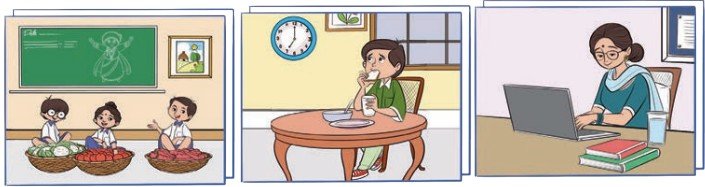
Look at these three pictures. Though they seem completely unconnected, you can connect them with some Creativity. This is creative stitching! First, let us change the order of these situations to help in bringing meaning.
Now, the story could be:
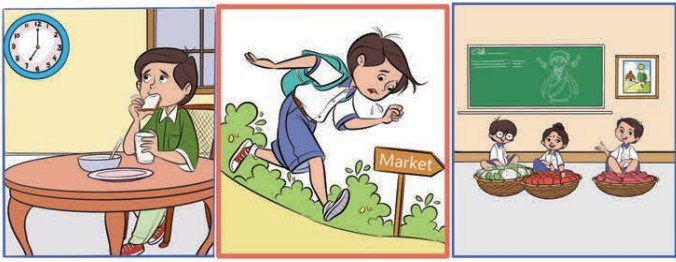
Raju was getting ready to go to school. Just
as he was eating breakfast, he remembered
that he had to take four different vegetables
to school for a project on health and
nutrition. However, when he looked at the
clock, he realised that now he would be late
to the school. If he went to the market, he
would have missed the project which he had
planned and practised with his friends. So,
somehow he ate fast and ran to the market.
But to his disappointment he could find
only two out of the four vegetables. Left with
no choice, he went to the school with only
two vegetables. But Raju’s mother came to
his rescue. She called the school teacher to
check if Raju had everything for the project.
Realising that he needs two more vegetables,
she immediately placed an online order for
the vegetables to be delivered directly to the
school. They were thankfully delivered just
in time and Raju completed the project with
flying colours!
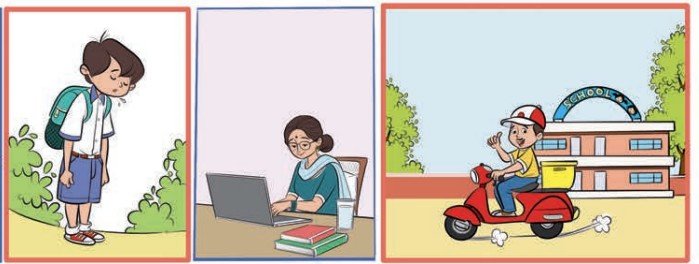
If you noticed, we added a few things between the main situations to bring a ‘flow’ to the story. The flow refers to the continuity of situations, so they don’t seem like unconnected pieces.
The pictures in the orange boxes are the new parts added to maintain the flow of the story, though the main situations remain the same.
Now you can try connecting more such situations by adding your own ideas to maintain the flow of the story. Now, you have learnt my kind of stitching— stitching stories! It is called a storyboard. Storyboards are used by professionals and film makers.
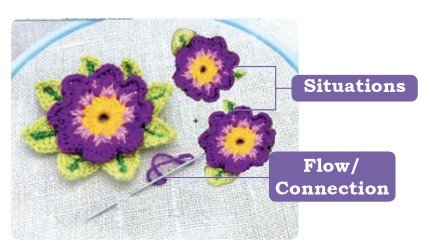
Embroidery Storyboard: Think of each flower on the cloth as a separate situation. The thread connects one flower to another to maintain the ‘flow’. That is how numerous pictures are connected in a storyboard.
The visual arts activity (3.5) on storyboarding will also help you with this.
ACTIVITY 7.1
Story Through Drawing
You can continue working in the same groups. Each group comes up with imaginary situations. They are then combined together like the example given previously, to present a simple story, with proper flow between situations.
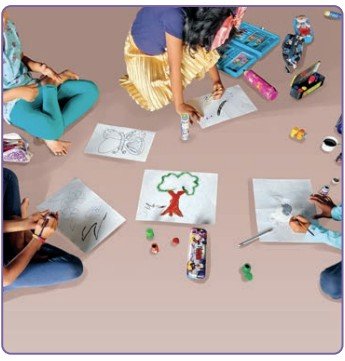
Basic: Each group narrates the situations. The full story, with all connections can also be a narration. Simple drawings to make a storyboard can be tried. Once you feel the story is interesting, you can assign roles and enact it. Remember the ‘role-play’ in Grades 3 and 4?
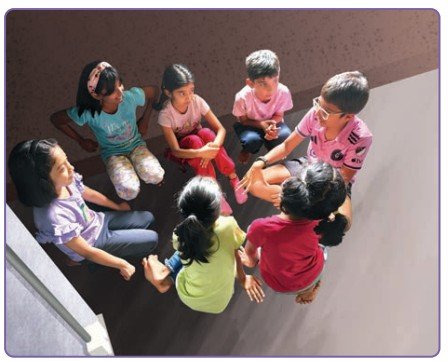
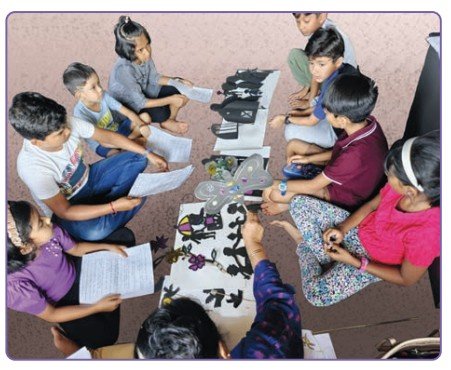
Advanced: A bowl of chits is given with all kinds of situations. It could be from history, everyday life, an imaginary situation or even from the stories read before. Each group picks up a chit. No matter how random it is, they work towards connecting them.
- Do you think storyboards are like comics? How are they different?
- What was the most challenging aspect of this exercise?
- What lessons from the Visual Arts section you studied in Grades 3 and 4 were useful when you had to make storyboards?
Assessment
| CHAPTER 7 – STITCH IT FOR A STORY | ||||
|---|---|---|---|---|
|
Competencies
C–2.1: Creates and performs drama in the classroom based on everyday events, by combining various characters, roles, situations, spaces, and basic props. C–2.2: Compares and contrasts themes and elements of drama, and related artistic expressions created in the classroom. |
||||
| CG | C | Learning Outcomes | Teacher | Self |
| 2 | 2.1 | Combines two situations by creatively adding story elements. | ||
| 2.1, 2.2 | Understands ‘flow’ of the story and compares it with friends’stories. | |||
| 2.2 | Understands the concept of storyboard. | |||
| 2.1 | Creatively changes order of situations to get a new story. | |||
| 2.2 | Works on building the scene ‘together’ and not just one’s ideas. | |||
| Overall participation in class. | ||||