Chapter 10
SING AND PLAY
Dear Music Teacher,
As we continue on this journey of music education, we have an opportunity to help our students love music, art and learn to express themselves freely. Every child is inherently creative and as educators, it is our role to make the classroom a safe space for every child, where they can learn and explore without fear or judgement. This book can be a guide for you.
Here are some guidelines that can help you prepare for a wonderful classroom experience:
- Start the class with a smile, a warm greeting and a warm-up exercise to help children ease into learning.
- Always use a tambura (instrument, electronic or app), a harmonium or a keyboard to help children match the pitch while singing.
- This book includes a variety of songs in many different languages. You are free to choose a similar song in a language from your region as a substitute, ensuring that the learning objective from the activity is met.
- Wherever possible, ensure there is enough space for students to move around during activities.
- Encourage students’ effort as much as possible. In addition, encourage all children to participate in the activities.
- Wherever possible, encourage them to experience live music of different styles.
- Try to organise a field trip to a performance or a live music performance in the school.
- Look at other resources available in your city or town to help students experience music and the arts.
- If there are talented or gifted students in the class, find ways to showcase their abilities during some class and school events.
As this is the final year of the Preparatory Stage, try and reinforce concepts from earlier years whenever possible, to ensure that the Competencies and Curricular Goals for this stage are met.
There are guidelines for Formative Assessments at the end of each chapter, which should be conducted in a relaxed and engaged manner, and mainly through observation in the classroom. The suggestions for Summative Assessments are provided at the end of the music section and the competencies for this stage are given below. The aim of assessments is mainly to see whether children are able to reach the competencies laid out or whether more support is needed. Give children qualitative feedback to help them develop further.
Activities marked with a star symbol can be facilitated by any teacher, even in a school with limited resources.
Competencies for the Preparatory Stage:
- C–1.1 Expresses enthusiasm to practise and perform music that is familiar to them.
- C–1.2 Discusses own thoughts and responses while working collaboratively in music.
- C–2.1 Practises and performs songs and rhythms in a variety of musical arrangements (arrangement of vocal, instrumental, solo, duet, ensemble or group).
- C–2.2 Compares and contrasts musical elements (Laya, Taala, Sur, Bhaava), lyrics and expressions in a variety of musical styles introduced in the classroom.
- C–3.1 Makes choices while working with voices, instruments and arrangements used in music.
- C–3.2 Contributes ideas while selecting music for performance and participates in rehearsals.
- C–4.1 Recognises musical elements in nature and describes their artistic qualities.
- C–4.2 Demonstrates curiosity towards local art forms and culture.
Welcome back, students!
As we continue on our musical journey, let’s start by singing a song together. You can choose a song you already know or try the one given here.
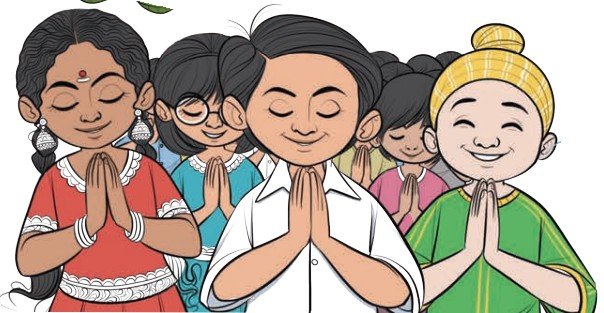
Song Summary: This is a prayer song in Hindi that asks God to give us strength so that our faith never wavers and we walk the path of goodness.
Prayer song: Itni Shakti Hame Dena Daata Language: Hindi
Itni shakti hame dena daata Man ka vishwas kamzor ho na Hum chale nek raste pe hamse Bhool kar bhi koi bhool ho na
Door agyaan ke ho andhere Tu hamein gyan ki roshni de Har buraai se bach ke rahen hum Jitni bhi de bhali zindagi de Bair ho na kisi ka kisi se Bhawana man mein badle ki ho na
Hum na sochen hamen kya mila hai Hum yeh sochen kiya kya hai arpan Phool khushiyon ke baate sabhi ko Sabka jeevan hi ban jaaye madhuban apni karuna ka jal tu baha ke Kar de paavan har ek man ka kona
Song Summary: This is a prayer song in Hindi that asks God to give us strength so that our faith never wavers and we walk the path of goodness.
Here are some things to focus on when singing in a group:
- Everyone should start and stop at the same time.
- Everyone should sing in the same pitch, tempo, and volume.
Before singing, one person, like your teacher, can indicate the starting note and count the beats to tell everyone when to start.
After you sing, think about whether the voices blended together.
If they didn’t sound the way you want, try again. Music, like most things, improves with practice.
Now that you’ve sung as an entire class together, let’s try working in smaller groups.
- Sing a song with one or two partners as a duet or a trio. Keep in mind the earlier principles of group singing. How is this different from singing alone or in a big group? Which is easier and which is harder?
- Choose a song that has three or four sections and divide the class into three or four groups. Each group can work separately on your section of the song. Once you are ready, put the groups together and sing the entire song
Song: Mi Dolkara
Language: Marathi
Walhaw re naakhawa ho walhaw re raama Mi dolkar, dolkar, dolkar daryaacha raaja Ghar paanyaawari, bandaraala karato ye ja Ayabaapaachi laaraachi lek mi laari Choli piwali go nesalny anjiri saari Maajya kesaan go maalila fulaila chaafa Waas paramaalata waarayaan ghetay jhepa
Nath naakaan saajirawaani Gala bharun sonyaache mani Koliwaarayaachi mi go raani Raat punawela naachun karatay mauja Mi dolkar, dolkar, dolkar daryaacha raaja Walhaw re naakhawa ho walhaw re raama
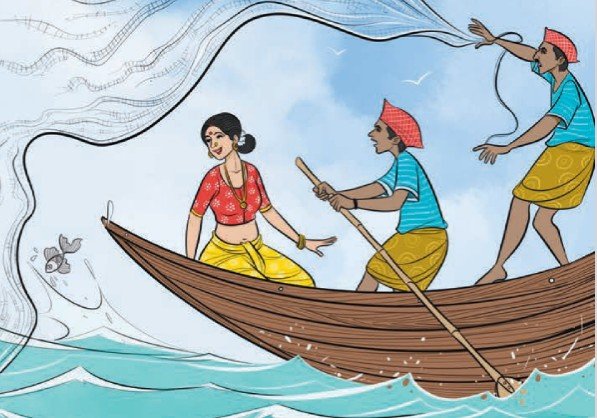
Note to Teacher: There are folk songs related to fishing and other traditional occupations in every region. You can choose a song related to traditional occupations from your own region.
Song Summary: This is a lively and energetic Marathi folk song that celebrates the spirit of the sea and the fisherfolk. The lyrics describe the fisherfolk as the ‘Kings of the Sea’, expressing pride, freedom and a deep connection to the ocean
This is an activity that can be done by two individuals or two groups. While one person or one group sings the song, the other claps to keep the time of the song.
Choose a song you know well. Would you like to sing, solo, duo, or in a group? Sing with either live accompaniment on an instrument (if someone can accompany you) or with a karaoke track. While singing with the accompaniment, make sure you stay in the same time and pitch. Try to balance the volume of the voice(s) with the accompaniment.
A cup song is a fun activity where you tap out the rhythm of a song using clapping of hands and the tapping and rotating of cups. Watch a video of a cup song online and learn the rhythmic pattern. Practice until you can do it fluently. It may take a few classes to be able to do the cup song fluently. Once you are confident, practice it with the video.
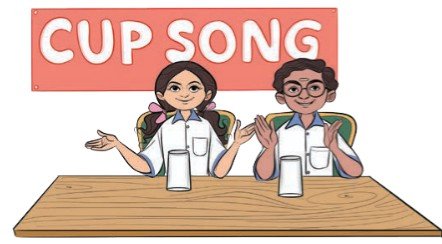
You can try the rhythmic pattern of the cup song with any song in eight beats and it will fit. Pick a song of your choice and try.
Beatboxing or Vocal Percussion
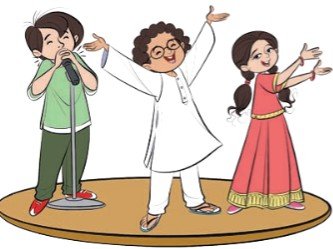
Making the sounds of drums with your mouth is called beatboxing.
- Try saying: “Boots ‘n Cats ‘n” repeatedly in rhythm.
- After you are comfortable, try to emphasise the consonant sounds (B, T, C, T) and minimise the vowel sounds. It will sounds like “Buh Tt Cc Tt”. The ‘Buh’ is a low sound that imitates a drum in the lower register. The ‘Cc’ and ‘Tt’ sounds imitate higher pitched drums.
- See where you can add your beatboxing pattern as a layer in a song.
A Cappella or Voicing Instruments
A Cappella or Voicing Instruments A cappella is a style where all the vocal and instrumental parts are sung by voices
Find and listen to an a cappella song online. See if you can make a song you know well, into an a cappella by mimicking the different parts.
- First listen to your chosen song carefully to see how many different parts you can hear.
- Then see how to divide the parts amongst yourselves.
- Try all the parts separately.
- Put them together. It usually helps if someone keeps time and gives the starting pitch.
- Don’t be discouraged if you can’t do it on the first try; it can be complex.
Assessment
| CHAPTER 10 – SING AND PLAY | |||
|---|---|---|---|
| CG | Learning Outcomes | Teacher | Self |
| 1.1 | Is able to sing a song fluently in pitch and rhythm. | ||
| 1.2 | Can sing in a group with live music or karaoke | ||
| 1.1 | Performs simple rhythms in a steady tempo. | ||