
Chapter 12
SOUNDS AND INSTRUMENTS
Over the past few years, we have learnt about various musical instruments. Now, let us continue that journey.
Sitar, tabla, mridangam, tanpura…you may have seen, listened to or heard about some of these musical instruments, right? Musical instruments enable us to create and embellish music with various sounds, making a song or piece of music rich and layered.
There are hundreds of musical instruments, from simple to highly complex.
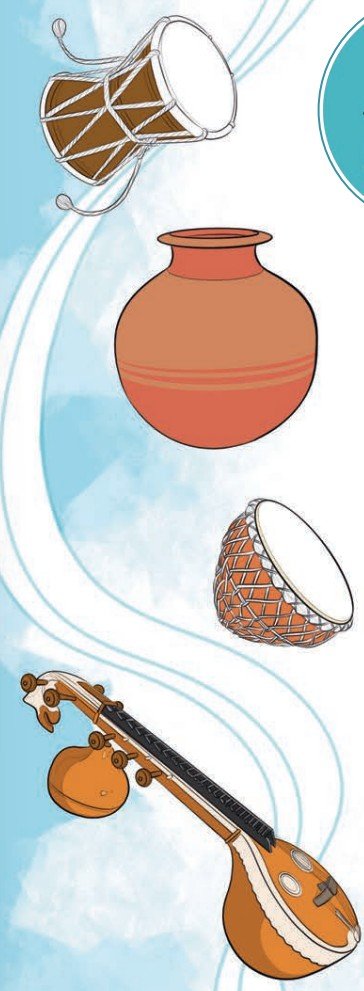
As we studied earlier, musical instruments are divided into four categories, namely: string (tata vadya), wind (sushira vadya), percussion (avanaddha vadya) and solid (ghana vadya).
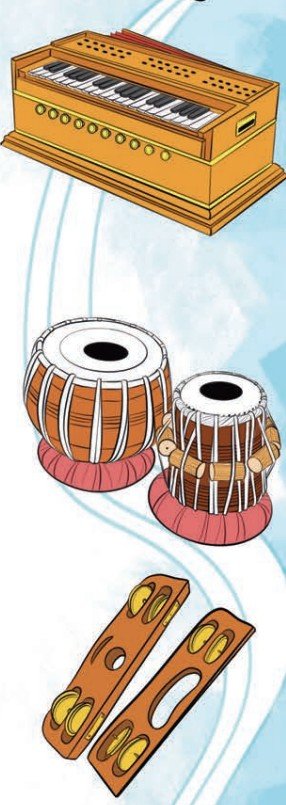
Your teacher will play various sounds to familarise you with different instruments. Listen carefully:
- What category do you think the instrument belongs to?
- Can you identify the name of the instrument?
- Can you share any details about the instrument, its origin or in what form of music it is used?
Note to Teacher: Play from a recording device, computer or mobile phone the sounds of various instruments and encourage them to identify the type of instrument (string, wind, percussion or solid), and also the name of the instrument.
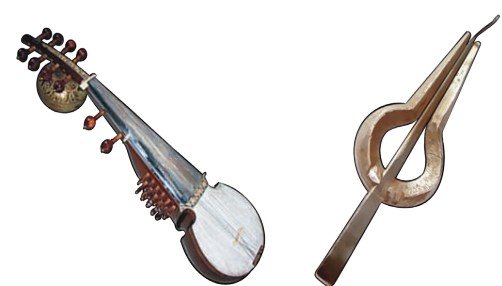
Carefully look at the pictures of these musical instruments.
- What category does the instrument belong to?
- What is the name of the instrument?
- By looking at the instrument, can you guess how it is played?
- Find the music of these instruments online and familarise yourself with its sound.
This is a beautiful instrument called rudraveena. It is a large plucked string instrument with two resonators (thumba) and is used to play Hindustani music, in particular the ancient form called dhrupad. It has a very deep and resonant sound. The instrument is often decorated using intricate carvings, with traditional or floral patterns and designs.
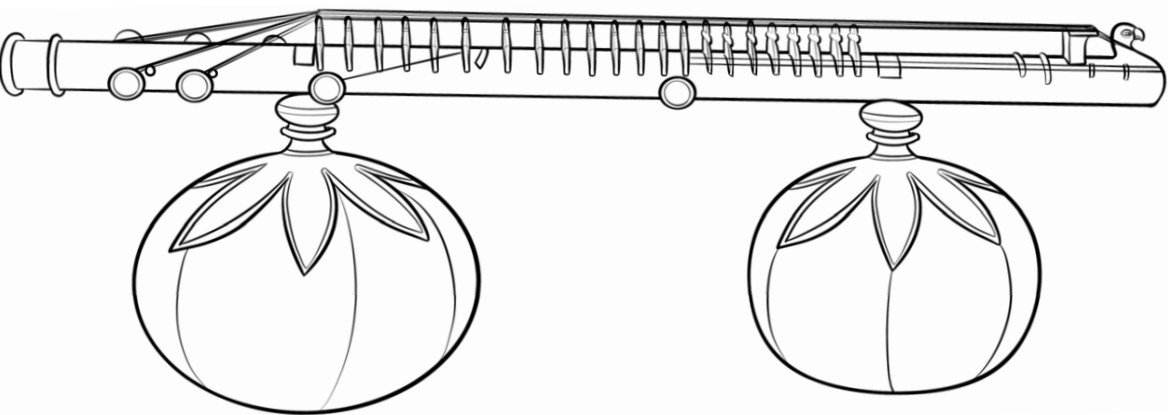
Decorate the rudraveena above, especially the two resonators. You can use patterns and ideas from your visual art chapters to decorate the instrument.
Now, listen to music played on the rudraveena online. Do you find similarities or differences between its sound and that of other musical instruments?
Story of Santoor
Santoor is an Indian stringed instrument, which is played by striking a pair of mallets (called mizrab) on strings. The body of the instrument is made of maple or walnut wood. Santoor generally has 100 strings. In ancient Sanskrit texts, the instrument is referred to as Shatatantri Veena. Hailing from Kashmir, santoor was used to accompany a form of music called Sufiyana Mausiqui, connected to the Sufi tradition. Santoor gained a place in the world of Hindustani classical music, due to the contributions of legendary santoor maestros like Pandit Shivkumar Sharma and Pandit Bhajan Sopori. This instrument creates a sense of peace and calmness, while also reminding us of the sounds of the Kashmir valley.
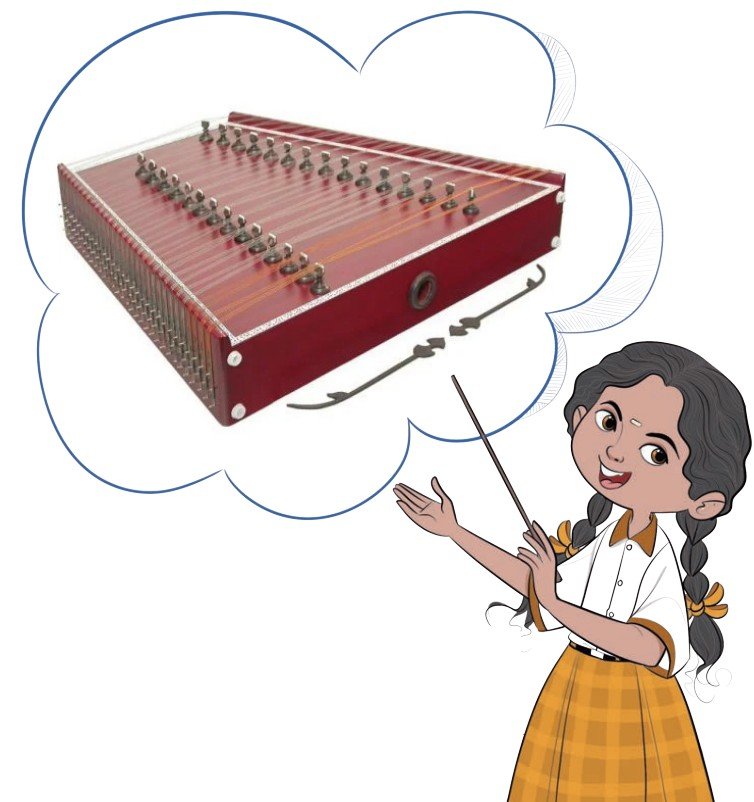
Quiz Time: Look at the picture of santoor. What is its geometrical shape?
One-Stringed Instruments
An ektara is a onestringed musical instrument that is used to provide a drone and sometimes also play tunes.
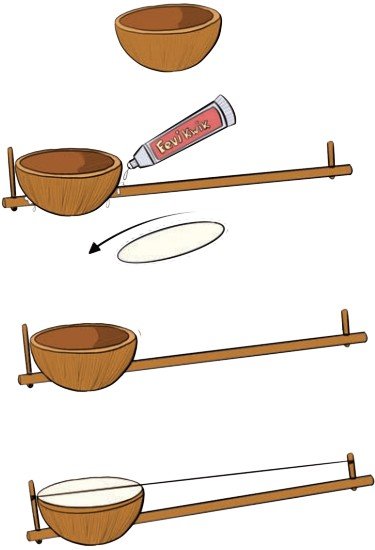
Material: Coconut shell, thin bamboo stick of 12 inches, two small pieces of wood, thin copper wire of 15 inches, white paper, tape and strong glue.
- Take half a coconut shell.
- Attach the stick to one end of the shell and another small piece to the other end, using a very strong glue.
- Cover the open mouth of the shell with paper and stick it firmly.
- Attach the pegs at the top and bottom.
- Wind the copper wire firmly on both ends of the peg such that, it is stretched tightly. There must be space between the string and the body of the instrument for it to vibrate.
- Adjust the tightness and position of the string until you get a good sound when you pluck it.
- Your ektara is ready! Decorate the long stem and the resonator shell or color and paint.
Song: Baadol Baaul Baajay Re Ektaara
Language: Bengali
Baadol baaul baajay re ektaara Saara bela dhore jharojharo jharo dhaara.
Jaamer bone dhaaner khete aapon taane aapni mete Neche neche holo saara.
Ghano jatar ghata ghanaya aandharo aakash maajhe, Paatay paatay tupur tupur nupur modhur baaje.
Ghar chhaarano aakul sure udaas hoye beray ghure Pube haawa grihohaara.

Song Summary: This is a song, which speaks about playing an ektaara and also describes nature.
Bird Whistle
You may have seen this simple musical instrument in the shape of a bird. It is called a clay bird whistle and is made of terracotta. If you fill water in the whistle and blow through it, it makes a sound like the tweeting of a bird. The bird whistle is found in many states of India, and is among the earliest musical instruments created.
Assessment
| CHAPTER 12 – SOUNDS AND INSTRUMENTS | |||
|---|---|---|---|
| CG | Learning Outcomes | Teacher | Self |
| 3.1 | Is able to make a model of an instrument. | ||
| 4.1 | Learns about musical instruments that mimic sounds in nature. | ||
| 4.2 | Is familiar with common Indian musical instruments. | ||