
Chapter 13
BUILDING BLOCKS
Try this: run around the playground, or jump up and down, and then immediately try to sing a song, or hold a note. It is difficult, right? This is because to sing, our breath needs to be smooth and regulated. Our breath is like the engine of a car that gives it energy and power.
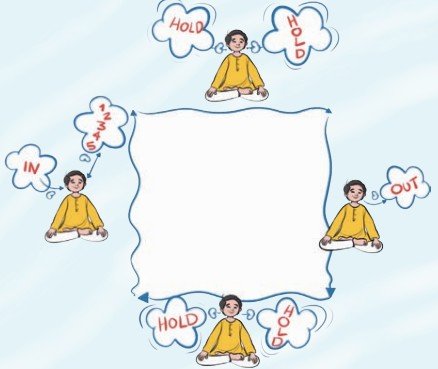
Find a quiet place to sit. Now gently breathe in counting to four – 1, 2, 3, 4… . Now, hold your breath for the next four counts. Then, breathe out (exhale) slowly for four counts. Hold your breath for four counts. Do this cycle about 4–5 times.
This is called box breathing, because each of the four parts of the breathing cycle are of the same length. Not only does this exercise regulate your breath for singing, but it can also help you feel calm when you are angry or agitated.
What is Dhwani?
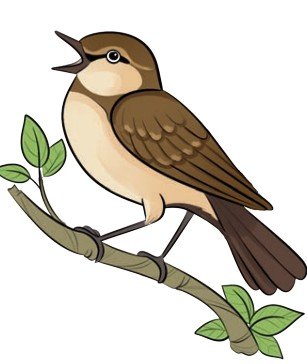
Dhwani is sound. We hear so many sounds around us. The sound of our friends talking, the chirping of birds, the sound of cars, buses, trains, aeroplanes, the sound of a melodious voice of a musical instrument. These sounds enable us to remain aware of the numerous events unfolding around us.
What is Naada?
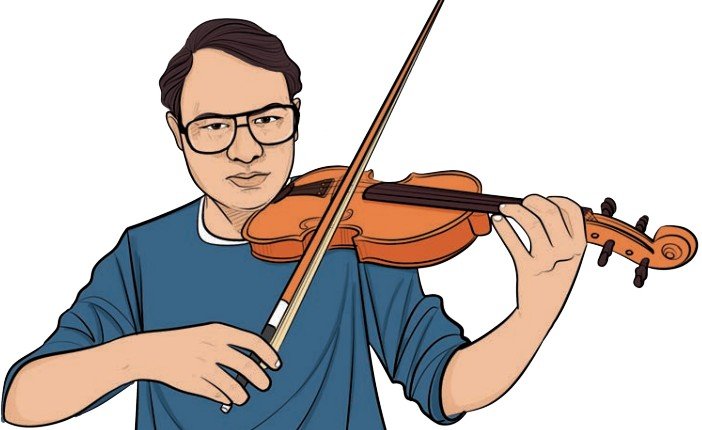
Naada is muscial sound. When you hear the noise of traffic or a blaring horn, it may not sound as musical. However, when you hear tuneful music from a muscial instruement or a voice, it has a pleasant sound with a regular and steady pattern of vibration.
Do You Know?
The notes of Indian classical music evolved from the ritual chanting of the Samaveda. Initially, the Vedas were chanted with three notes, namely, Udatta (normal or medium tone), Anudatta (not raised, or lower note) and Svarita (raised pitch or higher). These gradually evolved into the seven notes (sapta swara) that we use in music.
Singing sargam/swara patterns is a very good way to warm up our voices and prepare to sing songs. It also helps us improve our pitching.
Here are a few patterns for you to complete and sing.
- SGRS, RMGR, GPMG, MDPM, PNDP, DSND, NRSN, SGRS SDNS, NPDN, _ _ _, PGMP, _ _ _, GSRG, _ _ _, SDNS
- . SMGR, RPMG, _ _ _, MNDP, PSND, _ _ _, NĠRS SPDN, NMPD, DGMP, _ _ _, MSRG, GNSR, _ _ __
- SRSG, RGRM,_ _ _ _, MPMD, PDPN,_ _ _, NDNP, _ _ _, PMPG, _ _ _, GRGS
- RS, GR, MG, _ _ , DP, _ _, SN, _ _NS, _ _, PD, _ _ , GM, _ _, SR, _ _
Do You Know?
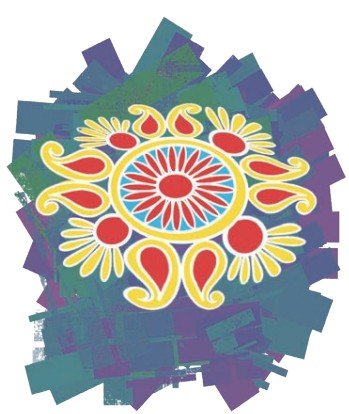
Patterns are found in various art forms, especially visual art, where motifs and repetitive elements are found in paintings, prints and murals.
The traditional art of rangoli features interesting patterns of dots, lines and curves. It is often used to decorate the floor and walls in homes.
Every year we have been learning a little more about the two classical music forms of India – Carnatic and Hindustani.
Carnatic Music
Let us learn two geethams, which are simple Carnatic compositions.
Vara Vina
Raga: Mohana
Tala: Rupaka
Arohanam
S R2 G3 P D2 Ś
Avarohanam
Ś D2 P G3 R2 S
| G Va |
G|P ra|vee |
, - |
P Naa |
,||D -||mru |
P|S du|paa |
, - |
S Nee |
,|| -|| |
| R Va |
S˙ |D na|ru |
D ha |
P lo |
,||D -||cha |
P|G na|raa |
G - |
R Nee |
,|| -|| |
| G su |
P|D ru|chi |
S ra |
D bam |
,||D -||bha |
P|G ra|ve |
G - |
R Nee |
,|| -|| |
| G su |
G|D ra|nu |
P ta |
G kal |
,||P -||yaa |
G|G -|- |
R - |
S Nee |
,|| -|| |
| G ni |
G|G ru|pa |
G maa |
R shu |
G||P bha||gu |
G|P Na|lo |
, - |
P la |
,|| -|| |
| G ni |
G|D ra|ta |
P ja |
D yaa |
,||D -||pra |
P||S da|shee |
, - |
S laa |
,|| -|| |
| D va |
G|R ra|da |
R - |
S pri |
S||D ya|ran |
S|D ga|naa |
D - |
D yaa |
P,|| ki|| |
| G van |
P|D -|chi |
s ta |
D pha |
P||D la||daa |
P|G -|- |
G - |
R ya |
S|| ki|| |
| S ra |
R|G raa|see |
, - |
G jaa |
,||G -||sa |
R|P na|ja |
G na |
R nee |
,|| -|| |
| S ja |
R|S ya|ja |
G ja |
R ja |
S|| ya|| |
Padumanabha
Ragam: Malahari
Talam: Tishra Jathi Triputa Tala
Composer: Purandara Dasa
Arohanam
S R1 M1 P D1 S
Avarohanam
S D1 P M3 G3 R1 S
Pallavi
| R Pa |
S du |
D ma |
| | |
S na |
-| -| |
S bha |
- || - || |
M pa |
G ra |
R ma |
| | |
M pu |
M ru |
| | |
P sha |
- - |
|| || |
| S pa |
D ram |
D | - | |
D jo |
P - |
| M | - |
P thi |
|| || |
D swa |
D ru |
P - |
| | |
M pa |
G - |
| | |
R - |
S - |
|| || |
| R Vi |
S du |
D | ra | |
S van |
- - |
| S | dhya |
- - |
|| || |
M vi |
G ma |
R la |
| | |
M cha |
M ri |
| | |
P tha |
- - |
|| || |
| S vi |
D hang |
D | - | |
D ga |
P - |
| M | - |
P di |
|| || |
D ro |
D - |
P ha |
| | |
M na |
G - |
| | |
R - |
S - |
|| || |
Anu Pallavi
| P U |
M dha |
P | dhi | |
D ni |
S va |
| D | - |
S sa |
|| || |
R u |
S ra |
D ga |
| | |
D sa |
S ya |
| | |
D - |
P na |
|| || |
| D U |
D - |
P | nna | |
P tho |
- - |
| P | nna |
M tha |
|| || |
R ma |
M hi |
M - |
| | |
P ma |
- - |
| | |
P - |
- - |
|| || |
| D Ya |
D du |
P | ku | |
P lo |
- - |
| P | ttha |
M ma |
|| || |
R ye |
- - |
M gna |
| | |
M ra |
G - |
| | |
R kshaka |
S kshaka |
|| || |
| S A |
- - |
S | gna | |
D si |
D - - | |
D ksha |
P ka |
|| || |
P ra |
- - |
P ma |
| | |
M na |
G - |
| | |
R - |
S ma |
|| || |
Charanam
| D Vi |
S bhee |
- | - | |
D sha |
Pna |
| M | pa |
P - |
|| || |
D la |
D ka |
P - |
| | |
M na |
G mo |
| | |
R na |
S mo |
|| || |
||||||||||||||||||||||||||
| D I |
S bha |
- | - | |
D va |
P ra |
| M | da |
P - |
|| || |
D ya |
D ka |
P - |
| | |
M na |
G mo |
| | |
R na |
S mo |
|| || |
||||||||||||||||||||||||||
| P Su |
M bha |
P | - | |
D Pra |
S da |
| D | Su |
S ma |
|| || |
R no |
S - |
D ra |
| | |
D tha |
S - |
| | |
D - |
P Su |
|| || |
||||||||||||||||||||||||||
| D Re |
D - |
P | ndra | |
P ma |
- - |
| P | no |
M - |
|| || |
R ran |
- - |
M ja |
| | |
P na |
- - |
| | |
- - |
- - |
|| || |
||||||||||||||||||||||||||
| D A |
D bhi |
P | - | |
P na |
- - |
| P | va |
M pu |
|| || |
R ran |
- - |
M da |
| | |
M ra |
G - |
| | |
R - |
S vi |
|| || |
||||||||||||||||||||||||||
| S tal |
- - |
S | la | |
D bhal |
D - |
| D | la |
P ra |
|| || |
P ra |
- - |
P ma |
| | |
M na |
G - |
| | |
R - |
S ma |
|| || |
Hindustani Music
We will focus on learning Raag Khamaj, through a Bandish.
Bandish
Namana Karu Mai Sada Guru Charana Saba Dukha Harana Bhava Nistarana
Suddha Bhava Dhara Anta Karana Sura Nara Kinnara Vandita Charana
Raga Khamaj
Aroh— S G M P D N Ś
Avroh— Ś N D P M G R S
Pakad— N D, M P D, M G
| Sthayi | |||
|---|---|---|---|
| 1 2 3 4 | 5 6 7 8 | 9 10 11 12 S S˙ N N Na ma na Ka |
13 14 15 16 D P M G ru Mai |
| G M P D Sa da Gu ru |
N N S˙ S˙ S˙ Cha ra na |
S˙ S˙ Ġ M Sa ba Du kha |
Ġ R˙ N S Ha ra na |
| N N S˙ S Bha va Ni s |
N S˙ N D ta ra na |
||
| Antara | |||
|---|---|---|---|
| 1 2 3 4 | 5 6 7 8 | 9 10 11 12 G M N D Su ddha Bha |
13 14 15 16 N N S˙ S va Dha ra |
| N N S˙ S An ta |
N S˙ N D Ka ra na |
S˙ S˙ Ġ M Su ra Na ra |
Ġ R˙ S˙ N S Ki nna ra |
| N N S˙ S Va n di ta |
N S˙ N D cha ra na |
||
- Make a practice journal. Mention the date, time, duration, and what you have practised. Keep time for vocal warm-ups and exercises in addition to the compositions. Make a note of how you feel—did something difficult become easier? Did you start something new that felt exciting?
- By maintaining a practice journal, you can chart your progress. If you find a practice journal helpful, try making one for other subjects that you are studying.
Repeated and regular practice is essential for any art form. This is referred to as riyaaz, abhyaasa, or saadhakam in Indian classical music. Many legendary artists have practiced for over 6–8 hours every day from when they were children.
Attend a classical music performance near you. If you cannot attend one in person, watch a video of a full concert online.
- Draw a sketch of the stage and performers.
- What instruments are being played?
- Write down the names of the pieces that you heard and any other information you can find out, like the raga or the taal/tala.
- Observe the interactions between the performers on stage, and between the performers and the audience. Write down your observations.
Assessment
| CHAPTER 13 – BUILDING BLOCKS | |||
|---|---|---|---|
| CG | Learning Outcomes | Teacher | Self |
| 3.1 | Learns the importance of breathing for singing. | ||
| 2.2 | Knows about some basic forms of Indian classical music. | ||
| 3.2 | Practices and rehearses as per a set schedule. | ||