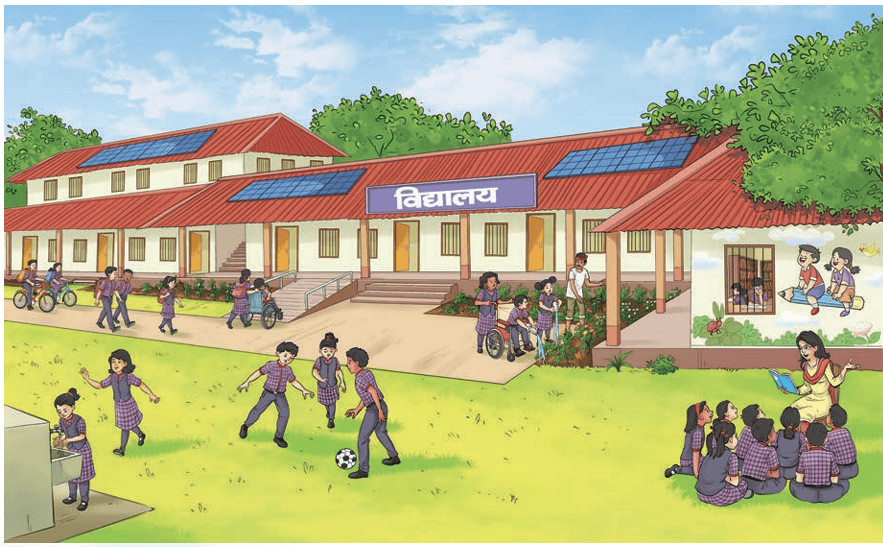
Chapter-4
Our School — A Happy Place
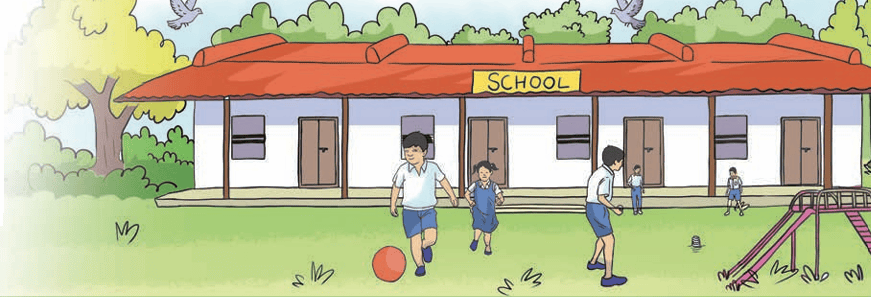
Green School
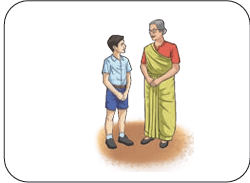
Aasha and Mohit were walking to school together. “Do you like going to school?” Aasha asked. Mohit smiled happily and said, “I love school! It is where I see my friends, play games and learn new things every day. It is my happy place”. Our school is a place where we feel safe, and cared for. It is where we learn so many things. Asha said, “My school teaches us how to care for plants, trees and animals. I want to make my school better like a green school”. “What is a green school?” Mohit asked. “My brother told me once, green school is a school where we manage our waste, save water, use electricity carefully, and make the campus green by planting more trees and taking care of them”. Aasha and Mohit share their idea with their classmates. Everyone became curious. What about our school? Can we make it a green school too? Their teacher Anupam, who is teaching them ʻThe World Around Usʼ asked, “I enjoyed your discussion, I want to know how will you begin this?”. Aasha shared her suggestion with her classmates, “Let us take a closer look at our school and decide what we can do to make our school a happy, safe and green school”.Do you know?
Swachh Bharat Swachh Vidyalaya (Clean India Clean Schools) is a part of the Swachh Bharat Mission started by the Government of India. It focuses on keeping schools clean and healthy for all. This includes clean toilets, safe drinking water, proper waste management, and hygiene education. Every child has the right to study in a clean and safe environment!
Think

Write
- What do I really like about my school?
- How can I make my school greener?
- In case there is any difficulty at school, whom do I talk
to or inform?
Be a School Explorer!
You and your classmates can form ‘School Explorer Teams’. Here are some name ideas for your groups to choose from:- Water watchers
- Electricity savers
- Waste warriors
- Green guardians
- Traffic trackers
Here are some suggestions:
Electricity Savers
- Are lights and fans ‘on’ when no one is using them?
- Do the classrooms use natural light?
- Which areas of the school feel the hottest and the coolest during the day?
Green Guardians
- Are there trees or plants in the school?
- Who takes care of them?
- Where can we plant more?
- Do birds or butterflies visit these areas?
- Is there a compost pit in the school?
Water Watchers
- Are there any leaking taps?
- Is water being wasted?
- Are water tanks clean and covered?
- Are there any wet places that could be breeding mosquitoes?
Traffic Trackers
- What happens outside the school gate during arrival and exit times?
- Is there a pedestrian crossing across the road for children?
- Do vehicles speed in front of the school?
Waste Warriors
- Where do you find litter? What kinds of litter do you see?
- Are there enough dustbins around the school?
- Are the students using these bins? Why or why not?
- Are there separate bins for food waste and other waste?
Once you have finished making your explorations, it is time to sit together and discuss your findings with the class.
- What did you find?
- Was there anything that made you feel concerned?
- Did anything surprise you? What was it?
- What made you feel proud?
Waste Management
We can reduce waste by using only what we need, reusing things and not throwing away useful items. However, some waste such as food peels, leftovers and paper still remain. We have learned in earlier classes about the importance of separating waste into dry and wet categories to manage it better, and to keep our surroundings clean.Write
Can you name the colour of the bin used for the following?Dry waste: _________________ Wet waste: _________________
Have you noticed that things like old newspapers are never thrown into these bins? They are usually kept aside and given to the traditional recyclers. Different recyclers collect different items. What are the various recyclers in your area called? Find out what each one collects.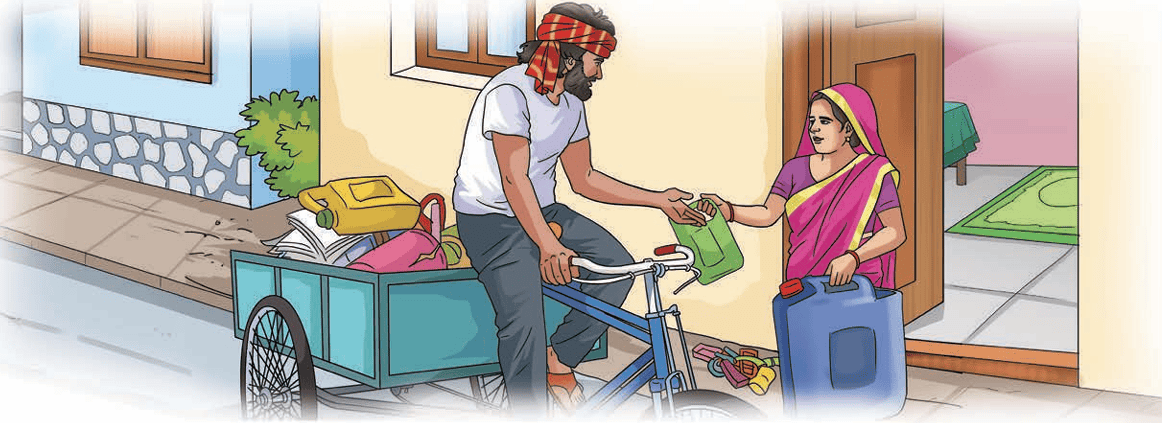
Write
- What things does your school give to recyclers?
- Ask your parents and find out if there are any items
that they had set aside to give to the recyclers. What
are they?
Find out
With the help of your teacher, ask a recycler to visit your class and share what they do at work. It will be interesting to find out where these items go and how they can be reused or recycled.Note to the Teacher
Extend the discussion about the process of recycling, connecting to Grade 4 activity on recycling paper. Also, encourage the students to think about the contribution of recyclers and sanitation workers, to instil the value of dignity of labour.Activity 2
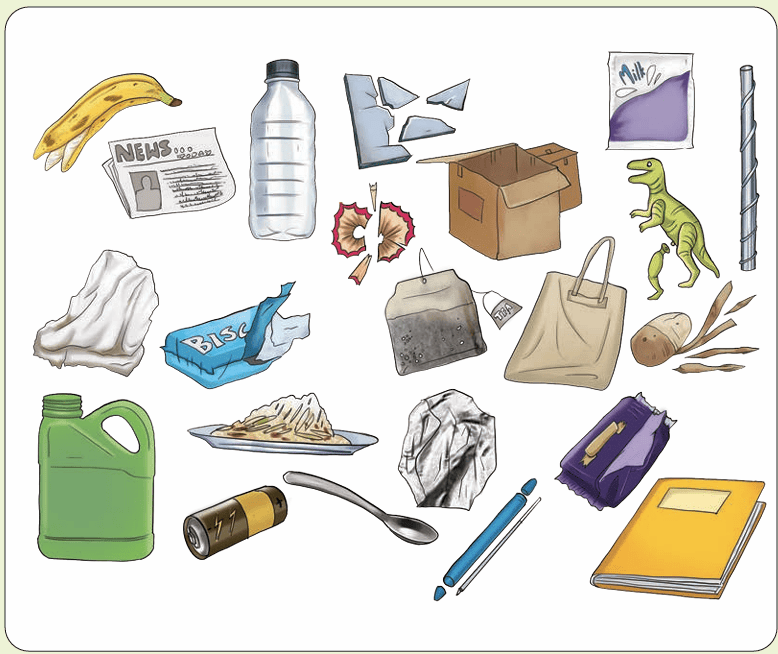
Make small paper chits (30 – 40) with the names or drawings of the different items shown below. Add more items to the list based on what you see around your school or home. Take three empty boxes, and label them — green for wet waste, blue for dry waste, and the third can be labelled as ‘Items for recycler’. One by one, pick a chit and put it in the box that is correct. After all the chits have been put in the boxes, take one box at a time and discuss whether it has been put correctly.
How is wet waste managed?
- In your school
- In your home
Discuss
- What happens if we do not separate our waste?
- What can we do to make the work of sanitation workers easier and safer? Ask your teacher to invite a member of the sanitation workers to your classroom. Ask them to share what they do, the challenges they face, and how we can play a better role in waste management.
Let Us be Cool!
Have you ever thought why some rooms feel warmer than others? Let us explore this and find out what keeps them cool.Trees that give shade and classrooms with windows where the breeze can come in, can make a difference. A white roof can also make the roof cool because it reflects the Sun’s heat. On the other hand, a black surface absorbs heat.
Activity 3
Which one felt cooler?
Write
If you have to paint the roof of your school or home white, what would happen?Discuss
If your area is getting warmer, what actions can be taken to keep it cool?Dripping Water
We all need water every day for many things. Water is a precious treasure. But do we use it carefully?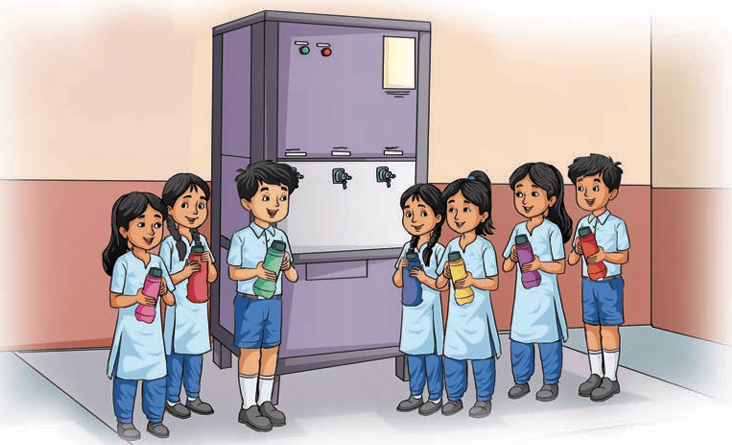 You have already looked around your school and
checked dripping taps. However, have you ever
thought about how much water can be lost, drop
by drop? Even a small leak can waste a lot of water
over time. Let us find out how!
You have already looked around your school and
checked dripping taps. However, have you ever
thought about how much water can be lost, drop
by drop? Even a small leak can waste a lot of water
over time. Let us find out how!Activity 4
Time taken to fill one glass:
How many glasses would become full in one day?
You will be surprised at how quickly water adds up and how much is wasted without anyone noticing.
Discuss
- What are some easy things we can do in our school to prevent the wastage of water?
- How can you collect and use rainwater at home or in school?
Do you know?
Greenery Around Us
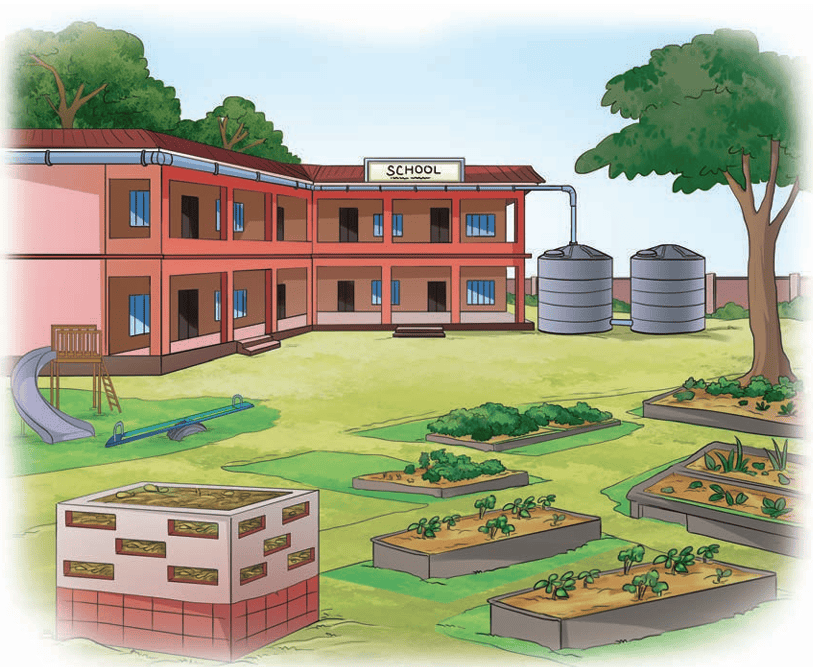
Write
- Name the trees on your campus or near your school.
- Which birds and insects have you seen near the plants
or trees on your school campus?
Let us find out!
Activity 5
- Take two glasses of water. Measure the temperature using a thermometer under the guidance of your teacher. Record your readings.
- Keep one glass under a tree and the other under the
Sun. After one hour, measure the temperature again.
Record your readings. What do these readings tell us?
- With the help of your teacher, try to find out the names of the trees and plants that attract birds, and butterflies. Try to create a butterfly garden in your school.
Their dream to make their school ʻthe best green schoolʼ made them think about problems in their community and society. They felt that as students, they could play an important role by spreading awareness about the issues that are making our lives difficult.
Thomas talked about the problem of road accidents. He had seen one while going home from school the other day. Mohit said, “I think people don’t follow traffic rules, we learned about them in our earlier class”.What do you think about what Mohit said?
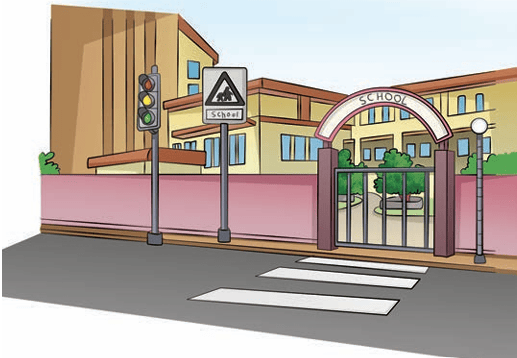
Traffic Signs
Many accidents happen on the roads because people do not follow the traffic rules correctly. It is very important that we know the rules and follow them.Write
- Find out and write at least three traffic rules.
- Think and write about what you saw at the school gate.
You can use simple words, drawings or symbols.
Make your traffic signboard here.

Discuss
Besides making signboards, what else can we do to improve traffic near the school?Mohit’s school arranged a session on fire safety. All the students of the class attended this session.
Fire Safety
 It is very important to learn how to stay
safe from dangers like fire. Even if they do
not happen often, being prepared can help
everyone feel safer and more confident.
It is very important to learn how to stay
safe from dangers like fire. Even if they do
not happen often, being prepared can help
everyone feel safer and more confident.Write
- Where is the fire extinguisher kept in your school?
- In case of a fire, where is the assembly point in your
school?
- What should you do if there is a fire or if you smell
smoke?
Let us practice
With the teacher’s help, practise a safe fire drill.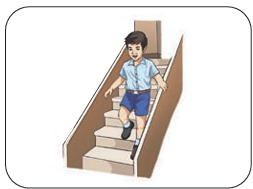 1. Move quickly and calmly to the
nearest exit route. Do not panic.
Do not run.
1. Move quickly and calmly to the
nearest exit route. Do not panic.
Do not run.
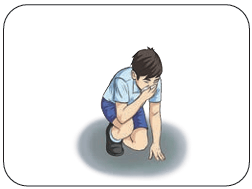
2.Crawl low under smoke with
your mouth covered to breathe
cleaner air.
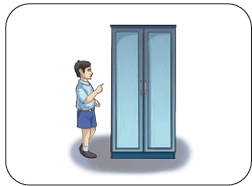 3.Do not hide in closets or bathrooms.
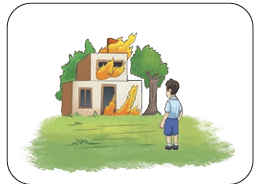 4.Help others if it is safe to do
so, but never return to the
building once you are outside.
4.Help others if it is safe to do
so, but never return to the
building once you are outside.
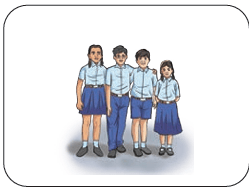 5.Go to the assembly point and stay
with your group.
5.Go to the assembly point and stay
with your group.
 6.Once you have reached the
assembly point, alert staff
or teachers immediately if
anyone is missing, or injured.
6.Once you have reached the
assembly point, alert staff
or teachers immediately if
anyone is missing, or injured.
What We do Matters!
Just as we all need safety, care and respect to feel well and happy, the way we behave with others at school, at home, or in public places also matters a lot.Our behaviour can make these places peaceful and welcoming, or uncomfortable and unpleasant. Let us look at some everyday situations to think about what is right and what is not.
Activity 6
- Two students are pushing and skipping the line at the water tap while others are waiting.
- A student is scribbling on a classroom bench with a marker. Another child watches but says nothing.
- Someone throws a wrapper in the playground. A younger student copies the same act.
- One student keeps teasing and making fun of another student.
- A group of students are making noise in a public park and disturbing a small group doing yoga nearby.
- If you see such a situation unfold before you, what would you do?
- What steps can we take to prevent such incidents?
We have explored many ways to make our school a happy place by saving water, managing waste, keeping it cool, and caring for plants, places and the people around us. Let us all join hands to make our school, our very own happy place!
Let us reflect
- Out of all the classrooms in your school, which one do you think is the nicest and why?
- Create a happiness tree. On a wall or chart paper, draw a large tree with many branches. Each student should add a ‘leaf’ with one small action written on it that makes the school a happier place (for example, greeting someone, turning off lights, sharing space, etc.).
- Sharing one’s feelings is exciting. Write a letter to your teacher on ‘My School — My Happy Place’.
- Which actions would you extend to your home, neighbourhood and communities to make it a happy place for all? Describe any one of them in detail.
- Imagine a day in school from someone else’s perspective.
Choose any one of the following:
- A student who navigates school using a wheelchair.
- A student who speaks a different mother tongue.
- A sanitation worker at school.
- As principal for a day, what three changes would you make to enhance happiness, safety and greenery in your school?
- In groups of 4 – 5, act out the following:
- A student showing kindness in a difficult situation.
- A team solving a school water wastage problem.
- A student helping a shy classmate feel included.
- Write a one minute speech for your morning assembly on ‘My Dream School’. Mention what makes it special, who helps it stay that way and what every student can do.
- Take a quick survey, ask five students and one teacher:
(a) What is the one thing that makes them feel happy in school?
(b) What is the one thing that could be improved?
(c) What is the one kind thing that they saw today?
Record and present your findings to the class. What did you learn from others?