Unit-5
Our Amazing Planet
About the Unit
By the end of the Preparatory Stage students learn about various landforms, lives and a wide range of activities around them. They also know about the Sun, moon, stars and wonders of the world they live in. This unit invites students to explore the deep connection between nature and everyday life.This unit in Grade 5, helps students
explore the natural rhythms and deep
connections that shape the life on
Earth. Through seasons, stories and
journeys of birds, foods and ideas,
they discover how nature, people and
cultures are linked. With journaling
and hands-on activities, they connect
to their surroundings and understand
that Earth is our shared, living home.
Note to the Teacher
This unit consists of two chapters. Chapter 9 ‘Rhythms of Nature’ and Chapter 10 ‘Earth: Our Shared Home’.Chapter 9: Rhythms of Nature
• ‘Rhythms of Nature’ helps students observe and understand the natural rhythms of change in the world around them — day and night, seasons, and how plants, animals, people and places transform over time. Through journaling, activities and reflection, it encourages students to connect deeply with their local environment and notice repeating patterns in nature.Chapter 10: Earth — Our Shared Home
• This chapter helps students see the Earth as a connected, living planet where people, animals, plants, and ideas travel, mix and grow together. Through stories, it shows how we share nature, knowledge, and culture across borders. It brings alive the idea of ‘Vasudhaiva Kutumbakam’ fostering care, respect, and a sense of belonging to our shared planet.
How to Facilitate
- Encourage students to observe their surroundings like seasonal changes, the arrival of birds or butterflies, flowers, or changes in weather. Use journals and charts to help them track and reflect on these observation.
- Take students outside the classroom to the school ground, garden, or nearby pond, to explore real-life patterns in nature.
- Ask simple critical thinking questions like, “Where did this come from?” or “Why do we all use it?” to spark curiosity.
- Use mapping, drawing, posters, and globe-based activities to help students trace how things travel across the Earth.
- Compare seasonal experiences from different parts of India (for example, winter in Kashmir vs. Kerala) to deepen their understanding of local diversity.
- Help students see that we all share the same Earth and are part of one big family — ‘Vasudhaiva Kutumbakam’.

Chapter-9
Rhythms of Nature
Write
Try to remember the time you were in Grades 3 and 4. Think and write about the changes that you have noticed in yourself and your friends, in your school, and in your environment.| Grade 3 | Grade 4 | Grade 5 | |
|---|---|---|---|
| Yourself and your friends | |||
| School | |||
| Surrounding area |
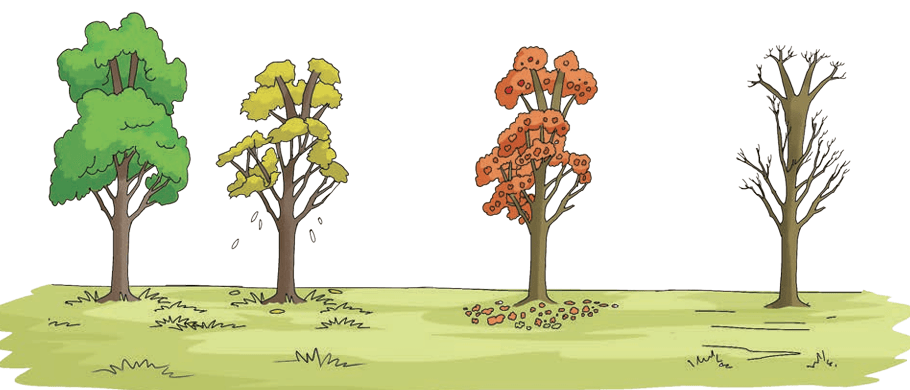
Changes are happening to us and to the world around us all the time. Some changes take years, some happen in just days or minutes! Have you noticed how things keep changing around you? Think about it. You grow taller each year, leaves fall off trees and grow again, flowers bloom, dry up and bloom again, the sky changes colour, the sun appears to rise and set every day.
Write
- Can you think of something that takes a really long time to change, maybe over years?
- What about something that changes within just a few
years?
- Are there changes that happen every year, again and again?
- Can you name something that changes in just a few
minutes or even seconds?
Changes Around Us in a Day (Day and Night)
Just like we grow and change, the world around us is changing too. The day changes into night and the night becomes day.What causes day and night?
The Sun seems to be rising in the east moving across the sky and setting in the west. So, is the Sun moving?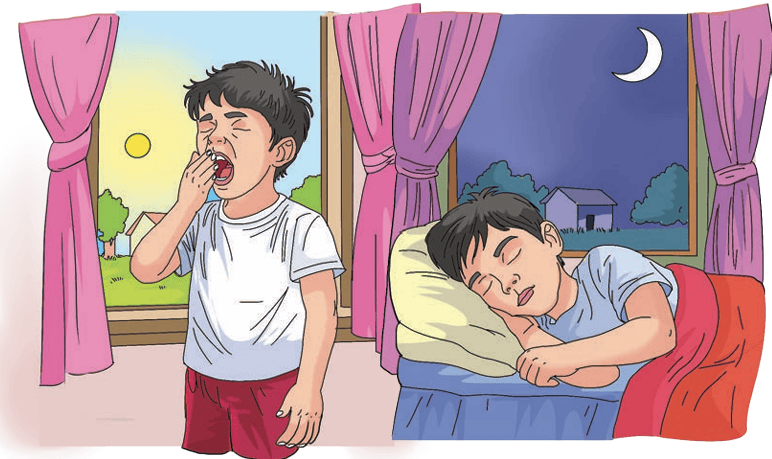 Let us understand with one simple game.
Activity 1
Let the student playing ‘Earth’ stand in one place and slowly turn around (rotate). As long as the student sees the ‘Sun’, they keep saying — “day … day … day”, looking straight ahead. When the student stops seeing the ‘Sun’ they keep saying “night … night … night”.
Now, let us do this activity using a torch and a globe.Demonstration — Day and Night
Step 1: Place a globe on a table and flash a torch on one side of the globe. The torchlight represents the Sun. The side where the light falls has day, and the side with no light has night.Step 2: Rotation — Slowly rotate the globe while keeping the torch steady.
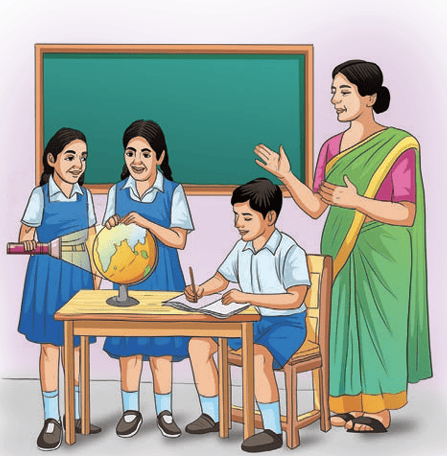
Step 3: Observe how different parts of our globe face the light as it rotates.
Like the torch, the Sun stays in one place and it is actually the Earth that rotates.
Did you notice how the light made day on one side of the globe and night on the other?Do you know?
 A globe is a model that represents our Earth.
It is shaped like a ball, just like the real Earth.
The blue part of the globe are the seas and
oceans; they cover about three-fourth part
of the Earth. Seas are usually smaller than
ocean and are partly enclosed by land, while
the oceans are vast and open water bodies. The remaining
parts are the land masses, where we have all the countries.
A globe is a model that represents our Earth.
It is shaped like a ball, just like the real Earth.
The blue part of the globe are the seas and
oceans; they cover about three-fourth part
of the Earth. Seas are usually smaller than
ocean and are partly enclosed by land, while
the oceans are vast and open water bodies. The remaining
parts are the land masses, where we have all the countries.Find out
Study the globe and write in the space given below, when it is day time in India, which countries will have night?Changes Around Us in a Year (Seasons)
Seasons’ Journal
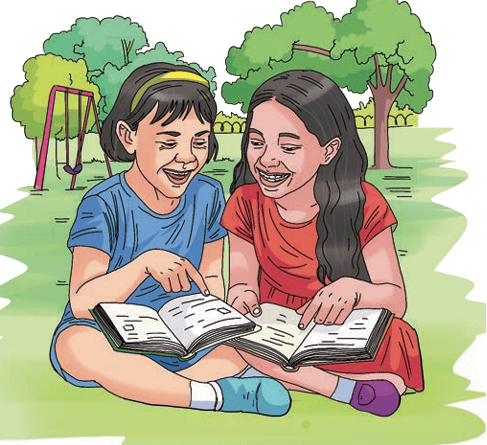 Saba and Aparna are
sitting in the school
garden, looking
at their seasons’
journal.
Saba and Aparna are
sitting in the school
garden, looking
at their seasons’
journal.
You also have been looking closely at the world around you over the year and making observations in your journal.
Now, it is time to record your own observations. Let us do it together, just like Saba and Aparna!Classroom Activity — Seasons’ Chart
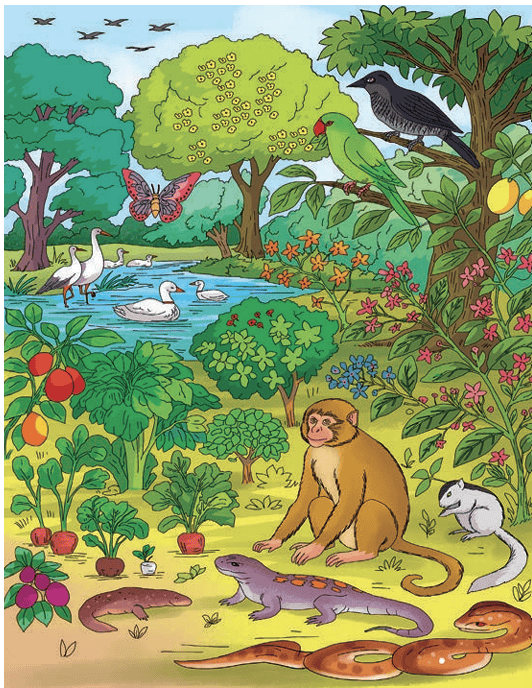 All year long, you have
been curious explorers of
nature, observing plants,
animals, sunlight, water
and human activities.
Now, it is time to bring
all your learning together
and understand the
patterns of change that
happen throughout the
year.
All year long, you have
been curious explorers of
nature, observing plants,
animals, sunlight, water
and human activities.
Now, it is time to bring
all your learning together
and understand the
patterns of change that
happen throughout the
year. Step 1: Making a Chart for Classroom
Let us begin by preparing a large wall-sized chart in your classroom to note the observations from our journals. This will help us bring all our observations on one chart so we can see the full picture!The chart will have the following time periods: April – June, July – September, October – December, and January – March marked in columns. The themes: plant life, birds and animals, air, heat and light, water and water bodies, and human activities listed in rows.
Chart Template
| Theme | Time Period | |||
|---|---|---|---|---|
| April – June | July – September | October – December | January – March | |
| 🌿 Plant life | ||||
| 🐦 Birds and animals | ||||
| ☀️ Air, heat and light | ||||
| 💧 Water and water bodies | ||||
| 🧑🤝🧑 Human activities | ||||
Step 2: Fill the Chart
For each of the boxes (for example, April to June for plant life) one of you can stand up and ask for observations from the class. Each of you may share your observations from your journal. Discuss and write the main observations on the chart.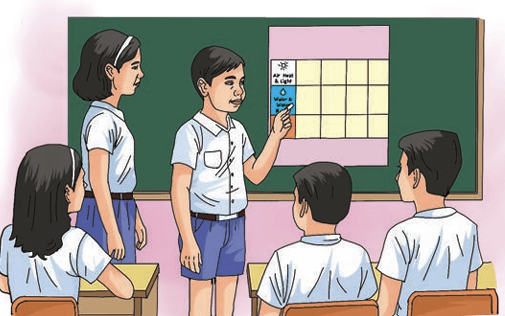 The next student
can stand up to fill the
next box in a similar
way. This way, all
your observations will
be on your chart in
the classroom. Now,
the chart is ready for
everyone to see and
learn.
The next student
can stand up to fill the
next box in a similar
way. This way, all
your observations will
be on your chart in
the classroom. Now,
the chart is ready for
everyone to see and
learn.
Step 3: Tracking Changes in a Year
It is time to take a closer look at the patterns of change you have noticed throughout the year.Let us form five groups. Each group can choose one theme from the chart and study the patterns of change observed across different time periods during the year.
Group 1: 🌿 Plant life
Group 2: 🐦 Birds and animals
Group 3: ☀️ Air, heat and light
Group 4: 💧 Water and water bodies
Group 5: 🧑🤝🧑 Human activities
For example
🌿 Group 1 will show how plants changed in different months—like leaves, flowers or fruits.
💧 Group 4 can show how ponds, puddles or rain changed in different months.
Once ready, present your poster to the class.
Step 4: Looking at the Year Together
Once all the groups have made their presentations, form new groups. Make sure that the new group has one student from each theme. Form 4 groups, one for each time period.Group 1: April – June
Group 2: July – September
Group 3: October – December
Group 4: January – March
Each group will now analyse the observations on the chart across all five themes for their chosen time period.Use these observations to create a short story about your time period (for example, January – March), linking what you saw in nature with what you have noticed in people’s lives. Read it out in the class.
Discovering Seasons
We have seen how plants change, how animals behave, how the air feels, what happens with water and what people do throughout the year. You now know that nature changes slowly over the year. The weather warms up, gets hot and then it rains, and then it gets cooler before warming up again. We observed these changes throughout the year, but do you think the same things happened last year too? Will they happen again the next year?Yes! These changes follow a pattern, a natural rhythm that repeats itself every year. This repeating pattern in nature is what we call seasons.
What are the seasons called in your region? India hosts both the wettest place on Earth — Mawsynram in Meghalaya—and one of the driest — the Thar Desert.Do you know how many seasons we have in India?
In India, we experience six seasons based on how nature changes in every few months.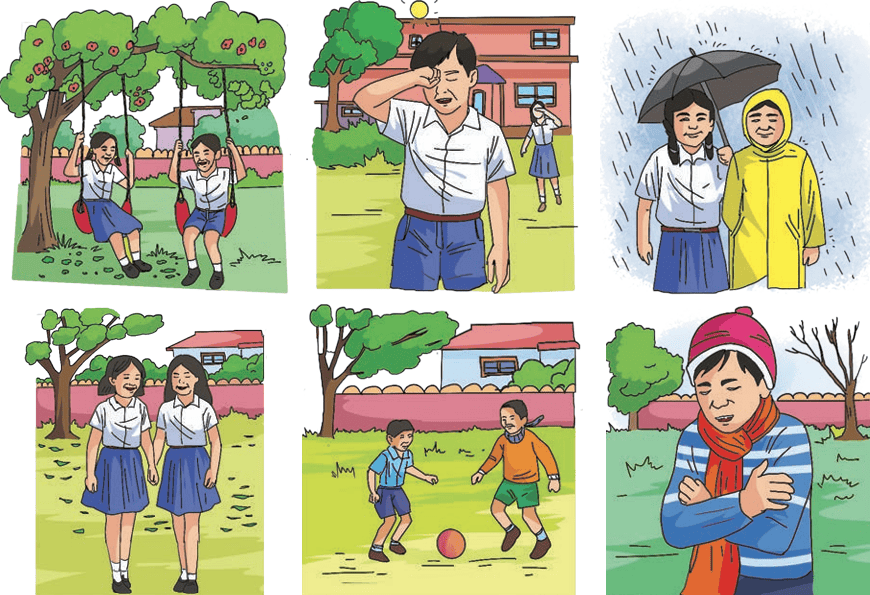
| Seasons | Month of the Year (Fill it up for your region) |
|---|---|
| Vasanta (Spring) | |
| Grishma (Summer) | |
| Varsha (Monsoon) | |
| Sharad (Autumn) | |
| Hemant (Pre-winter) | |
| Shishir (Winter) |
Write
How do you feel when the season changes? Would you prefer one season to continue throughout the year? Give the reasons for your answer.Discuss
Winter in Kerala is different from winter in Kashmir valley. Monsoon in Assam is different from Rajasthan. Why do you think it is so?Celebrating Seasons
In India, we have many songs associated with seasons. Do you know any? Find out some songs.Farmers grow different crops in different seasons. Some crops grow best in winter, while some grow best in the heat of summer. Some are planted in the rainy seasons because they need more water to grow.
With the help of your teacher and elders, name the crops that grow in summer and winter in your region.| Summer Crops | Winter Crops |
|---|---|
Many of our festivals are connected with seasons. See if you can match these festivals to the season they are celebrated in!
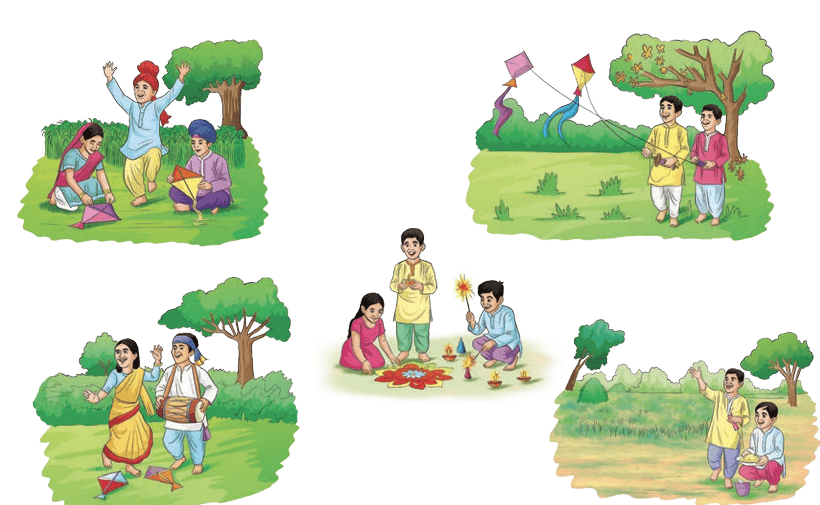
| S.No. | Festival | Season |
|---|---|---|
| 1. | Pongal, Makar Sankranti | (a) Spring — when flowers bloom |
| 2. | Holi | (b) Autumn — after crops are harvested |
| 3. | Diwali | (c) New year and harvest festival |
| 4. | Baisakhi, Gudi Padwa, Vishu, Rongali Bihu | (d) Winter |
In this way, seasons not only shape what we do, but also teach us about the cycles of life. By understanding the seasons, we understand how life moves in cycles. As you step out each day, you are witnessing nature’s rhythm unfolding, one season at a time.
Let us reflect
- Ask your family members and write about seasons. Do you find any major differences in the patterns or changing seasons? What could be possible reasons for these differences?
- Narrate your experiences about the season changes.
- Seasons have local names. Find out and write the
seasons mentioned below are called in your region, and
your local language.
(a)Spring:
(b) Summer:
(c) Monsoon:
(d) Autumn:
(e) Pre-winter:
(f) Winter:
- Fill the table below based on your observations and
experiences.
Name of the Season Food You Eat Clothes You Wear Festivals You Celebrate Nature Around You Spring Summer Monsoon Autumn Pre-winter Winter - Share your experience of seasons’ journaling.
- Make a comparative drawing of the three major seasons.
| Summer | Monsoon | Winters |
|---|---|---|