UNIT I

Basic Motor Movements
Welcome to the exciting world of movements once again. Let us take our journey forward. In continuation to the basic motor movements that we learnt in Grades 3 and 4, we use our large muscles for movements such as jumping, throwing, catching, kicking, and hitting. These are known as gross motor skills, which play a vital role in everyday tasks, sports, and maintaining physical fitness. In contrast, fine motor skills involve the use of small muscles in our hands and fingers, which are helpful for more precise actions like writing, drawing, picking up small items, and gripping objects. Both gross and fine motor skills are essential components of basic motor development. There are five key motor movements that we emphasise: throwing, catching, kicking, receiving, and striking. The aim is to practice these skills through engaging activities using objects of various shapes, sizes, weights, and textures.
Chapter 1
Throwing and Catching
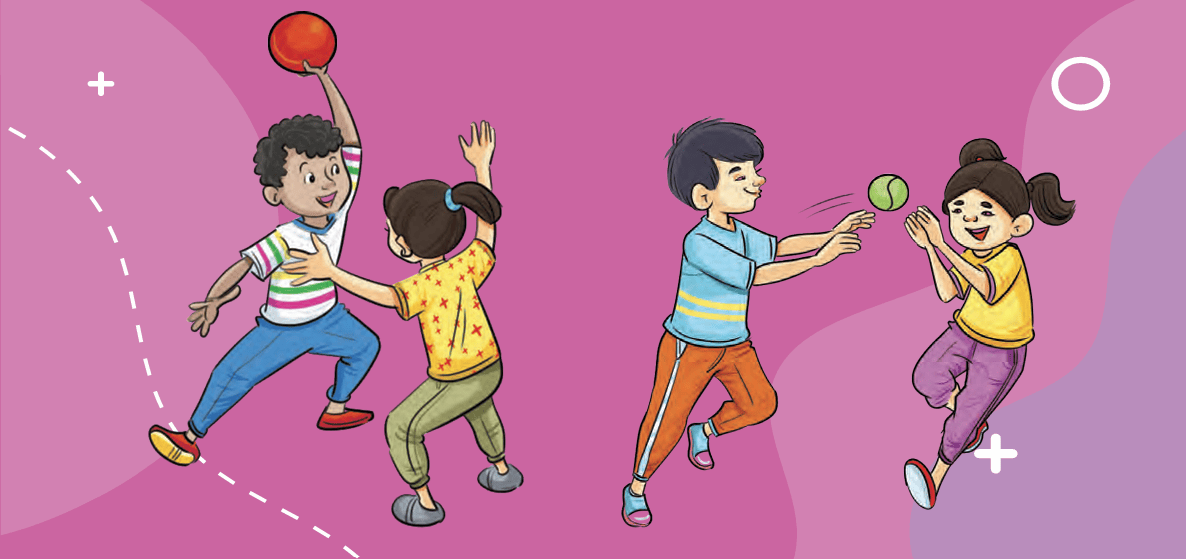
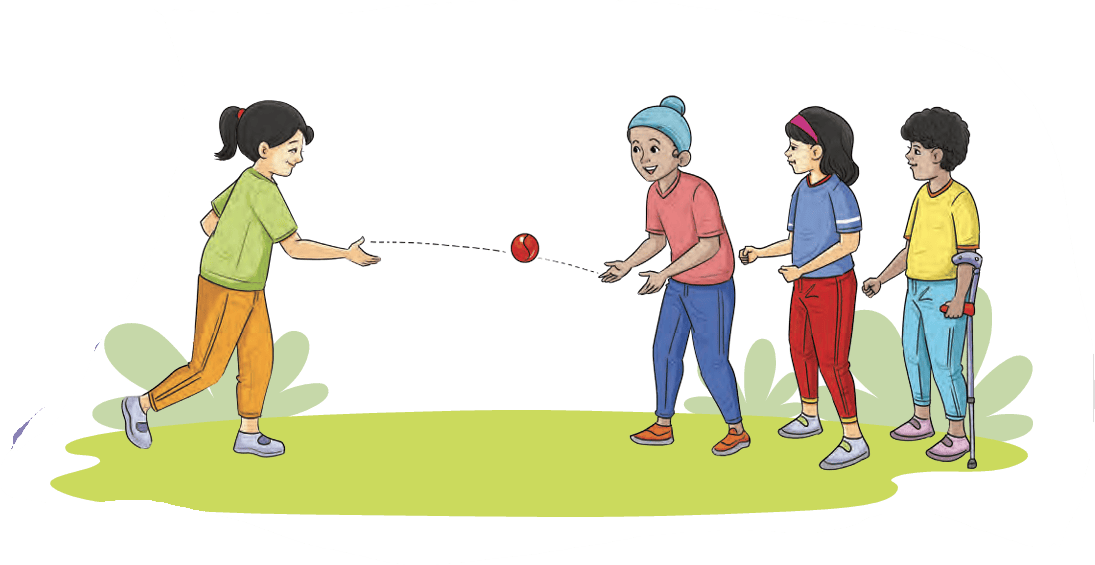
As we have learnt in the previous grades, throwing and catching are done with the help of our arms, shoulders, and torso. However, the hands are also used for releasing and catching an object. Now, we will learn how to throw and catch by playing some interesting games.
Throwing
Notes for the teacher
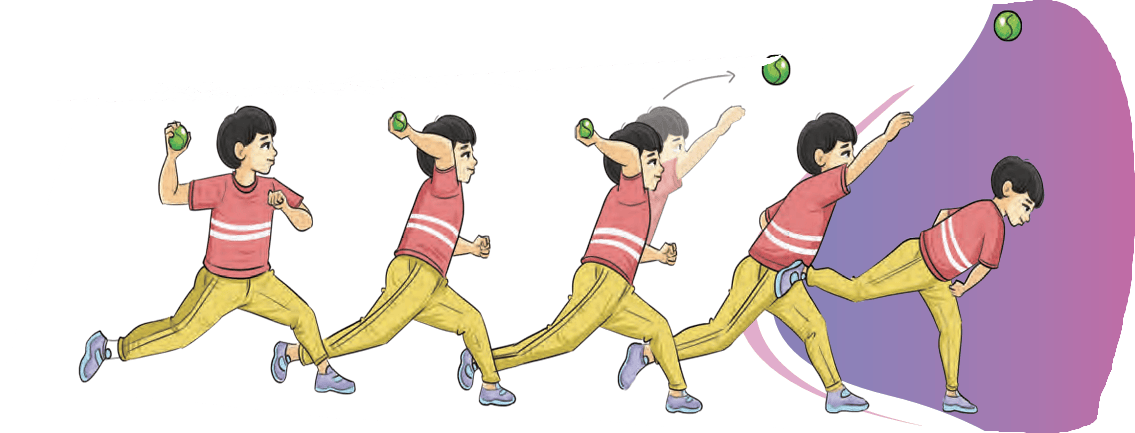
- Grip: The student holds the ball firmly with the fingers spread out.
- Stance: Focus on the target, and run for 3–4 steps to generate force.
- Throw: Twist the upper body smoothly, take back the throwing arm and swing it forward to release.
- Follow-through: It should be smooth and without any jerk.
Catching
Notes for the teacher
Ensure the following while the students practice catching —
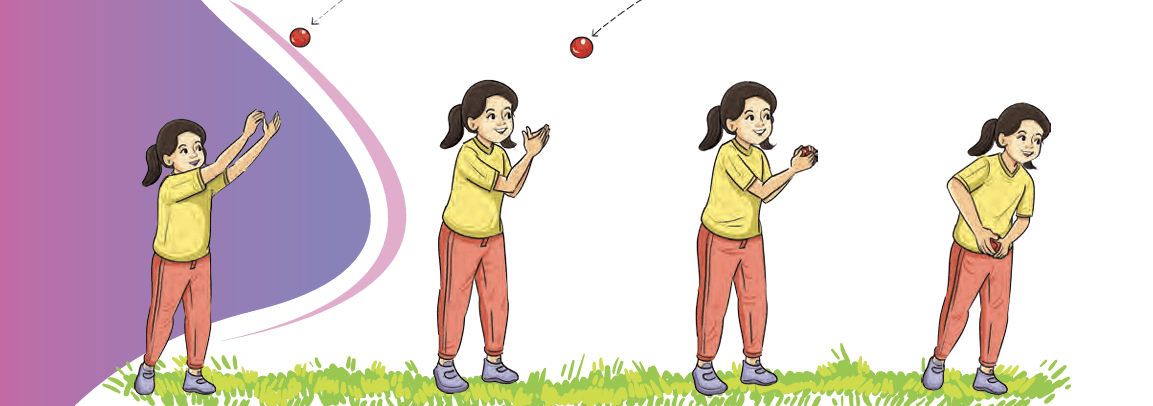
- Grip: Holds the ball firmly with the fingers spread out.
- Stance: The body is relaxed and ready to approach the target.
- Catching: Run where the ball is expected to land; body is behind the line of the ball; palms are joined to form a cup.
- Hands are soft, and the eyes are on the ball.
- Follow-through: Let the ball fall into the hands; the hands are pulled back, and the knees are bent to minimise the impact.
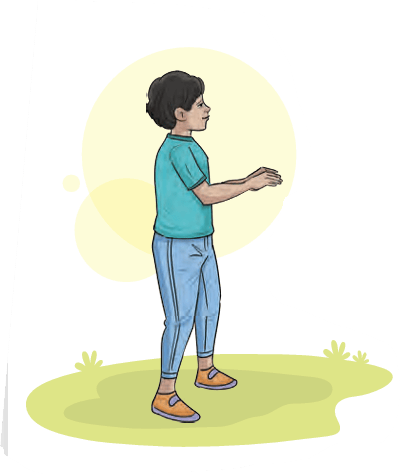
Stand with knees slightly bent like you are getting ready to jump.
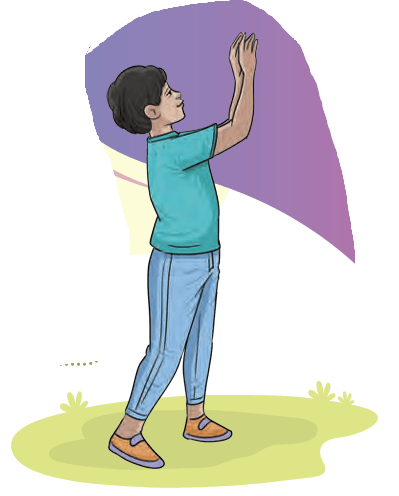
Join your palms together above your head to form a reverse cup. Keep your head still, eyes up and on the ball.
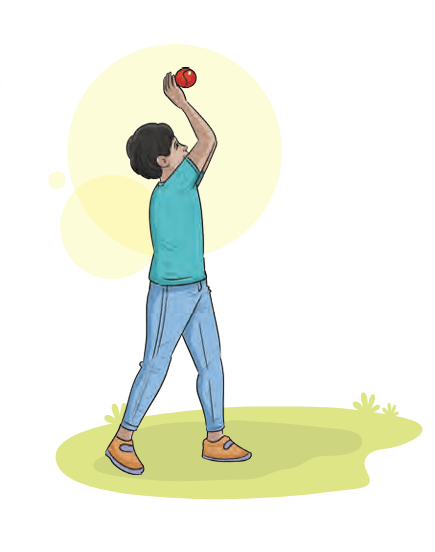
Catch the ball softly over your head.
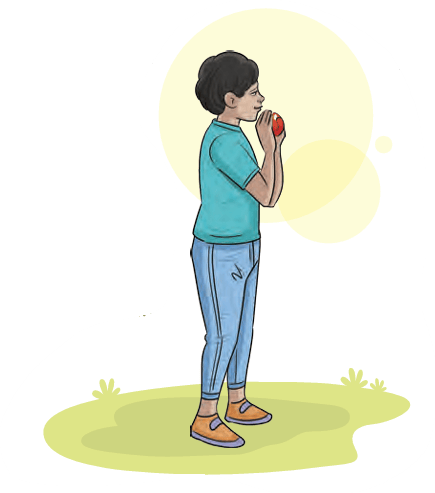
Hold the ball firmly and bend your elbows back towards the body.
BM 1
Hush Hush Throw
Required Material
Soft ball
How to play
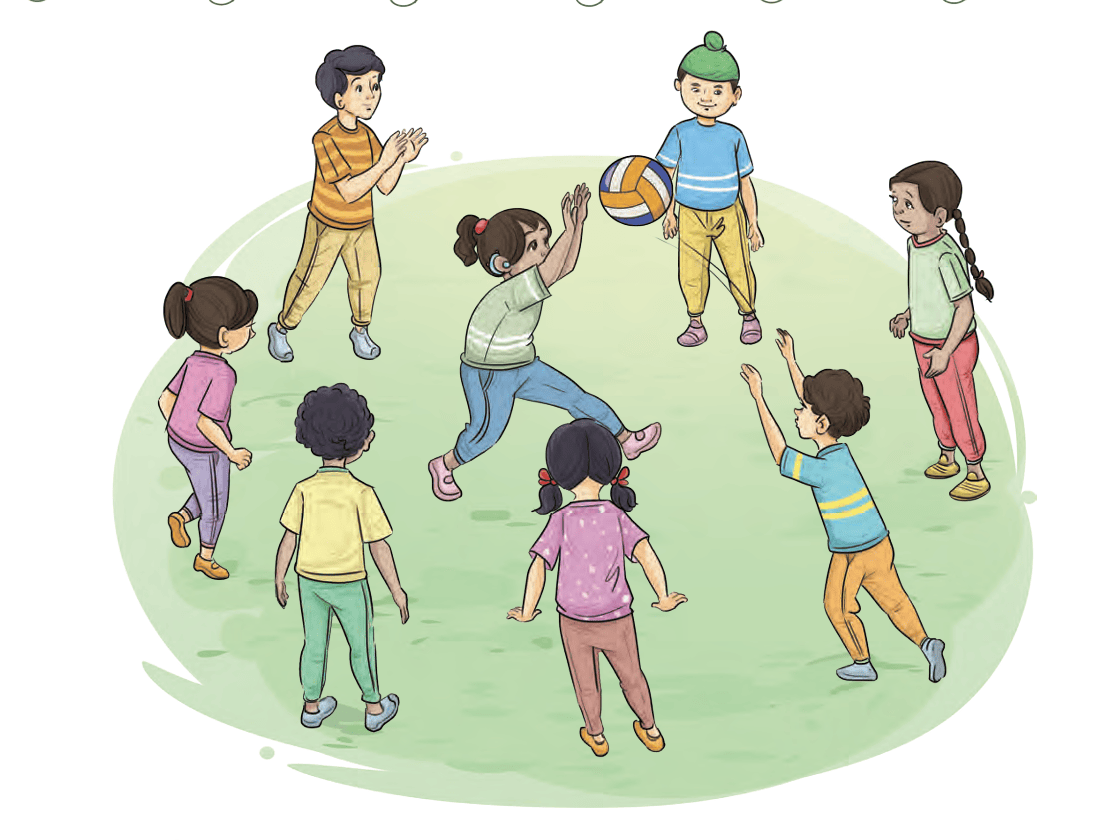
- . Form multiple teams and make them stand in a circle marked on the ground.
- . A defender stands at the center of each team.
- . Any one student in the circle will hold the ball.
- . At the sound of the whistle, the students will throw the ball to each other randomly without any signal or noise.
- . Students are not allowed to hold the ball for more than three seconds.
- .The defender will try to intercept the ball, and if intercepted, the thrower will become the defender, and the game will continue.
DID YOU KNOW?
The human body has 206 bones which give them structure and shape.
PURPOSE
To develop agility and coordination with quick decision making skills.
VARIATION
- . Vary the size of the ball.
- . Vary the number of balls and defenders to make the game harder.
- . Rules can be made to throw the ball below or over the head.
- . Use different throws like underarm, overhead and sidearm.
Circle Time
Discuss and share ideas on how you can measure the 3 seconds while playing. TIME What factors will you consider when deciding on whom to throw the ball to?

BM 2
Count and Rep
Required Material
Balls of different sizes
How to play
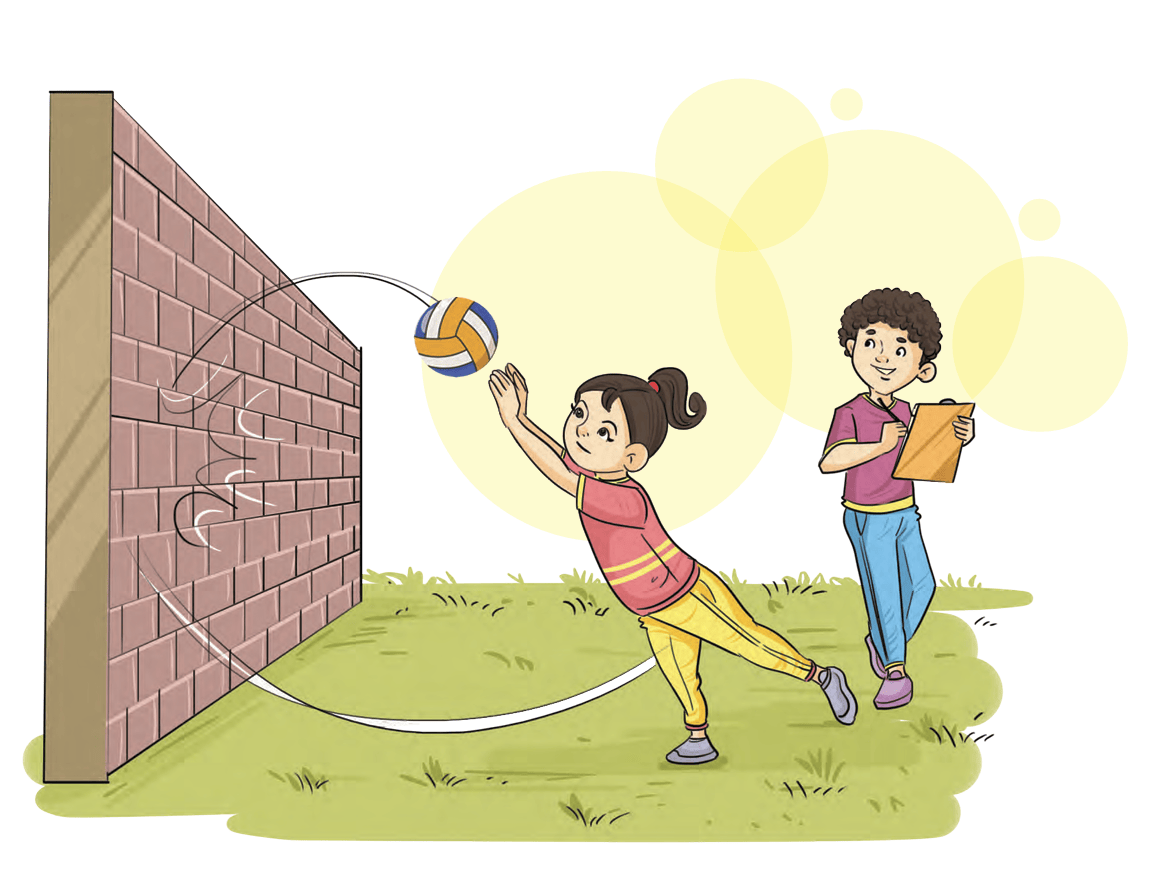
- .The students will stand in front of a wall with a tennis ball.
- . The student will match the counts with the number of catches.
- .Count 9: Throw the ball underarm on the wall and catch it as it bounces back for nine times.
- .Count 8: Throw the ball overarm on the wall and catch it as it bounces back for eight times.
- .Count 7: Throw the ball on the wall with the right hand and catch it with the left hand seven times.
- .Count 6: Throw the ball on the wall with the left hand and catch it with the right hand six times.
- .Count 5: Throw the ball on the ground, make it bounce back from the wall, and catch it five times.
- .Count 4: Throw the ball on the wall and clap twice before catching it back. Repeat this four times.
- .Count 3: Throw the ball on the wall, clap once on the backside, and receive the ball thrice.
- .Count 2: Throw the ball, aiming it high on the wall and jump to catch it over your head. Repeat this twice.
- .Count 1: Throw the ball on the wall, turn right, and move backwards to catch it as it bounces back.
PURPOSE
To develop coordination, concentration and reaction time.
VARIATION
- . Vary the size of the ball.
- . Vary the count, rep and throwing skill.
Circle Time
Which throw did you TIME f ind difficult, and what did you do to successfully complete it?
BM 3
Pass and Score
Required Material
Balls of different sizes
How to play
- .Divide the playing area into two equal zones (A and B). and form two teams (X and Y).
- . Distribute an equal number of students from both teams into each half.
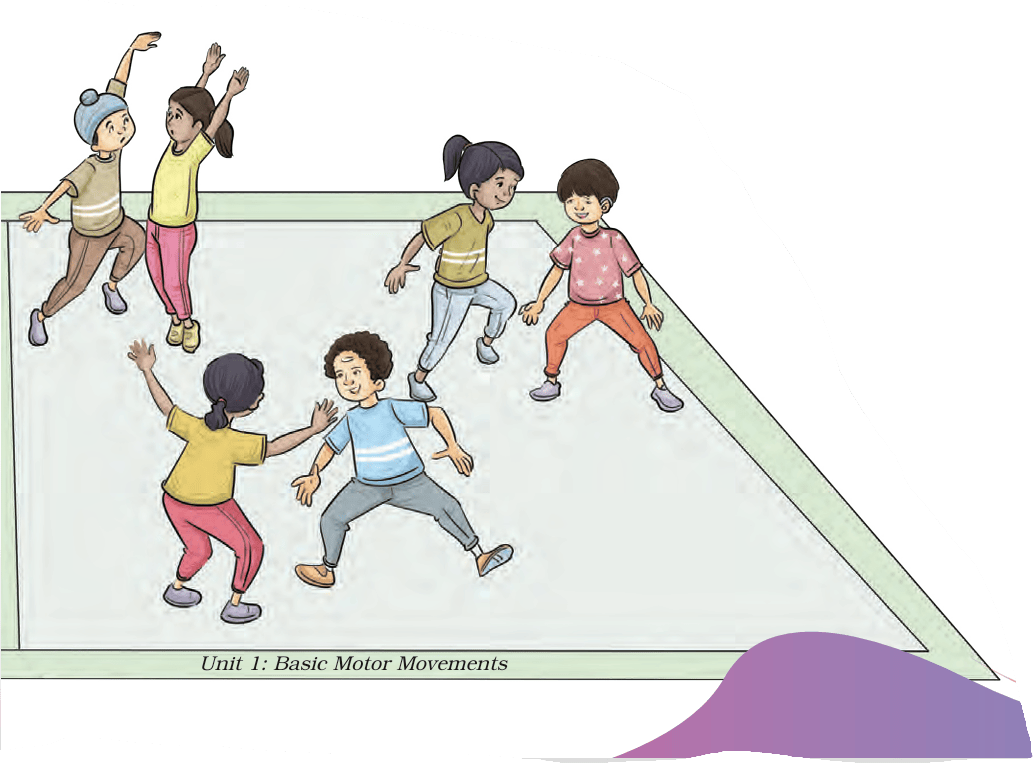
- .On the sound of the whistle, a student of Team X in zone A will start passing the ball to their teammates, and the students of Team Y will intercept.
- .They have to pass the ball at least three times in zone A before passing it to zone B to their teammates.
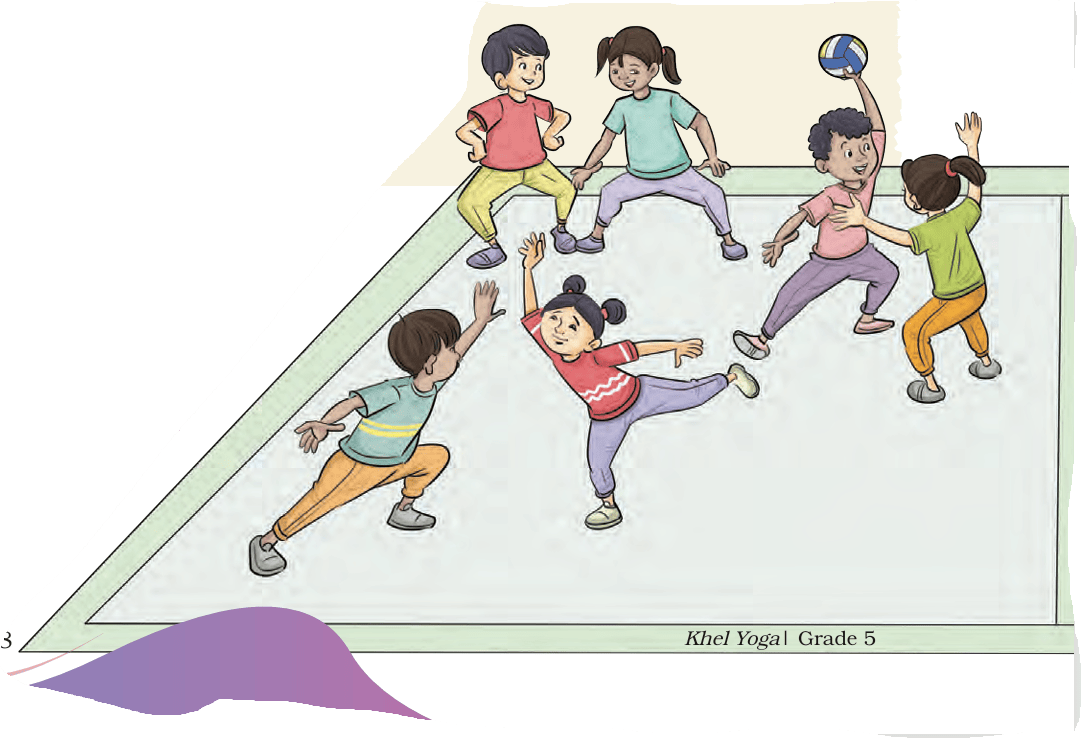
- . If a student of the same team catches the ball in zone B, the team will gain one point.
- . If a student of the other team intercepts the ball, they will pass it thrice before throwing it to the other half to score a point.
- .The team with maximum points at the end will win the game.
PURPOSE
To develop agility, coordination and teamwork.
VARIATION
- . Vary the number of students in each team.
- . Vary the size of the playing area.
Circle Time
Make changes to make the game more interesting.

BM 4
Hand the Ball
Required Material
Medium-sized ball
How to play
- .Divide the students equally into two teams.
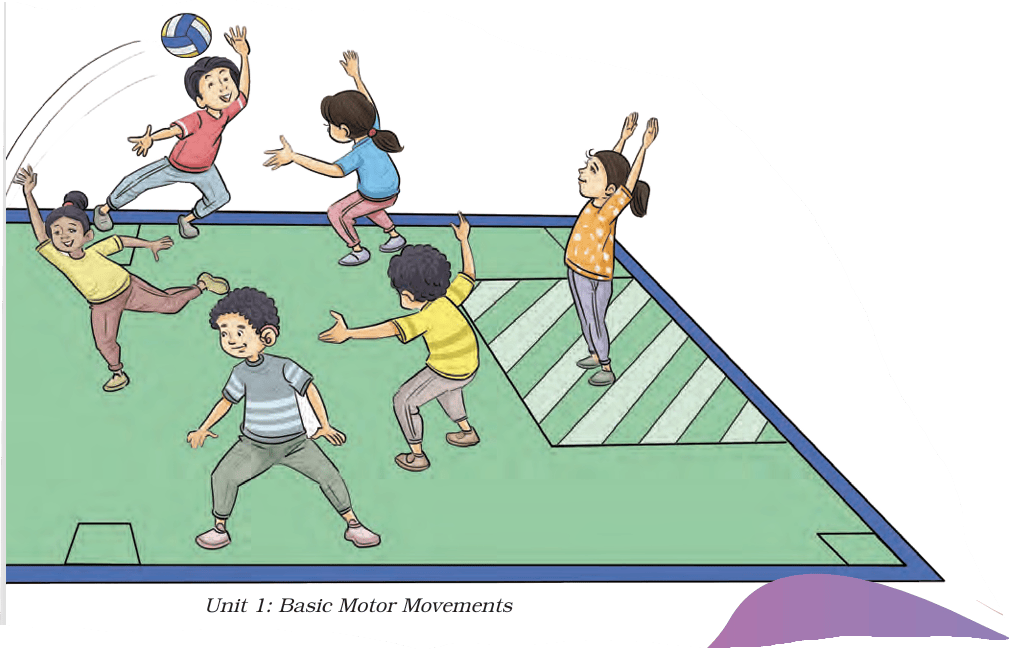
- . Mark a rectangular playing area, make two large boxes at each end and one small box at each corner (in total six boxes).
- .One student of each team will stand in the large box at their end.
- .The game will start from one end, and the students will aim to pass the ball to their teammate standing in the box at the other end.
- .Every successful reception inside the larger box will earn one point for that team.
- .Every successful reception in the smaller box will earn two points for that team.
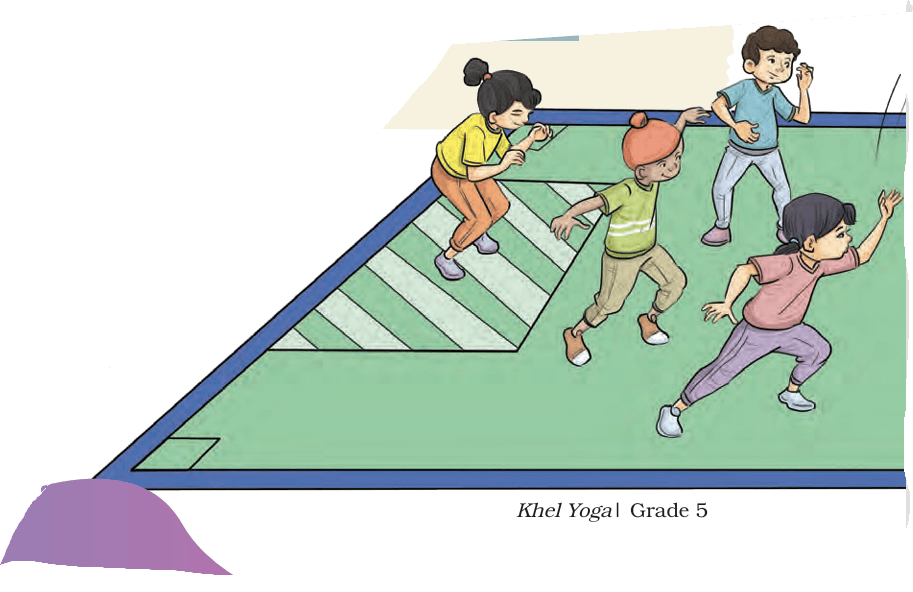
- .In order to receive the ball in the smaller box, any student of the same team can move into the box on their side and catch the ball.
- . After completing the pass, the ball will be handed over to the other team.
- .This will continue for a fixed time, and the team with the maximum points at the end will win the game.
PURPOSE
To develop spatial understanding and cooperation.
VARIATION
- . Vary the number of students in each team.
- . Vary the size of the playing area.
Circle Time
How will you help the students of the losing team to overcome the feelings of defeat? How did you anticipate the correct place to receive the ball?
BM 5
Catch and Hit
Required Material
Soft balls of different sizes
How to play
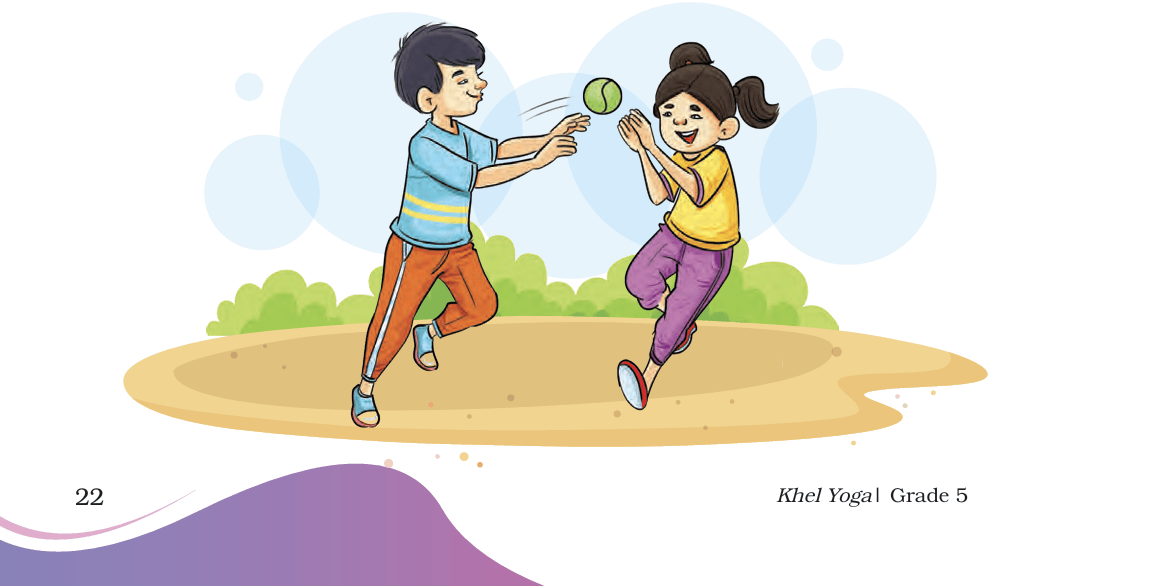
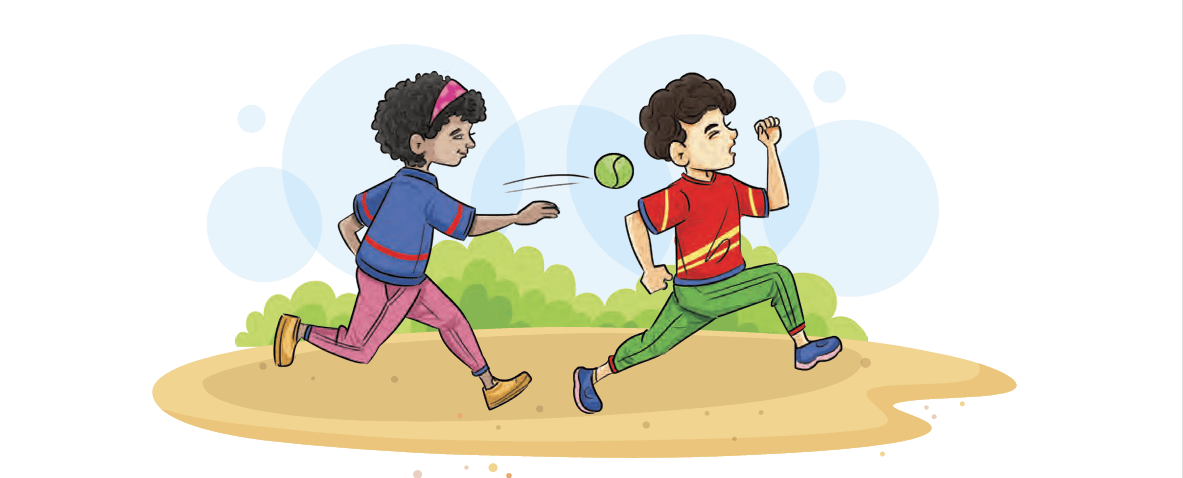
- .Divide the students into pairs, where each pair has a soft ball.
- . The pairs will find a safe space in the field and wait for further instructions.
- .On the call of “catch”, students will start passing the ball to each other.
- .When the teacher calls out “throw”, the student without the ball will start running away from the partner.
- .The student with the ball in hand will try to hit their partner with the ball, and the other student will try to dodge it.
DID YOU KNOW?
The left brain is known for helping with logic, math, reading, writing, and thinking in an organised, step-by-step way. On the other hand, the right brain is more creative and helps with art, music, imagination, and understanding pictures and patterns. While the left brain is like a planner, the right brain is like a dreamer.
PURPOSE
To develop accuracy in throwing and reaction time.
VARIATION
- . Vary the size, weight, and shape of the ball.
Circle Time
What did you do to make your throws more accurate? What strategies are used by the students while dodging and hitting the ball?

BM 6
Bull’s Eye
Required Material
Tennis balls and cones, a hula-hoop
How to play
- .Form teams of 4 –5 students.
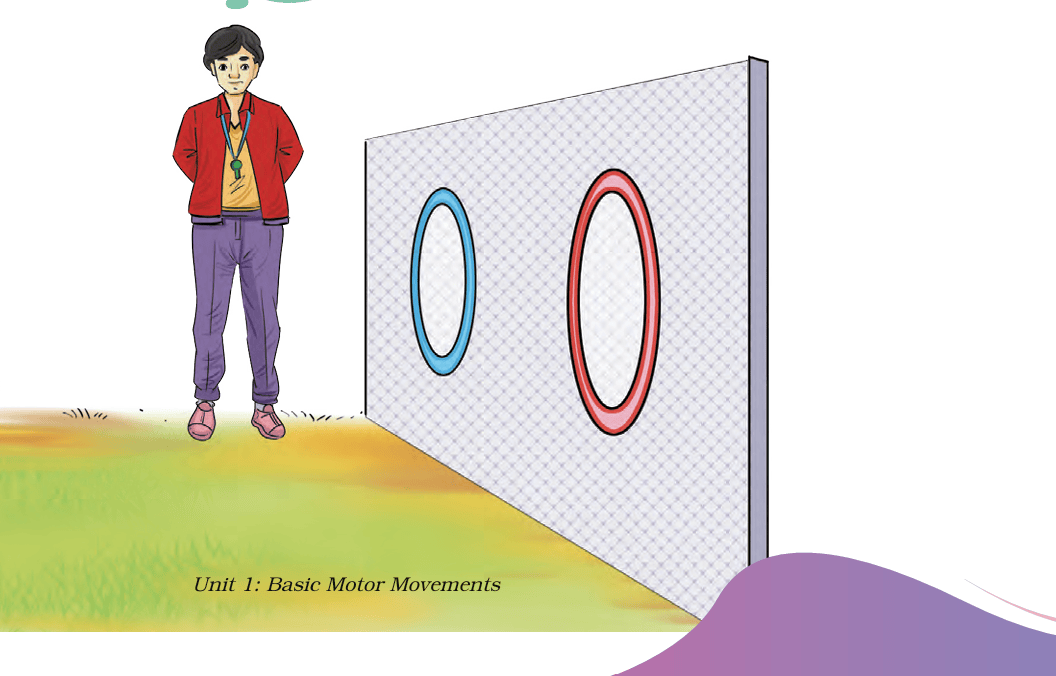
- .Place three markers. Spot A is where students will line up. Spot B, which is 5 metres from Spot A, is where tennis balls will be placed. Spot C, where a target/hula hoop/tyre/circle on the wall will be marked.
- .On the sound of the whistle, students from Spot A will run to Spot B, pick up the ball and throw hard at the target.
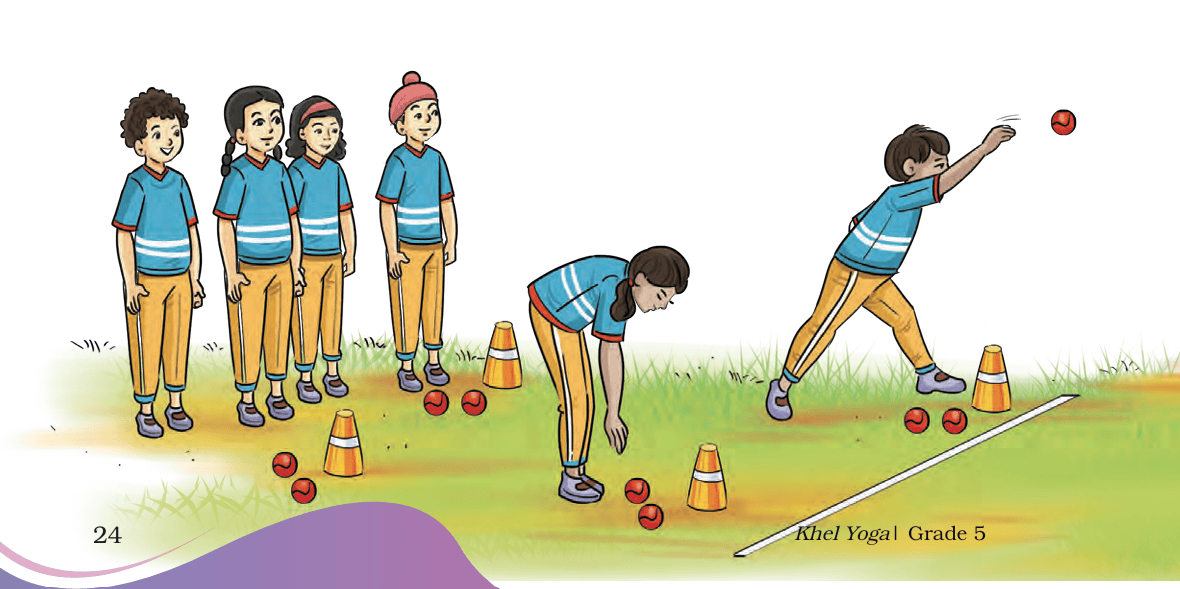
- .After throwing, students will run to collect the ball and place it back at point B.
PURPOSE
To develop power in their throw and also to foster a quick response.
VARIATION
- . Vary the number of students in each team.
- . Vary the size of the playing area and the distance between the spots.
Circle Time
How did you predict the ball’s direction after hitting the target, and how did you reach the ball quickly?
DID YOU KNOW?
Focus and concentration are the key aspects to target precisely.
Chapter 2
Kicking and Receiving
Have you ever played football? In football, we kick the ball to our teammates and also receive the ball from them. Kicking is an essential skill where we use our feet to direct the ball towards a specific target or direction. Receiving is equally important, as it involves controlling the ball with our feet when it comes to us, ensuring we don’t lose possession. Let’s explore how to kick and receive a ball effectively using our feet. After learning these skills, we’ll enjoy playing some fun games!
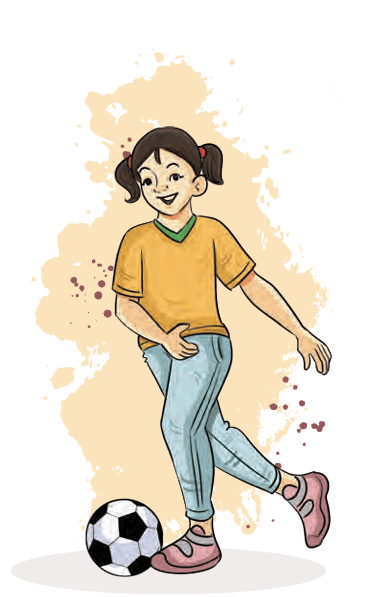
Kicking
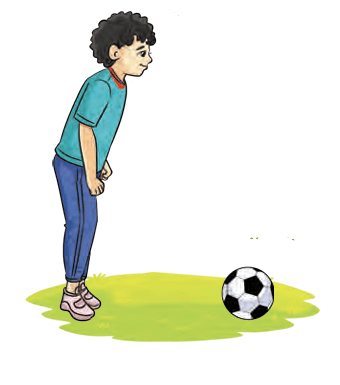
Stand 5 metres behind the ball and keep your eyes focused on it.
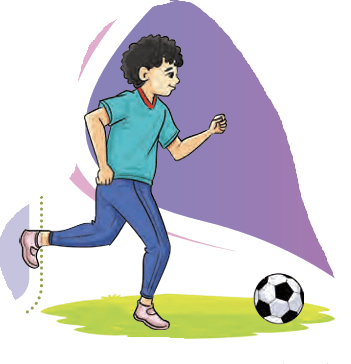
Run towards the ball.
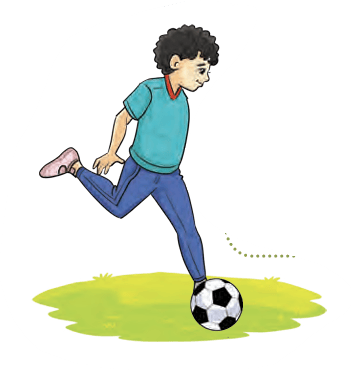
Keep the non-kicking leg to the side of the ball and then kick the ball using the inner part or the top part of the kicking foot.
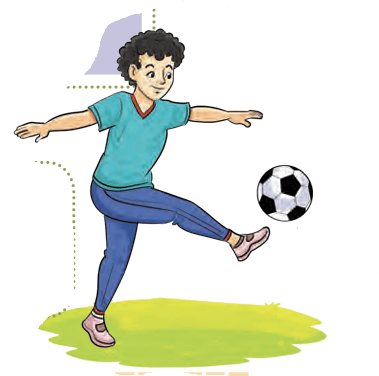
Swing the arms sidewards and follow through in the direction of the kick.
Notes for the teacher
Ensure the following while the children practice kicking—
- Stance: Relaxed shoulders while approaching the ball.
- Approach: Approach the ball and calculate the stride length.
- Kicking:Swinging back the kicking leg as required and bringing it fast to kick the ball.
- Follow through: The arm goes sidewards. The kicking leg and the body go forward in the direction of the ball. It should be smooth and without any jerk.
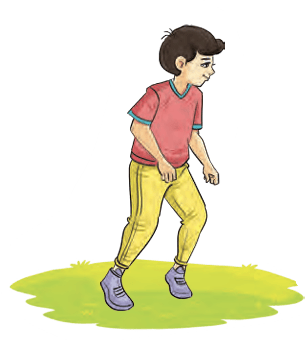
Stand and anticipate the direction and speed of the ball.
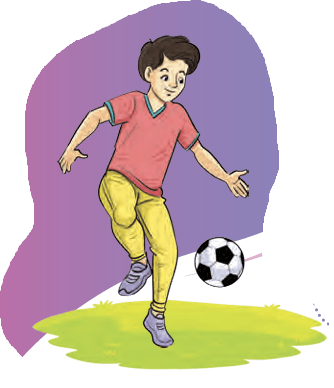
Approach the ball and take your position while raising the leg on which you want to receive the ball. Keep the other leg firmly on the ground.
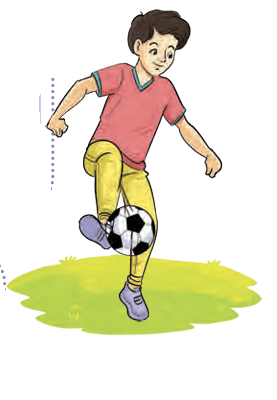
Receive the ball with the inside of the foot and move the leg slightly backwards while receiving.
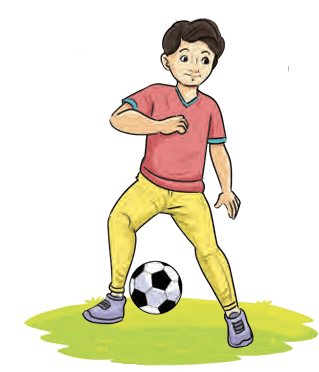
Balance your body as the ball touches the ground, and try to dribble the ball after receiving.
Notes for the teacher
Ensure the following while the children practice receiving skills—
- Stance: Legs and shoulders should be relaxed, run towards the ball and keep the body in line with the ball.
- Anticipate and be ready: Anticipate the path of the ball and approach the ball where you want to receive it.
- Receiving: Shift the body weight on the non-receiving foot, always receive the ball on the instep of the receiving foot and on contact, take the foot slightly backwards.
- Follow through: Keep the body low and maintain balance by shifting the body weight as required.
BM 7
Friendly Goal
Required Material
Football and cones
How to play
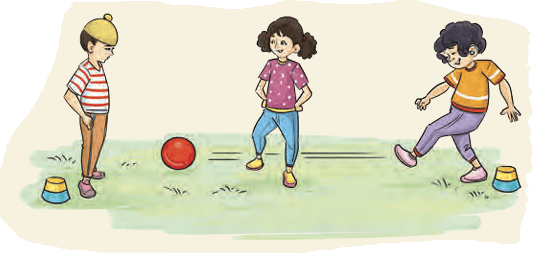
- .Form teams of three students each.
- .Place two cones 5 –7 meters apart and ask two students to stand in front of the cones and one at the centre.
- .The student at the centre will stand with feet apart, posing as a goal. The student is free to change their position.
- .On the sound of the whistle, a student standing near the cone will try to kick the ball between the legs of the student standing at the centre, and the other player will receive it.
- .The ball should be hit below knee height.
- .Change positions quickly to provide the opportunity to all three players.
PURPOSE
To develop accuracy in kicking.
VARIATION
- .Vary the distance between the students.
- .Use both legs alternately.
- .Students can also juggle the ball in the air 2–3 times before kicking.
Circle Time
Discuss steps to ensure safety of the student standing at the centre while kicking. As a student standing at the centre, how would you stand to ensure your own safety?

BM 8
Clear the Centre
Required Material
Marking powder and footballs
How to play
- .Form two uneven teams. Team A will have 4 – 5 students, and Team B will have 12 –15 students.
- .Form circles as shown in the picture.
- .Team A will stand inside the circle with each player
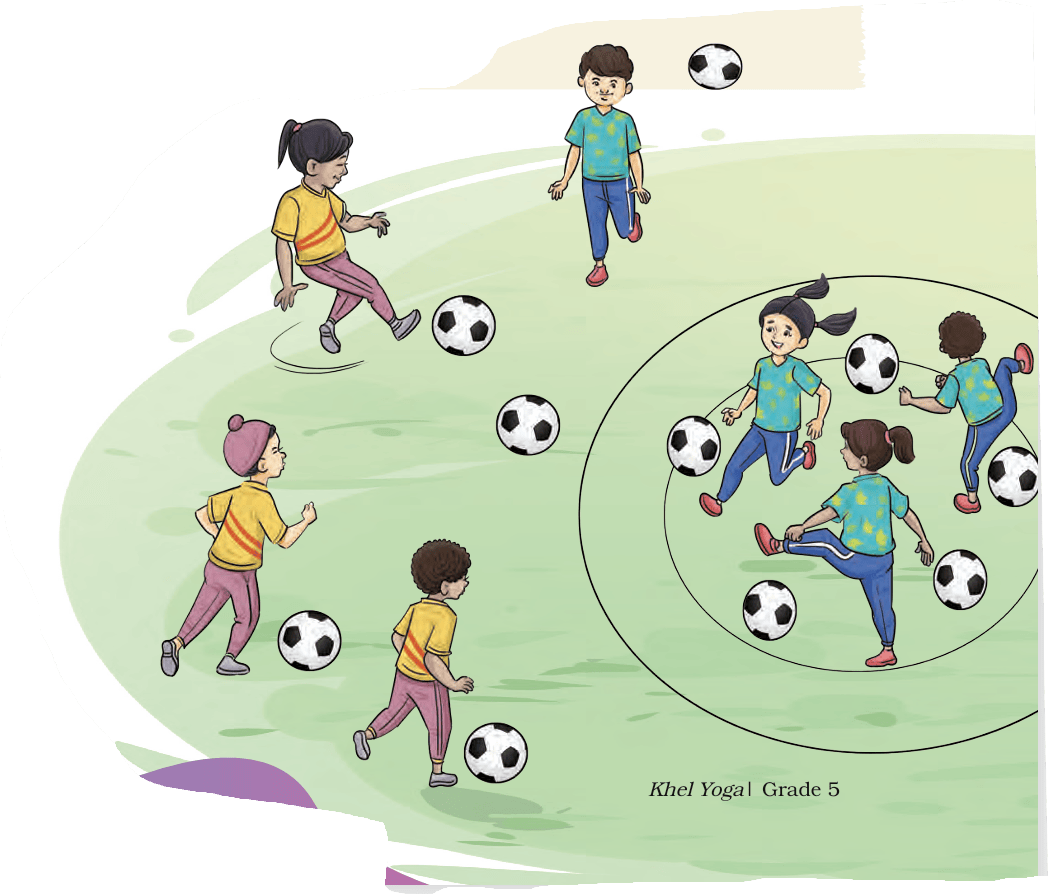
- having one football each, and Team B will stand outside the outer circle.
- .At the sound of the whistle, Team A will kick the balls outside the circle as far as possible.
- .Team B students will try to retrieve the footballs quickly and kick them back into the circle carefully so that they do not go out of the circle.
- .Rotate the students in the inner circle to provide an opportunity to all.
Note for the teacher
Ensure that the students retrieve the ball only with their legs.
PURPOSE
To develop response time with leg-eye coordination.
VARIATION
- . Vary the number of students in each team.
- .Vary the size of the playing area.
- . Use different sounds to start, pause and stop the game.
Circle Time
Suggest new rules for playing the game to make it more difficult and interesting.
BM 9
Wall Goal
Required Material
Cones and footballs
How to play
- .Form teams of 5 students each.
- .Provide one football and a cone to each team.
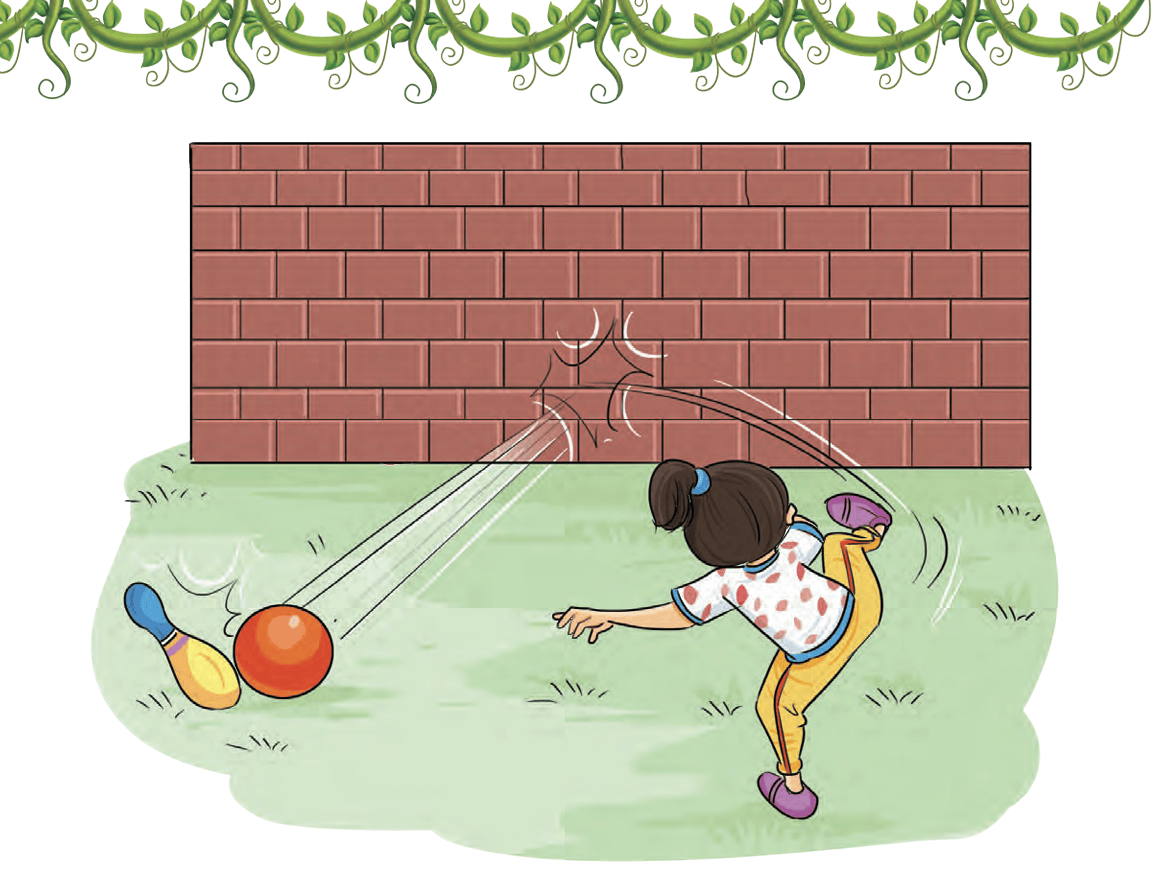
- .The student will place the cone at a distance of 5 feet from the wall and place the ball next to the cone.
- .The aim is to kick the ball onto the wall in a way that it will rebound and hit the cone.
- .If a team successfully hits the cone, they can move the cone 1 foot further and continue kicking.
- .Mark a line at ten feet; if the students cross it, they will receive one point.
- .The team with the maximum points will win the game.
DID YOU KNOW?
Rubber balls bounce from any hard surface primarily due to its elasticity and momentum.
PURPOSE
To develop a sense of force and work the angles while kicking.
VARIATION
- . Vary the number of students in each team.
- .Use different objects in place of cones to change the hitting target.
- . Keep the object at different rebound angles.
Circle Time
Discuss ways of hitting the ball on the wall so that it rebounds straight back or at different angles. Realise the difference in the force applied for hitting the cones placed at different distances and angles.

BM 10
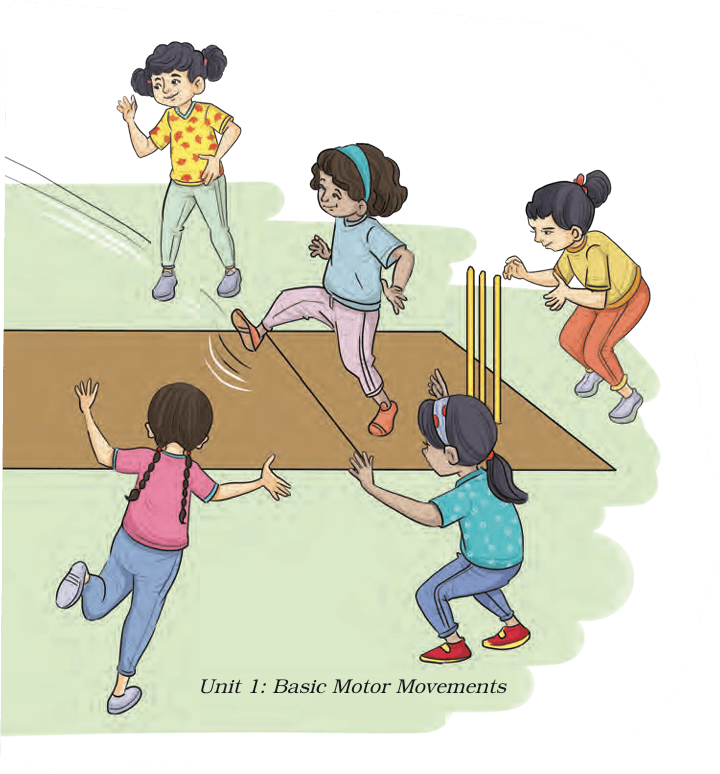
Foot Cricket
Required Material
Football
How to play
- .Form two teams. Toss a coin to choose batting or fielding.
- .Set up the ground, wickets and pitch as done in the game of cricket.
- .Bowlers and fielders will use their hands to roll the ball for bowling or to field.
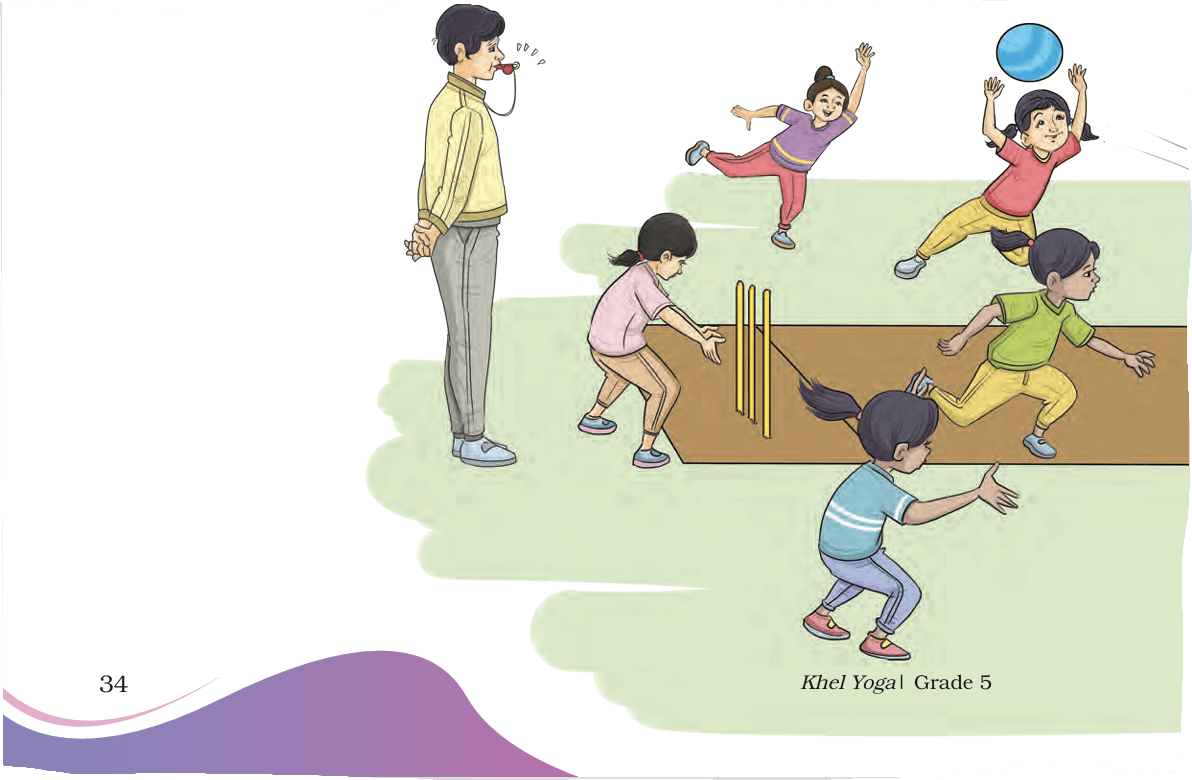
- .The batter will use their leg to kick the ball.
- .Fielders will use their hands to receive the ball.
- .The rest of the rules are the same as cricket. The team with the maximum runs at the end will win the game.
PURPOSE
To develop teamwork and coordination among teammates.
VARIATION
- . Vary the number of students in each team.
- .Vary the size of the playing area.
Circle Time
Share ideas on how to play better as an individual and as a team.
BM 11
Kick in the Square
Required Material
Football, marking powder.
How to play
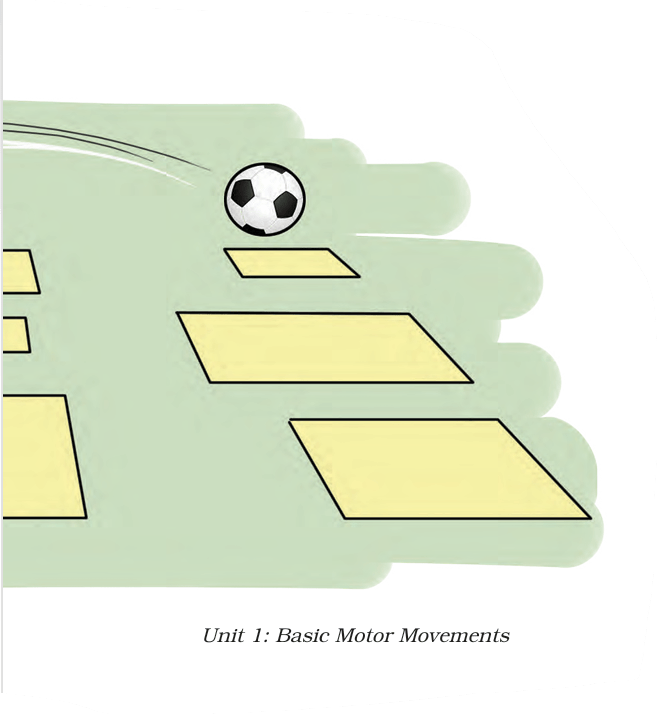
- .Mark 6 rectangles of different sizes on the ground and mark a line 5 –7 metres apart from the squares.
- .Form teams of 4 – 5 students each.
- .Give each team a football, and they will line up behind the kicking line.
- .The teacher will give a target to students to kick the ball into one of the squares.
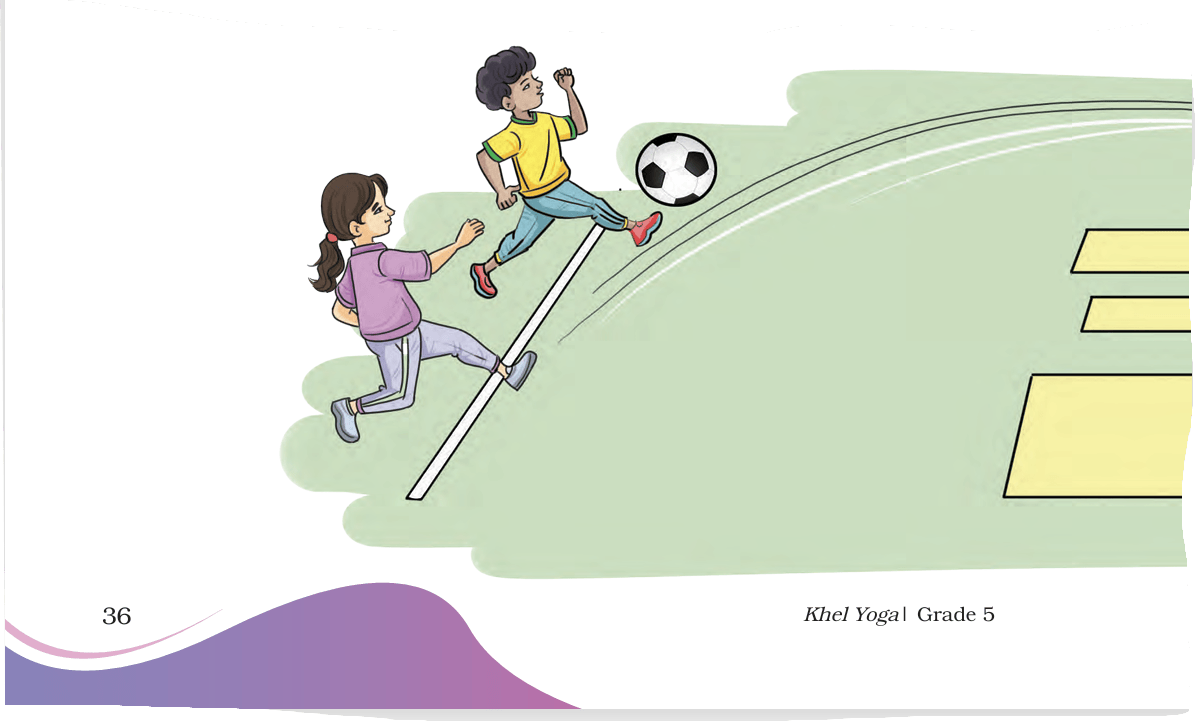
- .Both teams will try one by one to kick the ball inside the designated square.
- .Whichever team kicks in the square first will get a point.
- .This will continue until a team gets 10 points and is declared a winner.
PURPOSE
To develop leg-eye coordination, sense of space, and sense of force with respect to distance.
VARIATION
- .Vary the size, shape and weight of the ball.
Circle Time
Realise the difference in force applied while kicking the ball in squares of different sizes.
BM 12
Hit the Potato
Required Material
Tennis balls and footballs
How to play
- .Form teams of 8 students each.
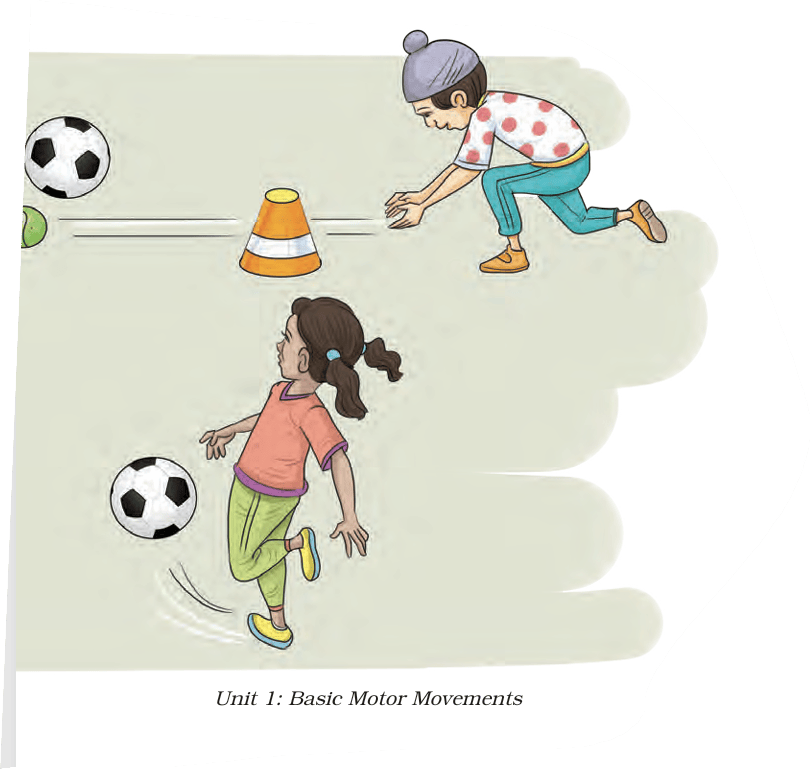
- .Place two cones 10 metres apart in the centre.
- .Place one student each with a tennis ball next to the cones.
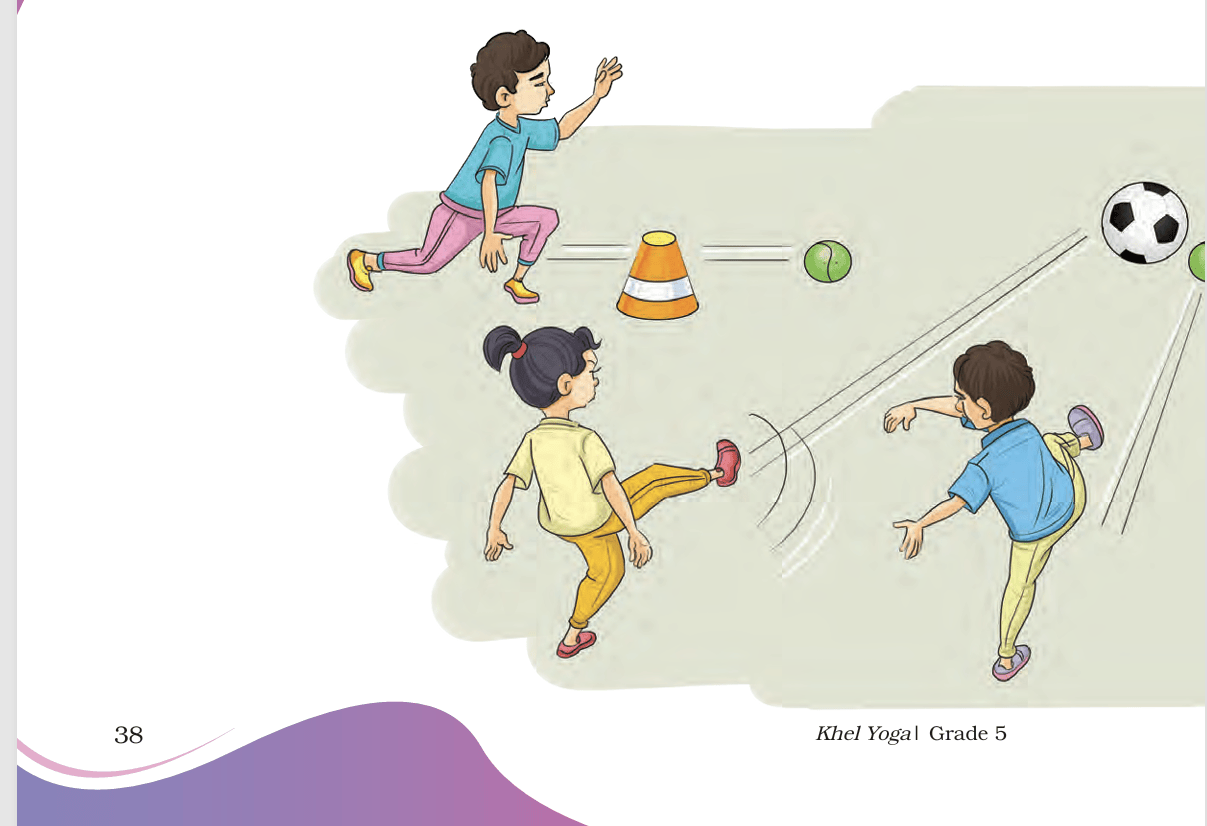
- .Place 3 students at a distance of 5 –7 metres from the cone on both sides and provide 3 footballs to each team.
- .The students standing at the cones will roll the tennis ball across the cones, and the students with the football will try to hit the moving tennis balls.
- .If a student hits a tennis ball, that student will exchange places with the student rolling the ball, and the game will resume.
PURPOSE
Develop a sense of space with respect to moving objects and accuracy.
VARIATION
- .Vary the number of students in each team.
- .Vary the size of the rolling targets.
- .Vary the pace of rolling.
Circle Time
Share the difficulties you faced while hitting the moving target and how you dealt with them.
Chapter 3
Strike the Object
Striking an object while playing helps us gain various types of learnings in an enjoyable way. Various racquet sports are emerging nowadays. For example, pickle ball, ball badminton, squash, etc., along with the more familiar badminton, table tennis and tennis. Learning to strike an object with a racquet or striking surfaces can be fun. Let’s try!
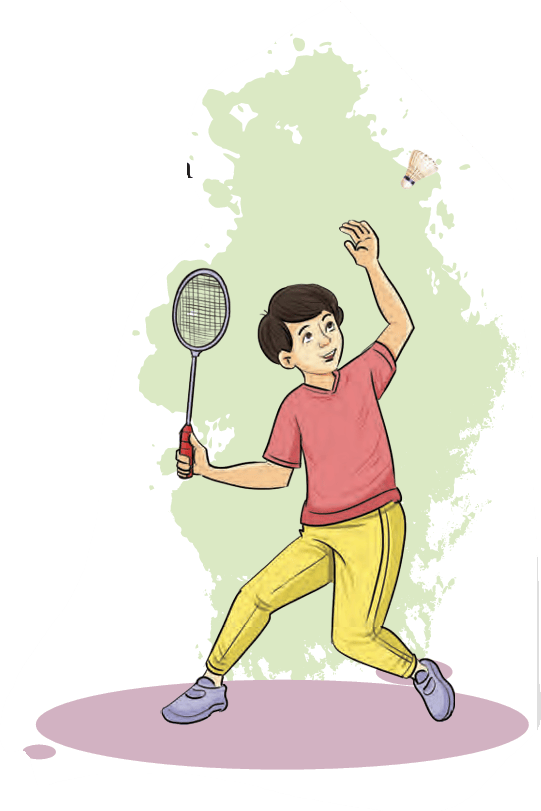
Striking the Object with a Bat/Racquet/Stick
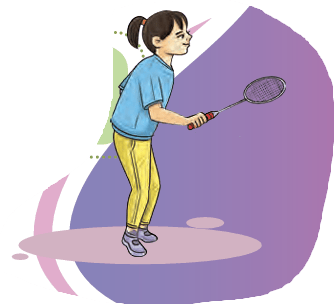
Hold the racquet and stand sidewards with the knees slightly bent.
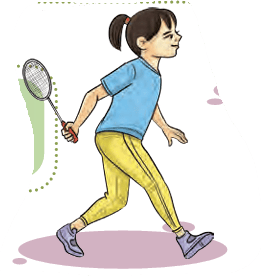
Anticipate the object and move towards it.
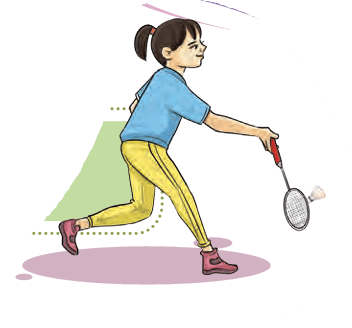
Reach and swing the racquet. Rotate shoulders and hips.
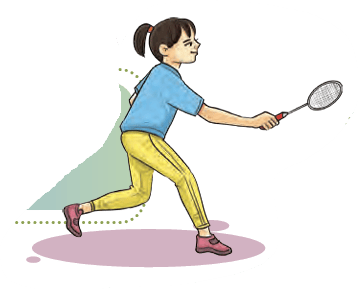
Hit the object while it’s in motion.
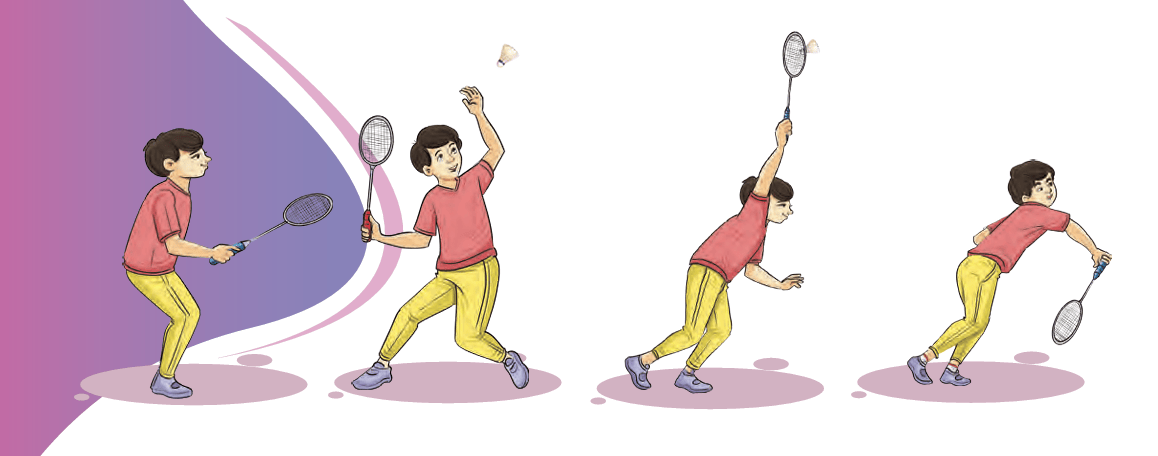
After hitting, follow through as shown in the picture.
Notes for the teacher
- Ensure the following while the children practice hitting skills—
- Stance: stands sidewards; legs are shoulder width apart, ready to approach the object; the eyes are always on the object.
- Grip: Firmly with the top hand and loosely with the bottom hand for direction.
- Hitting: Step forward on the front foot, swing and rotate the hips and shoulder while hitting, keep eyes on the object, extend arms fully at the contact point and hit.
- Follow-through: Swings the upper body along with the racquet, which goes around the body, and finishes over the shoulder.
Receiving the Object with a Racquet
Notes for the teacher
- Ensure the following while the students practice receiving with an object—
- Stance: Keep the feet shoulder width apart, knees slightly bent, and the body facing the object and ready to approach.
- Grip: Holds the racquet gently with both hands.
- Anticipate: Predict the path of the object, approach the object and keep the body low and aligned with the body accordingly.
- Receive: Align in line with the approaching object and receive, keeping your hands gentle.
BM 13
Handle with Care
Required Material
Racquets and Tennis balls
How to play
- .Mark a starting and finish line 10 meters apart from each other.
- .Divide the students into groups of 5 and ask them to stand in a line.
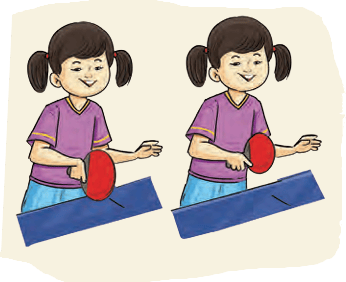
- .Students in the front will stand on the starting line with a table tennis racquet or a hard board, and a plastic ball.
- .On the sound of the whistle, they will start walking and tossing the ball until they reach the finish line
- .While returning, hold and balance the ball on the racquet or hard board, and come back to the finish line.
- .Other students will follow till all have completed the activity.
PURPOSE
To develop concentration and balance.
VARIATION
- .Vary the distance between the start and finish lines.
- .Vary the actions, such as balancing multiple balls, etc.
- . Vary the tapping with forehand, backhand and mixed.
Circle Time
Identify the things that distracted you from concentrating on the task. What did you do to overcome them?
BM 14
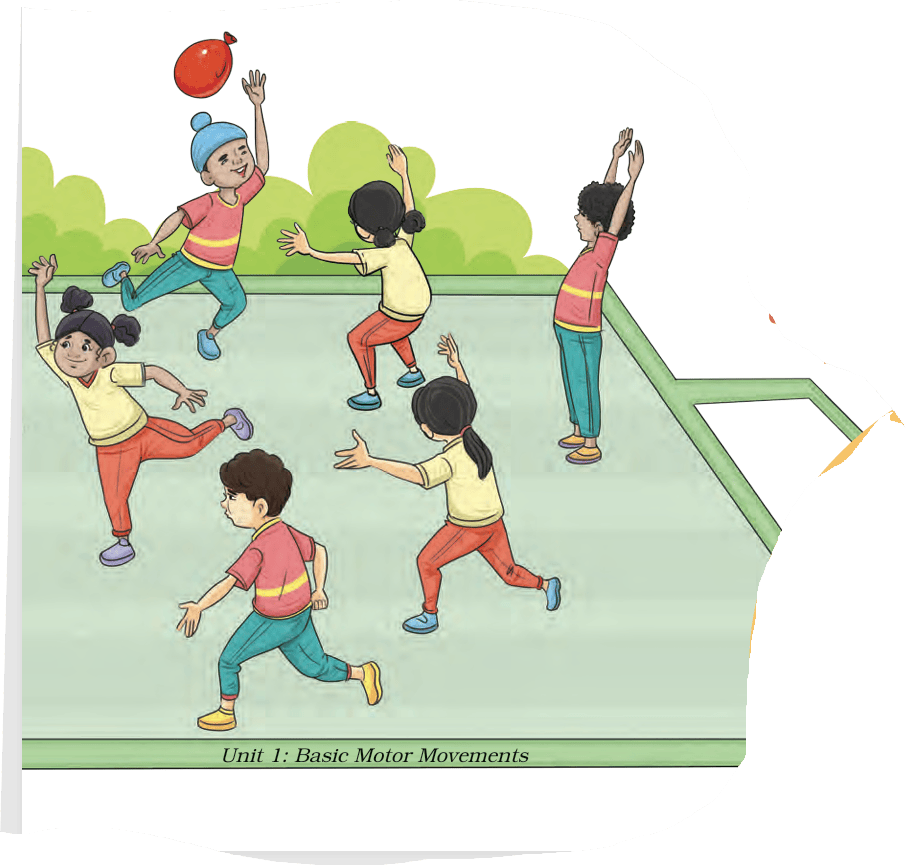
Balloon Strike
Required Material
Balloons or small-sized ball
How to play
- .Mark a rectangular playing area with a goal at both ends.
- .Make two teams each consisting of 4–5 students.
- .Give one balloon to any team and they have to put the balloon in the opponent’s goal.
- .Every time the student has to toss the balloon and strike it to pass the balloon to their teammates.
- .The team with the most goals will win the match.
PURPOSE
Develop coupling movements (hitting while running) with cooperation among teammates
VARIATION
- . Vary the size of the playing area.
- . Replace the balloon with soft balls.
DID YOU KNOW?
Spatial sense is important that it helps in recognising space, shape, sizes, positions, directions and movements and how objects relate to oneself and others.
Circle Time
Discuss the difference in the path of the balloon at different contact points after tossing and hitting (very high above the head, just above the head in front or right of the head).
BM 15
Catch to Win
Required Material
Cricket bat and tennis ball
How to play
- .Divide the students into 2 teams A and B.
- .Mark a square as required and ask Team A to take position inside the square.
- .Team B will stand ten meters from the square, with one student with a bat and one with ball.
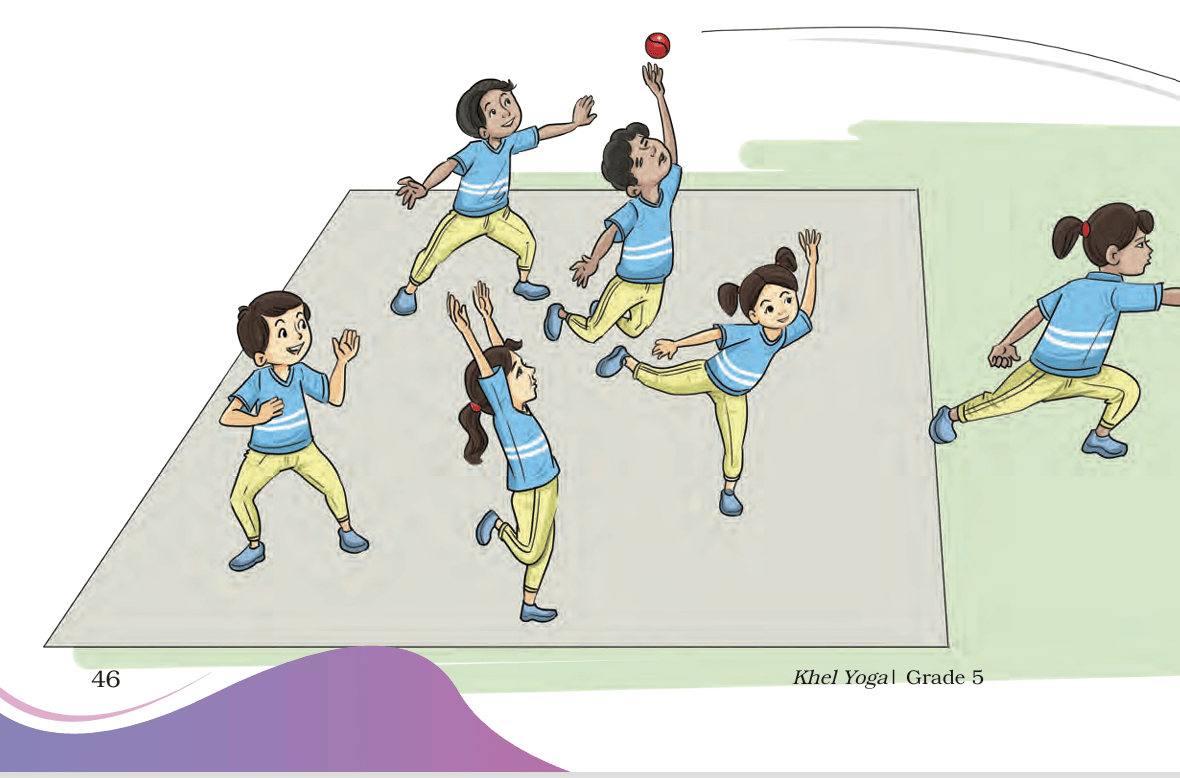
- .On the blow of the whistle, one student from Team B will throw an underarm ball to the student with the bat.
- .The student will hit the ball into the square.
- .If Team A catches the ball, they will score one point; if the ball falls on the ground, then Team B will score one point.
- .Students take turns to hit the ball one by one, and each student will hit the ball at least 5 times before changing positions with Team A.
- .The team with the maximum points will win the match.
PURPOSE
To develop hand-eye coordination, accuracy and range of striking with a sense of force.
VARIATION
- .Vary the size of the square and the distance between students.
- .Vary the size of the ball or the hitting apparatus.
- .Hit the ball high, straight or low to add variations.
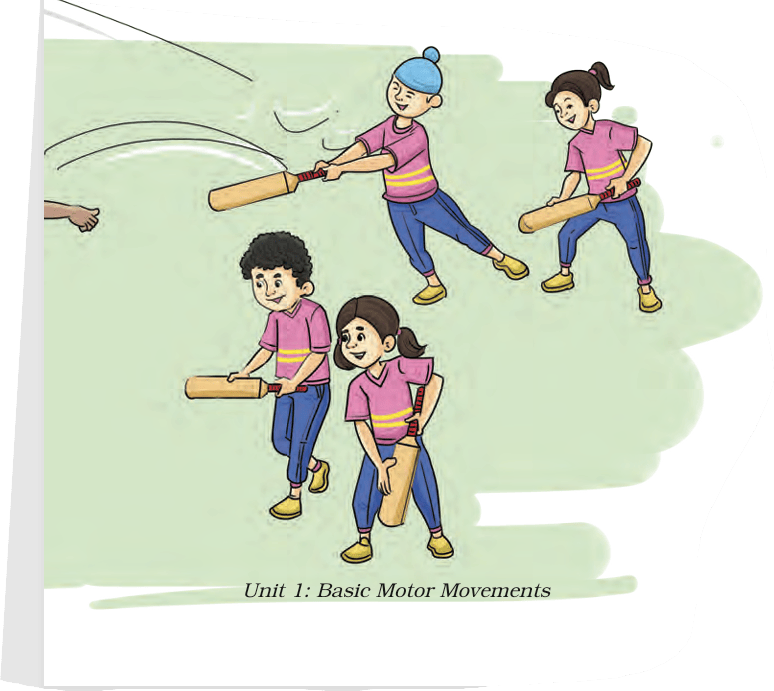
Circle Time
Discuss the difference between striking the ball and hitting the ball high, straight, or low.

BM 16
Corner Tennis
Required Material
Racquet and tennis balls
How to play
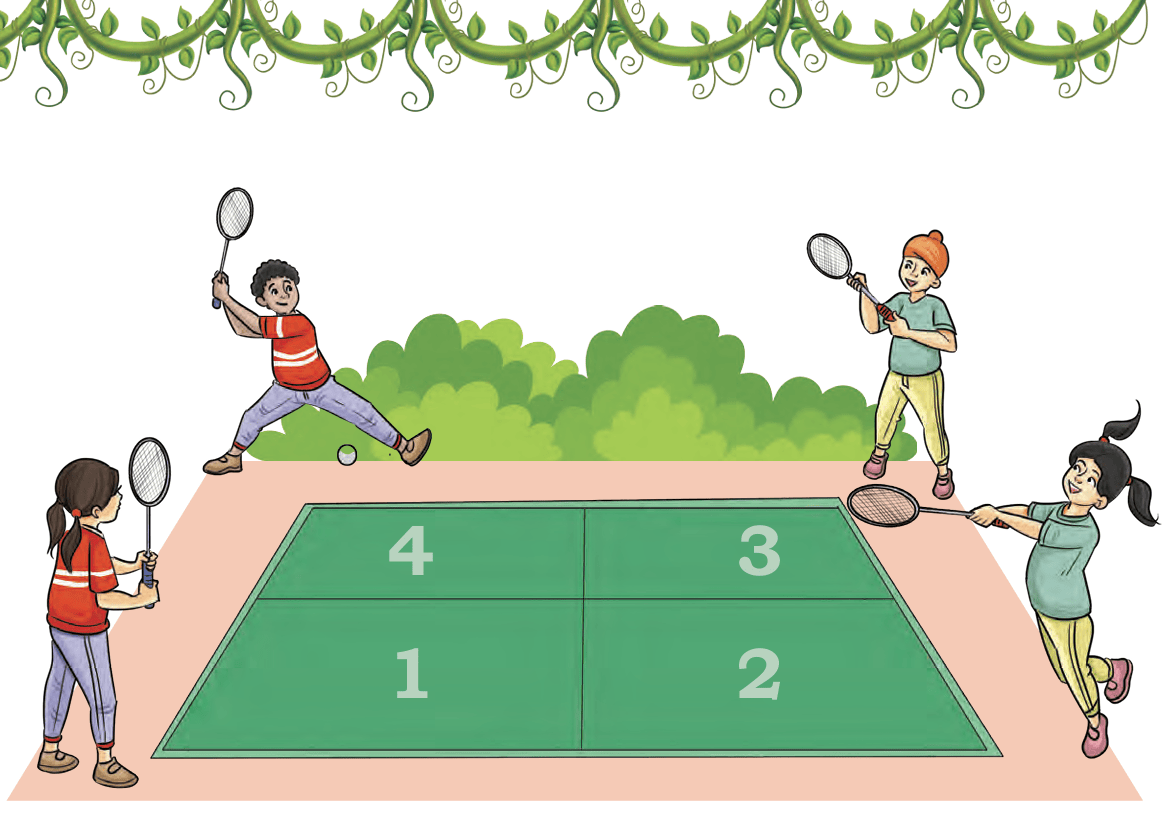
- .Mark a big square and divide it into 4 zones.
- .Place 4 students at each corner of the square.
- .A student at Zone 1 will hit the ball so that it bounces into the zone of any other student.
- .The student in whose zone the ball bounces in, will try to hit it in any other student’s zone after one bounce.
- .If a student fails to hit or land the ball in the other student’s zone, they will leave the racquet and give it to the students waiting for their turn.
DID YOU KNOW?
Playing outdoor games improve motor skills, balance, and coordination.
PURPOSE
To develop accuracy and anticipation with quick decision making.
VARIATION
- .Use your palm to hit the ball instead of the racquet.
- .Vary the size of the playing area.
- .Vary the size of the ball.
Circle Time
Discuss the factors that you will keep in mind to reach the ball. For example, the path, bounce and the speed of the ball. To hit the ball, it is vital to judge the position of the body and find an easier angle to hit.
BM 17
Hit and Cover
Required Material
A long stick or bat and tennis balls
How to play
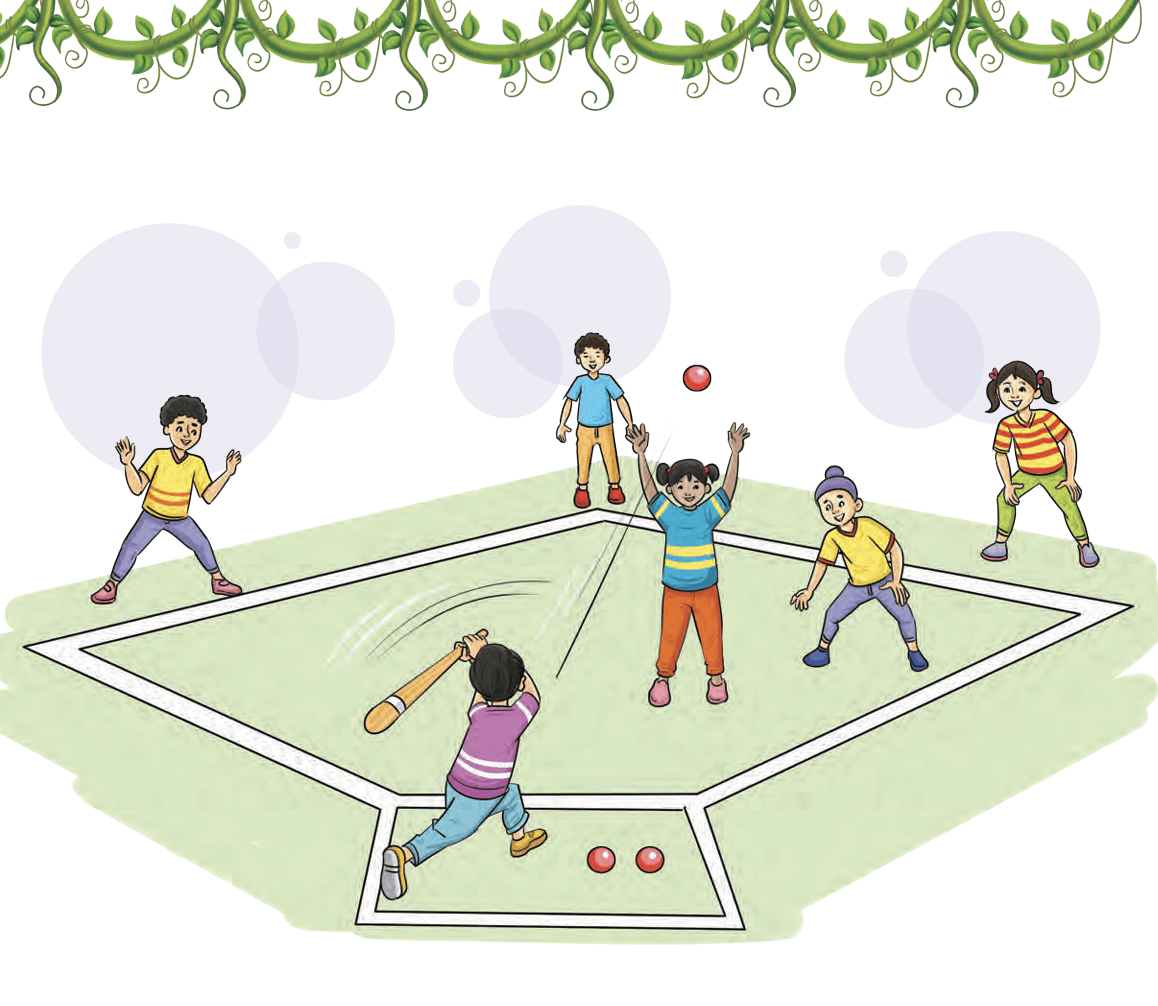
- .Divide the students into equal teams and mark a square of 10 × 10 meters with three bases and a smaller square at one corner.
- .One team will bat, and the other will field.
- .Place three balls in the smaller square, and the first batter will hit all the balls quickly.
- .The batter will run after hitting the third ball and try to cover as many bases.
- .The fielders will try to gather the balls and quickly put them back in the small square.
- .The batting team will get points equal to the bases covered by the batter.
- .After this, the next batter will come and his points will be added to the score.
- .Once everyone has batted in the batting team, the roles will be reversed.
- .The team with the maximum score at the end will win the game.
PURPOSE
To develop upper body strength, speed, and hand-eye coordination.
VARIATION
- .Vary the size of the balls.
- .Vary the size of the field.
Circle Time
This activity will help you develop upper-body strength. Discuss other activities that involve upper body movement to strengthen your muscles.

BM 18
Hidden Ball
Required Material
Stick, tennis balls/ soft/cushion balls
How to play
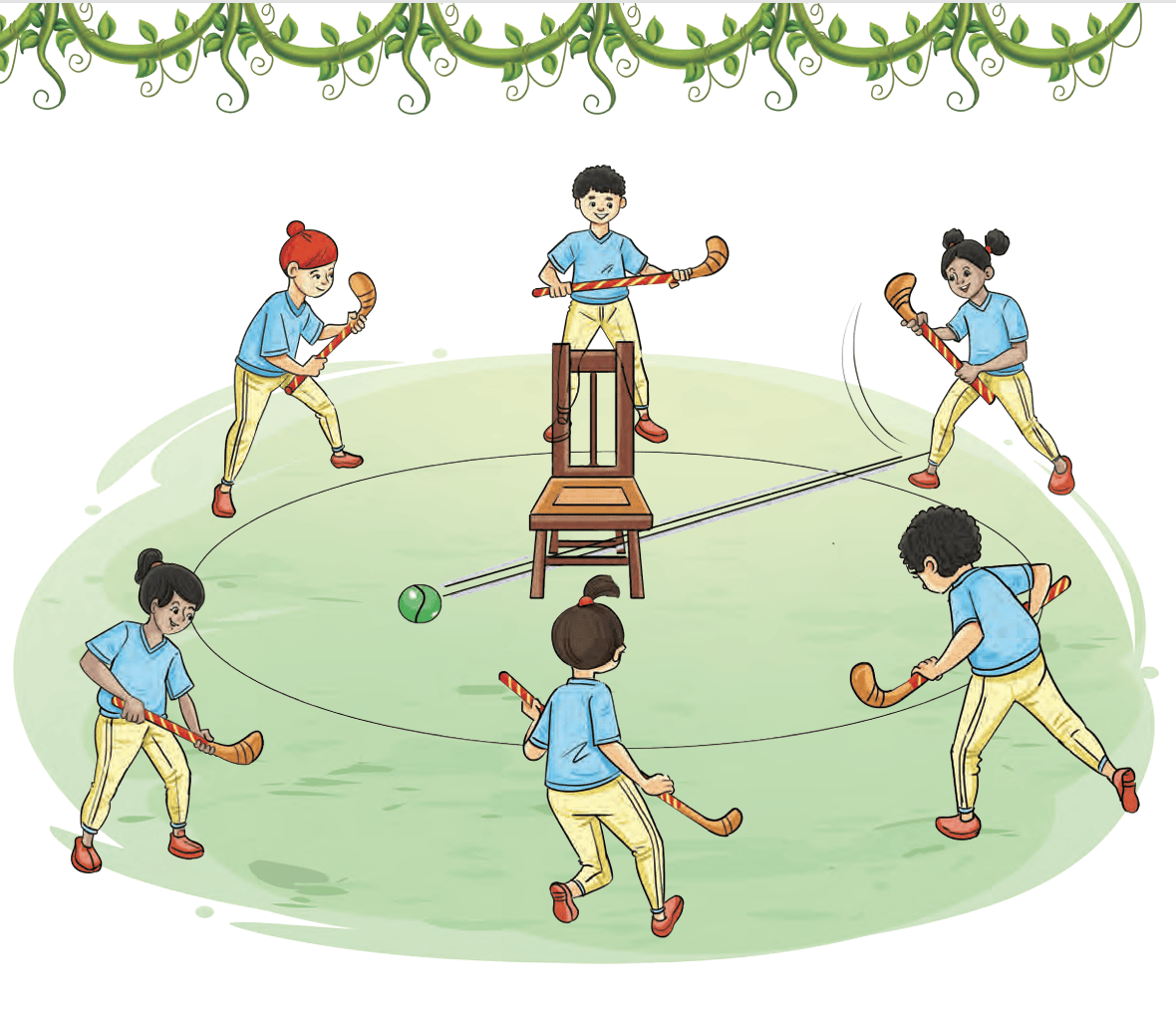
- .Mark a circular area with a chair in the middle and a ball placed under the chair.
- .6 –7 students each with a tennis ball and a stick in their hand stand outside the marked circle.
- .The aim of each student is to hit the ball under the chair and move it to the other side of the circle.
- . The students will retrieve balls from other students and try to hit the ball under the chair.
DID YOU KNOW?
A game played with a stick and a ball called hockey has given India eight Olympic gold medals.
PURPOSE
To develop sense of coordination and improve accuracy when hitting a target.
VARIATION
- .Vary the size of the circle.
- .Place a goalkeeper to guard the centre.
Circle Time
How did you adjust your position while retrieving the ball hit by your teammates?
Chapter 4
Little Steps
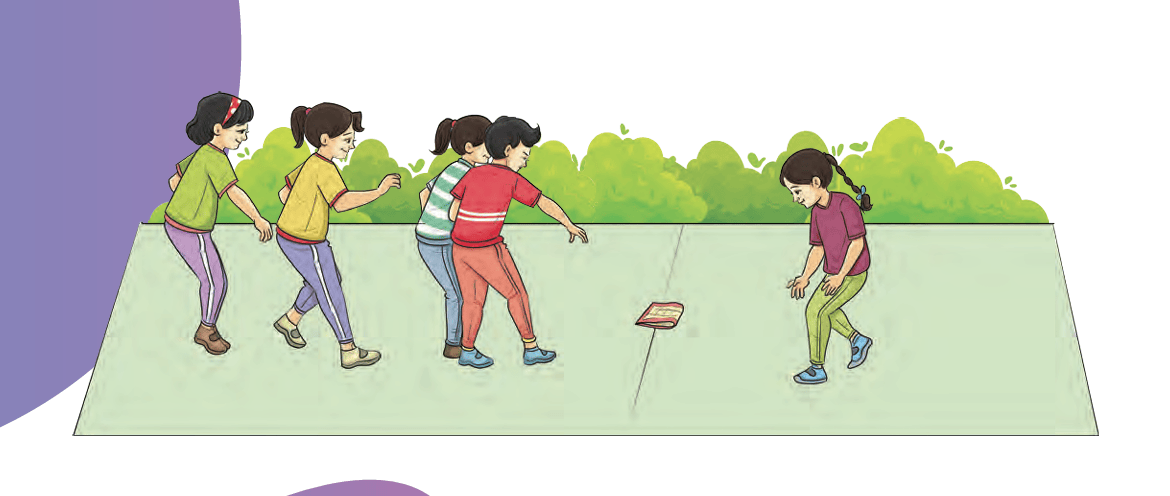
The key to success is to set and achieve goals. For example, holding the naukasana for 20 seconds, T-balance on one leg for 20 seconds or doing jumping jacks for 60 seconds. Every individual sets different goals based on their needs, but there are some goals which all of us should try to achieve. In this chapter, we will set and achieve individual goals on maintaining balance and growing strong.
BM 19
Crab Wheel
Required Material
Mats
How to play
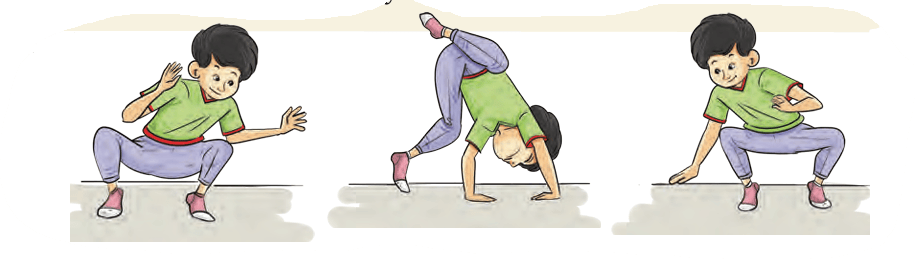
- .Find and mark an area and sit on the ground in a crouching position with legs spread a little broader than the shoulders.
- .Tuck your elbows inside to avoid injury and maximise strength.
- .On the whistle, put both hands sidewards one by one while moving the feet, and roll in the air to the other side.
- .The pattern is one hand, then the other hand, then one foot and lastly the other foot.
- Repeat this activity by changing the direction.
Note for the teacher
Discuss with the student how to improve flexibility and upper body strength to perform this skill correctly.
PURPOSE
To develop upper body strength and flexibility.
VARIATION
- .As the students get comfortable, change crab wheels to cart wheels.
Circle Time
Think about other such activities that help to improve upper body strength or flexibility.
BM 20
Listen Carefully
Required Material
Cones
How to play
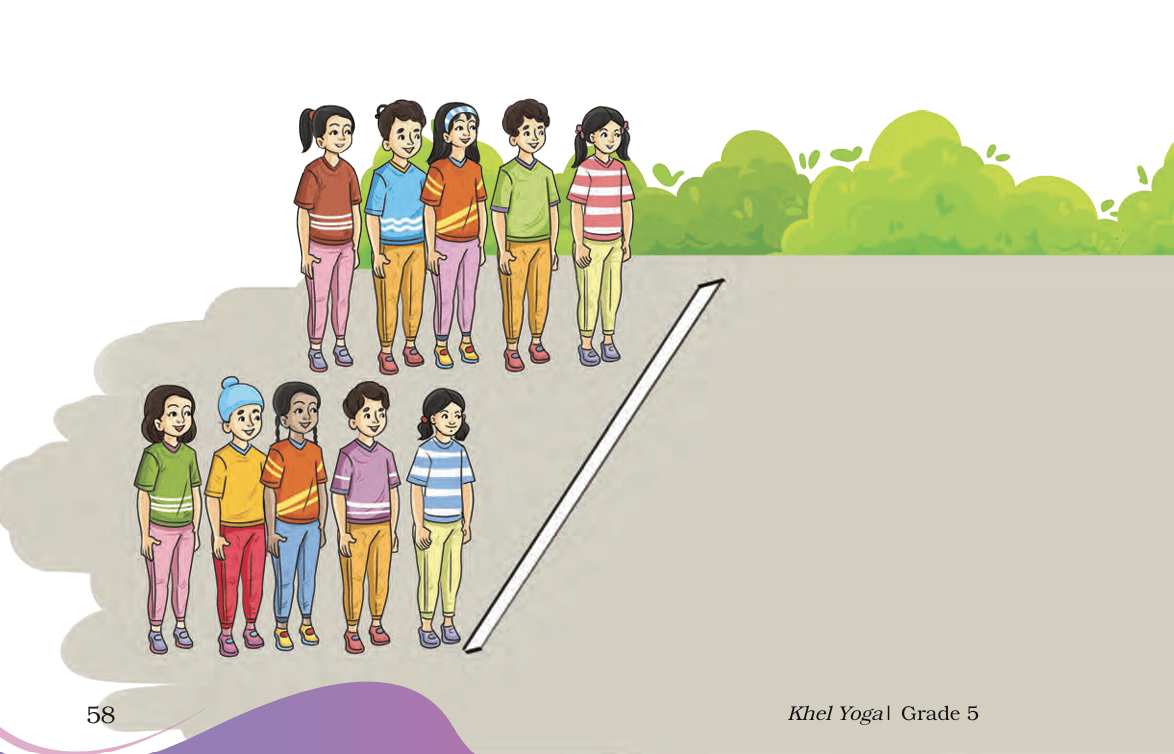
- .The students will be divided into groups of 10-12 each and stand on the starting line.
- .On the sound of the whistle, The students will start jogging towards the finish line.
- .The teacher will randomly take names of different movements, such as walking on the toes, walking on the heel, jumping on the spot, back running, right side shuffle, left side shuffle, hopping, etc., and the students will perform that movement.
- .After reaching the finish line, walk back to the starting line.
DID YOU KNOW?
Your brain gets the signal (like seeing a ball coming towards you), makes a decision, and tells your body what to do — all in less than a second!
PURPOSE
To develop different motor movements and response time.
VARIATION
- .Vary different movements in every round.
Circle Time
Discuss the movements which you found difficult to perform and find ways to overcome the difficulty.
BM 21
Run for Fun
Required Material
Cones
How to play
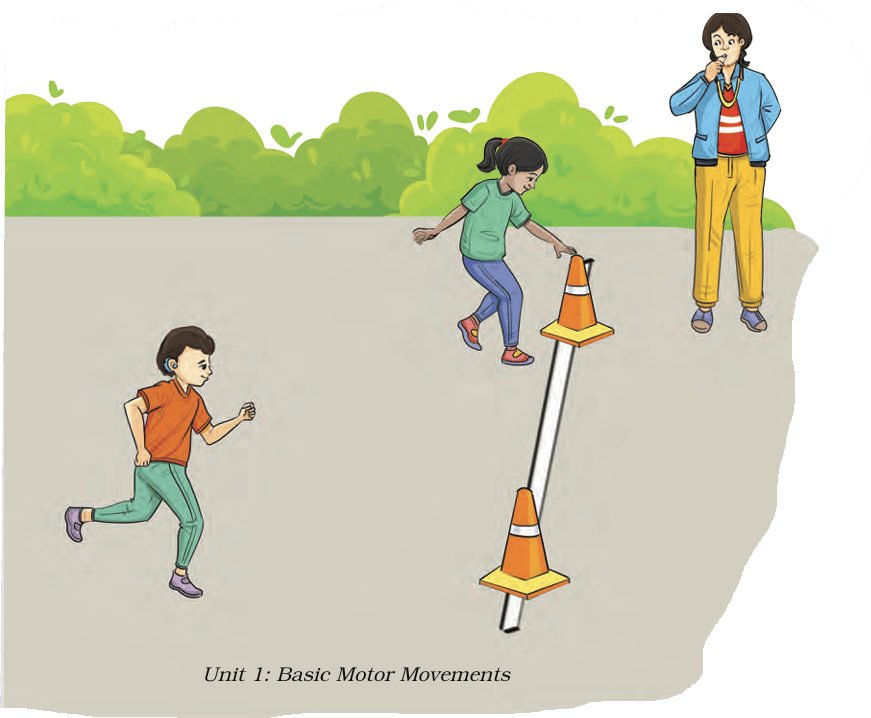
- .Mark the starting line and finish line 10 metres apart.
- .Form multiple teams with 5 members each and stand in a straight line near the designated cone.
- .On the sound of the whistle, the first member of each team will run towards the end line.
- .Students will touch the cone placed at the finish line, run back to the starting line, and clap the next student’s hand.
- .After receiving the clap, the next team member will run, and the process will continue until the last student has run.
- .The team that finishes first will win.
PURPOSE
To develop speed and lower body strength.
VARIATION
- .Vary the sprint with other movements such as the back run or side shuffle.
Circle Time
Note down your individual timing to cover the distance and try to improve it next time.
BM 22
Push and Pull
Required Material
Mat, rope, heavy object
How to play
- .Students line up at the starting line.
- .On the sound of the whistle, start running on the path, reach the first station, and perform push-ups on the mat as shown in the figure (5 times).
- .Run 5 metres to reach the next station and perform squats on the mat as shown in the figure (5 times).
- .Run to the next station and perform sit-ups on the mat as shown in the figure (10 times).
- .Reach the next station to drag the weight or a discarded tyre and drag it to its original position.
- .Jog back to the finish line.
DID YOU KNOW?
If you are tired, your reaction time slows down. Getting good sleep makes you sharper and healthier.
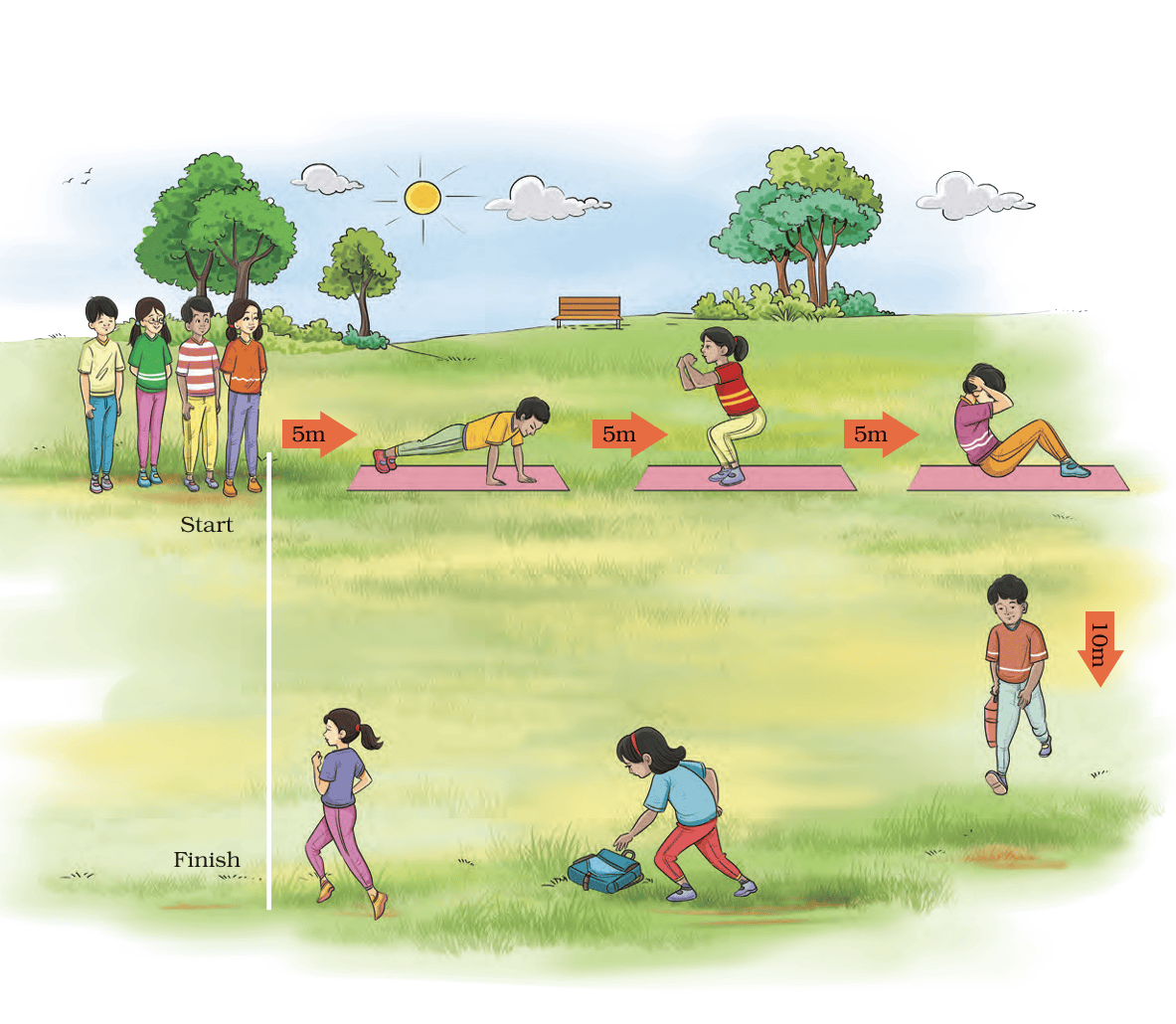
Note for the teacher
Every student should perform the activity at least twice.
PURPOSE
To develop upper body and lower body strength.
VARIATION
- . Vary the number of repetitions.
Circle Time
Feel the part of the body which was involved during the exercise.
BM 23
Run and Cross the River
Required Material
Marking powder and cones
How to play
- .Students stand at the starting line.
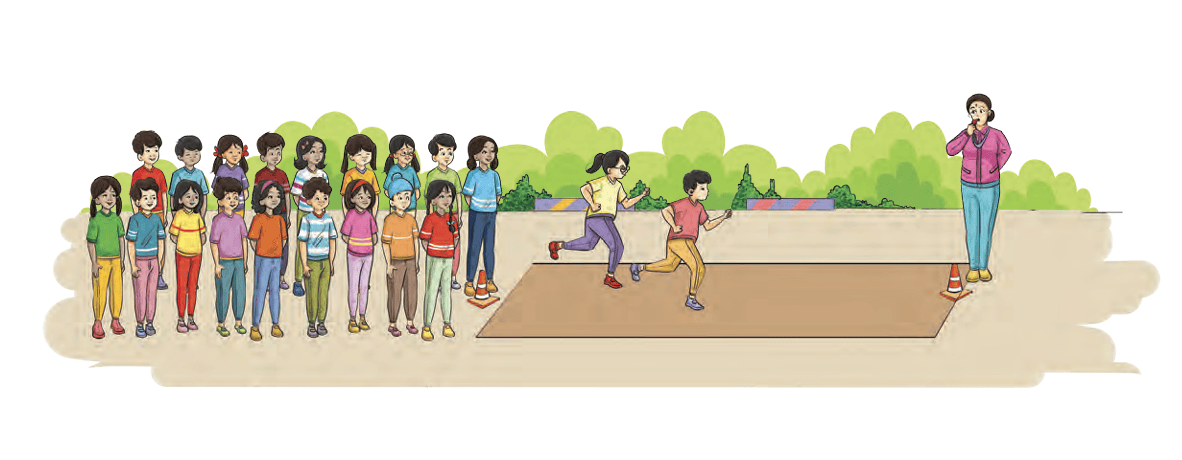
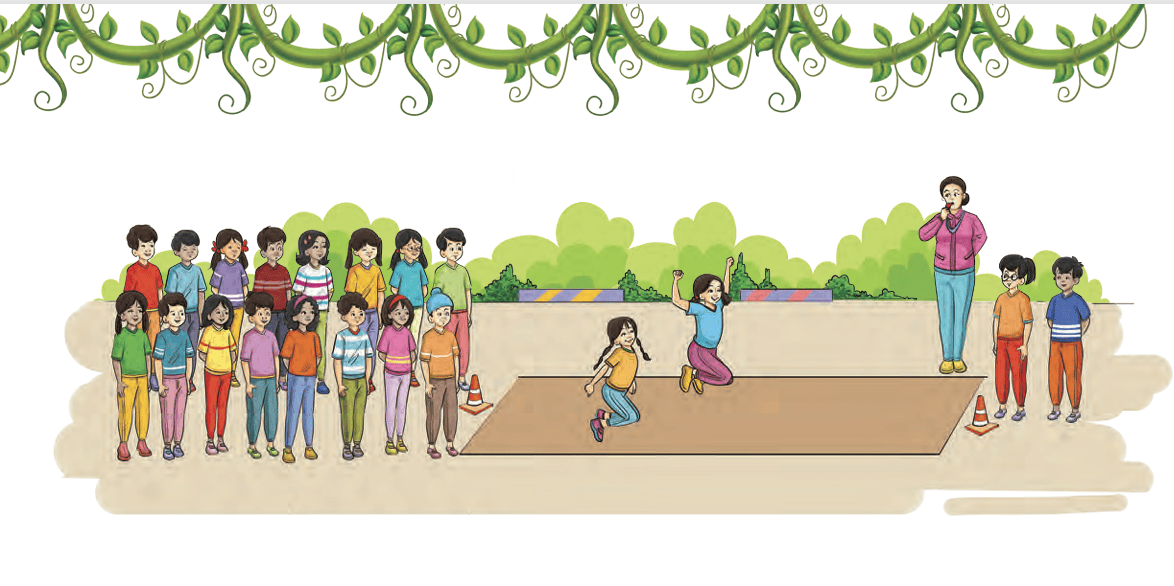
- .On the sound of the whistle, start running on the path and jump over the cones.
- .Reach the running area and jump from the jumping line.
- .Note the distance of the landing.
- .Try to do better in the next jump.
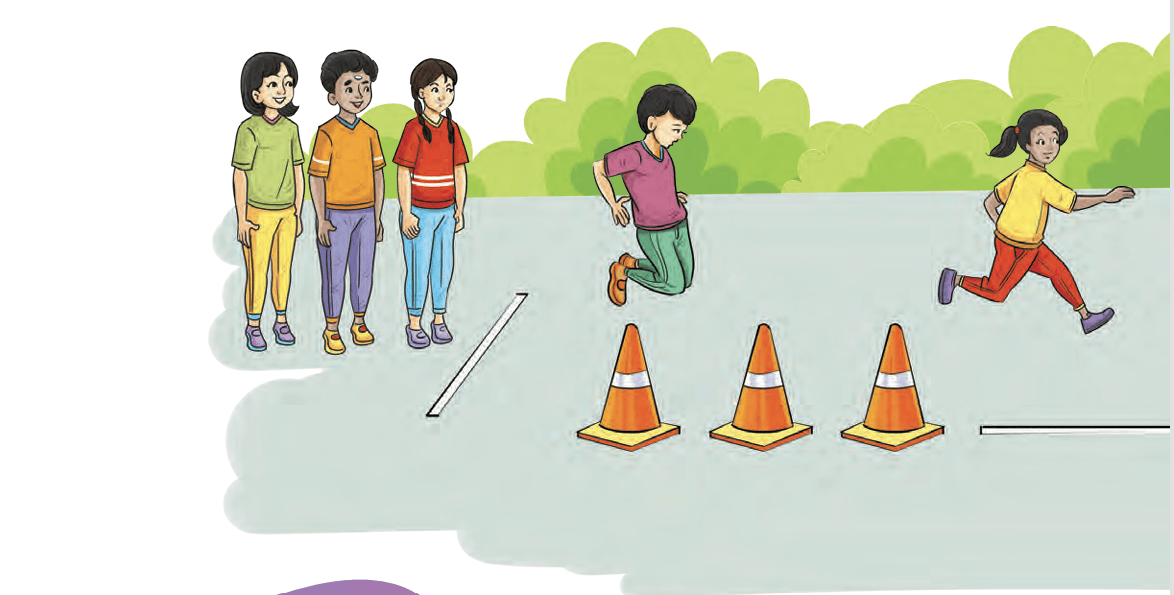
Note for the teacher
Ask the students to jog for at least seven to ten minutes before performing the activity.
PURPOSE
To develop a sense of accomplishment with the lower body strength.
VARIATION
- . Vary the size and number of cones placed for the horizontal jump.
- . Vary the type of jumps, such as single-leg hop, etc.
DID YOU KNOW?
You react faster to sounds than to sights. So you might jump quicker at a loud noise than at a flashing light!
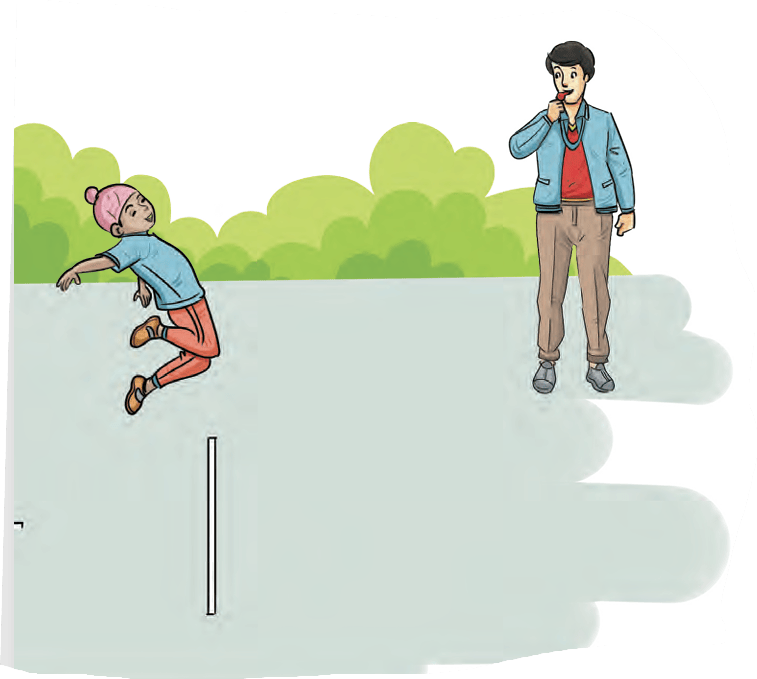
Circle Time
Measure the distance of your jump (in metres) and set a higher target for next time, considering your past performance.
BM 24
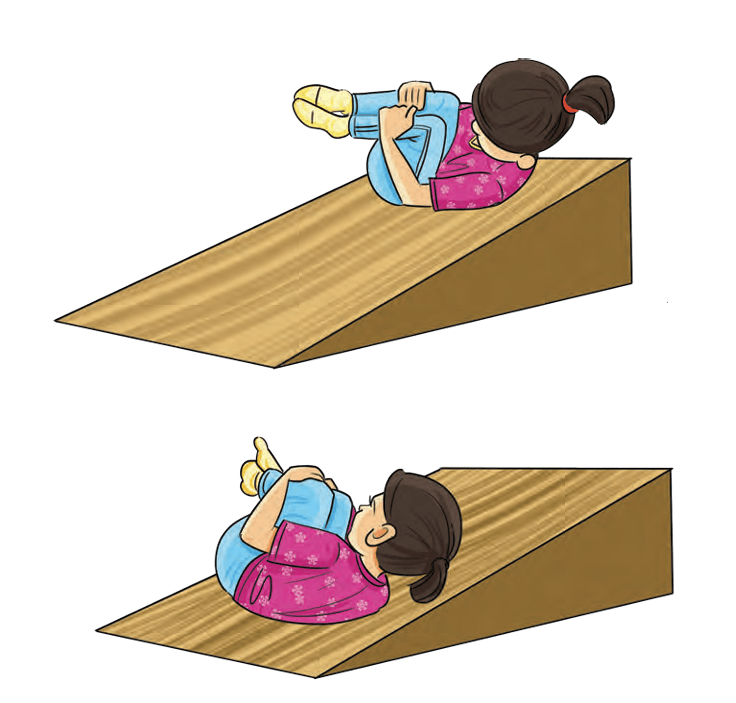
Side Roll
Required Material
Inclined mats or use flat mats on ramps
How to play
- .Line up the students in front of the mat and have them sit in a crouched position while holding the knees and head tucked into their knees.
- .To avoid injury, the head should be closer to the knees.
- .On the sound of the whistle, they should roll downwards in sideward position.
- .Change the direction of the roll every time.
DID YOU KNOW?
Side roll is a simple gymnastic or movement activity where you roll your body sideways on the ground like a lock. It helps in building balance, coordination and core strength.
Note for the teacher
Discuss with the student how to improve their flexibility and upper body strength to perform this skill correctly. Perform this activity in the presence of teacher only.
PURPOSE
To develop dynamic balance.
VARIATION
- .Side roll on a flat surface.
Circle Time
What did you enjoy the most while doing the activity? Discuss and create similar activities, play and have fun.
Guided self-assessment for Students
The purpose of this exercise is to track the children’s progress in Physical Education classes, emphasising self-improvement and personal growth rather than comparison with others. In Grade 5, the emphasis is on developing basic motor movements, developing specific personal and social behaviour, getting mentally engaged in activities (Bhartiya Khel) and getting introduced to self-assessment. This ensures a holistic and supportive learning environment.
Instructions
Read the statements and tick the number which is most suitable for you.
Throwing
1 |
2 |
3 |
4 |
5 |
|---|---|---|---|---|
| I can throw with moderate power and sometimes hit the target, but I need to improve consistency. | My throws are strong, well-aimed, and consistent across different distances and directions. | I catch the ball and throw it properly after a short pause. | I throw the ball immediately after catching it with proper technique. | I try to talk to teammates about how to improve our throw all the time. |
Catching
1 |
2 |
3 |
4 |
5 |
|---|---|---|---|---|
| I can catch most balls with both hands and am working on holding it more securely. | I can sometimes catch the ball with single hand, but I need to work on consistency. | I catch the ball properly and hold it securely before making my next move | I catch the ball smoothly and quickly get ready to throw. | I always appreciate other students who take a good catch repeatedly. |
| I sometimes Appreciate other students who make a good catch. | I occasionally appreciate other students who make a good catch. | I occasionally appreciate other students who make a good catch. | I always Appreciate other students who make a good catch. |
Notes for the teacher
- The teacher will guide the students to observe the following points while performing the skills and for assessing the skill for oneself.
Throw: Twist the body and swing the arm forward to throw,
then step forward and balance after releasing the ball.
Catch: Keep eyes on the target with a stable stance.
Kicking
| 1 |
2 |
3 |
4 |
5 |
|---|---|---|---|---|
| I show better technique by kicking with moderate accuracy and force. | I show better technique by kicking with moderate force. | I can kick the ball with good technique, but I need to work on adjusting my power for different distances. | I kick the ball smoothly and can adjust my power to reach different distances. | I can help and demonstrate the correct way to kick the ball with proper technique. |
| I kick with good control, but I need to improve my accuracy and direction.” | I can help and demonstrate the correct way to kick the ball. | I can help and demonstrate the correct way to kick the ball. |
Receiving
| 1 |
2 |
3 |
4 |
5 |
|---|---|---|---|---|
| I am quick to react but struggle with ball control. | I control the ball better, but I need more accuracy over different distances. | I adjust my control based on the speed and direction of the ball, but I need more consistency.” | I adjust my control smoothly when receiving passes of different speeds and directions. | I adjust my control smoothly when receiving passes of different speeds and directions. |
| I sometimes help pick up the equipment after practice. | I help pick up the equipment after practice. |
Notes for the teacher
- The teacher will guide the students to observe the following points while performing the skills and for assessing the skill for oneself.
Kicking:Swing back the kicking leg and bring it forward to
kick the ball, then move the opposite arm forward and balance
the body.
Receiving:Shift weight onto the non-receiving foot, receive
the ball with the instep while moving the foot slightly back on
contact, then stay low and balance by adjusting body weight
as needed.
Hitting
| 1 |
2 |
3 |
4 |
5 |
|---|---|---|---|---|
| I sometimes hit the ball with strong force and accuracy, But I need to improve my consistency. | I find it difficult to hit the ball in the right direction when it’s far. | I am able to hit the ball with strong force and accuracy, making only a few mistakes. | I can hit the ball confidently during a game and I appreciate others who played well. | I can hit the ball confidently during a game and I appreciate others who played well during practice as well during the game. |
Notes for the teacher
- The teacher will guide the students to observe the following points while performing the skills and for assessing the skill for oneself.
Hitting:Stand sideways with legs shoulder-width apart, knees slightly bent, and eyes on the ball. Step forward on the front foot, swing while rotating hips and shoulders, fully extend arms at the contact point to hit the ball, then follow through by swinging the upper body with the apparatus finishing over the non-dominant shoulder.
Walk or Run
| 1 |
2 |
3 |
4 |
5 |
|---|---|---|---|---|
| I can continuously jog for 3 minutes. | I can continuously run for 5 minutes. | I can continuously run for 10 minutes. | I can do short sprint repeats of 50 m × 2 times with over 2 minutes breaks. | I enjoy running and walking. |
Notes for the teacher
- The teacher will guide the students to observe the following points while performing the skills and for assessing their own skills.
Walk and run:These actions should be done with proper posture, arms moving naturally, eyes looking ahead, and ensuring smooth movements.