Chapter-10

Symmetrical
Designs
Alphabet Cutout
Prem and Manu want to paste 'Happy Birthday' cutouts on a wall for Lali's birthday. While preparing cutouts of letters, they observe that some letters can be cut out in an easy way.
They remember that they learnt about reflection symmetry and lines of symmetry in Grade 4. They used their knowledge of lines of symmetry to make the cutouts. The letter A has a vertical line of symmetry. So, to cut out the letter 'A'-
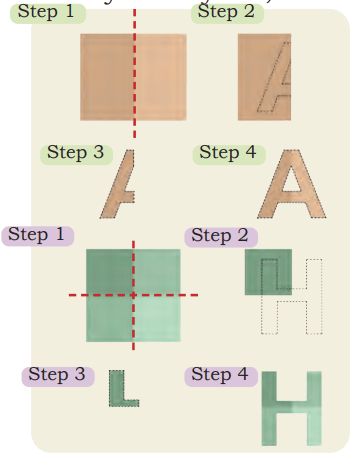
1. Fold a paper in half
2. Draw half of the letter A along the fold.
3. Cut along the outline.
4. Open the paper to see the full letter A.
The letter H has two lines of symmetry.
1. Fold the paper into one-fourth (once vertically, once horizontally).
2. Draw one-fourth of the letter H along the fold.
3. Cut along the outline.
4. Open the paper to see the full letter H.
Which of the following alphabet cutouts can be made by just drawing half (1/2) or quarter (4) of the letter? You can do it by drawing lines of symmetry on the letters.

Which of the letters have a horizontal line of symmetry? _________________
Which of the letters have a vertical line of symmetry? _________________
Which letters have both vertical and horizontal lines of symmetry?_________________
Let Us Do
Use lines of symmetry to make paper cutouts of diya, boat, and other designs. Look along the border of the page to find the pictures.
Let Us Make a Windmill Firki
Lali makes firkis for her friends. Follow the steps given below to make your own firki.

1. Take a square paper.

2. Fold the paper in half diagonally to make two triangles.
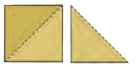
3. Open and fold it the other way to make two more triangles.

4. Open it again. You will see an 'X' shape on the paper.
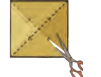
5. Use scissors to cut along the four lines of the 'X'. Stop cutting about halfway to the centre.

6. Take one corner of each triangle and fold it gently towards the centre of the paper. Do not press it flat.

7. Fold every other corner towards the centre.
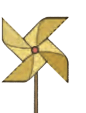
8. Push a pin through the folded corners and the centre of the paper.
9. Push the pin through a stick or straw.

Make sure the pin is not too tight.
Check if your windmill spins when the wind is blowing.
Observe the dot in the firki. Does the firki look the same after full turn? 1/4 1/2 3/4 and a full turn? ___________________.
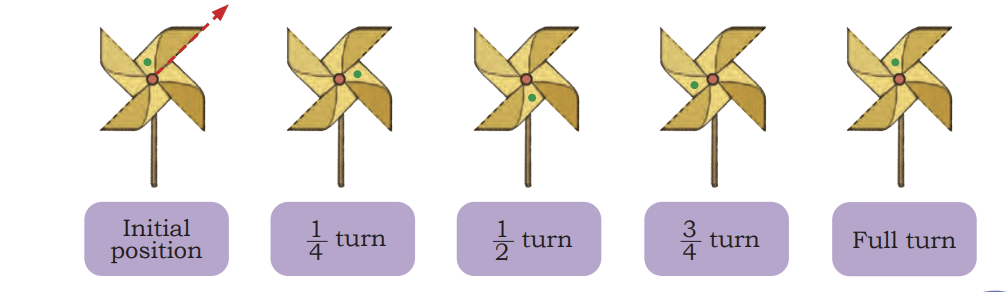
Observe the letters below. Do they look the same when turned? Dots have been marked on the letters to keep track of the orientation of letters. You may also cut out the letters and fix the centre point of the letter by a nail or use a tracing paper to check if the letter looks the same when turned.
| Original letter | 1/4 turn | 1/2 turn | 3/4 turn | Full turn | Rotational symmetry (Yes/No) |
|---|---|---|---|---|---|
 |
 |
 |
 |
 |
Yes, at 1 2 turn |
 |
|||||
 |
|||||
 |
The letter H has rotational symmetry, as it looks the same when rotated by half a turn.
A firki has rotational symmetry, as it looks the same when rotated by 1/4, 1/2, and 3/4 turn.
Let Us Do
Find symmetry in the digits.

Which digit(s) have reflection symmetry? ___________________________
Which digit(s) have rotational symmetry? ___________________________
Which digit(s) have both rotational and reflection symmetries? ________
Now, let us look at the following numbers: || , |00|
Do these have (a) rotational symmetry, (b) reflection symmetry or (c) both symmetries?
Give examples of 2-, 3-, and 4-digit numbers which have rotational symmetry, reflection symmetry, or both.
Making Designs
(a) Does the design have rotational symmetry? Yes/No.
(b) Try to change the design by adding some shape(s) so that the new design looks the same after a 1/ 2 turn. Draw the new design in your notebook.
(c) Now try to modify or add more shapes so that the new design looks the same after 1/ 4 turn. Draw the new design in your notebook.
(d) Do the new designs have reflection symmetry? If yes, draw the lines of symmetry.
Let Us Think
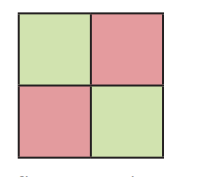
Does this design look the same after 1/ 2 turn? __________
Does the design look the same after 1/ 4 turn?__________
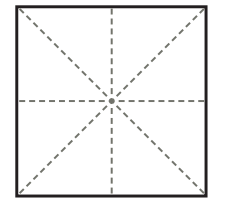
Colour the square given in the adjoining figure using two colours so that the design looks the same after every 1/4 turn.
How many times does this shape look the same during a full turn?
Do these designs have reflection symmetry also? Draw the line(s) of symmetry.
Let Us Do
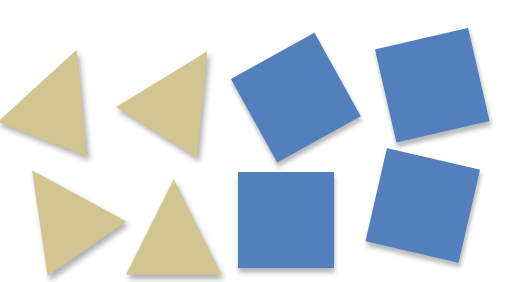
Cut out squares and equilateral triangles with the same side length. These are provided at the end of the book.
Make different symmetrical designs by using these two shapes.
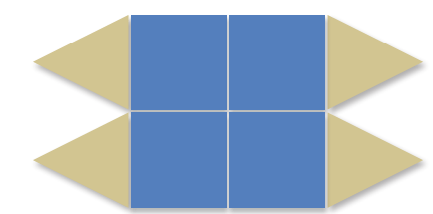
Does this shape have reflection symmetry?
If yes, draw its line(s) of symmetry.
Does it have rotational symmetry?
If yes, at which turn?
Does it have both symmetries?
Now, make your designs. Sort your designs in 3 categories—designs with only rotational symmetry, designs with only reflection symmetry, and designs with both rotational and reflection symmetry.
Let Us Explore
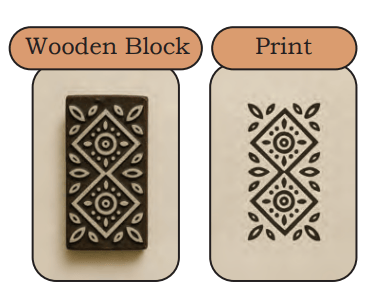
Block printing is a traditional craft of Rajasthan, known for beautiful patterns and bright colours.
Artisans use carved wooden blocks to print designs on fabric.
This art has been practised for centuries and makes Rajasthan’s textiles special.
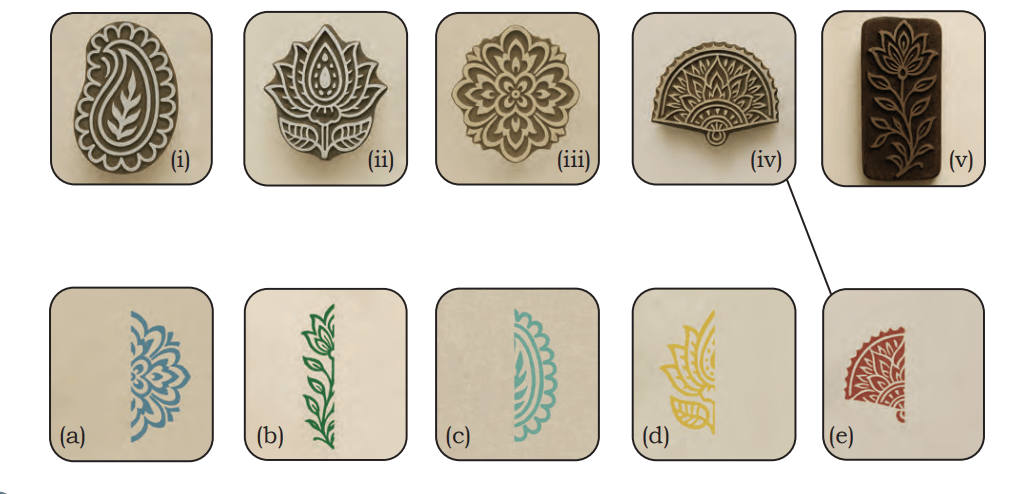
Below are images of wooden blocks and a part of their prints. Match each block to its correct print by drawing a line. One is done for you.
Observe the pattern made by the wooden block below. We get the final print by using the block 4 times.
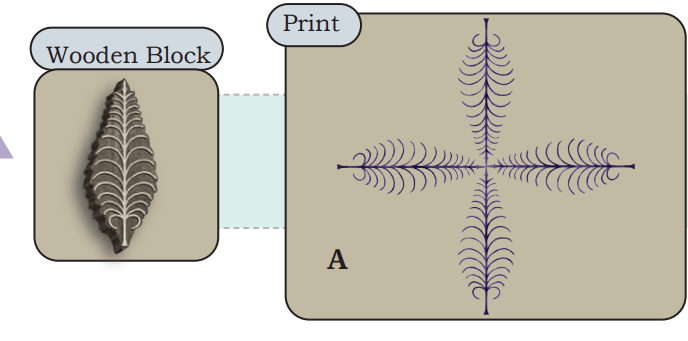
The design A looks the same after every 1/ 4 turn.
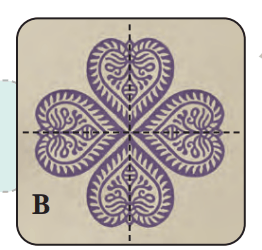
The design B looks the same after every ____________ turn. This design has _________________symmetry.
Let Us Do
Observe the shapes given on the border. Which of the shapes have reflection symmetry? Put a (✔) mark on them. Put a * on the shapes that have rotational symmetry.
Project Work
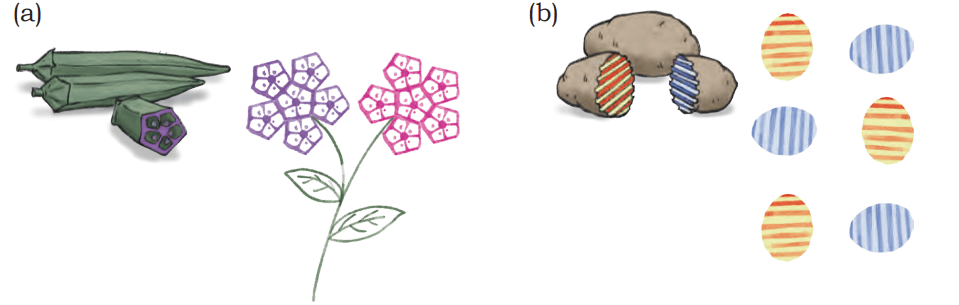
Create symmetrical patterns and designs using vegetable blocks. Some are shown below.