Unit 4: Ups and Downs
7. Gilli Danda
Let us Recite
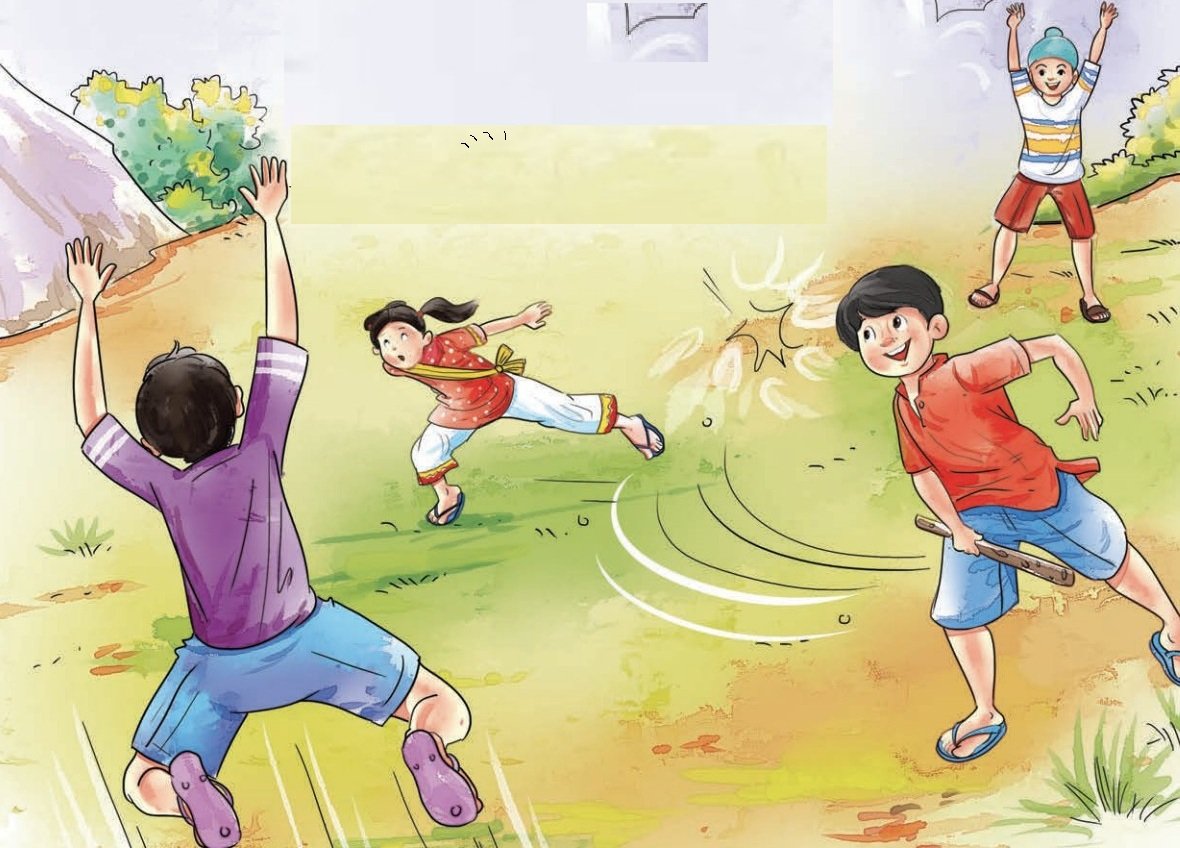
   In the playground, we gather around,
 With a stick and a small gilli to throw,
   Gilli Danda, our game is so sound!
    We play with joy, watch it go!
   One, two, three, swing and hit,
   With our friends, we never quit!
  With every swing, we feel so free,
    Oh, what fun it is, you see!
   The small gilli, up high it flies,
  Underneath the bright blue skies.
    Laughing, playing, having fun,
  Under the golden rays of the sun!
New Words
gather gilli quit underneath
Let us Think
- A. Answer the following questions.
- 1. Which game does the poem mention? What are the things needed to play this game?
- 2. According to the poem, how do the players feel while playing Gilli Danda?
- 3. What happens to the tiny gilli when the stick strikes it?
- 4. Which lines tell us that the children are playing the game outside?
- 5. What is the meaning of the line “our game is so sound”?
- 6. Which word in the poem shows ‘happiness’?
- B. Think and discuss
- 1. Do you enjoy playing outdoors? Why or why not?
- 2. Name five outdoor games that you enjoy playing with your friends.
- 3. Imagine you are the small gilli. What would you see while flying up in the sky?
Let us Learn
Sameer was unhappy because he was unable to find his drawing book. He decided to redo his work.
Both ‘un-’ and ‘re-’ are prefixes. When we add a prefix at
the beginning of a word it changes that word’s meaning.
Each prefix has a different function.
Un + happy unhappy (not happy)
Re + draw redraw (draw again)
Look at the meaning of the following prefixes.
Un : not Re : again
- A. Add correct prefixes to the following words to create new words. Write the new word along with its meaning in the space given below.
- B. In the following table, encircle the nouns that you can see, taste, touch, or smell.
- Introduce the concept of abstract nouns through examples from daily life.
- Facilitators may also use examples from L1 to show the correlation of abstract nouns and adjectives to the learners.
- Discuss the difference between abstract nouns and adjectives and how to identify the two.
- 1. The book on the table is mine.
- 2. The red handbag is hers.
- 3. There is a new cycle near the gate, is it yours?
- C. Fill in the blanks with the most suitable word from the list below.
- 1. These crayons belong to me. These are ......................... .
- 2. The toy train belongs to Mudit. The toy train is ......................... .
- 3. The house with the red roof belongs to my cousins. The house is ......................... .
- 4. The little girl has bought a set of bowls to play Jal Tarang. The bowls belong to her. The bowls are ......................... .
- 5. We have a cow with large brown eyes. The cow is ......................... .
- 6. You should take better care of your things. After all, they belong to you. The things are ......................... .
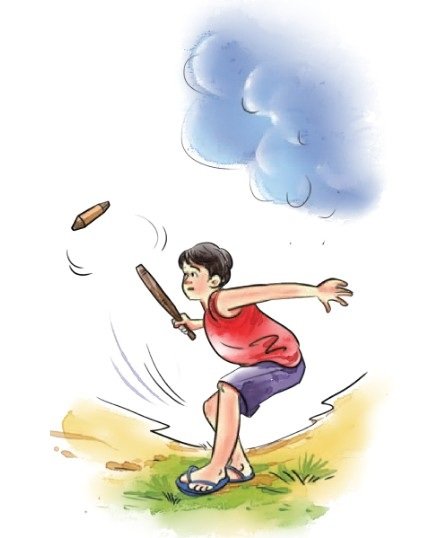
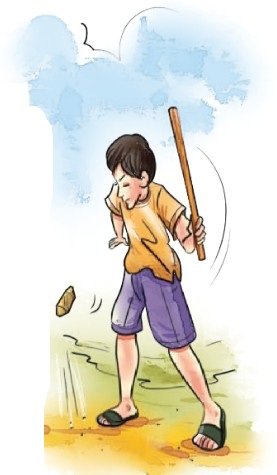
- It is played with two sticks—one short (gilli) and one long (danda).
- One of the players hits the gilli with the danda to make it fly in the air.
- Other players try to catch the gilli.
- 1. The name of the game.
- 2. Whether it is an indoor or outdoor game.
- 3. Number of players needed.
- 4. Material required for the game.
- 5. Rules of the game along with safety instructions.
| Prefix | Word | New word | Meaning |
|---|---|---|---|
| Un- | common | uncommon | Something that is not easily found |
| write | |||
| aware | |||
| comfortable | |||
| arrange | |||
| think |
| joy | leaf | anger | mountain |
| sun | shirt | toffee | rose |
| ice cube | sugar | hat | truth |
| chessboard | lie | football | deer |
| tree | happiness | cat | spoon |
| river | fear | cup | tiger |
The words that you have NOT encircled are abstract nouns. The word ‘abstract’ refers to something that has no physical shape. For example, ‘sadness’ is an abstract noun.
‘Happiness’ and ‘rose’ are both nouns, but you can touch, see, and smell a rose.
However, you cannot touch happiness. It is a feeling.
Feelings, thoughts, ideas, etc., are all abstract nouns as they cannot be touched, smelt, or seen.
Can you think of a few more abstract nouns? Write them in your notebook and share them with the class.
Possessive pronouns indicate ownership or relationship
between people and things.
For example:
theirs, mine, yours, his, hers, ours
Did You Know?
Gilli Danda is known as tip-cat in English.!
Let us Speak
Let us Listen
- 1. “Swing and hit”: Pretend to swing an invisible danda.
- 2. “Watch it go!”: Raise your arms as if you have just hit the gilli and you are watching it fly.
- 3. “Laughing, playing”: Giggle or clap hands.
- 4. “Shade your eyes from the sun”: Keep your hands above your eyebrows.
Let us Write
- A. Find the meanings of the following words using a dictionary.
- 1. Quit
- 2. Gather
- 3. Swing
- 4. Underneath
- 5. Golden
- Demonstrate the use of a dictionary to the learners.
- Encourage the learners to work in pairs and find the meaning of the above words.
- Keep assigning similar activities at regular intervals.
- B. Rearrange the following to form a question and write them in your notebook. Remember to put a question mark at the end.
- are cows where the
- is your house which
- it time is what
- the blue why sky is
- the many are how birds on tree
- you my when return will book
- walk you to do school
- a can fly kite you
- C. The word ‘gilli ’ has double ‘l’ in it. Similarly, the words ‘millet’ and ‘bullock’ have double ‘l’.
- D. Circle the word that is different in meaning from the underlined word.
- 1. Miibi went to the market and bought an expensive toy.
- 2. Anju and Farida forgot to buy popcorn and juice for the picnic.
- 3. The moon continued to count the stars night after night.
- 4. I always complete my homework on time.
- 5. There was excitement in the shop among the toys.
- 6. Badal nervously told his mother about the dog he found on his way home.
- 7. Everyone liked the vibrant colours of the bangles.
- 8. The fort is known for its unique style of construction.
Ensure that the learners use a capital letter for the beginning word and that a question mark is put at the end.
| tt | .............. | .............. | .............. |
| pp | .............. | .............. | .............. |
| ee | .............. | .............. | .............. |
| mm | .............. | .............. | .............. |
| bb | .............. | .............. | .............. |
| rr | .............. | .............. | .............. |
| nn | .............. | .............. | .............. |
| dd | .............. | .............. | .............. |
| ss | .............. | .............. | .............. |
| gg | .............. | .............. | .............. |
Initially, young learners may come up with only nouns. Encourage them to think of adjectives, verbs, and adverbs too.
Let us Do
- A. Let us make a Gilli Danda using waste material.
- 1. A thick, firm twig or a wooden stick (for the danda)
- 2. Thick small twig (for the gilli )
- 3. A rough stone (for smoothening the sticks)
- 4. Colours or coloured papers (optional, for decoration)
- 1. Find a Stick
Use any thick, firm twig or discarded wooden stick. - 2. Smoothen the Surface
Use a rough stone to smoothen the surface of the stick. - 3. Decorate (Optional)
Make your stick attractive by painting it with colours or covering it with a coloured paper. - 1. Find a Small Stick
Use a small twig, or a piece of a discarded stick, about 3–4 inches long. - 2. Shape the Ends
Sharpen both ends of the gilli using a rough stone to give it a proper shape. - 3. Smoothen the Surface
Ensure it is smooth by rubbing it with a stone. - 4. Decorate (Optional)
Colour or paint the gilli for an attractive look. - B. Spellathon
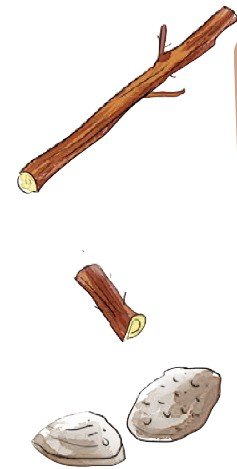
Things required:
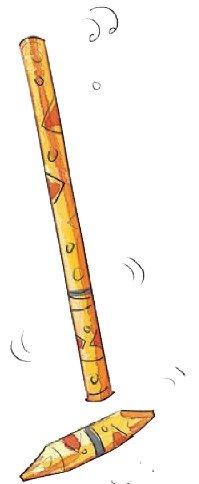
Steps
Ensure that safety measures are in place for this activity.
Just for Fun
Riddle
	It belongs to you.
     But, your friends use it
          more than you.
           What is it?
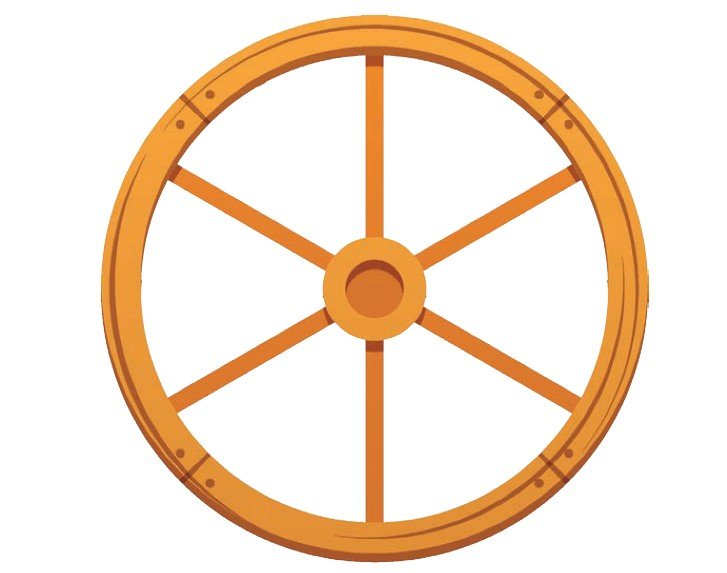
How many words of three or more letters can you make from the letters shown in the following wheel?
Rule: One letter can be used as many times as it appears in the wheel.
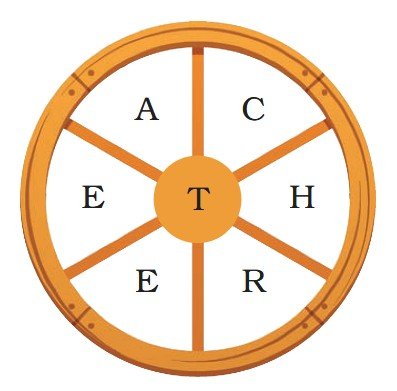
Can you make a seven-letter word using all the letters in the wheel?
Now, create a letter wheel similar to the above.