
Chapter 8
A Journey through States of Water
On a bright summer afternoon, Aavi and Thirav enjoy their
shikanji (lemonade). After looking at the ice in the lemonade,
Thirav wonders about the nature of ice and water.
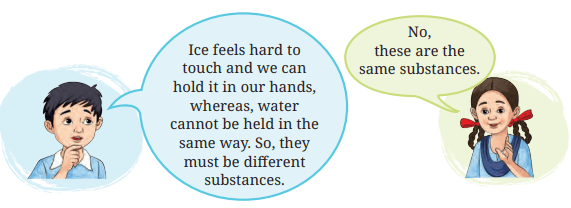
Aavi has a counterview to Thirav. What do you think? Why?
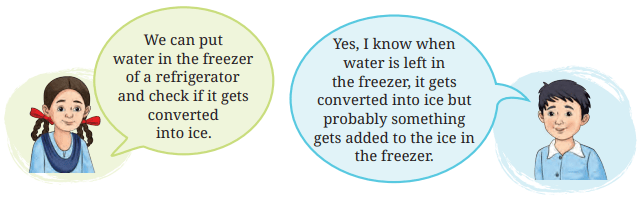
Do you think Thirav is right? How can you find out?
Activity 8.1: Let us observe
- Put an ice cube in a cup, leave it on the table and
observe.
Ice gets converted into water.
What can you conclude from the observations?
Does this mean that ice and water are the same substance?
Yes, ice and water are the two forms of the same substance.
These forms are also called states. These different states
of water show many differences in their behaviour. Water
flows but ice does not. Water splashes but ice does not.
8.1 Investigating Water’s Disappearing Act
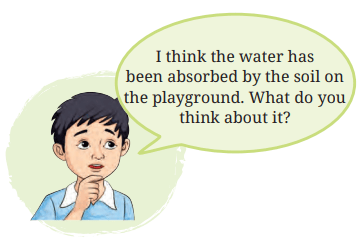
It is a rainy morning. While going to school, Aavi and
Thirav observe that there are a lot of water puddles in the
playground. That evening, when they go to play, they are
surprised to observe that some of the water in the puddles
had disappeared.
Have you ever noticed water
in the puddles disappearing?
Where does it go? Discuss with
your friends.
Where else have you seen
water disappearing? Can you
think of a possible reason why this
happens?
You might have observed that after washing the
utensils, water left on the surface of the utensils, dries
up after some time. Does the reason you thought earlier
to explain water disappearance apply in this case also?
Aavi wonders if water has seeped through the surface of
the utensils.
Thirav thinks that water does not seep through the
surface of the utensils. Design an activity to investigate
whose idea is correct.
Activity 8.2: Let us investigate
- Take a tablespoon of water on a steel plate as shown in Fig. 8.1.
- Observe whether water seeps through to the other side of the plate or not.
- Keep observing this at regular intervals
until the water completely disappears
What do you infer? Is this activity enough
to come to the conclusion that water does
not seep through a steel plate?
If water does not seep through the steel
plate. Then, where has the water gone?
This water gets converted into gaseous
state called water vapour. The water vapour is
another state of water. Let us think of another
observation where you notice the water
disappearing.
While making dosa, we sprinkle some water
on the hot pan and it disappears. Where does
it go?
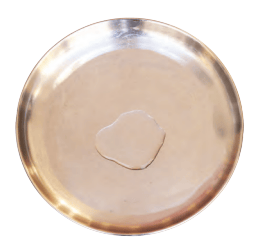
Fig. 8.1: Steel plate with
a tablespoon of water
Let us draw
Draw a detailed sketch (with labels and
caption) about what happens to the water
Do you
know?
Water vapour is
actually invisible
but the
presence of
tiny droplets
of water in the
steam makes it
visible.
The water which is sprinkled on the hot pan gets converted into steam. Steam is actually water vapour, some part of which converts into water droplets.
The process of conversion of water into its vapour state is called evaporation.
The process of evaporation takes place continuously, even at room temperature. Can you think of other examples of evaporation?
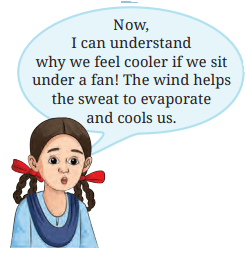
Drying of wet clothes, mopped floor, and sweat on our body are some examples of it.
Now what do you think is the reason for the disappearance of water from the puddles? Is it due to (i) seeping of water into the ground or (ii) evaporation of water or (iii) both of these?
Hand sanitiser disappears as you rub it on your hands. What happens to it?
8.2 Another Mystery
Next day, Aavi, Thirav and their friends decide to make
lemonade. During the preparation, they take cold water in a
glass tumbler and add ice cubes into it. After a few minutes,
they notice something exciting about the outer surface of
the glass tumbler.
Let us find out by conducting a similar activity ourselves.
Activity 8.3: Let us experiment
- Take cold water in a glass tumbler.
- Add a few ice cubes into it as shown in Fig. 8.2.
- Leave it undisturbed for five minutes and observe it.
- Record your observations and the
questions that arise in your mind
in Table 8.1. You can also touch the
outer surface of the glass tumbler to
feel if there is any change.
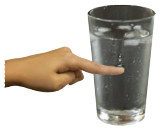
Fig. 8.2: A glass tumbler containing
cold water and ice cubes
You may have many observations and questions here.
Table 8.1: Record the observations and questions
One observation that arises in Aavi’s mind is, “There are
some water droplets (tiny drops) appearing on the outer
surface of the glass tumbler.” Initially, water droplets are
deposited and these droplets combine together to form
bigger drops. You can also try the above process with a
metal container. You may be curious about where the water
droplets come from.
Suggest possible reasons explaining the appearance of
water droplets on the outer surface of the glass tumbler
Discuss with your friends. Write down the possible
reasons in Fig. 8.3.
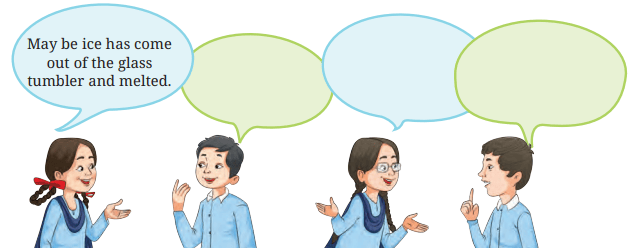
Fig. 8.3: Provide your possible reasons explaining the appearance
of water droplets on the outer surface of the glass tumbler
You may have various possible reasons. You may agree
or disagree with the reasons of others. Aavi and Thirav
argued with a chain of reasons. What do you think about
the possible reasons mentioned in Fig. 8.4?
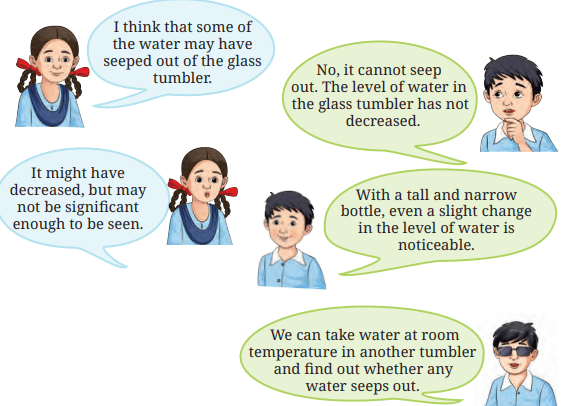
Fig. 8.4: Chain of reasoning
Continue the discussion on the given reasons or conduct
activities to find evidence for the reasons given to help in
this discussion. Where else have you seen water droplets
like this?
You might have seen dew drops on
plants. Why do we see dew drops more
in the morning? When we boil the
water in a half-filled utensil and cover
it with a steel plate, some water drops
accumulate on the inner side of the steel
plate. Where do these water drops come
from? What do you think?
When the water vapour present in the
air comes in contact with a cold surface,
it forms water droplets. The process of conversion of water
vapour into its liquid state is called condensation.
After understanding the concept of condensation of water,
let us go back to Activity 8.3. Could the water appearing on
the outer surface of the glass tumbler in Activity 8.3 also be
due to condensation of water vapour present in the air? Let
us investigate it.
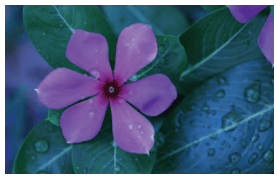
Dew drops on plants
Activity 8.4: Let us measure
Aavi and Thirav conduct an activity to find evidence for
their reasons. You can also conduct the activity by following
the steps given below. Record your data in Table 8.2.
- Take a glass tumbler half-filled with water containing a few ice cubes. Cover it with a small steel plate. Weigh it on a digital weighing balance.
- Observe the reading on the balance and record the weight after every five minutes.
- Continue observing for 30 minutes. Record your
observations in Table 8.2.
Predict what will happen to the mass of cold water kept on
the digital weighing balance. Will it increase or decrease or
remain the same?
Table 8.2: Measurement of mass in condensation
experiment using a digital weighing balance
Do your findings match with
your predictions? Explain your
observations.
More to
do!
The amount of water vapour in
the air is also known as humidity.
The daily humidity data for
your area is reported in the
newspapers and other sources.
Compile the data for the year and
study any patterns, if present.
You may observe some water
droplets on the glass tumbler.
Water vapour from the air
comes in contact with the cold
surface of the glass tumbler
and gets converted into water
droplets on the glass tumbler
through condensation. There is an increase in the reading
on the digital weighing balance. Can we conclude that water
is not seeping through the wall of the tumbler? Can we also
conclude that the water collected outside the tumbler is only
due to condensation? No, we cannot say that conclusively
from Activity 8.4. What more can you do to show that water
is not seeping from the glass tumbler? How would you
modify Activity 8.4 to find the answer?
Repeat Activity 8.4 with the following modifications—
- Mark the water level on the glass tumbler with a
permanent marker or a visible tape.
What do you observe? Water level in the glass tumbler
does not go down but the extra water gets collected on the
outer surface of the glass tumbler. What can you conclude from this? This activity shows that water is not seeping from
the glass tumbler and the extra water is getting collected
because of condensation.
8.3 What are the different States of Water?
Water is a substance that can be observed in three different
states in our daily life. In the solid state, it exists as ice. On
heating, the ice melts and gets converted into its liquid state.
On further heating, water gets converted into its gaseous
state. Let us perform Activity 8.5 to identify the properties
of different states of water.
Activity 8.5: Let us identify
- Put an ice cube in one container and transfer it to another container of different shape. What changes do you notice in the shape of the ice cube? Record your observations in Table 8.3.
- Pour water from one container to another container of a different shape. Observe how water behaves compared to the ice cube and make a record. Did you notice how water flows from one container to the other? What happens to its shape?
- Pour water on a clean surface and observe how it spreads.
- When water gets converted into water vapour, how
does this water vapour spread? Compare this with the
spreading behaviour of water.
Table 8.3: Compare different states of water
What are the differences in the properties of water in solid, liquid and gaseous states?
Ice (solid state) retains its shape irrespective of the container in which it is placed while water takes the shape of the container. Ice does not flow or spread.
Water (liquid state) flows and changes its shape. Water does not have a fixed shape. It takes up the shape of the container in which it is kept, but the volume of water remains constant. Does water also possess the property to spread? Yes, water also has the property to spread while keeping the volume constant.
Water vapour (gaseous state) exhibits a property of spreading out in the entire available space. Gases do not possess a fixed shape. Water vapour exists even at room temperature; though it is invisible to us. It is present in the air around us. The water that evaporates during processes like drying of clothes or mopping of floors contribute to the water vapour in the air around us.
You are now familiar with the three states of water. Some other substances also exhibit these states. For example, wax, oil and ghee. Let us look at some more examples of solids, liquids and gases.
Look around and find some examples of solid substances. Some examples could be stones, wood and glass.
What are the other examples of liquids you can think of? Here are two examples— milk and oil. Think of five more examples.
Have you ever noticed that you can smell the food being cooked even without entering the kitchen? How does this smell reach us?
It is because the smell of yummy food from cooking spreads through the air and reaches our nostrils, even if we are not in the kitchen.
What are the other examples of gases you can think of? What about oxygen and carbon dioxide
8.4 How can we change the States of Water?
So far we have learnt that water can exist in solid, liquid
and gaseous states. How can you change the state of water? How can you quickly change
ice to its liquid state, water?
If we have to change ice into
water, and water into water
vapour, we have to supply heat
to it. If we want to change
water into ice, what should be
done? It can be done by placing
water in a cold environment,
such as a freezer. Water freezes and is
converted into ice. If we take the ice out of the freezer,
it melts and is converted into water.
Can you think of any other example, besides water, that
can change from solid to liquid?
A candle, which is made of wax, is one such example.
How can we turn candle wax into liquid state?
How can
we change the liquid wax back into solid state? We should
cool the liquid wax to change it into a solid. What are the
other liquids you have seen which get converted into a
solid? Have you ever seen coconut oil getting converted into
its solid state during the winter season?
Hence, we can see that water and other substances change
their states on heating or cooling. The process of conversion
of a solid into liquid state is called melting. The process of
conversion of liquid into solid state is called freezing.
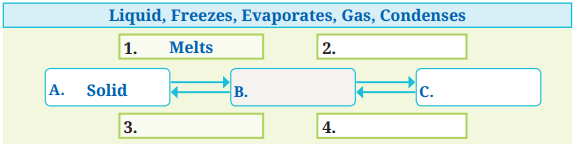
Let us check the connection between different states of
water through Activity 8.6.
Activity 8.6: Let us complete the diagram
8.5 How can Water be Evaporated Faster or
Slower?
Activity 8.7: Let us investigate
Activity 8.8: Let us explore
8.6 Cooling Effect
Activity 8.9: Let us make a model
8.7 How do Clouds give us Rain?
Activity 8.10: Let us engage in a group activity
Activity 8.11: Let us understand the process
More to know!
Atmospheric Water Generator (AWG)
machines collect water from humid air
to produce drinkable water. This is done
through condensation of water vapour by cooling the air. This process
is similar to the formation of
drops of water outside the
glass tumbler filled with ice
cold water
Activity 8.6: Let us complete the diagram
Fill up the blank boxes in Fig. 8.5 marked as A, B, C and 1, 2,
3, 4 for conversion of different states of water using the
words given in the box. Two words have been filled for you.
Fig. 8.5: Conversion of different states of water
8.5 How can Water be Evaporated Faster or
Slower?
In section 8.1, we have learnt about evaporation. Let us
explore it more!
Observe your surroundings. What are the conditions that
affect how fast water evaporates? What differences do you
see in evaporation on a cold day versus a hot day? Discuss
with your friends. The following words may help in your
discussion—fan, drying cloth, sweating, windy day, hot day,
rainy day.
Let us perform Activity 8.7 to investigate conditions that
will affect how fast water will evaporate.
Activity 8.7: Let us investigate
- Take water in a small cap of a bottle (you may use sanitiser in place of water).
- Take the same amount of water in a plate. The exposed area of water in the bottle cap and the plate are different.
- Keep both of them near each other.
- Record the time taken for the water to completely evaporate in each case in Table 8.4
Let us investigate
Reflect on
what you
did really
well in this
activity
Table 8.4: Findings of the investigation
What can you conclude from this investigation?
If you spread out water on a plate, its area exposed to air
is larger. Therefore, evaporation is faster.
What would happen if milk is taken instead of water in
the above activity?
Other conditions which affect how fast water evaporates
Design an activity similar to Activity 8.7 to find out what are
the other conditions which can affect how fast water will
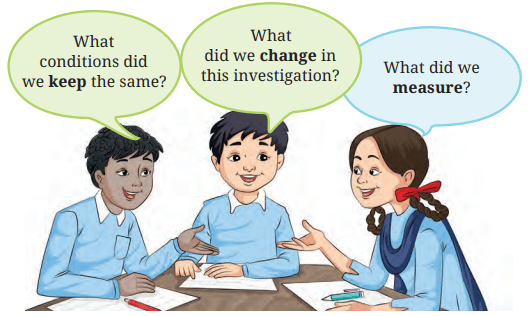
evaporate. What would you change? What would you keep
the same? Perform this activity, use Table 8.5 to record the
data and discuss your observations
Table 8.5: Record the data of an investigation where one
condition is changed and other condition remains the same
Condition that is kept the same: _________
Other than the conditions you have explored to find how
water can be made to evaporate faster or slower, you can
also conduct Activity 8.8 to explore it further.
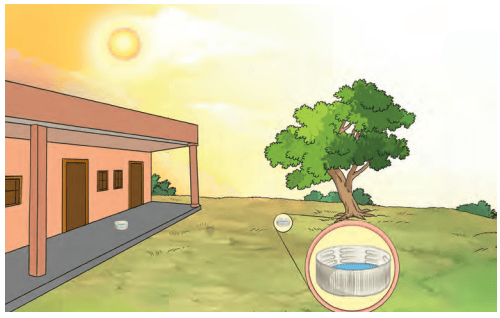
Activity 8.8: Let us explore
- Take identical caps of two bottles.
- Pour equal amount of water in each of the cap.
- Place one of the cap in sunlight and keep the other in shade as shown in Fig. 8.6.
- Observe the two caps of bottles after every 15 minutes.
- Record the time taken for the water to completely evaporate in each case.
- You can also repeat this activity on a windy or a rainy day, and record your observations.
Fig. 8.6: Evaporation of water in sunlight and in shade
What conclusions can you draw from Activity 8.8 and other
similar experiences?
- Water evaporates faster from the cap kept in sunlight compared to the cap kept in shade.
- It is a common observation that clothes dry faster on
a hot sunny day. Do clothes dry faster or slower on a
windy day? It is once again a common observation that
clothes dry faster on a windy day. With the increase in
the movement of air, water evaporates faster.
- It is also a common observation
that clothes dry slowly on a
rainy day. On a rainy day, water
evaporates slowly. If the amount
of water in the air is already
high (more humidity), water
evaporates slowly.
Do you know!
The amount of water
vapour in the air is
more on rainy days
and hence rainy days
are more humid.
8.6 Cooling Effect
Aavi’s mother purchased a new matka (earthen pot) to
replace the stainless steel pot for storing drinking water.
Upon returning from school, Aavi notices the earthen pot
and drinks water from it. Aavi expresses surprise and
asks, “Why is the water in the earthen pot so cold? I never
observed water getting cold in a stainless steel pot.” What
do you think is the reason?
Water seeps through the surface of the
earthen pot and evaporates, which imparts
a cooling effect on the water. What are the
other examples of cooling effect? Sprinkling
water on the floor or the roof during summer
to cool it, is another example.
How do you feel when you rub sanitiser on
your hands?
Let us perform Activity 8.9 to observe the cooling effect
by making a simple and electricity-free model of pot-in-pot
cooler.
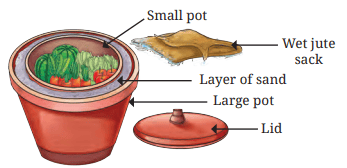
Activity 8.9: Let us make a model
- Take two earthen pots of different sizes.
- Fill the bottom of the larger pot with a layer of sand.
- Place the smaller pot into the centre of the larger one as shown in Fig. 8.7.
- Fill the gap between the pots with more sand.
- Pour water in the sand area.
- Place a lid or wet jute sack to cover the top of the smaller pot.
- You can also make
a drawing of the
pot-in-pot cooler once it
is ready
Fig. 8.7: A pot-in-pot cooler
Allow 4-5 hours for the mini pot-in-pot cooler to cool
down. The time range can be influenced by many conditions.
Observe and discuss how it creates a cooling effect
inside the pots. Keep some vegetables and fruits in
it and observe for a week on a daily basis to check
for the freshness of the vegetables and fruits kept
inside the cooler. You will have to add water regularly
to keep the sand moist. For how many days can the
vegetables and fruits be kept fresh in it? What are
the conditions which can affect the number of these
days? What else can be used in place of sand for
better cooling?
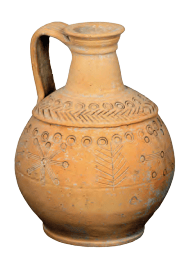
You all may be familiar with this unique clay pot
which is called Surahi (Fig. 8.8). In summers, surahi is
used to keep the water cold.
Fig. 8.8: A surahi
8.7 How do Clouds give us Rain?
Condensation plays a significant
role in the process of bringing
evaporated water back to the
Earth’s surface. How does
this happen? When air moves
higher above the Earth’s
surface, it becomes cooler and
cooler. At certain heights, the
air gets so cool that the water
vapour in it turns into droplets
which are generally formed
around dust particles. These small droplets float in the
air and form clouds. Many droplets join together to form
bigger drops of water. Some drops get so heavy that they
start falling. These falling water drops are what we call rain.
Under special conditions, it might also fall as hail or snow.
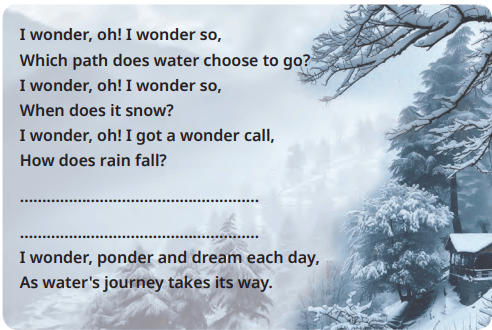
Aavi enjoys the rain and creates a poem. You can complete
the poem and present it in your class.
Do you
know?
Why does air containing
water vapour go up in the
atmosphere (thin layer of air
that surrounds the Earth)?
As we know, gas balloons
containing lighter gases go
up in the air. Similarly, water
vapour is lighter than air,
causing it to rise.
Activity 8.10 demonstrates the role of dust particles in the
formation of clouds.
Activity 8.10: Let us engage in a group activity
- Take an empty discarded one litre plastic bottle. Pour about one cup of water into it.
- Close the lid tightly. Now quickly squeeze and release the bottle continuously for about 2–3 minutes. Observe the space above the water in the bottle.
- Repeat the same activity after adding a small burnt piece of newspaper into the water.
- What will you observe?
- In this case, you will observe some haziness (clouds) above the water in the bottle.
- The burnt newspaper provides very small invisible dust particles, around which water vapour condenses and forms clouds.
Caution
Handle burning paper carefully
Let us perform Activity 8.11 to represent our understanding
of how water changes its state and its movement.
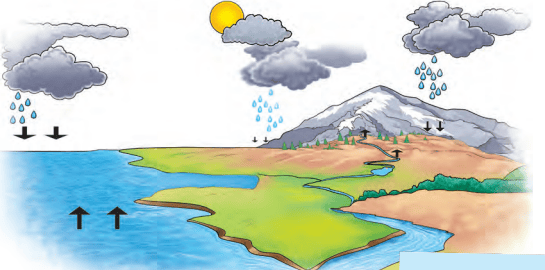
Activity 8.11: Let us understand the process
Label Fig. 8.9 using arrows shown and the words given in
the box to show where water is stored, how water changes
its state and where it moves.
Cloud, Lake, Ocean, River, Groundwater, Evaporation,
Condensation, Rain, Snow
Fig. 8.9: Change of states and movement of water
What did I do well?
Was I able to label all
the parts of the water
cycle? Which parts of
the water cycle were
unclear to me?
The water from the ocean and the Earth’s
surface evaporates into the atmosphere as
vapour and returns as rain, hail or snow,
ultimately flowing back to the oceans.
This circulation of water is known as the
water cycle.
Only a small portion of water available on the Earth is
fit for use by plants, animals and humans. Most of the water
is in the oceans and it cannot be used directly. We use water
for drinking and also for many other activities. The number
of people using water is increasing with a rise in population.
The increasing demand for water causes its shortage in
many parts of the world. Hence, it is very important to use
water wisely and avoid wasting it. Let us keep our water
bodies free from pollution. You will learn more about water
and its conservation in the chapter ‘Nature’s Treasures’
Keywords
Summary
- The process of conversion of water into its vapour state is called evaporation.
- The process of conversion of water vapour into its liquid state is called condensation.
- Water is found in different states—solid, liquid and gas.
- Water changes its state on heating or cooling.
- Conditions which make the evaporation faster or slower are exposed area, humidity, air movement, etc.
- Evaporation causes cooling effect.
- The water vapour in the air condenses to form tiny droplets of water, which appear as clouds. Many tiny water droplets come together and fall down as rain, hail or snow.
- The circulation of water between the Earth surface and atmosphere is known as the water cycle.
- We have used the process of observation, questioning, possible reason and experimenting to find out the concepts of evaporation and condensation.
Let us enhance our learning
1. Which of the following best describes condensation?
(i) The conversion of water into its vapour state.
(ii) The process of water changing from a liquid intogaseous state.
(iii) The formation of clouds from tiny water droplets.
(iv) The conversion of water vapour into its liquid state.
2. Identify in which of the given processes, evaporation is very important—
(i) Colouring with
(a) crayons (b) water colours
(c) acrylic colours (d) pencil colours
(ii) Writing on paper with
(a) pencil (b) ink pen (c) ball point pen
3. We see green coloured plastic grass at many places these days. Space around natural grass feels cooler than space around the plastic grass. Can you find out why?
4. Give examples of liquids other than water, which evaporate.
5. Fans move air around, creating a cooling sensation. It might seem strange to use a fan to dry wet clothes since fans usually make things cooler, not warmer. Normally, when water evaporates, it requires heat, not cold air. What do you think about this?
6. Usually, when sludge is removed from drains, it is left in heaps next to the drain for 3–4 days. Afterward, it is transported to a garden or a field where it can be used as manure. This approach reduces transportation cost of the sludge and enhances the safety of individuals handling it. Reflect upon it and explain how.
7. Observe the activities in your house for a day. Identify the activities that involve evaporation. How does understanding the process of evaporation help us in our daily activities?
8. How is water present in the solid state in nature?
9. Reflect on the statement “Water is our responsibility before it is our right.” Share your thoughts.
10. The seat of a two-wheeler parked on a sunny day has become very hot. How can you cool it down?
Learning further
- Wet one hand with water and leave the other dry. Blow air across both hands and feel the cooling effect. Find out the reasons for it.
- Make a game to navigate through different states of water and water related concepts to reach the finish line. Challenge cards with questions related to water cycle, evaporation, condensation, etc., can be some game elements.
- Discuss with your teacher and act out the stages of the water cycle through a role-playing activity in your school assembly.