
Chapter 9
Methods of Separation in Everyday Life
Malli and his sister Valli are excited for their summer
vacations. Their parents have planned a trip to visit their
relatives and friends living across India. They always stay
in touch with their relatives and friends. Do you also keep
in touch with your loved ones?
Their first halt is at their Nani’s (maternal grandmother’s)
house in Haryana. It is surrounded by large fields. Malli
and Valli are fascinated by the variety of grains piled up
in the courtyard. Their Mami (maternal aunt) and Mama
(maternal uncle), along with other community members,
are busy separating small stones and husk from the grains
with their hands.
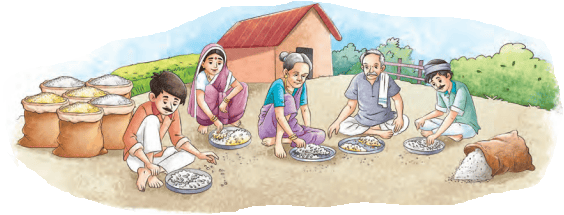
Malli and Valli are curious to know why this is being
done. Their Nani notices their curiosity and explains, “We are
removing these stones so that the grains are fit for cooking.”
They go around the house to see the fields and the
cattle. To keep them busy, Nani gives them a challenge of
handpicking small stones from grains while keeping their
eyes closed.
The method of picking by hand from a mixture (when
two or more substances are mixed) such as small stones and
husk from wheat and rice is called handpicking. It is done
on the basis of differences in size, colour and
shape of the particles. If the particles to be
removed are present in small quantities and
can easily be picked by hand, handpicking
proves to be a convenient method.
At lunch, Malli and Valli are served
steaming hot vegetable pulao. While
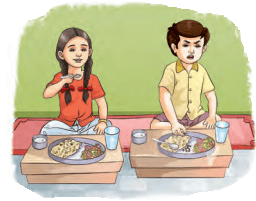
eating the pulao, Nani observes that
Malli is separating whole black peppers
from the pulao and is placing them
aside on his plate (Fig. 9.1). Valli playfully teases,
“Wow! This is a handpicking method, nice one!”
Nani tells them about the benefits of black pepper and
encourages Malli to eat it.
Later in the day, their Mama takes them to the fields
where they observe bundles of harvested wheat
stalks lying in the fields. Some stalks are
spread in the sun for drying. Both of them
pick up a stalk each and notice numerous
grains attached to it. A group of farmers are
beating the stalks on a large wooden log.
Curiously, Valli asks Mama, “Why are they
doing this?”
Mama explains, “They are beating the
stalks to separate the grains” (Fig. 9.2). This
process of separating grains from the stalks
is known as threshing. Farmers
work hard, yet they enjoy their
work. From time to time, they sing folk songs
while working.
Have fun while you learn
Explore folk songs of your region and try to sing along with your friends.
The separated grains get mixed with
piles of husk.
Valli whispers to Malli, “Will the farmers
handpick the grains to remove them from
so much husk?” She wonders, “How much
time will the farmers take to separate
these?”
Let us perform an activity to find out
the answer to the questions raised by Valli
A small amount of
puffed rice is mixed
with chana dal. Can you think of
separating the mixture
by any method other
than handpicking?
Activity 9.1: Let us explore
- Take a handful of roasted peanuts and rub them between your palms. What happens?
- Is it possible to separate the removed skin and the peanuts?
- Now, try blowing it. What do you observe?
Which of these components—removed peanut skins or peanuts are blown away?
You observe that blowing air separates the heavier and the lighter components.
How do you think farmers separate so many grains from husk?
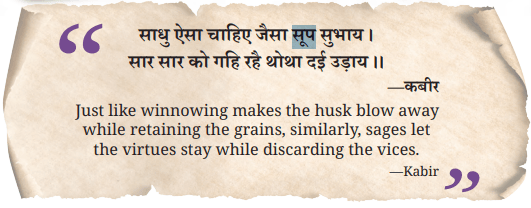
Traditionally, a soop (bamboo tray) is used for separating heavier and lighter components of a mixture (Fig. 9.3).
Next day, their Nana takes them to the fields to show this process at work.
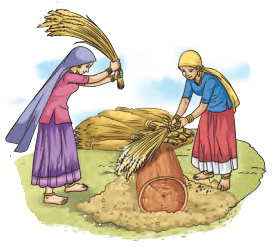
Malli and Valli observe a farmer standing on a raised platform. The farmer is moving the bamboo tray which contains threshed wheat grains in the direction of air or wind (Fig. 9.4).
What do you infer from Fig. 9.4? Do both the components, wheat grains and husk, fall at the same place? Which of the two components get blown away? Can the wind separate the two components?
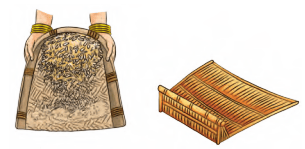
Fig. 9.3: Bamboo tray
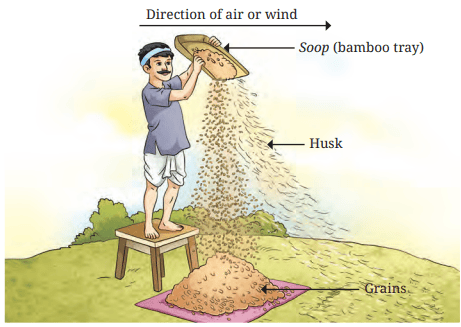
Fig. 9.4: Winnowing
This method of separating heavier and lighter
components of a mixture by wind or by blowing
air is called winnowing. Have you seen any
similar kind of activity being done at your home?
Valli is unable to
separate husk
from rice in a
closed room. How
can you help her?
More to know!
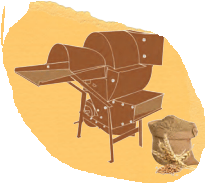
Technological developments have
resulted in developing of threshing
machines called threshers. These machines are used for separating grains from the stalks and husk. They perform both the tasks of threshing and
winnowing simultaneously.
Next day, Malli and Valli board a train to Ahmedabad to
visit their father’s friend Ghanshyam bhai. Before leaving,
Valli requests her Mami to prepare meethi puri (sweet Indian
bread made from wheat flour) for their journey.
Valli: Shall I help you knead the wheat flour?
Mami: To prepare a dish with flour, first we need to
remove bran that may be present in the flour.
Valli: How do we do it?
Mami: We use a sieve for this purpose.
Sieving allows the fine flour particles to
pass through the holes of the sieve as shown
in Fig. 9.5. The bigger particles such as bran
and small stones remain on the sieve.
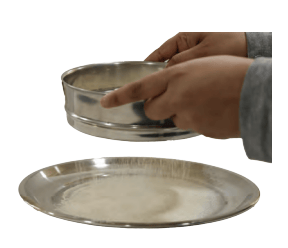
Fig. 9.5: Sieving
Carefully observe a sieve. Are all
the holes of the sieve the same size?
Will sieving work if the holes of the
sieve are larger than the substances?
Is there any difference in the size between
the particles that pass through the sieve
and the particles that remain on the sieve?
Sieving is used when components of a
solid–solid mixture have different sizes.
Upon reaching Ahmedabad, they visit
Sabarmati Ashram along with Ghanshyam
bhai where they learn about the Namak
Satyagrah (Dandi March).
Have you ever observed
sieves being used at
construction sites to
separate pebbles and
stones from the sand?
More to do!
What is Sabarmati Ashram famous for?
Draw a poster showing Dandi March and discuss why it was organised.
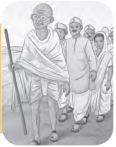
Malli asks, “Where is namak (common salt) obtained
from?”
“From seawater”, replies
Ghanshyam bhai.
Seawater is a mixture
of salts and some other
substances dissolved in
water. To obtain salt,
the seawater is kept in
shallow pits and exposed
to sunlight and air. In
a few days, the water evaporates completely, leaving behind the solid mixture
(Fig. 9.6). Common salt is then obtained from this mixture
by further purification
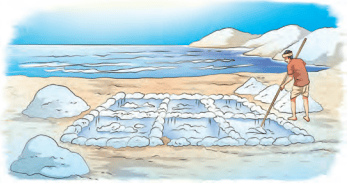
Fig. 9.6: Obtaining salt from seawater
More to do!
Find out about some water bodies in
India that contain common salt. One such
source is Sambhar Lake in Rajasthan.
Let us explore how salt can be separated from a salt solution.
Activity 9.2: Let us observe and create
- Take a bowl or any container and fill it half with water.
- Add 2-3 teaspoons of salt into it and stir till the salt dissolves to form a solution.
- Take a small piece of black or dark coloured thick paper and spread a few drops of the salt solution on it (Fig. 9.7a).
- You can also create any art of your choice with this salt solution.
- Allow it to dry and then observe it (Fig. 9.7b and Fig. 9.7c).
Have you ever
observed white
patches on the
dark coloured
clothes you
wear during hot
summers? How
are these patches
formed?
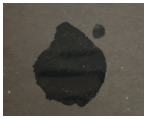
(a) Before drying
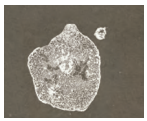
(b) After drying
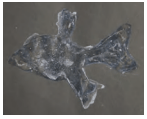
(c) Art created
Fig. 9.7: A few drops of salt solution spread on thick black paper
Do you observe some patches on the paper? What do you
think is left on the paper? You can feel the presence of salt
by touching the paper. Where has the water disappeared?
Recall the chapter on ‘A Journey through States of Water’.
Let us probe further to get the answer
Do you
know?
In the traditional Indian system of holistic health and medicine
called Ayurveda, the herbs or parts of plants are prescribed as
remedies. These ingredients like roots, leaves, flowers or seeds
of various medicinal plants are often dried in the shade. This
practice facilitates the evaporation of excess water, leaving
behind the important part of the medicine.
Activity 9.3: Let us investigate
This activity may be demonstrated by the
teacher.
- Take some salt solution (prepared in Activity 9.2) in a china dish. If a china dish is not available, another suitable vessel may be used.
- Heat and let the water boil away as shown in Fig. 9.8.
- Allow the china dish to cool.
- What do you observe? What is left in the china dish?
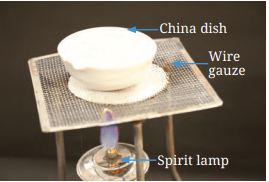
Fig. 9.8: Heating of china dish
containing salt solution
Caution
Be careful
while heating
the china dish
Did you get the salt back? You can feel the presence of salt
in the china dish by touching the salt with your fingers.
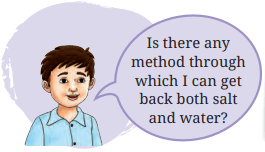
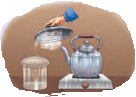
Observe the
figure. Does
it answer the
question? Can
you name the
process involved?
It is now time for them to visit Dada and Dadi (paternal
grandparents) residing in Puducherry, located in southern
India. Malli and Valli are excited to meet their old
neighbourhood friend, Balan. After reaching Puducherry,
they start talking about the old times and do not realise that
it is already evening, Dadi’s tea time.
Dada: I shall prepare tea for you.
Children: We will also help you.
As Dada makes the tea, he shares tips on how to make a cup of tea.
Balan: After preparing tea, how do you remove the tea leaves?
Dada: Obviously, with a strainer. You know if we do not have a strainer, we can still remove most of the tea leaves.
Valli: How?
Dada: Leave the sauce pan (vessel) containing tea undisturbed for some time and gently pour the tea in a cup (Fig. 9.9).
Valli: Oh Yes! And then the tea leaves will be settled at the bottom
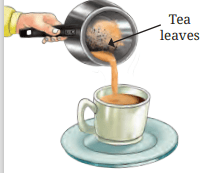
Fig. 9.9: Decantation
The process of settling down of heavier insoluble
component at the bottom of a liquid is called sedimentation.
When the water (liquid) is removed by tilting the vessel,
the process is called decantation.
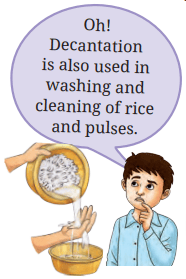
In the chapter ‘Materials Around Us’, you have studied that oil does not mix with water and forms a separate layer when left undisturbed for some time. Which method of separation would you use to separate oil and water?
Dada: But I can still get a few tea leaves in my mouth because decantation does not completely separate all the tea leaves from the tea.
Balan: Oh! It means it is not a proper method of separation.
Dada: Yes, you are right. The tea is ready now.
Malli picks up the tea-strainer from the shelf and gives it to his Dada.
Dada: Let me pour the tea through this strainer. You can see all the tea leaves collected in the strainer. This process of separating tea leaves from tea is called filtration.
Balan asks Malli if he could use a tea strainer to filter muddy water. Let us try and find out.
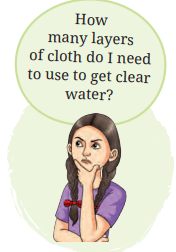
Dada: Also, try to filter the muddy water through a piece of cloth and observe the difference.
Malli: Why should we use a piece of cloth?
Dada: In a piece of cloth, there are very small holes
or pores between the woven threads. These pores in the
cloth can be used as a filter. People of ancient times also
followed this practice.
But if the water is still muddy, impurities can be
separated using a filter with even smaller holes or
pores. A filter paper is one such filter that has very fine
pores in it.
Activity 9.4: Let us experiment
- Try to fold the filter paper yourself and make a cone as shown in Fig. 9.10.
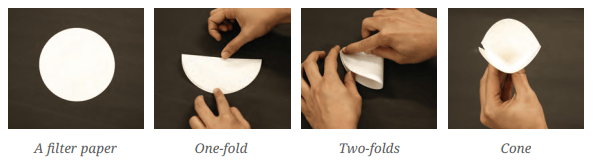
Fig. 9.10: Folding a filter paper to form a cone
- Place it inside a funnel kept on a conical flask and pour muddy water into it (Fig. 9.11) .
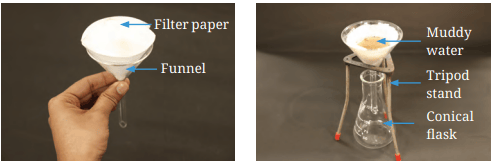
Fig. 9.11: Filtration
- What do you observe? Do the mud particles pass through the filter paper?
- The water coming from the funnel will be collected in the conical flask.
- You will get mud as a residue on the filter paper and clear water as filtrate in the conical flask.
More to know!
Other than the filter paper, many materials such as
cotton, charcoal, and sand can be used as filters. The
choice of filter depends upon the size of the particles of
the materials to be removed.
Activity 9.5: Let us design and create
Valli goes for a nature walk with her Dadi and collects
some water from a pond in a container. She observes some
unwanted substances in it. Design and create a working
model of water filter using low-cost materials.
Do you know!
Tea bags were initially made of soft cloth, like silk, because it could hold the tea leaves and let water pass through. Silk was strong and did not fall apart when it touched hot water. Later, people started using gauze or muslin. Eventually they began using filter paper, which is what most tea bags are made of today.
Malli and Valli go on a
boat ride in a nearby river
with their Dada and his
friend, Otukkam. Otukkam
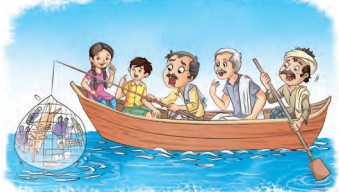
is a fisherman. As they cast
the fishing net, water drains
out through the mesh. Valli
recalls the filtration method
she had learnt and realises
that this method of catching
the fish is somewhat similar.
Malli is taken aback when he saw plastic bags, broken
bottles, a large fish with a straw stuck in its mouth, and food
wrappers along with the other fish trapped in the net.
Let us raise awareness about the issues of river and ocean pollution by composing a poem.
A few lines have been written here, add more lines—
Piece of plastic in my neck,
As in pain I cry,
Koilas, Koilas…where are you dear?
Papa fish cries and Mama fish has tears.

_____________________
_____________________
Aware of the harm, yet they let it flow,
Koilas faintly hears mother’s sorrow,
_____________________
Stop plastic pollution at source,
Rivers are our huge resource.
_____________________

Discuss with your parents
A bowl of milk in your home has gone sour. Discuss
with your parents how you can use it in another way.
Also, which method of separation will you use in the
process?
Malli and Valli take blessings from their
Dada and Dadi, bid goodbye to Balan and
travel to Madhya Pradesh.
The train reaches Bhopal in Madhya
Pradesh. The sun is rising and it is getting
hot. On their way to Maasi’s (maternal
aunt’s) home, they drink chhach
(buttermilk) in the dhaba (roadside
eatery). Malli asks the shopkeeper about
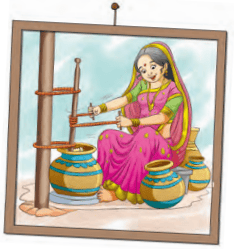
the big painting, hanging on the wall of
the dhaba. The shopkeeper explains that
the picture shows a lady performing the process of churning curd
using a big mathni (churner)
to separate butter. In this
process, the butter being
lighter floats at the top, while
the buttermilk is left behind.
Their stay at Maasi’s place
has become enjoyable and
they are looking forward to
share all their memories with their friends upon returning
home. Now, it is time for them to reach their final destination
of the trip, Shillong, the capital of Meghalaya.
On their arrival at their Bua’s (paternal aunt’s) house in
Shillong, they notice a carpenter making a wooden door.
While working, he accidentally drops a few iron nails in the
sawdust.
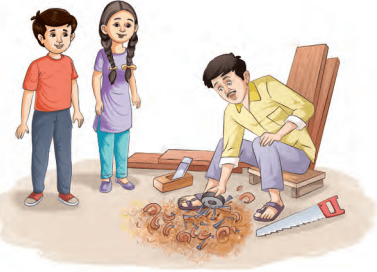
Fig. 9.12: Magnetic separation
The carpenter starts handpicking the iron nails. The
children tell the carpenter to wait. They get a magnet from
their Bua. They ask the carpenter to move the magnet
through the sawdust. All the nails get attracted to it (Fig. 9.12).
Which method of separation did the carpenter use? Recall
the chapter on ‘Exploring Magnets’.
The substances which are attracted towards a magnet are
called magnetic substances. Iron is a common example of a magnetic substance. Separation of magnetic and nonmagnetic substances by using a magnet is called magnetic
separation.
More to know!
Nowadays, recyclers use magnets to separate iron articles from a heap of waste.
In many industries, the waste material often contains scrap iron. This is separated from the heap of waste materials using magnets fitted to a crane.
The scrap iron can be recycled and reused.
Malli and Valli had delightful holidays and the ‘Bharat ki
Yatra’ (tour of India) filled with fun will be a ever lasting
memory for them.
They not only enjoyed exploring different regions of India
but also gained a lot of knowledge about various methods of
separation of substances.
Activity 9.6: Let us play
Write the following phrases on small slips of paper—
- Separating small stones from pulses.
- Churning curd to obtain butter.
- Taking out green chillies from cooked dalia (dish made of cracked wheat) or poha (dish made of flattened rice).
- Taking out seeds from watermelon.
- Sorting piles of sawdust and iron nails from a mixed heap of building material.
- Picking marigold flowers from a heap of other flowers to make a garland.
- Separating pebbles from sand.
- Separating coconut pieces from rice flour.
- Separating oil from water.
- Separating salt from salt solution.
Now, take two baskets, each representing one of the two
purposes for which we separate substances. Form two teams
and see who will get the maximum correct entries
Think and start
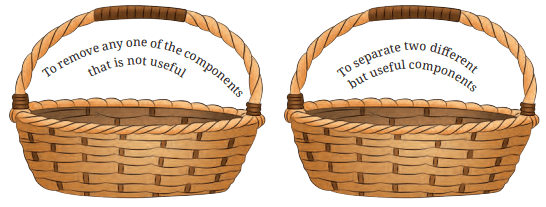
This activity helps in assessing your understanding as to
why we separate substances.
Keywords
Summary
- Handpicking is used for separating solid materials on the basis of differences in size, colour and shape from a mixture.
- The process in which the stalks are beaten to separate grains from them is called threshing.
- The method of separating lighter husk from heavier grains by wind or blowing air is called winnowing.
- The process of separating solids from a mixture based on variations in particle size using a sieve is called sieving.
- Evaporation is the process in which a liquid gets converted into its vapour. It can be used to separate a solid dissolved in a liquid.
- The process of settling down of heavier insoluble component at the bottom of a liquid is called sedimentation. When the liquid is removed by tilting the vessel, the process is called decantation.
- Filtration can be used to separate insoluble solid components from a liquid.
- Churning is used to extract butter from curd.
- Separation of magnetic and non-magnetic substances by using a magnet is called magnetic separation
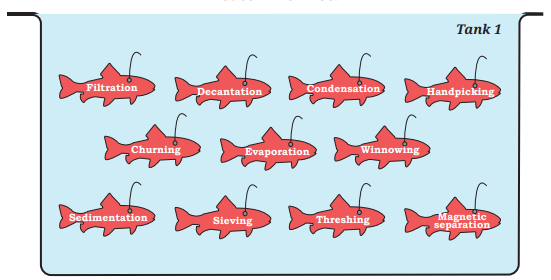
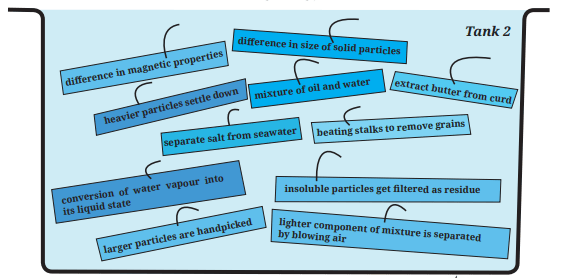
Play a Game—WISE FISH
Prepare your own fishing rod with locally available eco-friendly
materials. Tie a thread to one end of the rod and a magnet to the
free end of the thread. The Tank 1 has red cardboard fish and
Tank 2 has blue cardboard slips attached to iron clips. Fish out a
red fish representing a method of separation first and then fish
out one blue slip related to the red one.
Watch out for your friends. Are they fishing out correctly?
Catch me first!
Then me!
Let us enhance our learning
1. What purpose does handpicking serve in the process of separation?
(i) Filtration (ii) Sorting
(iii) Evaporation (iv) Decantation
2. Which of the following substances are commonly separated using the churning method?
(i) Oil from water (ii) Sand from water
(iii) Cream from milk (iv) Oxygen from air
3. Which factor is usually essential for the filtration?
(i) Apparatus size (ii) Presence of air
(iii) Pore size (iv) Temperature of the mixture
4. State with reason(s) whether the following statements are True [T] or False [F]. Also, correct the False statement(s).
(i) Salt can be separated from salt solution by keeping it under the Sun. [ ]
(ii) Handpicking should be used only when thequantity of one component is less. [ ]
(iii) A mixture of puffed rice and rice grains can be separated by threshing. [ ]
(iv) A mixture of mustard oil and lemon water canbe separated by decantation. [ ]
(v) Sieving is used to separate a mixture of rice flour and water. [ ]
5. Match the mixtures in Column I with their method of
separation in Column II.
6. In what situations would you use decantation instead of filtration to separate solids from liquids?
7. Can you relate the presence of nasal hair to any separation process?
8. During the COVID-19 pandemic, all of us wore masks. Generally, what material are they made of? What is the role of these masks?
9. A mixture containing potatoes, salt and sawdust has been given to you. Outline a stepwise procedure for separating each component from this mixture.
10. Read the following story titled ‘Intelligent Leela’ and tick the most appropriate options. Provide a suitable title of your choice for the paragraph.
Leela was working in the farm with her father when she realised
that they left their drinking water at home. Before her father
felt thirsty/hungry, she went to the nearby pond to fetch some
water/grains. After obtaining some water in the container, she
noticed that the water was muddy and fit/unfit for drinking. To
purify the water, she kept it for some time and then she filtered/
churned the muddy water using a piece of paper/muslin cloth.
Leela, then, cooled/boiled the water for about 10 minutes in
a covered pan. After cooling/boiling, she filtered/churned it
again and made it fit/unfit for drinking. She served this water to
her father while having food, who blessed her and appreciated
her efforts.
Learning further
- Fun with parents: We are proud of our Indian heritage. Under supervision of your elders, try to prepare some herbal remedies using various parts of plants. For example—tulsi kadha. Which methods of separation will you use while preparing herbal kadha?
- Stage play: Imagine you and your friend are Malli and Valli. Write dialogues of a play presenting their entire ‘Bharat ki Yatra’, highlighting the different methods of separation of substances that they observed. Enact the play in your school assembly.
- Group activity: Observe and list separation methods you employed and noticed in your surroundings throughout a week. Explain the reasons behind using these methods and compile the ones you utilised or observed the most. Compare your observations with your group members.
- Be a stalwart of your community: Interview a ragpicker(s)
and prepare a case study about the method(s) of separation
he/she uses in his/her daily life. Encourage children of your
community below the age of 14 to join a neighbourhood
school.
- Be a reporter: (i) Gather newspaper clippings and articles
related to various methods of separation implemented in
your society, such as in agricultural fields or at construction
sites. (ii) Conduct interviews with local farmers to explore
the latest agricultural separation methods that they use.
- Think like a scientist: You are provided with a mixture of iron nails, sand, black pepper, stones, common salt and water. Which steps will you follow to separate each component of a mixture?
The given steps may help you to think like a scientist.
Reflection Steps
I observe_______ . I wonder ______.
You might have wondered about questions such as—
- Which component should I separate first?
- What method of separation should I use first?
- How can we separate these components effectively?
- Will some of the components be soluble in water?
- What properties of the components can help us in their separation?
- What is the most appropriate sequence?
Activity Steps
- Some possible answers to the questions which occurred in my mind are ____________
.
- I performed the following methods of separation_________
- My findings are _________
Hint: A mixture that has more than two components requires a combination
of several methods of separation.