
Chapter 10
Living Creatures: Exploring their Characteristics
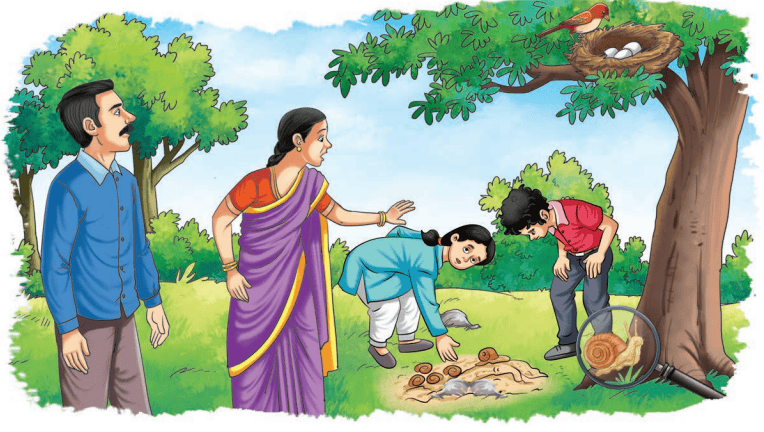
Avadhi and Aayush go for a morning walk with their parents.
Avadhi notices some shells and tries to pick them up. Her
mother advises her not to do so and explains that the shell
could be home to a living snail and is actually a part of its
body. Avadhi and Aayush wonder how the shell that is not
even moving could have a living being inside! Later that
day in school, Avadhi and Aayush share this incident with
their friends. They approach the teacher to understand how
a shell which is not even moving could be a body part of a
living snail. The teacher initiates a discussion in the class on
living and non-living.
Activity 10.1: Let us record
We are surrounded by numerous things. Just look around
in your classroom and you may find many examples—the
pencil that you are holding, the book that you are reading or
the pigeon near the window.
- List them in Table 10.1 and identify each of them as living or non-living on the basis of your understanding in column II.
- Write a reason for grouping them as living or non living
in column III
Table 10.1: Living beings and non-living things in our
surroundings
10.1 What Sets the Living Apart from the
Non-living?
Look at Table 10.1. Why do you think a pencil is non-living
but a pigeon is living? What do you think are the differences
between living beings and non-living things according to
you? What similarities do the identified living beings share
with each other?
You may have identified movement as one of the
similarities among living beings. You have also seen cars
moving on a road. Does it mean that a car is living? List the tasks that you can do but a car cannot. You are a wonderful
example of a living being. Whenever you attempt to group
things around you as living or non-living, you can compare
them with yourself. Which characteristics help you in
differentiating yourself from a car? For instance, a car
does not grow. Does it mean it is non-living? Now, which
characteristics have you used to classify a car as non-living?
Continue your discussion in a similar way to identify the
essential characteristics of living beings.
What are some common characteristics that make living
beings very different from the non-living things? Let us
learn about them.
Can we consider movement as one of the characteristics to
differentiate between the living and the non-living? List five
things around you that can move on their own. Do you think
that all five things that you have listed can be considered as
living just because they can move on their
own? However, unlike animals, plants do
not move from one place to another. Do
you consider them as living?
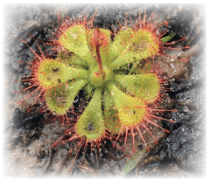
Drosera
Even though plants do not move from
one place to another, they do show certain
types of movements. Opening of flowers is
one of the examples of movement in plants.
Another example of movement in plants is
seen in insectivorous plants. Insectivorous
plants are dependent on insects for their nutrition. Drosera
is one of the examples of an insectivore. Drosera is
featured with saucer-shaped leaves having many hair-like
projections of unequal length with sticky ends. Whenever
an insect enters the saucer, hairs move inward and
trap the insect with their sticky ends. Try to observe
the mechanism of movement in other insectivorous
plants. Climbers also wind themselves around
any object placed close to them. That means,
even though plants do not move from
one place to another, they do show
some movements.
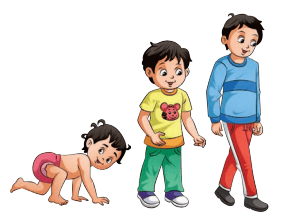
Growth of a child
Compare yourself with the
picture of your childhood. Can you wear the dress that you used to wear four years ago? No,
because you have become larger in size. This is due to growth
in your body. Plants and other living beings also grow. Can
we consider growth as a characteristic of living beings?
Living beings need food (nutrition) for their growth
and development. List five living beings that require food
to grow.
Now, think of a process without which we cannot live.
Count the number of breaths you take per minute after
a normal walk, after a run, and after a few dance steps.
Record the data and observe. Do you notice any difference
in the number of breaths after each situation? Do you notice
the process of breathing in other animals like dogs, cats,
cows and buffaloes? Notice the movement of their abdomen
while they are taking rest.
In the process of breathing, when we inhale, the air
moves from outside to inside our body. When we breathe
out, the air moves from inside our body to outside.
Breathing is part of a process called respiration. Do
plants also respire? There are tiny pores called stomata
on the surface of leaves. These pores help plants in taking
air in and out. Interact with senior class students in your
school and request if they can demonstrate stomata using
a microscope in your class. All living beings respire.
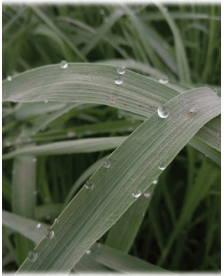
Water droplets on grass
Have you noticed white patches forming on shirts around
the armpits during summers? These
patches are formed due to sweat. The
sweat consists of water and salts removed
by the body as waste products. Removal
of waste products from the body is called
excretion. Urine is also formed as a
product of excretion in animals. Do you
know that plants also excrete? You may
notice plants excrete excess water and
minerals in the form of small droplets on
leaves. For example, grasses and roses. All
living beings excrete.
Let us look at another characteristic.
What is your reaction if you unexpectedly step on a sharp object, such as a thorn, while walking without shoes, or you accidentally touch a hot
cup of tea? Stepping on a thorn and touching a hot object are
stimuli. Any thing or any event that prompts living beings
to respond is called a stimulus. List three stimuli (plural
of stimulus) and your body’s
instant response to them.
Do plants also respond to
stimuli? Yes, plants also respond
to stimuli. For example, touchme-not (mimosa, chhui-mui,
lajjalu) plants fold their leaves
when we touch them. Have you
also observed that certain plants
fold their leaves after sunset?
Specifically, the leaves of certain
plants facing each other tend
to come together. This can be
observed in the sleeping leaves
of amla (Indian gooseberry)
tree. All living beings respond to stimuli. Find a few more
plants in your neighbourhood which fold their leaves after
sunset.
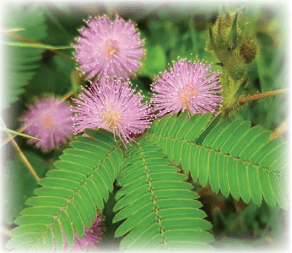
Touch-me-not (chhui-mui) plant
Why do the leaves of chhui-mui and amla plants respond
in this way? Which stimulus could be responsible for their
behaviour?
Have you seen young ones of cats, dogs or other animals?
List young ones of five different animals. Have you seen
young ones of any non-living things such as a pencil, a chair
or an electric bulb?
All living beings reproduce. Reproduction is the
process of producing new ones of one’s own kind. Why is
reproduction necessary? It is necessary for the continuity
of life.
When a living being is not able to exhibit all of the above
mentioned characteristics, despite the availability of all
resources (like food, air and water) needed for being alive,
it is said to be dead.
From the above discussion, we can understand that
all living beings share some common characteristics. For
example, all living beings show movement, they need food, and they grow. They also respire, reproduce, excrete,
respond to stimuli, and eventually, die. Absence of any of
these features indicates that they are non-living things.
Now that you know how to identify a living being, fill
up the remaining two columns (IV and V) of Table 10.1 and
complete the activity.
In which category would you place a seed—living or nonliving? Why?
Let us explore how a seed germinates to observe some
of these essential characteristics in plants
10.2 Essential Conditions for Germination
of a Seed
Have you observed a seed germinating? You might have
wondered what conditions are required for germination
of a seed. What conditions do you think are required for
seed germination? How will you investigate whether these
conditions have an effect on the germination of a seed?
Let us find out by performing Activity 10.2.
Activity 10.2: Let us experiment
- Take four identical pots filled with garden soil. Sow four bean seeds in each pot. Now, keep these pots in the following conditions for 15 days.
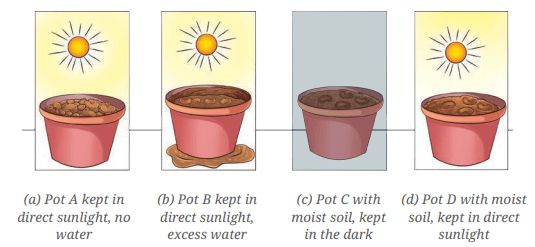
Fig 10.1: Bean seeds exposed to different conditions
- Pot B: Add excess water to the soil such that water
is always present above the soil. Keep adding water
on a regular basis if water reduces. Place this pot in
direct sunlight.
- Pot C: Keep the soil in this pot slightly moist by adding
a moderate amount of water on a regular basis. Place
this pot in a dark location.
- Pot D: Maintain the soil in this pot slightly moist by
adding a moderate amount of water on a regular
basis. Place this pot in direct sunlight.
- Indicate the availability of air, sunlight and water for the seeds in each of these cases in Table 10.2.
- When a seed turns into a sprout, it is said to have
germinated. Predict whether the seeds in each pot will
germinate. Record your predictions for each pot kept
under different conditions in Table 10.2.
Table 10.2: Effect of certain conditions on seed germination
- Regularly observe the pots for 7-10 days to check the status of germination of the seeds. Record your observations in Table 10.2.
- Compare your predictions with your observations.
Do you think sunlight is necessary for germination of
seeds? Do the seeds in all the pots receive air, water and
sunlight? Is there any pot in which air is not available to the
seeds? If so, why is it not available? What happens to the
seeds in the pot where water is provided in excess? Which
seeds receive both air and water? Identify the pots where
you can notice the germination of seeds.
Do your observations match with your predictions?
Write possible reasons in favour of your observations in
Table 10.2. Based on your observations, state the conditions
which favour seed germination.
Which of the following are essential for seed germination–
air, water and sunlight? Compare the available conditions
in each pot. Germination of bean seeds requires the right
amount of water and air. Why do seeds require these
conditions for germination? Do you think that the absence
of one or more of these conditions will affect
seed germination?
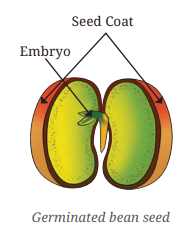
Let us understand how these conditions help
in seed germination. The effects of the following
conditions have been seen in Activity 10.2.
Water: Seeds require water for germination.
Water enables the seeds to carry out the
processes necessary for their growth. The outer
covering of the seed is called seed coat. Water
softens the seed coat and helps the tiny embryo
inside it to develop into a plant.
Air and Soil: Seeds need air for germination. They use the
air available in the spaces between soil particles. Moreover,
spaces between the soil particles allow roots to grow easily.
Light and/or dark conditions: We have learnt that for
the bean seeds, presence of light is not essential for their
germination. In general, most seeds do not require light for
germination. But after germination, sunlight is required for
further growth of the seedling
Do you
know?
Some seeds of flowering plants, like Coleus and Petunia, require light to germinate. Covering these seeds with soil inhibits their sprouting. Seeds of flowering plants, like Calendula and Zinnia, need darkness to germinate. These seeds should be covered with sufficient soil.
Some seeds of flowering plants, like Coleus and Petunia, require light to germinate. Covering these seeds with soil inhibits their sprouting. Seeds of flowering plants, like Calendula and Zinnia, need darkness to germinate. These seeds should be covered with sufficient soil.
In the Chapter ‘Mindful Eating: A Path to a Healthy Body’,
you have learnt that human beings need a balanced diet
for good health and proper growth. Similarly, plants too
need favourable conditions and nutrients
for their proper growth and development.
What other conditions do you think would
affect seed germination?
In Activity 10.1, what are the
characteristics of living beings which
made you place plants in living beings? Do
plants show growth in Activity 10.2? Are
there any other characteristics of living
beings that these plants show?
Let us study another characteristic that can be seen
clearly in plants—growth and movement.
How would you now categorise a seed, as living or non-living?
10.3 Growth and Movement in Plants
How do plants respond to sunlight? Does sunlight affect the
direction of growth of different parts of plants? In which
direction would the root and shoot of a plant grow and
move if the plant is placed inverted? How would you design
an activity to find answers to these questions?
Activity 10.3: Let us design
- Take some bean or gram seeds and allow them to germinate on a moist cloth or a moist tissue paper.
- Let them germinate until each of them develop into a seedling having a small root and a small shoot.
- Now, take three glass beakers or tumblers, and label
them as A, B and C.
- Take three glass plates and attach a thick blotting paper to one side of each plate using a thick soft cotton thread.
- Fix one seedling on each plate using a thick soft cotton thread, as shown in Fig. 10.2, ensuring that the plant is not damaged.
- Now, place one glass plate upright with a seedling attached into each of the beaker A and beaker C, as shown in Fig. 10.2a and Fig. 10.2c.
- In beaker B, arrange the plate such that the shoot of a
seedling is directed downwards and the root is directed
upwards, as shown in Fig. 10.2b.
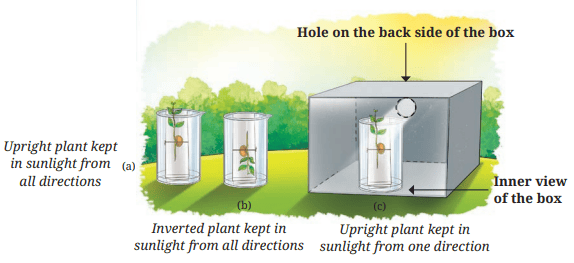
Fig. 10.2: Set-up showing plants kept in different conditions
- Pour water into all the three beakers to ensure that the seedling in each beaker remains above the water level.
- In each case, let the bottom of the blotting paper get completely wet by soaking in the water. In this way, the seedling will get the moisture from the wet blotting paper.
- Place beaker A and beaker B in sunlight as shown in Fig. 10.2a and Fig. 10.2b.
- Position beaker C as shown in Fig. 10.2c. Place a cardboard box in such a way that the seedling gets light from one direction only through a small circular hole.
- Fill Table 10.3 with your predictions and observations.
Table 10.3: Growth of root and shoot under different conditions
What is the direction of growth of root and shoot in
beakers A, B and C based on your observations? Do your
predictions match your observations? What do you conclude
from this activity?
Fig. 10.3: Direction of growth of root and shoot under different conditions
From the results of this experiment (Table 10.3 and
Fig. 10.3), we note that—
- When the plant is kept upright, the root grows downwards and the shoot grows upwards.
- When the plant is kept inverted, the root bends and grows downwards. Also, the shoot bends and grows upwards.
- When the plant gets sunlight only from one direction,
the shoot grows in the direction of light while the root
continues to grow downwards.
After conducting Activity 10.3, we can conclude that shoots
of plants grow upward and exhibit movement towards
sunlight but roots of plants grow downwords.
Know a scientist
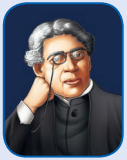
Jagadish Chandra Bose (1858–1937) was an Indian scientist who did some fascinating experiments with plants. He built a machine called a crescograph to record how plants respond to stimuli like light, heat, electricity and gravity. With this machine, he could measure how fast plants grow. He also showed that plants can sense and respond to stimuli.
Jagadish Chandra Bose (1858–1937) was an Indian scientist who did some fascinating experiments with plants. He built a machine called a crescograph to record how plants respond to stimuli like light, heat, electricity and gravity. With this machine, he could measure how fast plants grow. He also showed that plants can sense and respond to stimuli.
10.4 Life Cycle of a Plant
We have learnt about conditions required for germination
and how plants grow and exhibit movement. Let us now
explore the changes a plant undergoes in its whole life.
Activity 10.4: Let us explore
- Plant a bean seed and provide suitable conditions for its growth. Observe regularly for three months.
- Record your observations in Table 10.4 as and when changes become visible.
- Note the date when any change is observed. Record
answers for the following questions—
- How long does it take for any change to occur? Make
sketches of various changes that you observe in
Table 10.4.
- After how many days does the first flower appear?
- After some parts of the flower have dried, can you see any further growth?
- Which structure do the remaining parts of flower develop into?
- Can you notice a pod or a fruit with seeds develop from a flower?
- What happens to the plant after the fruits containing
seeds are formed?
Table 10.4: Changes observed during the growth of the plant
Go through the observations you recorded regarding the
growth of the bean plant in Table 10.4. What changes do you
observe after the fruits are formed? Does the plant become
yellow and dry even when you continue watering it? Sow
the seeds obtained from your bean plant. Watch how the
seeds give rise to a new generation of bean plants. Compare
the sketches that you have drawn in Table 10.4 with Fig. 10.4.
A seed grows into a young plant and matures to produce
flowers and fruit. The fruit, in this case a pod, contains
seeds which give rise to a new generation of bean plants.
The entire process from a seed to a plant, and then, to the
next generation of seeds is called the life cycle of a plant
(Fig. 10.4). When a plant stops growing and all activities of
life gradually comes to an end, even after the availability of
all the necessary conditions, the plant is considered dead
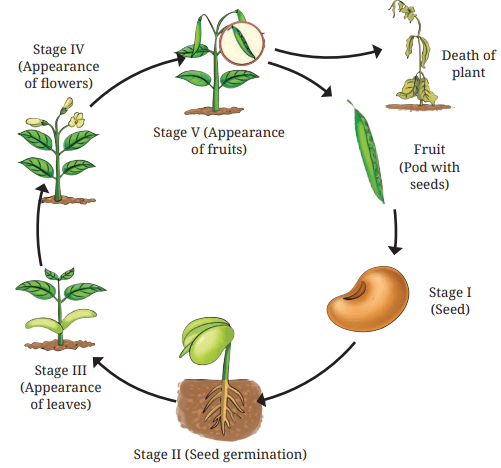
Fig. 10.4: Life cycle of a bean plant
10.5 Life Cycle of Animals
We have learnt about the life cycle of a plant. We have seen
that a plant goes through many changes in its life cycle.
Have you ever observed how animals grow over time? Draw
sketches of their young ones and name them.
10.5.1 Life cycle of a mosquit
Mosquitoes buzzing around is a common experience for all of
us. Female mosquitoes are bloodsucking insects that transmit
several diseases like malaria, dengue and chikungunya. You
might have learnt from newspapers, school noticeboards
or awareness campaigns that mosquito breeding should be
prevented. We are advised not to allow water to stagnate
anywhere in our surroundings. Why is it so? Does stagnant
water have any relation with mosquitoes laying eggs.
Conduct a safety audit in your school, or at your home
and surroundings to check for stagnant water (if available,
carry a hand lens to observe any small creatures). Some
common places where stagnant water is likely to gather
are desert coolers, planted pots and any open container.
You may find two different types of worm-like creatures
(Fig. 10.5). They are larva and pupa, two distinct life stages
during the development of mosquito. In case you observe
larvae and pupae, report to your teacher. Discuss with the
teacher and classmates about the necessary measures one can
take to prevent breeding of mosquitoes. What differences do
you observe in the shape of larvae and pupae?
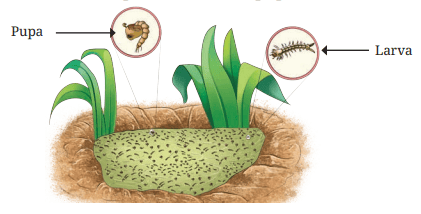
Fig. 10.5: Larvae and pupae of mosquitoes in a stagnant water body
Mosquito larvae and pupae observed in water bodies
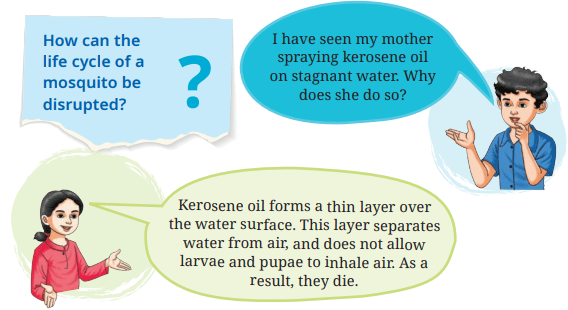
repeatedly come to the water surface. What can be the reason
for this? Mosquito larvae and pupae live in water and require
air to respire. They move to the surface of the water for air.
Activity 10.5: Let us analyse
Let us solve an interesting puzzle.
How will you decide which stage (larva or pupa) comes
immediately after the egg stage?
Suppose you are given a container with water from a
puddle containing larvae and pupae. Design an activity to
find out the correct sequence of these stages.
You can take help of the following activity designed by
Avadhi to create your own activity—

Step 1: I have a water container with mosquito larvae and pupae.
Step 2: I will separate 4-5 larvae and pupae into two separate containers with the same water.
Step 3: I will observe them every day until I see them changing to the next stage.
Step 4: If the larvae change into pupae, it would mean that the larval stage comes before the pupal stage or vice-versa.
Step 5: I will keep watching both the containers to see in which one a mosquito appears first.
These observations will help us to learn the correct
sequence of growth.
Now, suppose you are given a container filled with water
from a puddle which contains larvae and pupae. Without
separating them from the container, how would you design
an activity to decide which stage, out of the two, gives way
to the next?
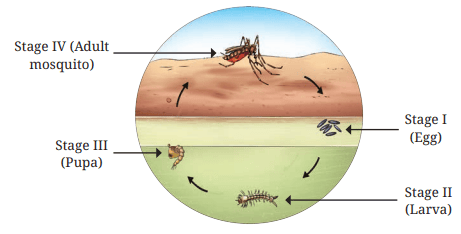
Fig. 10.6: Life cycle of a mosquito
Let us learn more about these stages in the life cycle of a
mosquito.
Mosquitoes pass through four stages in their life cycle—
egg, larva, pupa and adult (Fig. 10.6).
The adult mosquito that emerges from the pupa rests
briefly on the surface of water and then flies away.
The adult
mosquito may survive for 10 to 15 days.
We have seen that a mosquito begins its life as an egg
(stage I), the egg develops into a larva (stage II), the larva
grows into pupa (stage III), and the pupa transforms into an
adult mosquito (stage IV). The adult female mosquito lays
eggs directly on or near water, and the cycle continues.
Significant changes occur in the appearance, body shape
and structure during the various stages in the life cycle of
a mosquito. The shape of the egg is quite different from the
larva; the larva appears very different from the pupa. The
pupa appears very distinct from the adult mosquito. Is it
easy to imagine that a mosquito emerges from a pupa?
Do you
know?
The silk moth also passes through four life stages—egg, larva, pupa and adult. Eggs hatch into larvae, which then grow in size. Larvae secrete thread-like material which they wrap around themselves, before changing to pupae. These are the fibres that are used to make silk fabric. In India, the Khadi and Village Industries Commission (KVIC) has set up several centres for silk production
The silk moth also passes through four life stages—egg, larva, pupa and adult. Eggs hatch into larvae, which then grow in size. Larvae secrete thread-like material which they wrap around themselves, before changing to pupae. These are the fibres that are used to make silk fabric. In India, the Khadi and Village Industries Commission (KVIC) has set up several centres for silk production
10.5.2 Life cycle of a frog
Activity 10.6: Let us analyse
Avadhi and Aayush are dressed up in full sleeves shirts and
full pants today. It has been raining intermittently for a week.
They are going out with their classmates for an activity.
After a brief walk led by their science teacher, they reach a
shallow pond. It is surrounded by trees and tall grasses. The
teacher cautions them to watch everything from a distance without causing any disturbance. You may also go to a small
water body during the rainy season with a facilitator and
explore it by taking due safety precautions.
You may notice a white jelly-like substance on the surface
of water towards the edge of the pond (Fig. 10.7). This may
also be attached to plants growing in or around the water.
This jelly-like substance is actually a cluster of eggs of a frog
and is known as spawn.
Observe the features of all the stages of a frog shown in
Fig. 10.7. How will you decide the sequence of the given stages
(A, B, C, D, E, F)? Some of the stages show distinct changes in
their initial and final shapes. Record these changes in Table
10.5
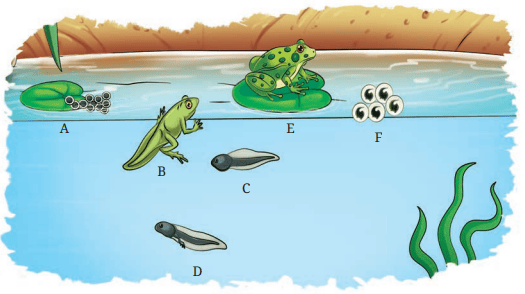
Fig 10.7: Different stages of a frog in a pond
Based on the observations listed in Table 10.5, draw the
life cycle of a frog. Compare the figure drawn by you with
Fig. 10.8.
Table 10.5: Changes in different life stages of a frog
Some of the stages have been clubbed together, for
example, stages A and F in Fig. 10.7 have been kept under
stage I. You will find four stages in the life cycle of a frog—
the egg stage, which progresses to the embryo stage; the
tadpole stage, consisting of an early stage with a tail and no
legs, and a late stage with hind legs; the froglet stage, and
the adult frog stage (Fig. 10.8).
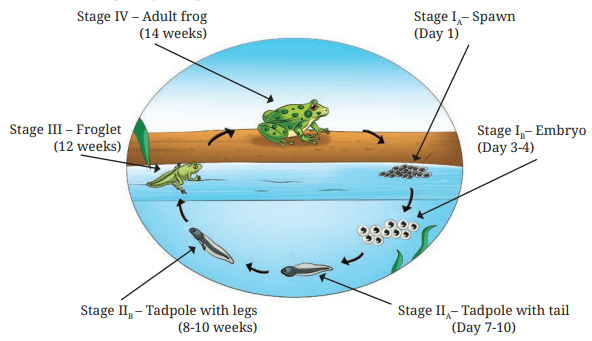
Fig. 10.8: Life cycle of a frog
Discuss in the class along the following points:
- How are these eggs of a frog different from the other eggs that you may have seen?
- Which stage has the shortest duration?
- Is there a change in the habitat during the various stages in the life cycle of a frog?
- How do the special features support that stage?
Observe Fig. 10.8. You will see that tadpoles develop legs
but still have tails. Tails help them swim in water. Tadpoles
grow gradually and start looking like little frogs called
froglets. They still live in water but begin to spend some
time on land. They continue to grow and lose their tails
completely. Their legs become strong to help them jump and
land. They become fully developed adult frogs living both in
water and on land.
Plants and animals are a part of the living world. They
go through various changes during the course of their lives.
We have learnt that a tiny plant grows and develops into a
big tree. We have also learnt how animals grow and change
from young ones to adults. This journey varies for each
animal, making it unique and special. We have seen pupae
change into insects, and tadpoles change into frogs. Such
changes are important for plants and animals to survive
and to maintain continuity of their kind. We should also take
care of them and their homes. By nurturing and preserving
their homes, we contribute to this flourishing living world.
Keywords
Summary
- The objects around us can be categorised into two types living and non-living.
- The essential features of living beings are that they move, eat, grow, breathe, excrete, respond to stimuli, reproduce and die. Absence of any of these features indicates that they are not living beings.
- Each living being goes through several stages during its life.
- Germination of seeds depends upon the availability of water, air and suitable light and/or dark conditions.
- During germination of seeds, roots generally grow downwards, while shoots grow upwards.
- A plant’s life cycle starts with seed germination, followed by several stages of its growth and development. These includes flowering and seed production. Seeds produced during their life cycle would germinate into new plants and the cycle continues.
- The life cycle of an animal as a result of reproduction, begin with a new born that undergoes various stages of growth and development followed by an adult stage and finally death. The process of reproduction maintains the continuity of its kind.
- Mosquitoes pass through the stages of egg, larva, pupa and adult. The life stages of a frog include eggs, tadpoles, froglets and adults.
- In some living beings, such as mosquitoes and frogs,
significant changes occur during the various stages of
their life cycles. These changes can be seen in body shape,
structure and sometimes even in the habitat.
Let us enhance our learning
- List the similarities and differences in life cycles of plants
and animals.
- The table on the next page shows some data. Study the data
and try to find out examples appropriate for the conditions
given in the second and third columns. If you think that
an example for any of the conditions given below is not
possible, explain why.
- You have learnt that different conditions are required for seed germination. How can we use this knowledge for proper storage of grains and pulses?
- You have learnt that a tail is present in a tadpole but it disappears as it grows into a frog. What is the advantage of having a tail in the tadpole stage?
- Charan says that a wooden log is non-living as it cannot move. Charu counters it by saying that it is living because it is made of wood obtained from trees. Give your arguments in favour or against the two statements given by Charan and Charu.
- What are the similarities and distinguishing features in the life cycles of a mosquito and a frog?
- A plant is provided with all the conditions suitable for its growth (Fig. 10.9). Draw what you expect to see in the shoot and the root of the plant after one week. Write down the reasons.
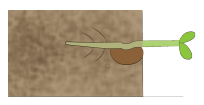
Fig. 10.9: Pot kept along the
ground
- Tara and Vijay set up the experiment shown in the picture (Fig. 10.10). What do you think they want to find out? How will they know if they are correct?
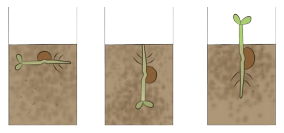
Fig. 10.10: Experimental set-up
- Design an experiment to check if
temperature has an effect on seed
germination.
Learning further
- Make a field trip to a local garden. Interact with a gardener to learn about various conditions and the time required for the growth of various plants.
- Can we grow plants without germinating their seeds? Explore and cite some examples.
- Observe the life cycle of five plants grown at home, school, or in a nearby garden. Create a picture book containing pictures of various stages of their growth. Write the name of each plant and the duration of each of its stage.
- Try to observe some of the stages in the life cycle of a butterfly or a moth. Are these stages similar to the stages in the life cycle of a mosquito?
- In your opinion, would the environment affect the life
cycles of insects? Explore and list the factors that affect the
life cycles of insects
Let us create
Add more lines to the incomplete poem given below. Include
information on the different stages in development of a
frog. You may also draw and paint each stage as it appears
in your poem.
In shaded and grassy bogs,
There lived a group of frogs.
They happily sang from dusk to dawn,
In double bass going on and on.
One day sitting beside a reed,
Female frogs think it’s time to breed ……..
…………………………………………