
Chapter 11
Nature’s Treasures
School vacations are always fun for Bhoomi and Surya. This
vacation, they visit their Ajji (grandmother). Ajji lives in a
village on the edge of a forest in the Western Ghats. The air
in the village is fresh and cooler than in the city. They can
see beautiful hills, streams, and many interesting plants,
animals and birds around them.
One afternoon, Bhoomi and Surya ask Ajji to tell them
more about the place. Ajji says, “Children, do you know that
this place has several treasures of nature that enrich our
lives? The pure air is refreshing and the soil is so fertile
that it supports a variety of living beings. Moreover, this
place gets plenty of sunlight which is useful in many ways.
Different varieties of trees provide food and shelter to
animals including various birds and insects. Can you think
of more such treasures of nature?”
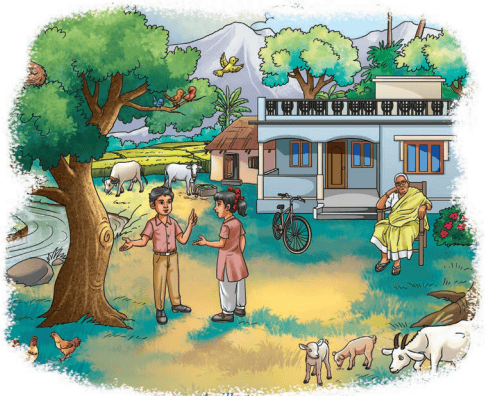
A village
Bhoomi replies, “Ajji, we use water for drinking and
growing vegetables.” Ajji says, “Yes. We need these treasures
for our survival and for making our lives more comfortable.
Without these treasures of nature, any form of life on Earth
is not possible.” We all are a part of nature.
Ajji explains the importance of air around us and how it
is essential for our survival. Let us find out more about air
11.1 Air
One morning, Bhoomi and Surya see
Ajji performing some breathing
exercises. Ajji asks them to join her.
She says, “I am taking deep breaths
in, and letting them out. This helps
in getting more fresh air in the
lungs to stay healthy.” Bhoomi and
Surya sit with Ajji and start taking
deep breaths.
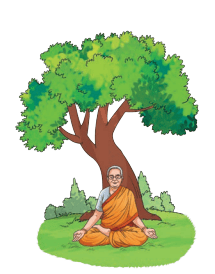
Breathing exercise
Let us also perform a breathing
exercise.
Activity 11.1: Let us experience
- Take a deep breath in, and then breathe out slowly.
- Take a deeper breath in again.
- Hold your breath for as long as you can and then breathe out slowly.
- How long can you hold your breath?
- How do you feel when you hold your breath?
From this activity, we find that it is difficult to
hold our breath for a long time. The air which
we breathe in has oxygen. Our body needs
oxygen to perform its functions. When we hold
our breath for a long time, the body does not
get enough oxygen to perform its functions.
Thus, we need oxygen for our survival. Similarly,
most of the living beings also need oxygen for
their survival.
Caution
Do not hold your breath for so long that you start feeling uncomfortable.
Do you know?
We can survive without food or water for a few
days, but we cannot survive without oxygen for
even a few minutes.
The air which surrounds the Earth is a mixture of gases.
Can you name some gases which are present in the air? Air
contains nitrogen, oxygen, argon, carbon dioxide and other
gases in small quantities. Fig. 11.1 gives the composition of air
in percentage. Notice that in Fig. 11.1 there are 100 squares.
Out of 100 squares, 78 are occupied by nitrogen,
21 are occupied by oxygen, and 1 by argon, carbon
dioxide and other gases.
More to know!
We can survive without food or water for a few days, but we cannot survive without oxygen for even a few minutes.
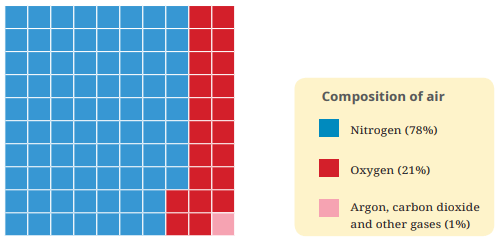
Fig. 11.1: Composition of air
You notice the presence of air when the leaves of a tree
rustle, the clothes hanging on a clothes line sway, or the pages
of an open book begin to flutter once a fan is switched on.
Moving air is called wind. Sometimes it blows fast, for
example, during a storm, and sometimes it blows gently as a
breeze. You must have played with a firki (paper pinwheel)
many times. Let us make a firki by performing Activity 11.2.
Activity 11.2: Let us make and decorate
- Take a square paper of size 15 cm x 15 cm, a pair of scissors, an all-pin and a soft stick.
- Follow the instructions shown in Fig. 11.2 to make a
firki.
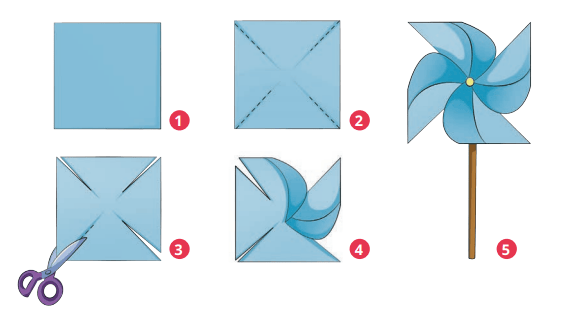
Fig. 11.2: Firki
Now, you can hold the firki in your hand and run.
You can also blow air on it. What do you observe?
Does the firki rotate? When you move it a little back
and forth, the firki rotates. What makes a firki
rotate? It is the wind that makes a firki rotate.
The working of a windmill is similar to that
of a firki. Wind rotates the wings of a windmill.
Windmills can be used to run flour mills, to pull
up water from a well, or to generate electricity.
In India, there are many windmill farms.
A windmill farm is an area that has a large
number of windmills which use the energy of
the wind to generate electricity (Fig. 11.3)
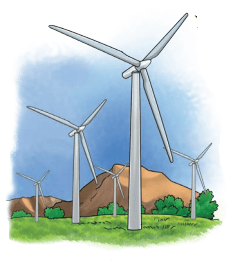
Fig 11.3: A windmill farm
More to know!
Muppandal Wind Farm in Tamil Nadu, Jaisalmer
Wind Park in Rajasthan and Brahmanvel Wind
Farm in Maharashtra are some of the leading
windmill farms in our country. Find out more
other windmill farms in our country
We have learnt that air is very important for us. Water too
is essential and precious for us. How do you feel when you
cannot get water to drink, especially when you are thirsty?
Let us find out more about water.
11.2 Water
Bhoomi and Surya help Ajji in
filling the troughs of water for
the cows. They also help her in
watering plants such as vegetables
and medicinal herbs in the garden.
Ajji teaches them how to water the
plants so that every drop is used
and none of it goes waste.
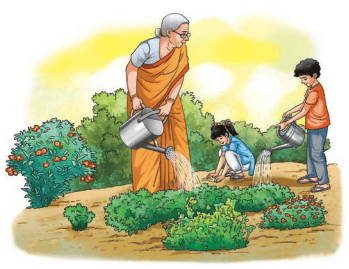
Watering the plants
Can you think of some more
uses of water in your daily life?
Write down your responses in the
blank bubble.
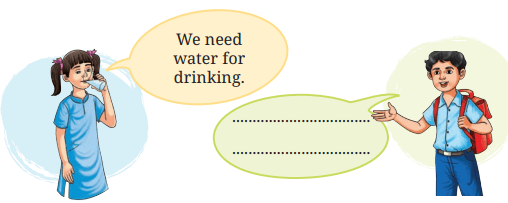
We need water for many daily activities such as drinking,
cooking, bathing, washing and cleaning. It is also used for
growing crops and for industrial purposes. Where do we get
water from? Make a list of the different sources of water.
Water covers about two-thirds of the Earth’s surface.
Most of the water is found in oceans and seas. However,
this water is saline or salty. This saline water is not fit for
domestic, agricultural and industrial use. For all these
activities, we need freshwater, which is present in the form
of ice sheets or snow, rivers or lakes on the surface of the Earth, and underground. Freshwater present in ice sheets and snow, or underground water is difficult to access. A very
small fraction of the freshwater present in ponds, rivers,
lakes and wells is easily accessible. Water is precious, that is
why Ajji guides them to use it with care.
Do you feel that water is being used efficiently in our
daily activities? Have you observed water being wasted in
your daily activities? Let us find out activities where water
is wasted and how this wastage can be reduced.
Activity 11.3: Let us find out
Fill the Column II and Column III in Table 11.1.
Table 11.1: Wastage of water in your daily activities
What conclusion can you draw from the information
you gathered in the table? What can you and your family
do to reduce this wastage of water? There are many ways
to reduce wastage of water. For example, turning off taps
when not in use and fixing water leakages. Recycling water
and water harvesting also help in saving water.
Our country is blessed with numerous rivers, streams
and lakes. Have you ever noticed plastic bags and wrappers
floating on the surface of water? We pollute freshwater sources by throwing trash (waste materials) in them. Waste
from homes and industries pollute our water sources when
it is dumped into them. Identify other human activities that
lead to water pollution. Discuss with your friends in the class
what you can do to reduce water pollution. Polluted water is
not fit for consumption by living beings.
As freshwater sources are limited, there is a shortage of
water in many parts of India. At some places, people have to
walk long distances to fetch drinking water. Everyone does
not have the same kind of access to water. It is important
for us to conserve water and use it judiciously. We must
also prevent it from being polluted so that water remains fit
for consumption by all living beings. In what ways can you
conserve water?
Water harvesting is one of the
methods for conserving water. In many
buildings, rainwater is collected
and stored in large quantities for
later use. This is called rainwater
harvesting (Fig. 11.4a). Do you know
that rainwater is also harvested in
many homes, residential societies or
schools? It is an age-old practice in
India.
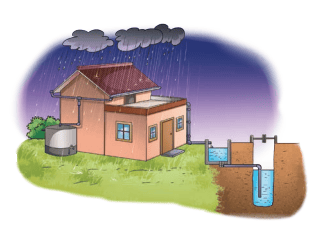
Fig. 11.4 (a): Rainwater harvesting
For example, stepwells (Fig. 11.4b),
commonly known as Bawadi in
Rajasthan and Vav in Gujarat are
built for water harvesting as a
response to the scarcity of water in
these regions. These stepwells have
a unique system of water harvesting.
They store not only rainwater but
also water seeping from nearby
lakes, ponds and rivers. The walls of
the trenches (long deep holes dug in
the ground) are lined with blocks of
stones that allow seepage of water.
Find traditional water harvesting
practices in your locality. Discuss
with your teachers and parents to
learn more about it.
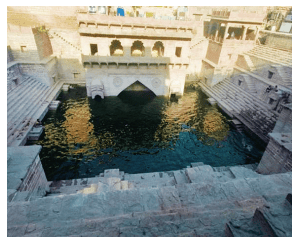
Fig. 11.4 (b): Bawadi (Toorji ka Jhalra, Jodhpur in Rajasthan)
Do you know?
World Water Day is observed on 22nd March every year.
Find out its importance.
In the chapter ‘A Journey through States of Water’, we have
learnt about water cycle, where the Sun plays an important
role in evaporation of water. Have you ever observed your
mother or grandmother cut raw mangoes and expose them
to the hot sun for several days to dry? Let us explore more
about energy from the Sun.
11.3 Energy from the Sun
On a sunny day, Bhoomi and Surya are helping Ajji dry
chillies in the Sun. Ajji says, “We use the heat from the Sun
to dry it. We can use dried chillies when fresh ones are not
available. I will give you some to take home. Do you know
that the Sun is the main source of energy on Earth? All plants
and animals are dependent on it.”
We use heat and light from the Sun for various purposes.
What are some of the activities for which we need heat and
light? Bhoomi draws some pictures to show the uses of heat
and light from the Sun. Help her by adding more examples.
Draw the pictures and write their descriptions in the
space provided.
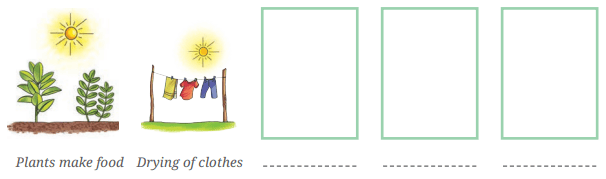
One afternoon, Bhoomi and Surya pass by the field near
Ajji’s house, where they see a cow grazing the grass. They
talk about the Sun being the main source of energy. Read
the conversation carefully and answer.
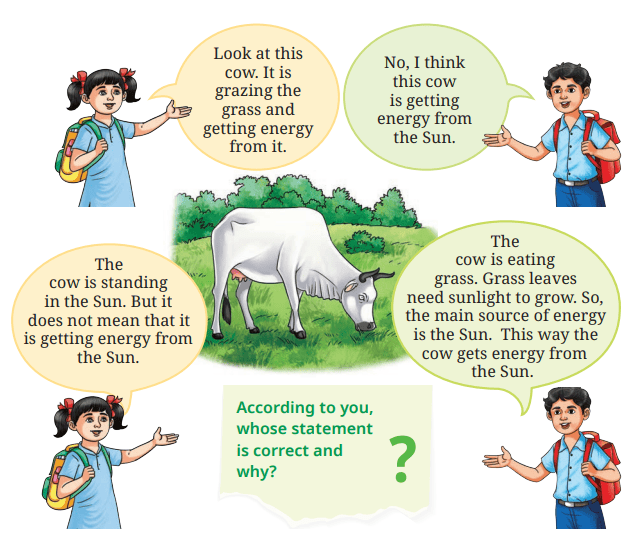
Sunlight helps plants prepare food. The Sun also provides
all the living beings on Earth with heat and light. It is their
main source of energy.
Do you know?
In many households in India, water is offered to the Sun early
in the morning as an expression of gratitude to the Sun.
Have you seen solar panels on
rooftops, on top of street lights or
on traffic signals? The solar panels
capture the Sun’s energy and
produce electricity. Energy from
the Sun can also be directly used
for cooking in a solar cooker or
for heating water in a solar water
heater.
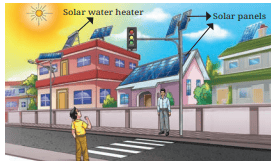
Uses of solar energy
One cannot imagine life on
Earth without the Sun. The Sun is
the main source of energy on the
Earth. Plants get energy from the
Sun and produce food. Animals eat
plants and grow. We get food from
both plants and animals. This cycle
on Earth is possible due to the Sun.
So, we all are dependent on the
Sun as the main source of energy.
Where do we find a large variety of
plants or animals? Let us explore.
What will happen if the Sun is not visible for a few days?
1. We may have to depend
on artificial lighting
during day time also.
2. _________
3. _________
11.4 Forests
One morning, Ajji takes Bhoomi and Surya for a walk in
the forest. They find a variety of herbs, shrubs and trees in
the forest. Ajji explains, “Forests are large areas with dense
growth of various types of plants.” On the way, they collect
some nellikai (Kannada term for Indian gooseberries)
that have fallen on the ground. Ajji tells them, “We have a
tradition in the village not to pluck fruits from the trees;
they are left for animals and birds to eat.”
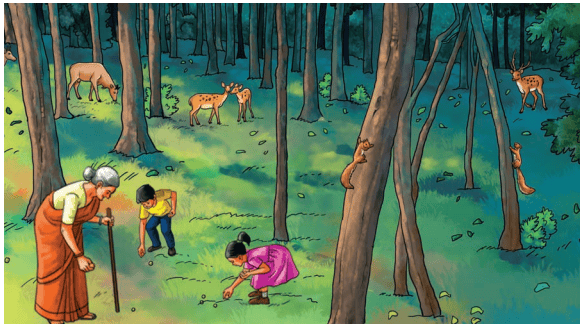
A forest
Discuss with your friends and make a list of at least five
products that we get from forests.
.............................................
Forests are a natural home for many wild animals,
including birds and insects. Forests provide food and shelter
to them. In nature, every animal depends on other life forms
for survival. The diversity of life forms ensures food for every
living being. However, over the years, the forest cover has
been decreasing, mainly due to human activities like large
scale cutting of trees. It takes many years to grow a new
forest or restore lost forests. Therefore, we must preserve
and use forests responsibly so that they get enough time
to regenerate.
Van Mahotsav is a week long event celebrated across
the country during the month
of July. It is a forest festival
during which new plants
and trees are planted, and
awareness about respecting
forests is raised. The aim of the
event is to increase the green
cover. You too can plan a Van
Mahotsav in your community.
What are the consequences of
cutting a large forest area? Make
a presentation or do a role play,
or write a story or a poem that shows what could happen
if we continue to cut down
trees in our forests.
Do you know?
From ancient times, India had a tradition
of respecting, protecting and preserving
forests. You have already learnt about
sacred groves in the chapter ‘Diversity
in the Living World’. Many efforts
have been made by common people
to prevent the cutting of trees, and
thus, saving forests. One such
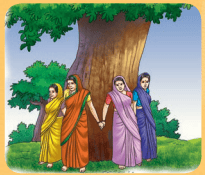
effort is the famous Chipko
movement. It started in the
early 1970s in Uttarakhand (previously part of Uttar
Pradesh). Local women actively participated in this
movement. They encircled and hugged the trees to
protect them from being felled.
During their walk in the forests, Bhoomi and Surya notice
that there are a lot of leaves on the ground and the soil feels
damp. Ajji explains, “The roots of plants hold on to the soil
and prevent it from being washed away. The leaves that
fall from the trees decay and enrich the soil with nutrients.
This soil is used by new plants and trees to grow. This is an
example of recycling in nature.” Let us investigate the soil in
more detail.
11.5 Soil, Rocks and Minerals
Bhoomi, Surya and Ajji come back
home from the forest. Bhoomi
and Surya help Ajji in preparing
the soil in the garden for planting
some vegetables (Fig. 11.5). Ajji
asks them to dig the soil gently
and loosen the lumps. You have
already learnt in the chapter
‘Living Creatures: Exploring their
Characteristics’ that for plants
to grow, the space between the
soil particles not only provides
sufficient air but also space for the
roots to grow easily. Bhoomi and Surya could see small
pebbles, the roots of plants and a few earthworms too in the
soil. Do you realise that earthworms are natural agents that
help in turning and loosening the soil?
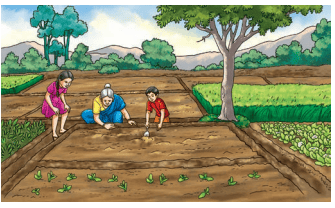
Fig. 11.5: Soil preparation for
planting vegetables
While Bhoomi and Surya help Ajji, let us do our own
experiment by performing Activity 11.4.
Activity 11.4: Let us investigate
- Collect samples of soils from different areas around your home and school.
- Guess what could be there in different soils.
- Observe carefully each soil sample
and note its colour.
- Touch each soil sample and feel its texture.
- Observe the soil samples with your naked eye. If you have a magnifying lens, look at the soil through it.
- Record your observations in Table 11.2.
Caution
Remember to wash your hands
thoroughly after touching the
soil collected from different
places. Sometimes soil that has
garbage carries germs that may
be harmful to us
Table 11.2: Soil samples
- Is there any difference between your guess and what you can actually observe when you look closely?
- Do you see any differences in the soil samples taken from different places?
- Do you see differences in what you are able to observe
with your naked eye and what you can observe with a
magnifying lens?
There are many things in the soil such as sand, insects
and worms. There may be many small organisms that we
cannot see with our naked eyes. Plants and animals also
become part of the soil as they decompose and decay. The
soil samples collected from different
places may be of different colours
because they may contain different
materials.
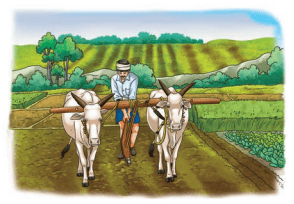
Ploughing
Have you ever wondered how
soil is formed? Soil is formed by the
disintegration (breaking apart) of
rocks by actions of the Sun, water
and living organisms over a long
time (thousands of years). There
are different types of soils. Some
are good for growing certain types of plants while some are good for making bricks for buildings.
Forests have a variety of soils. Soil is a precious treasure
that supports biodiversity.
You may have seen rocks in your surroundings. Rocks
are used in the construction of houses, buildings, temples,
roads, dams and table tops. Some rocks, like slate, are used
for roofing (Fig. 11.6) and laterite can be used as a building
material, like bricks (Fig. 11.7). Some of the important rocks
are granite, sandstone and marble. Human beings have been
using rocks to make tools such as hand axes (Fig. 11.8a) and
arrowheads (Fig. 11.8b) since thousands of years.
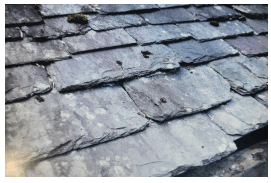
Fig. 11.6: Rocks used for roofing
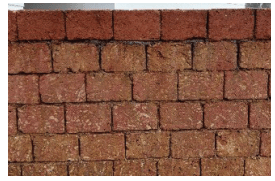
Fig. 11.7: Laterite rocks used as bricks
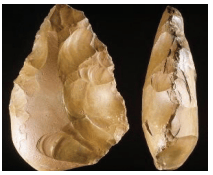
Fig. 11.8 (a): Hand axes
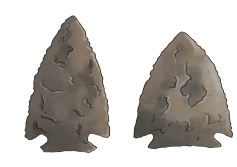
Fig. 11.8 (b): Arrowheads made from stone
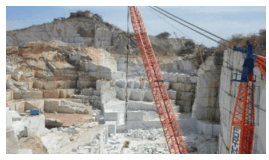
Mining of marble
What are rocks made up of?
They are made up of minerals.
Important metals, such as
aluminium, gold, copper
and iron are extracted from
minerals. Minerals are used in
the manufacturing of airplanes,
cars, jewellery, cosmetics, and electrical and electronic equipment. For example, the basic
mobile phones that we use contain about a dozen minerals
like gold, silver, copper, cobalt, etc.
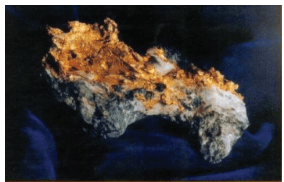
Naturally occurring gold
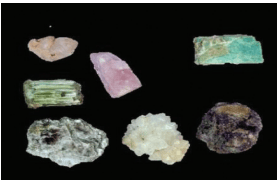
Some minerals found in nature
Rocks play a vital role in our lives. It takes thousands to
millions of years to form rocks. Therefore, it is important to
conserve and use them responsibly. Do you know how rocks
and minerals are transported from one location to another?
Most vehicles that we use for transportation use fossil fuels.
Let us explore more about fossil fuels.
11.6 Fossil Fuels
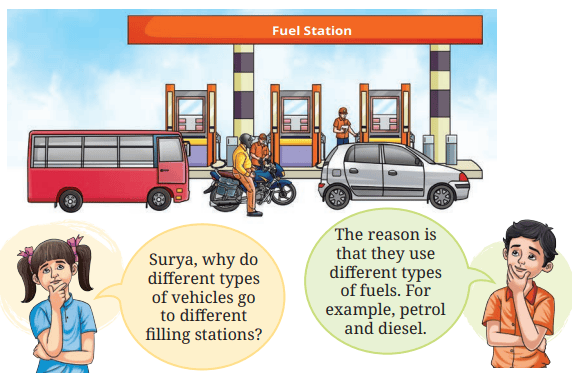
Let us explore more about it by performing Activity 11.5.
Activity 11.5: Let us conduct a survey
- Conduct a survey of vehicles in your neighbourhood.
- Which types of vehicles are there? What types of fuels do they use?
- Record the information that you collect in Table 11.3.
Table 11.3: Types of vehicles and fuels used
What are the most common types of fuels used? Petrol
and diesel are the two most widely used fuels for vehicles.
Petrol, diesel and kerosene are obtained from petroleum.
Petroleum along with natural gas and coal are commonly
called fossil fuels. They are formed essentially from the
remains of microorganisms and plants that got buried deep
inside the earth, and were converted to petroleum, natural
gas and coal. It takes millions of years for these fuels to form.
Natural gas is used for cooking and generating electricity.
Nowadays, it is also used in the form of Compressed Natural
Gas (CNG) as a fuel for vehicles. It is a cleaner fuel than
petrol or diesel. Coal is mainly used for the production of
electricity. It is found in several parts of India. Find out the
major coal-producing states and mark them in a map of
India.
Do you know?
Earlier, coal, wood and dung cakes were used
as fuels for cooking. Nowadays, less polluting
natural gas and Liquefied Petroleum Gas (LPG)
have gradually replaced these domestic fuels.
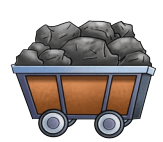
Coal
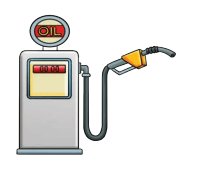
Petrol
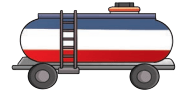
Natural gas
Fossil fuels are found in limited quantities. Hence, we
will soon run out of fossil fuels if we continue to use them in
the manner that we currently do. To avoid such a situation,
we need to explore alternate sources of energy. When fossil
fuels are burnt, smoke and carbon dioxide gas are produced
which pollutes the air. Over-dependence on fossil fuels for
transportation and as domestic fuels has resulted in large
scale air pollution.
Let us do our bit to conserve the fossil fuels by—
- Walking or cycling to nearby places.
- Using public transport.
11.7 Natural Resources: renewable and
non-renewable
Nature’s treasures fulfill our needs. They are essential
resources to sustain all life forms on the Earth. For example,
we get heat and light from the Sun, water from rivers, and
food from plants and animals. These resources which we
get from nature are called natural resources. We also
use natural resources to make many useful things for our
convenience. For example, electric bulbs, furniture, solar
panels, bicycles, etc., make our lives comfortable. All such
resources created by human beings are called humanmade resources.
You have learnt about various natural resources such
as air, water, energy from the Sun, forests, soil, rocks,
minerals and fossil fuels. Some of these natural resources get replenished through natural processes over a period
of time. If you remember, Ajji told Bhoomi and Surya that
they could collect only those nellikai that had fallen on the
ground. This makes sure that there would be enough fruits
for other animals and birds. The seeds from the droppings of
animals and birds would enable new trees to grow, though
it would take some years before we get fruits from these
new trees. Thus, resources which get renewed, replenished
or restored within a reasonable period of time are called
renewable resources. Air, water and forest are some of the
examples of renewable natural resources. Nature renews
them. We should use our natural resources judiciously.
On the other hand, fossil fuels take millions of years to
form. They are found in limited quantities and once used,
they get exhausted. They are not produced or replenished
within a reasonable period of time. These resources are called
non-renewable resources. Examples of non-renewable
natural resources are minerals, soil, rocks, coal, petroleum
and natural gas.
11.8 Resources we use
It is time for Bhoomi and Surya to go back home after a
wonderful holiday at their Ajji’s home. Their Amma (mother)
comes to pick them up. Bhoomi and Surya show her the
vegetable plants that have started to grow in the garden and
the dried chillies given by Ajji to take home.
They notice changes in the colour of the skyline and the
smell of the air once they reach the city. There are very few
trees. The air does not smell as good as the air at Ajji’s place.
They can smell smoke from the vehicles. The air is polluted.
Amma says, “Yes. When we use fossil fuels in our vehicles,
smoke is generated. Now, there are vehicles which cause
less pollution. For example, there are electric vehicles that
do not release any smoke. So, people are making an effort to
create alternatives.”
Can you list some alternatives for reducing air pollution?
_______________________________
_______________________________
We use many natural resources in our everyday life.
Let us identify some resources that we use by performing
Activity 11.6.
Activity 11.6: Let us make a list of natural
resources used
Make a list of activities you do in your daily life and write
down the natural resources that were used directly or
indirectly for each activity. In Table 11.4, some items are
already filled in. Using them as a guide, fill the remaining
blank rows.
Table 11.4: Natural resources used
How many natural resources did you list? Compare your
list with that of your friend.
You and your friends have listed many natural resources
that we use everyday. These resources are air, water, soil, and
food from plants and animals. We get these resources from
nature and also make things using them for our consumption.
Therefore, we must conserve our natural resources and use
them responsibly without wasting them. This way, we can
continue to fulfill our present needs while also saving for
the future, without harming the environment.
“Earth provides enough to satisfy every man’s need but not
for every man’s greed.”
– M. K. Gandhi
Keywords
Summary
- Resources required for our survival are provided by nature.
- Resources provided by nature are called natural resources.
- Some important natural resources are air, water, energy from the Sun, forests, soil, rocks, minerals and fossil fuels.
- Resources created by human beings to meet their needs are called human-made resources.
- Natural resources can be classified as renewable resources and non-renewable resources.
- Resources that get renewed, replenished or restored by natural processes within a reasonable period are called renewable resources.
- Resources that are in limited quantities and do not get replenished within a reasonable period are called non-renewable resources.
- All living beings, including humans, depend on natural resources for their survival so we should use them judiciously.
Let us enhance our learning
1. Fig. 11.9 shows items related to natural resources. Match
them with their jumbled up names. Make another table and
write the names of these resources. Classify these resources
as renewable or non-renewable.
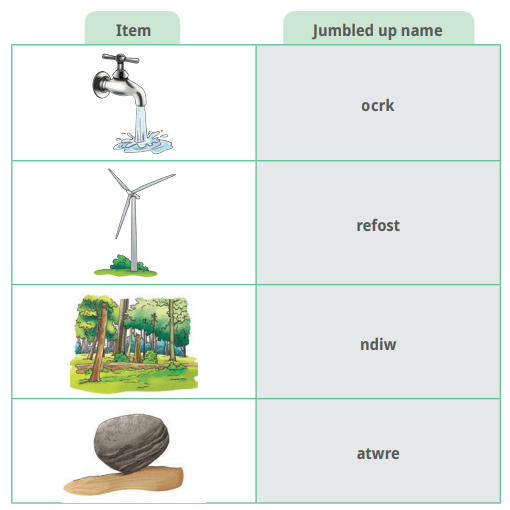
Fig. 11.9: Natural resources
2. State whether the following statements are True [T] or False [F]. If False, correct them.
(i) Nature has all the resources to meet human needs. [ ]
(ii) Machines are a resource found in nature. [ ]
(iii) Natural gas is a non-renewable resource. [ ]
(iv) Air is a renewable resource. [ ]
3. Fill in the blanks using the most appropriate option—
(i) A fuel that is commonly used in two wheelers like scooters or bikes is.........
(a) Kerosene
(b) Petrol
(c) Diesel
(d) LPG
(ii) An example of a renewable resource is ..................
(a) Coal
(b) Water
(c) Natural gas
(d) Petrol
4. Classify the following as renewable or non-renewable resources—coal, natural gas, forests and minerals.
5. Why do we say that petroleum is a non-renewable resource?
6. It is difficult to regrow forests. Justify this statement.
7. Make a list of five daily activities in which you use natural resources. Suggest ways by which you can reduce their use.
8. List four activities that are possible due to the presence of air.
9. How can you contribute towards enhancing the green cover of your locality? Make a list of actions to be taken.
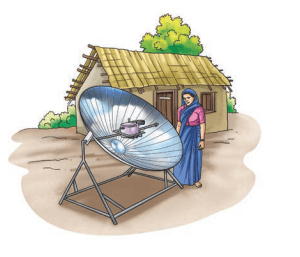
10. In the given illustration, we see that food is being cooked.
Answer the following questions—
(i) What type of energy is being used for cooking?
(ii) Name one benefit and one drawback of using this type of energy for cooking.
11. Cutting down trees on a large scale impacts the quality of the soil. Why do you think it is so?
12. Explain two ways in which human activities pollute the air. Propose one action which can help in reducing air pollution
13. A family uses solar panels to generate electricity, a gas stove to cook food and a windmill for pumping water from a well. What would happen if there were no sunlight for a week?
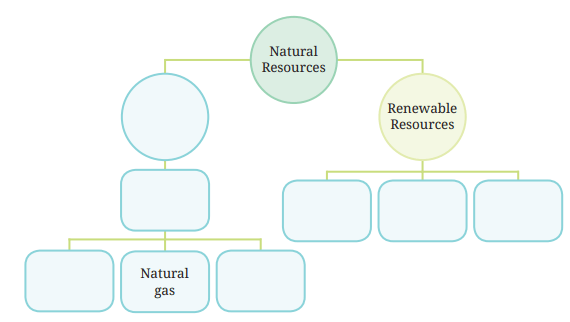
14. Fill up the blanks using the following terms— (fossil fuels, forest, air, petroleum, coal, water and non-renewable resource)
15. There is an increasing demand of trees to meet the requirements of industries and for housing. Therefore, trees are being felled. Is it justified? Discuss and prepare a brief report.
16. Propose a plan to use less water in your school. What steps would you take to make this plan happen and how would it help the environment?
Learning further
- Rainwater harvesting is an age-old practice in India. Find out some of the traditional rainwater harvesting techniques being used in your state or in other parts of the country.
- Investigate the effect of air pollution on human health by interacting with your elders or community members and identify the main sources of air pollution in your local area. Based on your findings, suggest two practical steps that your school or community could take to help reduce air pollution.
- Prepare a list of the names and uses of important minerals and rocks that are used in your village/town/city for various purposes.
- You are an eco-club monitor. Organise a tree plantation
drive in your school with the help of your teacher. List
the steps required for organising this activity. Prepare a
one-page report listing the names of the trees planted along
with their importance.