Chapter 12
Beyond Earth
Nubra is a beautiful region in Ladakh. An eleven-year old
girl Yangdol and her twin brother Dorjay live in one of the
villages of this region.
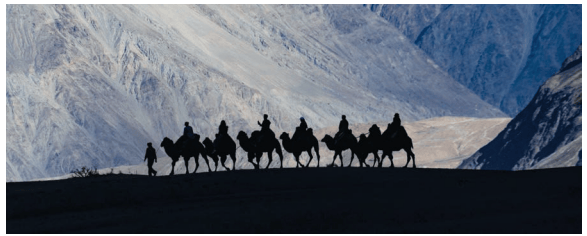
Nubra in Ladakh, India
They love their
surroundings—the majestic
mountain peaks, and
the glaciers, but their
favourite is the night sky
when the entire sky is lit
up with thousands of stars
(Fig. 12.1). The weather in
Nubra is almost cloudless.
With almost no air or
light pollution, the night
sky is very clearly visible.
Night after night, Yangdol
and Dorjay observe the
stars and experience an
immense sense of awe.
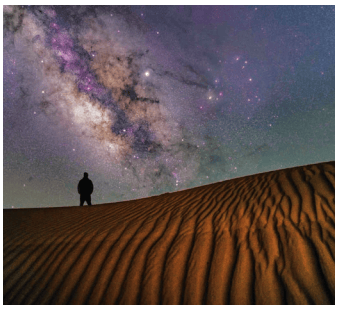
Fig. 12.1: The beauty of night sky from a very dark
location in Ladakh, India
Growing up, Yangdol and Dorjay have been hearing
interesting stories about stars from their elders. They have
heard how some particular stars in the clear skies helped
the caravans passing through Nubra in finding direction in
the ancient days. They wonder how far away and how big
the stars are. They also enjoy trying to find some patterns
among the stars that remind them of familiar objects. Have
you ever looked at the stars in the night sky and tried to
connect them with imaginary lines, just like dots and lines
in a drawing?
Activity 12.1: Let us draw
- Fig. 12.2 shows bright stars in one part of the night sky.
- Look at it carefully and try to imagine a pattern formed by a group of stars.
- Draw lines to connect the stars and make the pattern.
- Think of an animal or an object that is similar to the
pattern drawn by you. Write its name near your pattern
- Repeat the above steps and make some more patterns.
- Now think of an
interesting story
about your patterns.
Compare your
patterns with the
patterns drawn by your
friends. Are the patterns
same or different?
Narrate your story to
others and listen to their
stories. Do you notice
that everyone’s patterns,
names and stories are
different? Is it not fun?

Fig. 12.2: A part of the night sky
12.1 Stars and Constellations
At night, when we look up at the sky, we see
many stars. Some stars are bright and others
are dim. Stars shine with their own light.
Some groups of stars appear to form
patterns which are like shapes of familiar
things. Long ago, when watching stars in
the night sky was a favourite pastime of our
ancestors, they identified these star patterns with animals,
things or characters in stories. Many cultures had names
for patterns based on their own stories. These imaginary
shapes helped them in recognising stars in the sky.
Recognising stars and their patterns was a useful skill
for navigation in the olden times. Before the arrival of
modern technology or even before the invention of the
magnetic compass, it helped people, particularly sailors
and travellers, in finding directions at sea or on land. It is
still used in emergencies as a backup method.
In earlier times, groups of stars forming patterns were
called constellations. Currently, the regions of sky, which
include these groups of stars, are defined as constellations.
However, since in constellations, the patterns of stars are
often the most prominent, the term constellation is still
commonly used for these groups of stars.
More to know!
Since different cultures denoted the constellation
boundaries in different ways, an internationally agreed
set of constellation boundaries were defined by the
International Astronomical Union (IAU) in the early
20th century. 88 constellations were officially listed,
thus, dividing the entire sky into 88 regions. These
regions of sky are now defined as constellations
Some constellations are shown in Fig. 12.3. The stars
are joined by imaginary lines, drawn for easy identification.
The constellation Orion is often represented as a hunter.
There are three stars in the middle, which represent the belt
of the hunter. Some people imagine that the hunter Orion,
followed by his dog (constellation Canis Major), is battling
a bull (constellation Taurus). Canis Major contains a star called Sirius, which is the brightest star in the night sky (Fig. 12.3).
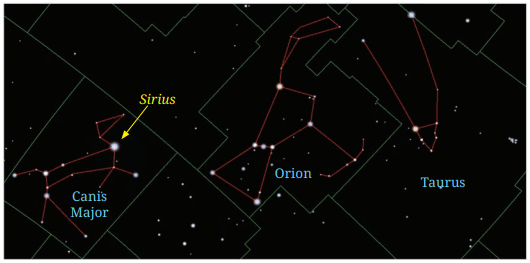
Fig. 12.3: Some constellations and stars
(The red lines indicate the patterns of stars while the green lines indicate the
regions of the sky. The lines are not seen in the sky and have been drawn only
for easy identification)
More to know!
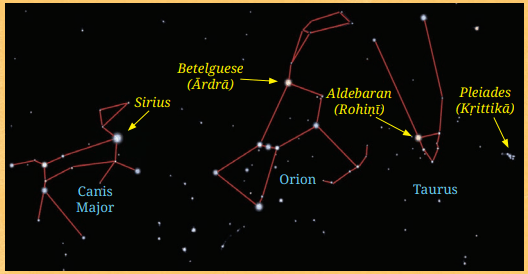
In Indian astronomy, the term nakṣhatra is used to denote
either a certain star or a group of stars, such as Ārdrā
(a star called Betelgeuse in the Orion constellation) and
Kṛittikā (a group of stars called Pleiades in the Taurus
constellation). Aldebaran, a star in the constellation Taurus, is known as Rohiṇī.
Two distinct patterns of stars, the Big Dipper and the
Little Dipper, are shown in Fig. 12.4. The Pole Star or Polaris,
which is part of the Little Dipper is also shown (Fig. 12.4).
The Pole Star appears stationary in the North direction,
which helps to locate the North direction in the Northern
hemisphere.
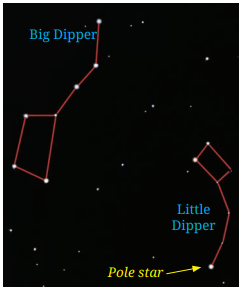
Fig. 12.4: Big Dipper, Little Dipper
and Pole Star (The lines are not seen
in the sky and have been drawn
only for easy identification)
More to know!
The Big Dipper lies in the
constellation Ursa Major
while the Little Dipper
lies in the constellation
Ursa Minor. In India, the
Big Dipper is known
as Saptaṛiṣhi, and the
Pole Star is known as
Dhruva tārā.
![img8]](/assets/ncert/2026/fecu112/OEBPS/Images/img8%5D.png)
Do you
know?
Apart from common regional stories associated
with stars in the constellations, many forest
dwelling communities or tribes of India also have
their own stories about them. For example, the
four stars in the Big Dipper that approximately
form a rectangle, are viewed by tribes in Central
India as the “grandmother’s cot” with
the three thieves (other three stars)
stealing it. Fishermen along the
Konkan coast imagine the four
stars as a boat, with the last three
stars as the neck of the boat .
12.2 Night Sky Watching
If it is a clear cloudless night, a large number of stars may be
visible in the sky. If you stay in a big city, you may find that
the sky is rarely clear and only a few stars are seen in the
night sky. This is due to light pollution, smoke and dust. The
presence of excessive artificial light at night time is referred
to as light pollution. In villages or areas where there is less
light pollution, a larger number of stars can be seen. Also,
your house may be surrounded by tall buildings and trees,
which may block your view. The night sky is best viewed
from open dark areas.
Do you know?
Light pollution is growing sharply globally. This is reducing our
ability to enjoy and study objects in the night sky. Some
dark sky reserves and parks have been established
around the world. Light pollution in the reserves is
controlled to preserve dark skies for research. There
are a few organisations which are working to educate people about reducing light pollution.
Not all stars and constellations are visible from
all places on Earth and on all nights in a year.
For example, the Pole Star is not visible from
the southern hemisphere of Earth. To identify
a star or a constellation, you need to know
how a particular constellation looks like
and where to look for it in the night sky. To
get familiar with the pattern of a constellation
you may use images such as Fig. 12.3 and Fig. 12.4.
To find out when and in which portion of the sky a star or
a constellation will be visible from your location, you may
take the help of sky mapping apps that can be downloaded
on a mobile phone, or other online resources
More to know!
Sky Map is a very handy app for identification
of stars, constellations and planets from mobile
phones. Stellarium is another such app. The
computer version of Stellarium is free for
download and has many features.
Preparation for night sky watching
- Under the guidance of adults, identify a dark open area for night sky watching. This should be away from lights, tall buildings and trees.
- Choose the date and time based upon what you plan to identify in the night sky.
- Choose a moonless night with no clouds, particularly for the Pole Star which is not very bright.
- It may be useful to have access to a mobile app with a sky map, or print out images of the constellations you plan to view. You may also carry a magnetic compass to find directions and a notebook to note or draw your observations.
- On the particular day and time selected, go to the identified place with an adult, where the night sky watching is to be done.
- After reaching there, wait for about half an hour for your eyes to get adjusted to the darkness. This will help you to see the night sky better (Fig. 12.5).
Caution!
Do not go to a
dark open place
at night time
without adults
accompanying you.
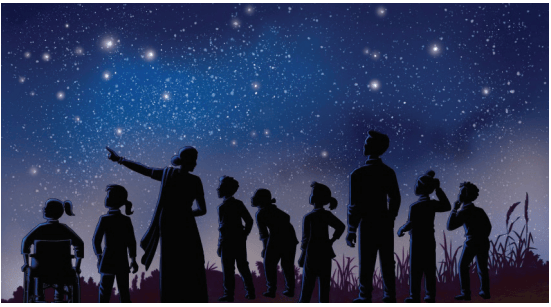
Fig. 12.5: Night sky watching
You may easily identify the Big Dipper and the Pole Star in the
night sky
Activity 12.2: Let us try to locate
- Look for the Big Dipper during summer time in the early part of the night, say, around 9 pm. View the sky above the horizon towards the northern part of the sky and identify the Big Dipper.
- Once you identify the Big Dipper, try to locate the Pole
Star. Look at the two stars present at the end of the
Big Dipper’s cup and imagine a straight line passing
through these towards the north. At about five times
the distance between these two stars, the imaginary
line will lead to another star which is not very bright.
This star is the Pole Star.
You may also locate the bright constellation Orion and the
star Sirius in the night sky.
Activity 12.3: Let us try to identify
- In India, Orion is best viewed during the months of December to April after sunset. So, look for it during that period.
- Three bright stars in a short straight line are located around the middle of Orion (imagined to be the belt of a hunter). Identify these three stars first, as this is the easiest way to find Orion.
- Once you identify Orion, it is easy to
locate the very bright star Sirius which is
located close to Orion. Imagine a straight
line passing through the three middle
stars of Orion and look along this line
towards the east. This will lead to Sirius.
12.3 Our Solar System
The Sun
The Sun is a star. It is the star closest to us. It is an extremely
hot spherical ball of gases. The Sun gives out a huge
amount of energy, and that is why it glows so brightly. The Sun produces heat and
light, and is the main source
of energy on the Earth
(Fig. 12.6).
How big is the Sun? It is
about 100 times bigger than
the Earth in diameter. And
still, it looks so small because
it is very far from the Earth.
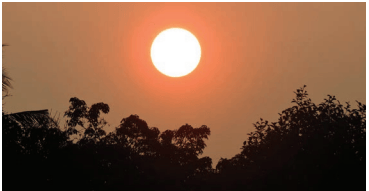
Fig. 12.6: The rising Sun
More to know!
The distance of the Sun from the Earth is about 150 million
km. A useful unit for expressing distances within the
solar system is ‘astronomical unit’ (au) which is
approximately the distance between the Sun and
the Earth.
More to know!
The Sun, being the brightest
object and the source of light
and heat on Earth, was elevated in most
ancient civilizations to the status of a deity.
In India, the Sun is worshipped as Sūrya. The
heat provided by the Sun keeps the Earth
at a temperature that makes life possible.
Sunlight is essential for plants to grow,
which provide food and oxygen to animals,
including humans. The Sun is responsible for
climate, seasons, weather, water cycle,
winds——all of which are important for
sustaining life on the Earth.
However, the Sun is much closer to us than the other stars
hence it appears much bigger than the stars. As the stars
(other than the Sun) are much farther away, they appear
like points, even though some of those stars are much bigger than our Sun. During daytime, due to the extreme brightness
of the Sun, it is not possible to view the other stars.
More to know!
The star nearest to us after the Sun is Proxima
Centauri which lies at a distance of about
269000 au. This means that its distance is about
269000 times our distance to the Sun.
There are many more objects
in the sky. Our Earth, along
with some of these objects,
and the Sun together form
our Solar System (Fig. 12.7).
Most of these objects move
around the Sun. The
movement of an object around
the Sun is called revolution.
Planets
A planet is a large, nearly spherical object that revolves
around the Sun. Our Earth is a planet as it revolves around
the Sun as shown in Fig. 12.7. The Earth takes nearly one
year to complete one revolution. Like the Earth, there are
other planets that revolve around the Sun.
More to know!
While revolving around the Sun, the Earth is also
rotating about its axis. For one full rotation, the
Earth takes about 24 hours which is called a day.
Like the Earth, other planets also rotate about
their axes while revolving around the Sun. You
will learn more about this in the next Grade.
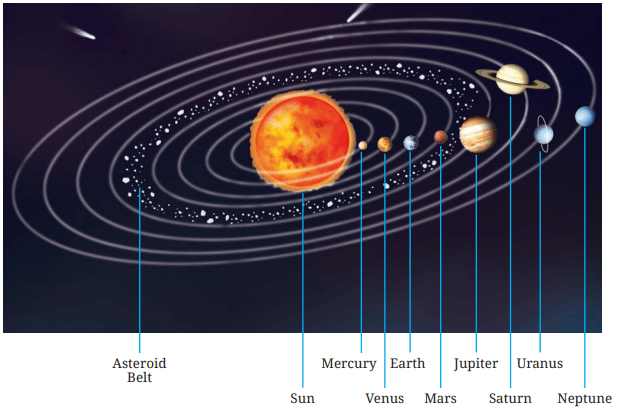
Fig. 12.7: An artist’s representation of the Solar System
(To fit this figure within the page, the sizes and distances of various objects are not as per their
actual sizes and distances in relation to each other, that is, the sizes and distances are not to
scale in the figure)
The eight planets, in order of their increasing distance
from the Sun, are Mercury, Venus, Earth, Mars, Jupiter,
Saturn, Uranus, and Neptune (Fig. 12.7).
The inner four planets nearest to the Sun—Mercury,
Venus, Earth and Mars—are smaller in size. They have solid
surfaces with rocks on them.
More to know!
From ancient times, various names have been used
across India for the planets visible to the naked eye.
For example, Budha (Mercury), Śhukra (Venus),
Pṛithvī (Earth), Mangala (Mars), Bṛihaspati or Guru
(Jupiter) and Śhani (Saturn).
Venus is usually seen shining brightly at dawn and dusk,
and is commonly called the Morning Star or the Evening
Star, even though it is not a star. Mars is called the Red Planet
because it appears red. This is because the soil on Mars is
reddish in colour.
A large portion of the Earth’s surface is covered with
water and thus, it appears blue from the space. Due to this,
the Earth is also called the Blue Planet.
The four outermost planets—Jupiter, Saturn, Uranus and
Neptune—are much larger compared to the Earth, and are
mostly made of gases. These giant gaseous planets have
large flat ring-like structures around them which are made
of dust particles and rocky material.
Planets get most of their energy from the Sun. So,
the farther they are, the colder they are in general. The
presence of an atmosphere on a planet can trap heat which
can significantly change the temperature of a planet. That is
why Venus, for example, is hotter than Mercury, although it
is farther from the Sun.
More to know!
There is another object called Pluto that lies farther than Neptune,
and revolves around the Sun. It is smaller than the Earth’s
Moon. When it was discovered, it was called a planet of the Solar
System. But later, when similar more small objects
were discovered, the International Astronomical
Union (IAU) in 2006 redefined the requirements of
an object to be called a planet. As per this definition,
these smaller objects, including Pluto, are now called
dwarf planets.
Among the planets, it is
easiest to identify Venus
which is very bright. After
the Sun and the Moon, Venus
is the brightest object in the
sky. Mercury, Mars, Jupiter
and Saturn can also be seen
with the naked eye. They are so far away that they look like shining dots, just like stars.
So how can we distinguish between planets and the stars?
Unlike planets, the stars appear to twinkle a lot.
Activity 12.4: Let us try to identify
- For most of the year, Venus can be located either at dawn or at dusk.
- When you are viewing at dawn, look for it near the Eastern direction before sunrise.
- When you are viewing at dusk, look
for it near the Western direction after
sunset.
While many of the objects in the sky can be seen
with our naked eyes directly, we can see them brighter
and larger using a pair of binoculars or an instrument
called a telescope (Fig. 12.8). A telescope also helps us
view many dim objects not visible by our naked eyes
directly.
You may get an opportunity to view the sky through
a telescope whenever a night sky watching event is
organised in your region.
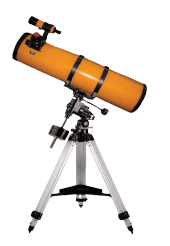
Fig. 12.8: A telescope
Do you know!
Many Higher Education
Institutions conduct night
sky watching activities for
school students. There are
many Amateur Astronomy
Clubs all over the
country which
organise sky
watching events
periodically. Museums
and Planetariums
also organise similar
events.
Natural Satellites
Objects that move around planets are commonly called
satellites. They are smaller in size than planets. Moons are
natural satellites of planets. The Earth has one Moon, while
Mars has two moons. Jupiter, Saturn, Uranus and Neptune
have a large number of moons.
More to know!
In general, any object
that moves around a
much larger object can
also be called a satellite.
For example, Earth can
be considered
a satellite of
the Sun.
The Moon
is about 3,84,000 km
away from the Earth.
The Moon
Earth’s natural satellite, the Moon,
takes about 27 days to complete
one revolution around the Earth.
It is our nearest neighbour in the
space. Unlike on the Earth, there
is hardly any atmosphere on the
Moon. How big is the Moon as
compared to the Earth? The Moon
is about a quarter the size of the
Earth in diameter. The Moon’s
surface shows circular bowl-like
structures called craters (Fig.
12.9). Most of these craters have
been formed due to the impact of
asteroids or rocks from the space
hitting the Moon’s surface. Since
there is no atmosphere, water or life on the Moon, these features stay on the Moon’s surface
for a very long time.
Although the Moon is very far, humans have sent
spacecrafts to explore and understand more about the
Moon. India has also launched three Chandrayaan missions
to study the Moon, and a further mission is being planned.
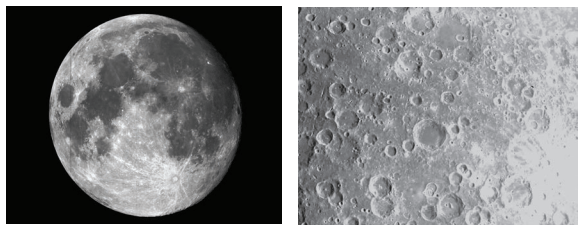
Fig. 12.9: The Moon (a) Image taken by Cartosat, ISRO.
(b) Close-up image by cameras onboard Chandrayaan-3, ISRO.
Do you know!
To improve our understanding of the Moon, India’s first mission to
the Moon, Chandrayaan-1, was launched in 2008 and the second
mission, Chandrayaan-2, in 2019. The third mission, Chandrayaan-3,
was launched in July 2023 and its Vikram lander carrying the Pragyan
rover successfully soft-landed on the Moon on August 23, 2023. With
this mission, India became the first country in the world to
achieve a landing near the little explored Moon’s south pole.
To mark this success, the Government of India declared
August 23 to be celebrated as ‘National Space Day’ in India. A
fourth mission, Chandrayaan-4, is being planned which aims
to bring back soil and rock samples from the Moon.
Asteroids
The Sun and the planets are nearly spherical in shape. There
are many small objects in the Solar System which are rocky
and irregular in shape. These are called asteroids. Many of
these asteroids revolve around the Sun
in paths that lie between those of Mars
and Jupiter. This region is called the
asteroid belt (Fig. 12.7). Occasionally,
asteroids pass very close to the Earth.
More to know!
The sizes of
asteroids are
from 10 m to
about 500 km.
Comets
Sometimes we have visitors from the
outer regions of the Solar System! These objects with long
tails are called comets (Fig. 12.10). They are made up of dust,
gases, rocks and ice. As a comet approaches close to the Sun,
the frozen material in it starts evaporating. This evaporating material forms the tail of the comet. Comets appear dim as
they move away from the Sun and then, it is not possible to
see them with the naked eye.
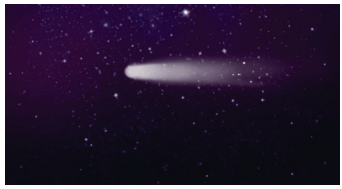
Fig. 12.10: A Comet
Many comets have been
found that revolve around
the Sun. These comets
approach close to the Sun
periodically. However, there
are a few comets that escape
and move out of the Solar
System. Few other comets
get broken up, or fall into the
Sun or other planets when
they approach them.
We have learnt about the objects which form the Solar System. Which are these objects? The Sun, eight planets, their moons, and many smaller objects including asteroids, and comets, together form the Solar System.
We have learnt about the objects which form the Solar System. Which are these objects? The Sun, eight planets, their moons, and many smaller objects including asteroids, and comets, together form the Solar System.
The Sun—our star—is the
largest and the heaviest object
in the Solar System. The Sun
produces almost all the energy in
the Solar System. All other objects
in our Solar System shine due to
the sunlight that they reflect from
their surfaces.
More to know!
One famous comet is the
Halley’s Comet which appears
every 76 years. Its last
appearance was in 1986.
In Sanskrit and a
few other Indian
languages, a comet
is called Dhūmaketu.
Various tribes in
India also call it Pucchya-Taro
(star with a tail) or ZendyaTaro (star like a flag).
In many cultures, comets have
been feared and it was earlier
believed that comets bring
bad luck. However, thanks to
scientists, we now know that
these are just icy-rocky visitors
making a trip close to the Sun!
12.4 The Milky Way Galaxy
In the moonless night sky, viewed from dark locations away
from city lights, one can see an extended faint band of light
from near north to south across the sky (Fig. 12.11). This
is our home galaxy called the Milky Way Galaxy or Ākāśha
Gangā. A galaxy has millions to billions of stars. Our Solar
System is part of the Milky Way Galaxy.
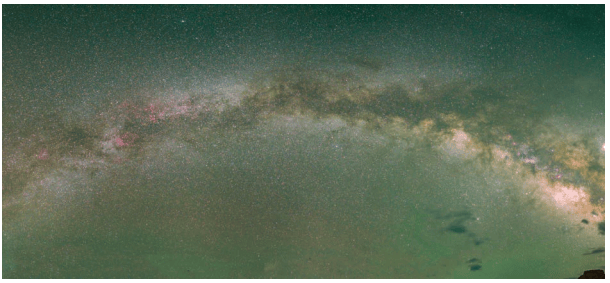
Fig. 12.11: Milky Way Galaxy as seen from a very dark location in Ladakh, India
12.5 The Universe
There are many galaxies in the
outer space beyond the Milky
Way Galaxy. Scientists study
them to understand the stars,
galaxies and the universe.
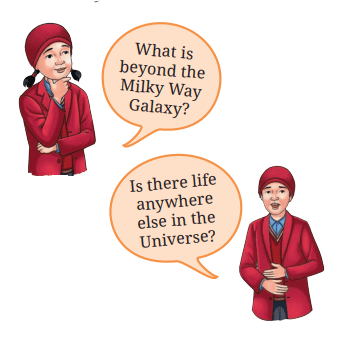
We do not know yet if life exists
elsewhere in the Universe. The search
for life has been directed mostly towards
exoplanets—the planets discovered
revolving around other stars in our
galaxy. Till now, scientists have not found
any evidence of life but this search is on
and continuing.
Keywords
Summary
- The sky is divided into regions called constellations, which include groups of stars that appear to form patterns.
- The Pole Star appears stationary in the North direction, which helps in locating the North direction in the Northern hemisphere.
- The Sun is a star which produces heat and light.
- A planet is a large, nearly spherical object that revolves around the Sun.
- The eight planets, in order of their increasing distance from the Sun, are Mercury, Venus, Earth, Mars, Jupiter,
- Saturn, Uranus, and Neptune.
- The Earth revolves around the Sun in nearly one year.
- Objects that move around planets are commonly called satellites.
- The Moon is Earth’s natural satellite.
- The Moon revolves around the Earth in nearly 27 days.
- The Sun, eight planets, their moons, and many smaller objects including asteroids and comets, together form the Solar System.
- Our Solar System is part of the Milky Way Galaxy
Let us enhance our learning
1. Match the column:
2. (i) Solve the following riddle.
My first alphabet is in MAN but not in CAN
My second alphabet is in ACE and also in FAN
My third alphabet is in RAT and not in CAT
My fourth alphabet is in SUN but not in FUN
I am a planet that moves around the Sun.
(ii) Make two similar riddles by yourself.
3. Which of the following is not a member of our Solar System?
(i) Sirius
(iii) Asteroids
(ii) Comets
(iv) Pluto
4. Which of the following is not a planet of the Sun?
(i) Jupiter
(iii) Neptune
(ii) Pluto
(iv) Saturn
5. Which is the brighter star, the Pole Star or Sirius?
6. An artist’s representation of the Solar System is given in Fig. 12.12. Is the order of the planets correct? If not, write the correct order in the boxes in the figure.
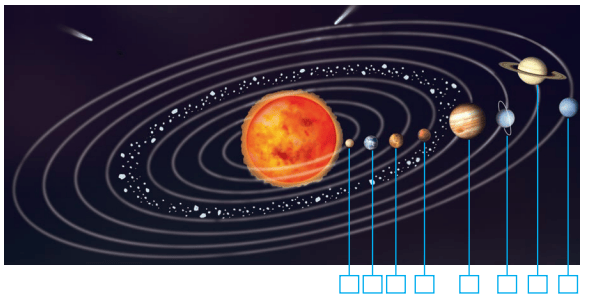
Fig. 12.12
7. A portion of night
sky with stars is
shown in Fig. 12.13.
Look carefully and
identify the groups
of stars that form
the patterns—the
Big Dipper and the
Little Dipper. Draw
lines to connect
the stars for these
patterns and label
them. Also, identify
and label the Pole
Star. You may refer
to Fig. 12.4 for help.

Fig. 12.13
8. A portion of the night sky is shown in Fig. 12.14. Draw lines
to connect the stars for Orion and label the star Sirius. You
may refer to Fig. 12.3.
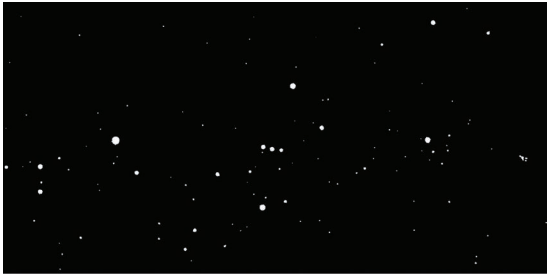
Fig. 12.14
9. You can see stars fading away at dawn and appearing at dusk. During the day we do not see the stars. Explain why.
10. During a clear night, try to observe the Big Dipper 3–4times at an interval of 2 to 3 hours. Also try to locate the Pole Star each time. Does the Big Dipper appear to move? Draw a rough sketch to illustrate this, mentioning the time in each case.
11. Think about the night sky and write a poem or a story on it.
Learning further
- Try to find out the names of planets in your local language. Also, find out the stories associated with stars and constellations in your region. Present these stories in a pictorial form.
- If there is a planetarium or a science museum nearby, then
you can visit it, especially if a night sky observation session
is scheduled by them. You will get to see the Moon, the
planets and the stars through a telescope. If you visit the
planetarium during daytime, you can also see their models,
pictures and sky shows.
- Find out if the increasing light pollution is causing problems for humans, wildlife and the environment. Write an action that you would take at the personal level to control light pollution.
- Find out the weather conditions due to which the Indian Institute of Astrophysics (IIA) found Hanle, Ladakh a suitable place to set up an observatory.
- If you enjoy doing embroidery, try to embroider
on a dark coloured cloth the constellations that
you have seen (Fig. 12.15). Otherwise, you may
use your creativity and depict constellations
in multiple other ways using various art and
craft ideas.
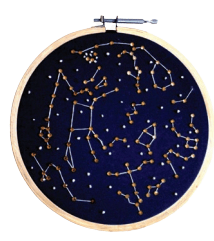
Fig. 12.15: Embroidery
of constellations
More to know!
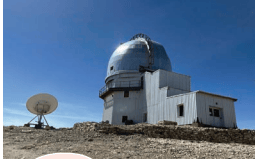
Indian Astronomical Observatory, Hanle,
is situated atop the highest peak of Digpa-rasta-Ri mountain range in Hanle. This
peak has been renamed Mount Saraswati.
It has several telescopes. One of them is
called the Himalayan Chandra Telescope,
which has been named after the Nobel
Prize winning scientist Subrahmanyan Chandrasekhar. It is an
observatory at one of the highest locations in the world.
The area surrounding this observatory was notified as the Hanle
Dark Sky Reserve (HDSR) in December 2022. The reserve is
open to the public throughout the year. Local people have been
provided with small telescopes and are trained to be Astronomy Ambassadors for visitors
by the Indian Institute of
Astrophysics. It is expected
to promote astro-tourism
in the region.
It is not the end, my friend!
This might be the last page of this book, but it is certainly
not the end of our ‘Curiosity’. The title of this book not only
drives our journey through the amazing world of science,
but also defines what it means to be human. As a species,
we are curious. We want to find out more about the world
we live in and worlds beyond. By now, you have perhaps
read a little bit about the world of plants and animals,
done some fun activities, learnt about how we measure,
wondered about the stars that shine in the night sky, and
so on. But remember, this is just the beginning. Science is
a never-ending adventure, with new discoveries coming
up all the time. And as you progress through the Middle
Stage, the things you come across will help you find out
even more about the world around you. The key lies in that
curiosity you have nurtured throughout this journey. Keep
observing the world around you, keep asking questions,
and do not be afraid to experiment. Remember, even
the most groundbreaking discoveries often begin with a
simple “Why?”. There are countless questions waiting to be
answered, and countless answers waiting to be questioned.
You, my young scientist, can find them out. So, go forth and
explore! And see you again in the next Grade for more
adventures in science!