
CHAPTER-4
Timeline and
Sources of History
The Big Questions ?
1. How do we measure historical time?
2. How can various sources help us understand history?
3. How did early humans live?
How Do We Learn About the Past?
THINK ABOUT IT
--- What is the earliest memory you can recollect? Do you remember how old you were at that time? Those memories together are a part of your past, maybe going five or six years back.
------- How do you think understanding the past will help us
understand the present world?
History: The
study of the
human past.
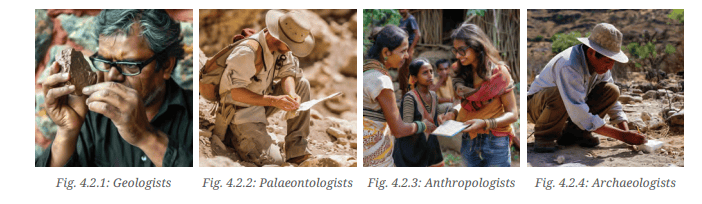
- Geologists (Fig. 4.2.1) study the physical features
of the Earth, like the soil, stones, hills, mountains,
rivers, seas, oceans and other such parts of the Earth.
- Palaeontologists (Fig. 4.2.2) study the remains of
plants, animals and humans from millions of years
ago in the form of fossils.
- Anthropologists (Fig. 4.2.3) study human societies
and cultures from the oldest times to the present.
- Archaeologists (Fig. 4.2.4) study the past by digging
up remains that people, plants and animals left
behind, such as tools, pots, beads, figurines, toys,
bones and teeth of animals and humans, burnt
grains, parts of houses or bricks, among others .
Fossils:
Impressions
of footprints,
or parts of
plants or
animals that
are found
preserved
within layers
of soil or
rocks.
How Is Time Measured in History?
Gregorian calendar: The calendar now used the world over; it has 12 months adding up to 365 days, and a leap year every four years. However, century years — for example, 1800, 1900, 2000 — are leap years only if they are multiples of 400; so in the three centenary years above, only 2000 is a leap year .
Auspicious:
favourable or
bringing luck;
for instance,
‘an auspicious
beginning’.
LET’S EXPLORE
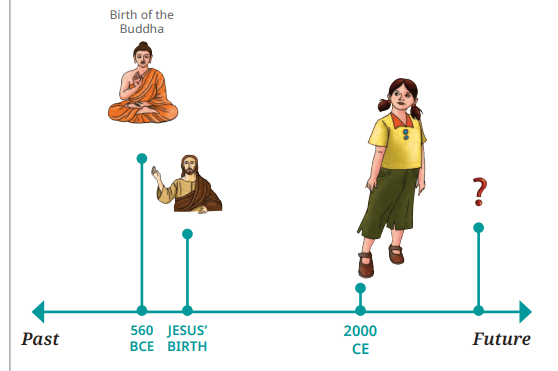
---->Such calculations are simple, but there is a catch. In the
Gregorian calendar, there is no ‘year zero’. The year 1 CE
follows immediately the year 1 BCE. Draw a simple timeline
marking every year from 2 BCE to 2 CE; you will see that
because of the absence of a year zero, only 3 years have
passed between those two dates.
----->So to calculate the number of years between a BCE date
and a CE date, you should add them but subtract 1 — in the
above case, 2 + 2 – 1 = 3.
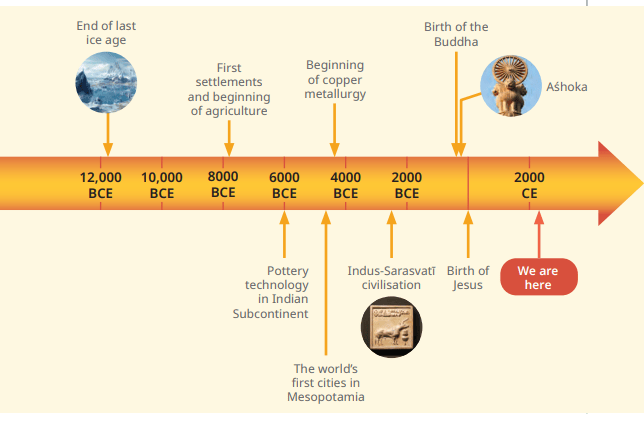
------->Practice a few examples with your classmates. For example, to return to the question about the Buddha, suppose we are now in the year 2024 CE, then the Buddha was born 560 + 2024 – 1 = 2,583 years ago .
DON’T MISS OUT
Along with a year and a decade (a period of ten years), we often use other terms to understand longer durations of time. Two of these are quite commonly used when learning about history.
1. Century: It is any period of 100 years. In history, specific centuries are counted every 100 years starting from the year 1 CE. For instance, we are currently in the 21st century CE, which runs from 2001 to 2100 The centuries BCE are calculated beginning from the year 1 BCE and keep going back in time. For example, the 3rd century BCE would include the years 300 BCE to 201 BCE.
2. Millennium: It is any period of 1,000 years. In history,
specific centuries are counted every 1,000 years from
the year 1 CE. For instance, we are currently in the
3rd millennium CE, which began in 2001 CE and will go up
to 3000 CE.
As with centuries, millenniums BCE are also calculated beginning from 1 BCE and go backwards. So the 1st millennium BCE would include the years 1 BCE to 1000 BCE .
In the timeline given on pages 62 and 63 (Fig. 4.3), can you mark the beginning of the 8th millennium BCE? (Note: In English, the plural of ‘millennium’ is ‘millenniums’ or ‘millennia’; both are correct.
LET’S EXPLORE
Create a timeline stretching from 1900 CE to the current year
and place the dates of birth of your grandparents, parents,
siblings and yourself. Also, mark the years that the 20th century
CE begins with and ends with .
DON’T MISS OUT
Do you know how calendars have been traditionally made in India? Many Indian calendars rely on the positions of the sun and the moon to define the months of the year. A pañchānga is a book of tables which lists the days of each month along with related astronomical data; for instance, it precisely predicts events like solar and lunar eclipses, times for sunrise and sunset, etc. Pañchāngas, still widely used in India, often also give weather predictions for the year, dates and timings of festivals, and more .
What Are the Sources of History?
LET’S EXPLORE
Can you collect information about at least three generations of
your family on your mother’s and father’s sides? Create a family
tree with your parents, grandparents and great-grandparents.
Find out their names, what they did for a living and where
they were born. Also, write the sources from where you got
this information.
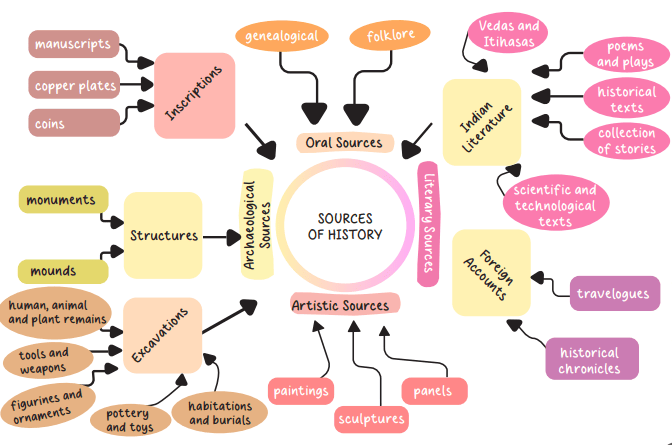
Source of history: A place, person, text or an object from which we gather information about some past event or period.
THINK ABOUT IT
Have you ever seen old coins, books, clothes,
jewellery or utensils in and around your
house? What type of information can we
gain from such objects? Or from old houses
or buildings?
Historian: A
person who
studies and
writes about
the past.
Genetics:
The branch
of biology
that studies
how, in plants,
animals or
humans, certain
features and
characteristics
get passed
down from one
generation to
the next .
LET’S EXPLORE
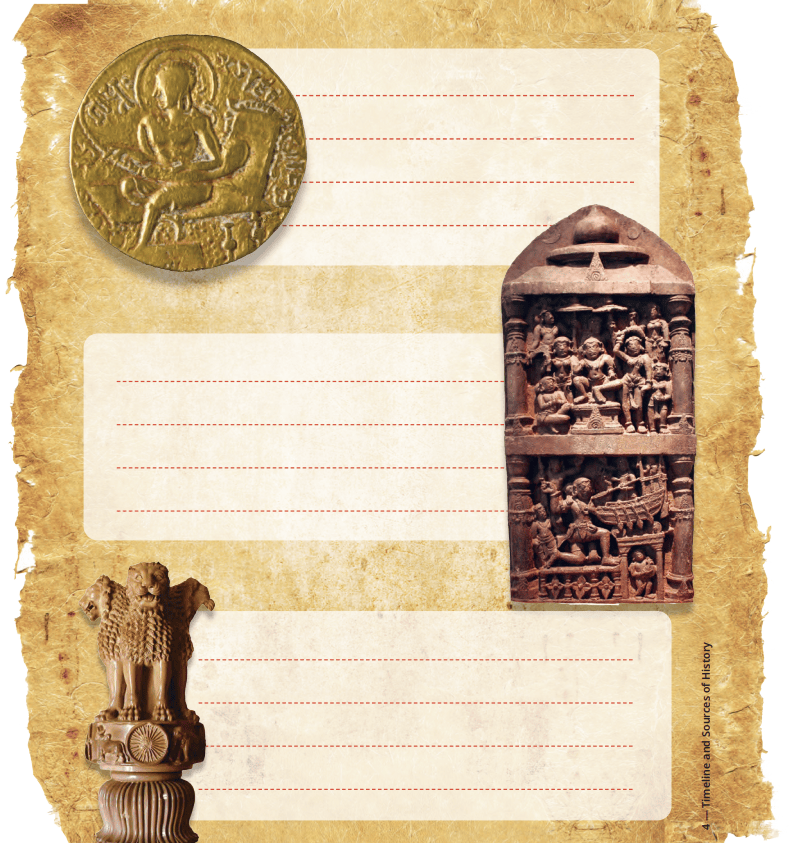
There are a few images of different sources of history on the
next page. Who and what do you think the objects show? Write
down in the boxes next to the images any information that you
get from these objects.
The Beginnings of Human History
LET’S EXPLORE
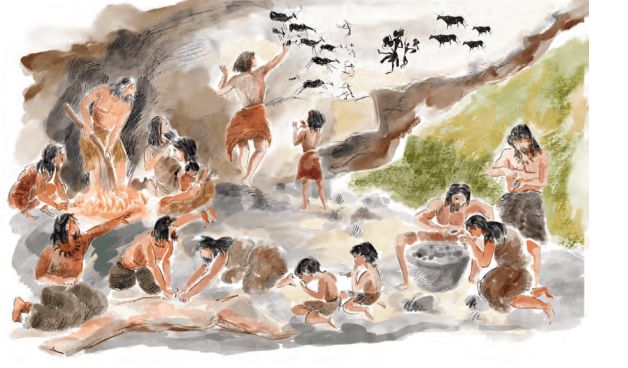
In the above picture, look at some activities of early humans
in a rock shelter. Which ones can you recognise? Give a brief
description for each .
Afterlife: A life that begins after death .
The First Crops
LET’S EXPLORE
Observe the scene on the next page. It depicts an agricultural
community from a few millenniums ago. List the main activities
you can identify .
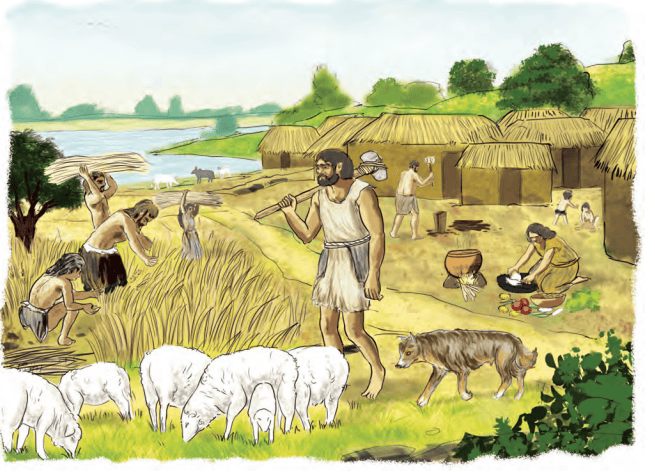
THINK ABOUT IT
- Both in this earlier picture of a rock shelter and in this one,
men and women are given certain roles. While they may
appear to be ‘natural’, they are not necessarily correct and
do not cover all situations. For instance, in a rock shelter,
women may have helped prepare colours for painting
the rock or may have done some of the painting. In both
scenes, men may have done some of the cooking or may
have helped take care of children.
- Keeping in mind that we have only limited information, think about such roles and situations, and discuss in class.
Welfare:
Health,
prosperity and
well-being .
Hamlet:
A small
settlement or
small village .
Questions, activities and projects
1. As a project, write the history of your family (or village if you live in one), using sources of history at your disposal. Ask your teacher to guide you.
2. Can we compare historians to detectives? Give reasons for your answers.
3. A few exercises with dates:
- Place these dates chronologically on the timeline: 323 CE, 323 BCE, 100 CE, 100 BCE, 1900 BCE, 1090 CE, 2024 CE.
- If King Chandragupta was born in 320 CE, which century did he belong to? And how many years was that after the Buddha’s birth?
- Rani of Jhansi was born in 1828. Which century did she belong to? How many years was that before India’s Independence?
- Turn ‘12,000 years ago’ into a date.
5. Invite to your school an archaeologist or a historian and
ask them to speak on the history of your region and why it’s
important to know it.