CHAPTER 5
India, That Is Bharat
In India at a very early time the spiritual and cultural unity was
made complete and became the very stuff of the life of all this great
surge of humanity between the Himalayas and the two seas.
— Sri Aurobindo
The Big
Questions ?
1. How do we define India?
2. What were the ancient names for India?
Today, the India we know is a modern nation, with defined
borders, defined states and a known population. However,
it was very different 500 years ago, 2,000 years ago or even
5,000 years ago. This region of the world, which we often call
the ‘Indian Subcontinent’, has had many different names
and shifting boundaries. We can learn about India’s past
and evolution from many different sources. Let us explore.
THINK ABOUT IT
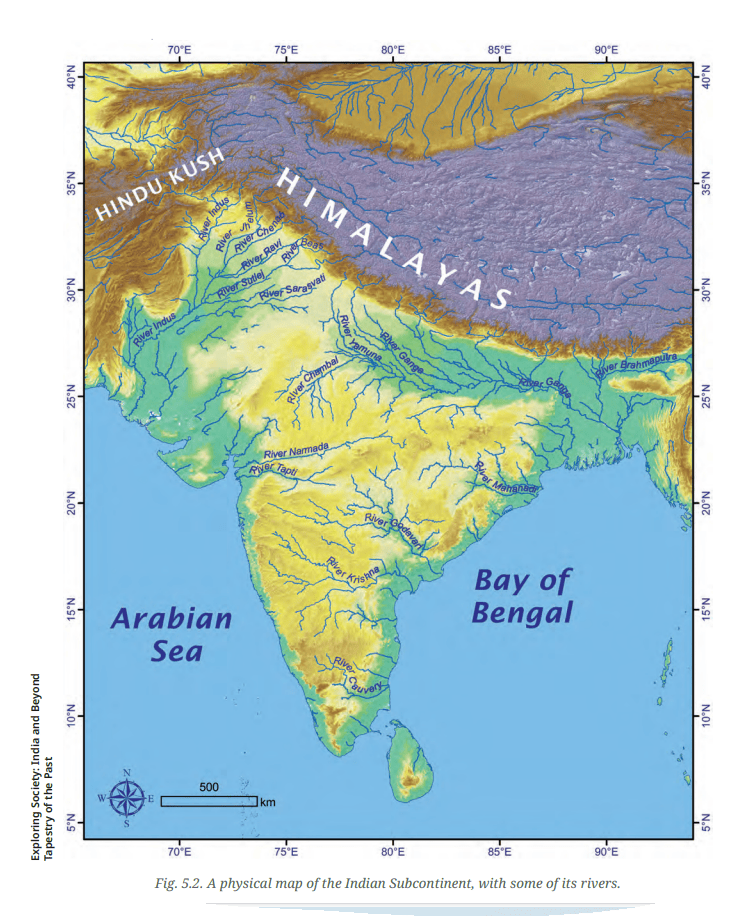
Consider the physical map of the Indian Subcontinent at
the start of the chapter. What are its natural boundaries
that you can make out?
In the course of history, India has been called by many
names — both by its inhabitants and by visitors from outside.
These names come to us from ancient texts, accounts of
travellers and pilgrims, and inscriptions.
Inhabitants:
People who
live in a
particular
place
How Indians Named
India
The Ṛig Veda is India’s most ancient
text; as we will see in Chapter 7,
it is several thousand years old.
It gives the northwest region of
the Subcontinent the name ‘Sapta
Sindhava’, that is, the ‘land of the
seven rivers’. The word ‘Sindhava’
comes from ‘Sindhu’, which refers
to the Indus River, or at times to a
river in general Moving on in time, we see names for other parts of India
appear in the literature. The Mahābhārata is one of India’s
most famous texts (we read about it in the theme ‘Our
Cultural Heritage and Knowledge Traditions’). Interestingly,
it lists many regions, such as Kāshmīra (more or less today’s
Kashmir), Kurukṣhetra (parts of Haryana today), Vanga
(parts of Bengal), Prāgjyotiṣha (roughly today’s Assam),
Kaccha (today’s Kutch), Kerala (more or less today’s Kerala),
and so on.
LET’S EXPLORE
Do you recognise the names of any regions given in the map
(Fig. 5.4) on page 79? List the ones that you have heard of.
But when do we come across a name for the entire Indian
Subcontinent? Because ancient Indian texts are difficult to
date, this is not an easy question to answer. The Mahābhārata
uses the terms ‘Bhāratavarṣha’ and ‘Jambudvīpa’, and
scholars generally agree that this long poem was written
from a few centuries BCE onward. The first term, ‘Bhāratavarṣha’, clearly extends to the entire
Subcontinent, and the text includes the names of numerous
rivers and peoples. ‘Bhāratavarṣha’ means ‘the country of
the Bharatas’. ‘Bharata’ is a name that first appears in the
Ṛig Veda, where it refers to one of the main Vedic groups
of people. In later literature, several kings named ‘Bharata’
are mentioned.
The second term, ‘Jambudvīpa’, means ‘the island of the
fruit of the jamun tree’. This is indeed a common tree native
to India, also called ‘jambul tree’, ‘Malabar plum tree’, etc.
‘Jambudvīpa’ came to mean the Indian Subcontinent.
In fact, we get a good clue from an Indian emperor — his
name is Aśhoka and we will meet him later; for now, we
can take his date to be about 250 BCE. As we will see, he
left us many inscriptions. In one of them, he used the same name ‘Jambudvīpa’ to describe the whole of India, which
at the time included what is today Bangladesh, Pakistan, as
well as parts of Afghanistan.
A few centuries later, ‘Bhārata’ became the name generally
used for the Indian Subcontinent. For instance, in an ancient
text called the Viṣhṇu Purāṇa, we read :
THINK ABOUT IT
Have you identified the ‘snowy mountains’? Do you think this
brief description of Bhārata is correct?
It is interesting to note that different parts of the country
adopted a similar definition for India. For instance, a poem
of ancient Tamil literature, from about 2,000 years ago,
praises a king whose name is known “from [Cape] Kumari
in the south, from the great mountain in the north, from
the oceans on the east and on the west...” You can now
recognise ‘the great mountain in the north’, and it should
not be difficult to identify ‘Cape Kumari’. It looks like ancient
Indians knew their geography well!
DON’T MISS OUT
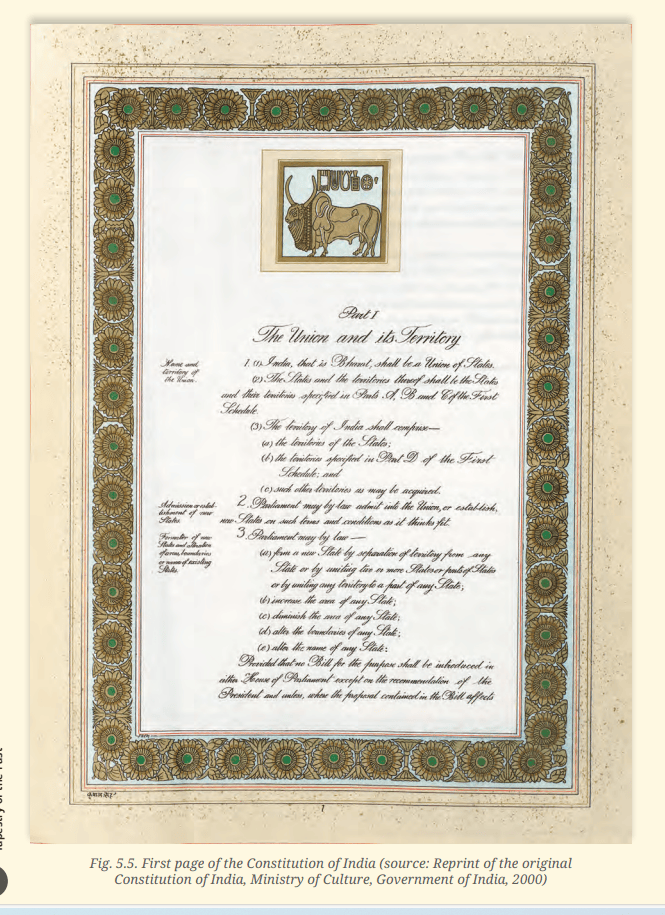
The Indian Constitution, which was first written in English,
uses the phrase ‘India, that is Bharat’ right at the beginning.
Similarly, the Hindi version of the Constitution mentions the
same as ‘Bhārat arthāth India’.
Constitution:
A document
that spells
out the basic
principles
and laws
of a nation.
The Indian
Constitution,
which will be
studied in Grade
7, came into
force in 1950 .
LET’S EXPLORE
In this reproduction of the first page of the original Constitution
of India in Fig. 5.5 (page 82), can you make out the phrase
‘India, that is Bharat’?
How Foreigners Named India
The first foreigners to mention India were the Persians,
the ancient inhabitants of Iran. In the 6th century BCE, a
Persian emperor launched a military campaign and gained
control of the region of the Indus River, which, as we saw,
was earlier called ‘Sindhu’. So, it is no surprise that in their
earliest records and stone inscriptions, the Persians referred
to India as ‘Hind’, ‘Hidu’ or ‘Hindu’, which are adaptations
in their language of ‘Sindhu’. (Note that in ancient Persian,
‘Hindu’ is a purely geographical term; it does not refer here
to the Hindu religion.)
Based on these Persian sources, the ancient Greeks named
the region ‘Indoi’ or ‘Indike’. They dropped the initial letter
‘h’ of ‘Hindu’ because this letter did not exist in their Greek
language.
Sindhu—---------> Hindhu —--------->Indoi / Indike
The ancient Chinese also interacted with India. In several
texts, they refer to India as ‘Yintu’ or ‘Yindu’. This word also
originally comes from ‘Sindhu’, in the following manner:
Sindhu—----> Hindhu—---> Indu—-----> Yindu