The most ancient civilisation of India, known variously as the
Harappan, Indus or Indus-Sarasvatī Civilisation, was indeed
remarkable in many ways. ... [It showed how] a well-balanced
community lives — in which the differences between the rich
and the poor are not glaring. ... In essence, the Harappan
societal scenario was not that of ‘exploitation’, but of mutual
‘accommodation’.
— B.B. Lal
The Big
Questions ?
1. What is a civilisation?
2. What was the earliest civilisation of the Indian Subcontinent?
3. What were its major achievements?
What Is a Civilisation?
At the end of Chapter 4, we saw the first human groups
settling down, practising agriculture, developing some
technologies (such as construction, metallurgy, transport)
and moving towards ‘civilisation’.
What, then, is civilisation? In general, the term is used for
an advanced stage of human societies. To be precise, we
will consider here that a ‘civilisation’ should have at least
the following characteristics:
some form of government and administration — to
manage a more complex society and its many activities.
urbanism — town-planning, the growth of cities and
their management, which generally includes water
management and a drainage system .
a variety of crafts — including the management of raw
materials (such as stone or metal) and the production
of finished goods (such as ornaments and tools )
trade both internal (within a city or a region) and
external (with distant regions or other parts of the
world) — to exchange all sorts of goods
some form of writing — needed to keep records and to
communicate
cultural ideas about life and the world, expressed
through art, architecture, literature, oral traditions or
social customs
a productive agriculture — enough to feed not just
the villages, but also the cities.
Metallurgy: Includes the techniques of extracting metals from nature, purifying or combining them, as well as the scientific study of metals and their properties.
THINK ABOUT IT
Which of the above characteristics do you think is the most
fundamental — that is, a characteristic essential to the
development of all others?
LET’S EXPLORE
For each characteristic in the list above, can you make a list of
professions or occupations that might exist in such a society?
It is easy enough to see that all these characteristics are
present in most societies in the world today. But when did
civilisation begin, in the sense we have now defined?
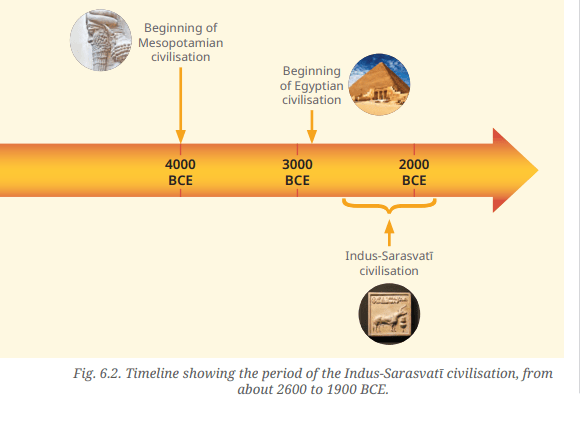
Civilisation began at different times in different parts of the
world. In the region known as Mesopotamia (modern Iraq
and Syria), that happened about 6,000 years ago, and the
civilisation in ancient Egypt followed a few centuries later.
You will learn about these and a few more civilisations in a
later grade. In many ways, humanity would not have reached
its present stage without the enormous contributions and
advances of those ancient civilisations.
For now, however, we will only look at the Indian
Subcontinent, and its northwest region is where our story
begins.
From Village to City
The vast plains of the Punjab (today
divided between India and Pakistan) and
Sindh (now in Pakistan) are watered by
the Indus River and its tributaries. This
made those plains fertile and, therefore,
favourable to agriculture. A little further
east, a few millenniums ago, another
river, the Sarasvatī, used to flow from
the foothills of the Himalayas through
Haryana, Punjab, parts of Rajasthan
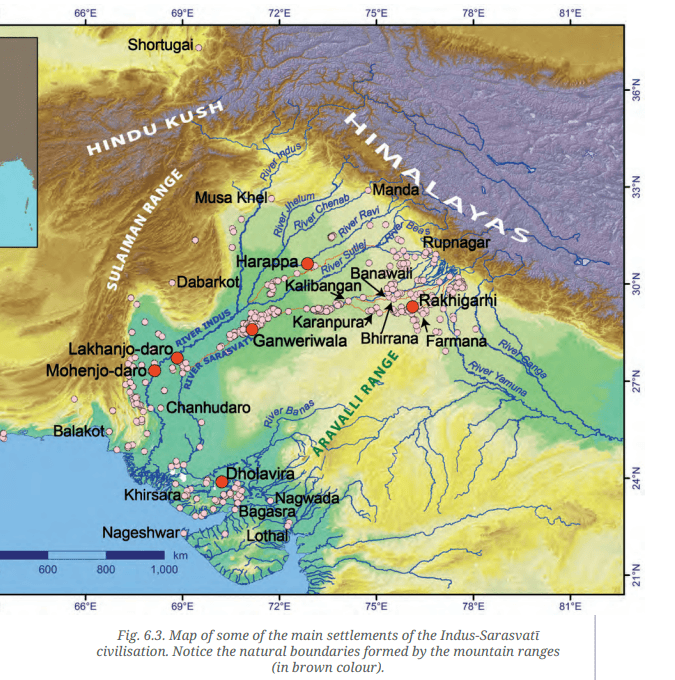
and Gujarat (see Fig. 6.3). In this whole
region, from about 3500 BCE, villages
grew into towns, and with increasing
trade and other exchanges, those towns
further grew into cities. This transition
happened around 2600 BCE.
Archaeologists gave this civilisation
several names — ‘Indus’, ‘Harappan’,
‘Indus-Sarasvatī’ or ‘Sindhu-Sarasvatī’
civilisation. We will use all these terms.
Its inhabitants are called ‘Harappans’.
It is one of the oldest civilisations in the
world.
Tributary: A river that flows into a larger river (or lake). For instance, the Yamuna is a tributary of the Ganga
DON’T MISS OUT
Why are the inhabitants of this civilisation called ‘Harappans’
today? That is simply because the city of Harappa (today in
Pakistan’s Punjab) was the first of this civilisation to be excavated, way back in 1920–21, over a century ago.
This development is also called the ‘First Urbanisation of
India’.
LET’S EXPLORE
Some of the important cities of this civilisation are marked in
the map (Fig. 6.3). As a class activity, can you try to match these
cities with the modern states or regions in the table on the next
page?
Harappan city
|
Modern state / region
|
Dholavira
|
Punjab
|
Harappa
|
Gujarat
|
Kalibangan
|
Sindh
|
Mohenjo-daro
|
Haryana
|
Rakhigarhi
|
Rajasthan
|
The Sarasvatī River
The map (Fig. 6.3 on page 89) shows the Indus (or
Sindhu) and its five main tributaries; important
cities grew along those rivers, such as Mohenjo-daro
and Harappa. But there are also many sites along
the Sarasvatī River, which today goes by the name
of ‘Ghaggar’ in India and ‘Hakra’ in Pakistan (hence
the name ‘Ghaggar-Hakra River’). This river is now
seasonal, because it flows only during the rainy season.
The Sarasvatī River is first mentioned in the Ṛig Veda, an
ancient collection of prayers which we will read about
in Chapter 7. In this text, Sarasvatī is worshipped both
as a goddess and as a river flowing ‘from the mountain
to the sea’. Later texts describe the river as drying up
and eventually disappearing.
Town-Planning
Harappa
and Mohenjo-daro, now in Pakistan, were the
first two cities of this civilisation to be discovered; their
identification goes back to 1924, a century ago. Several sites
followed in the Indus plains, which is why the civilisation
was initially called ‘Indus Valley civilisation’.
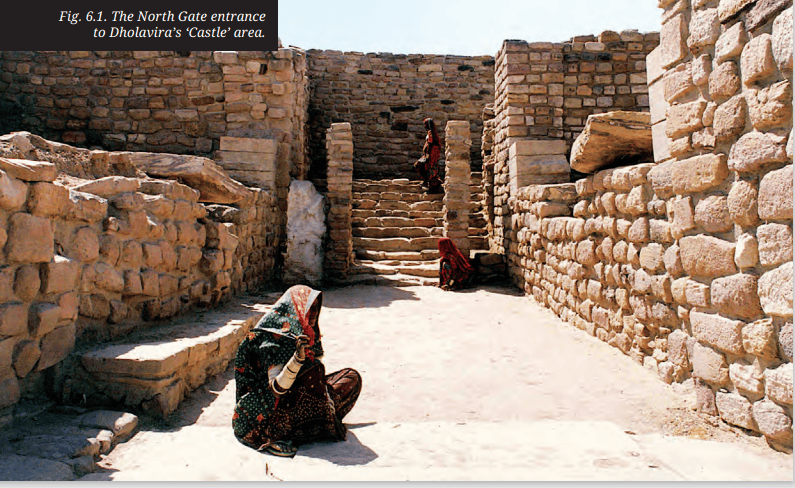
Later on, other major cities, such as Dholavira (in Gujarat),
Rakhigarhi (in Haryana), Ganweriwala (in the Cholistan
desert of Pakistan), and hundreds of smaller sites (such as Lothal in Gujarat), were discovered, some of them
excavated. Such discoveries continue even today! It is
interesting to note that the Sarasvatī basin includes not only
two major cities — Rakhigarhi and Ganweriwala — but also
several smaller ones (Farmana in Haryana, Kalibangan in
Rajasthan) and a few towns (Bhirrana and Banawali, both
in Haryana); indeed, the map (Fig. 6.3 on page 89) makes
clear the high density of sites in that region.
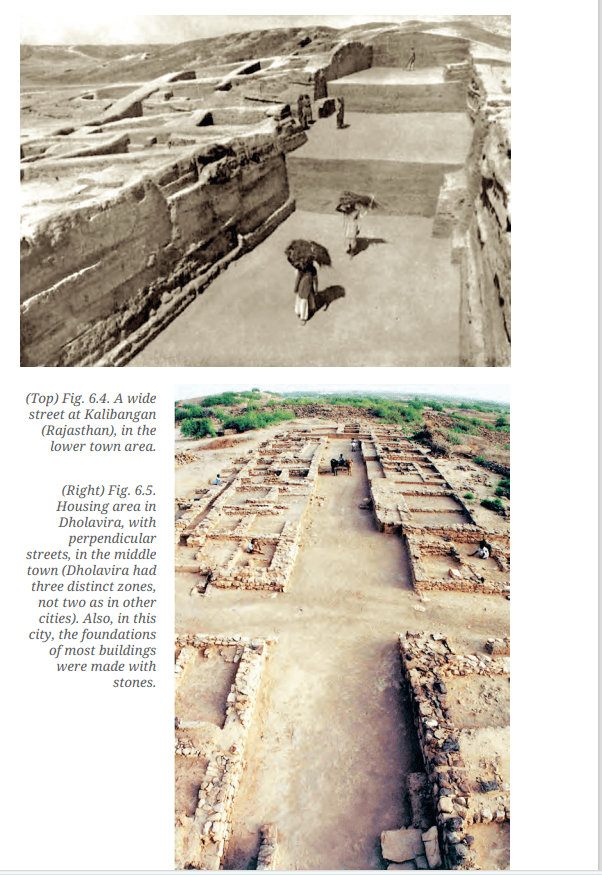
The larger Harappan cities were built according to precise
plans. They had wide streets (Fig. 6.4 and 6.5 on page 92),
which were often oriented to the cardinal directions. Most
cities seem to have been surrounded by fortifications and
had two distinct parts — the ‘upper town’, where the local
elite probably lived, and the ‘lower town’, where common
people lived.
Some large buildings seem to have been used for collective
purposes — for instance, warehouses where goods to be
transported were stored. Individual houses of various sizes
lined the streets and smaller lanes. Interestingly, the quality
of construction was the same for small and big houses. All
those buildings were generally made of bricks.
The purpose of some of the structures remains a matter
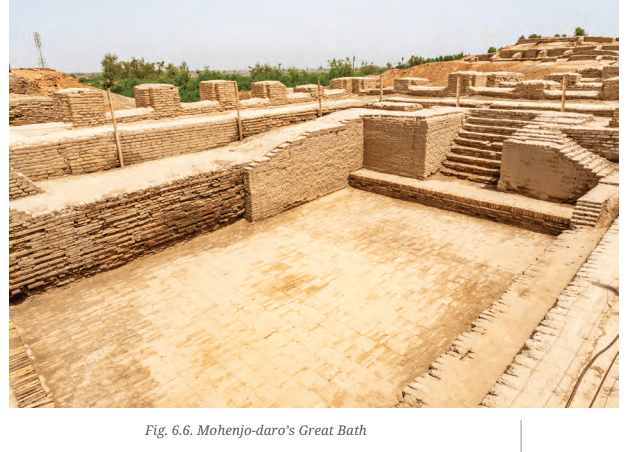
of debate. This is the case of the famous ‘Great Bath’ in
Mohenjo-daro (Fig. 6.6 on page 93), a small but elaborate
tank which measured about 12 x 7 metres and had
waterproofing materials (such as natural bitumen, a form
of tar) applied on top of carefully laid-out bricks.
Fortification:
A massive wall
surrounding a
settlement or
city, generally
for protective
purposes.
Elite: Here, the
word refers
to the higher
layers of the
society, such as
rulers, officials,
administrators,
and often
priests.
THINK ABOUT IT
You may have come across the term ‘Indus Valley
civilisation’ and noticed that we have not used it. A look at
the map (Fig. 6.3 on page 89) explains why the term ‘Valley’
is obsolete, as we now know that the civilisation extended
much beyond the Indus region.
The tank was surrounded by small rooms, one of which contained a
well; there was a drain in one corner of the tank to empty it
from time to time and refill it with freshwater.
What was the purpose of such a structure? Archaeologists
have proposed several possible interpretations — a public
bath for people; a bath for the royal family only; or a tank
used for religious rituals. The first interpretation is now
ruled out because it turns out that in this city, most houses
had individual bathrooms.
LET’S EXPLORE
Have a debate in class about the last two interpretations. Can
you think of any others? Remember that in this case, we do not
have any other source of history — no inscription, no text, no
traveller’s account .
Water Management
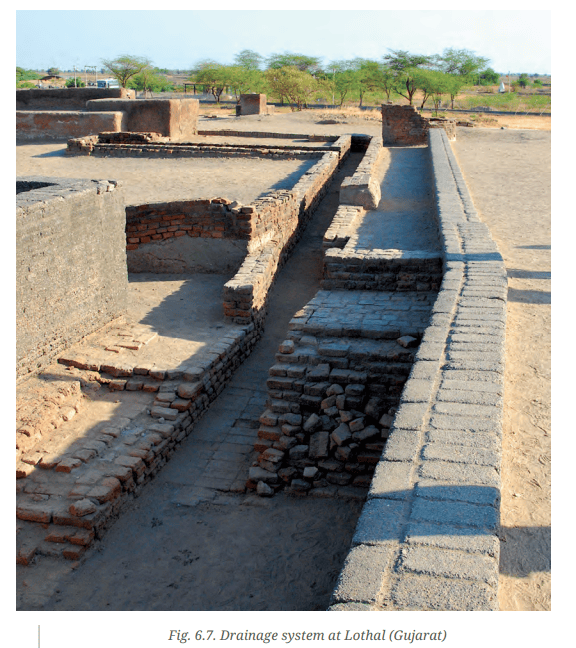
The Harappans gave much importance to water management and cleanliness. They often had separate areas for
bathing in their homes; these were connected to a larger
network of drains (Fig. 6.7), which generally ran below the
streets and took the waste water away.
In Mohenjo-daro, people drew water from hundreds of
wells made of bricks. But in other regions, it may have been from ponds, nearby streams or human-made reservoirs. In
the case of Dholavira (in the Rann of Kutch in Gujarat), the
largest reservoir measured 73 metres in length!
Reservoir: A
large natural or
artificial place
where water is
stored .
LET’S EXPLORE
As a class activity, measure the length of your classroom, a
school corridor or a playground with the help of any measuring
tape. Compare these lengths with the length of the largest
reservoir in Dholavira .
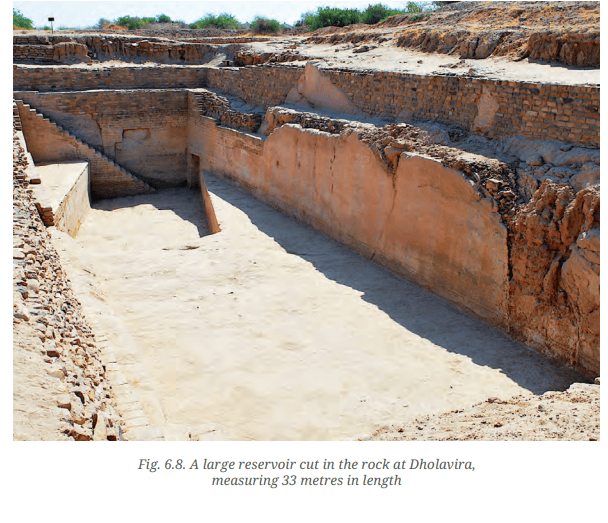
At Dholavira, at least six large reservoirs were built with
stones or even cut into the rock (Fig. 6.8). Most of them were
connected through underground drains for efficient water
harvesting and distribution.
THINK ABOUT IT
Imagine the large number of workers required to build such
a network of reservoirs. Who do you think organised their
work and gave them precise instructions? How do you think
they were paid for their labour? (Hint: there was no money
at that time in the way we have today.) Since the reservoirs
needed to be cleaned from time to time, was there some
local authority to manage their maintenance? What clues
do we get from all this about this city’s ruler and municipal
administration?
Use your imagination and discuss with your teacher.
Archaeologists also discuss these questions, and the answers
are not always final!
What Did the Harappans Eat?
The Harappans created many of their settlements along the
banks of large or small rivers. This is a logical choice, not
just for easy access to water, but also for agriculture, since
rivers enrich the soil around them. Archaeological findings
have shown that the Harappans grew cereals like barley,
wheat, some millets, and sometimes rice, in addition to
pulses and a variety of vegetables. They were also the first
in Eurasia to grow cotton, which they used to weave into
clothes. They made farming tools, including the plough
(Fig. 6.9), some of which continue to be used by modern day farmers.
This intense agricultural activity was managed by hundreds of small rural sites or villages. Then as now, the cities
could survive only if enough agricultural produce from
rural areas reached them on a daily basis.
The Harappans also domesticated a number of animals for
meat consumption and fished both in rivers and in the sea.
This is known from the large numbers of animal and fish
bones found during excavations.
What did Harappan cooking pots contain? Scientific
examinations of clay pots have provided some answers,
both expected ones (dairy products) and surprising ones —
such as remains of turmeric, ginger and banana. Clearly,
their diet was quite diverse!
LET’S EXPLORE
Imagine you cook a meal in a Harappan house. What dish or
dishes would you prepare, based on the data given above?
A Brisk Trade
The Harappans were engaged in active trade, not only
within their own civilisation (other cities nearby or far
away), but with other civilisations and cultures within
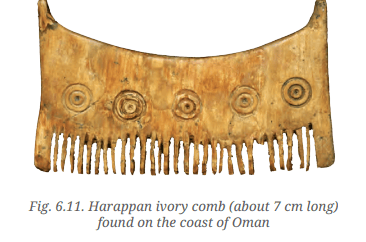
and outside India. They exported ornaments, timber, some
objects of daily use (Fig. 6.11 on page 98), probably also
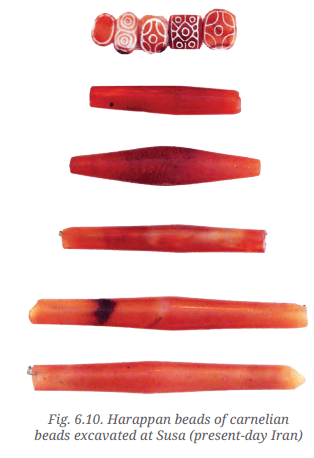
gold and cotton, and possibly some food items. The most
favoured ornaments were beads of carnelian (Fig. 6.10 on
page 98), a reddish semiprecious stone found mostly in
Gujarat. Harappan craftspeople developed special techniques to drill them, so a string could pass through them,
and to decorate them in various ways. They also worked
conch shells into beautiful shell bangles, which requires
sophisticated techniques as shell is a hard material.
What the Harappans imported in exchange of the exported
goods is not so clear. It probably included copper, since this
metal was not so common back home.
DON’T MISS OUT
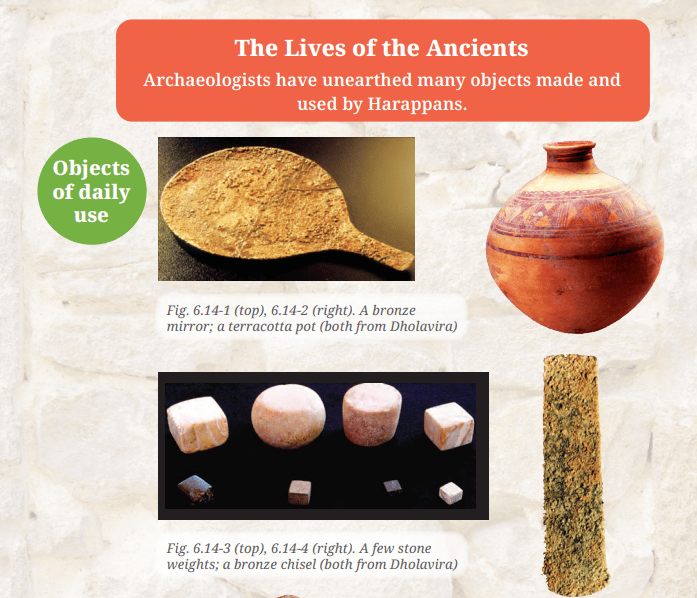
The Harappans mastered the art of working copper, a soft metal.
If tin is added to copper, the resulting metal is bronze, which is
harder than copper. The Harappans used bronze to make tools,
pots and pans, and, as we will see later, some figurines.
To conduct such a trade, they used
land routes and rivers, and the sea
for more distant destinations —
this is the first intensive maritime
activity in India. Indeed, quite a
few Harappan settlements are
located in the coastal regions
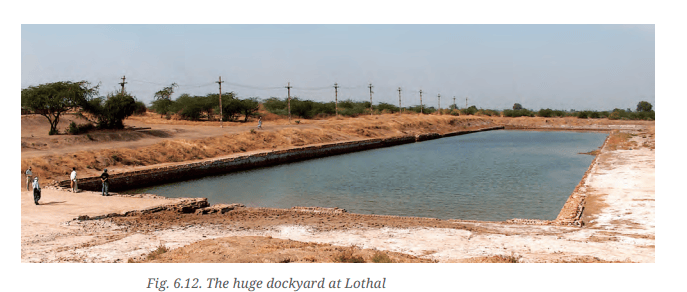
of Gujarat and Sindh. Lothal, a
small settlement in Gujarat, has a surprisingly huge basin measuring 217 metres in length
and 36 metres in width — the length is just a little more than
that of two football grounds! This basin must have been a
dockyard, that is, a structure used to receive and send boats
for further transportation of goods.
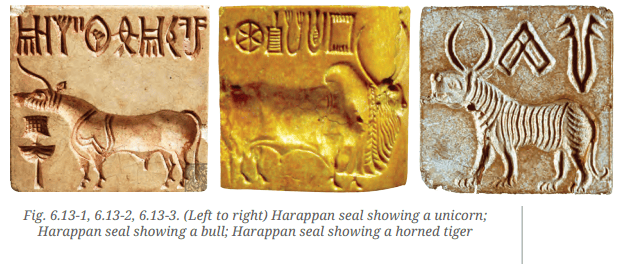
Such elaborate trade requires traders to be able to identify
their goods — and also each other! This seems to have
been the chief purpose of thousands of small seals, which
have been excavated from many settlements. These seals
were generally made of steatite, a soft stone that would
be hardened through heating. They measure only a few
centimetres and generally depict animal figures with, above
them, a few signs that are part of a writing system. But that
system and the symbolic meaning of the animal figures are
yet to be understood. What is certain is that they somehow
relate to trade activities.
LET’S EXPLORE
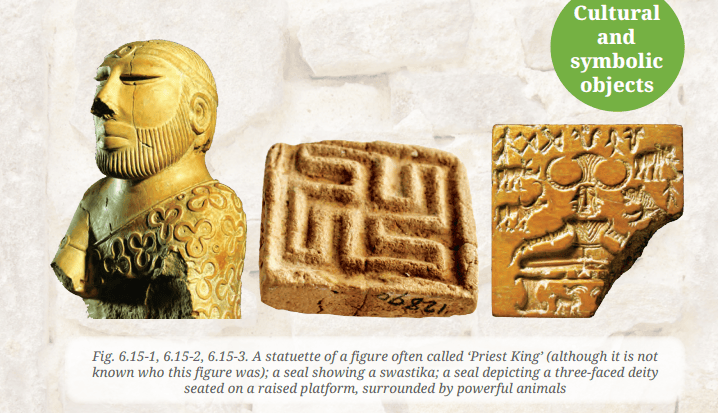
Looking at these three Harappan seals with some writing signs,
what goes through your mind? Would you like to suggest any
interpretations? Let your imagination run!
THINK ABOUT IT
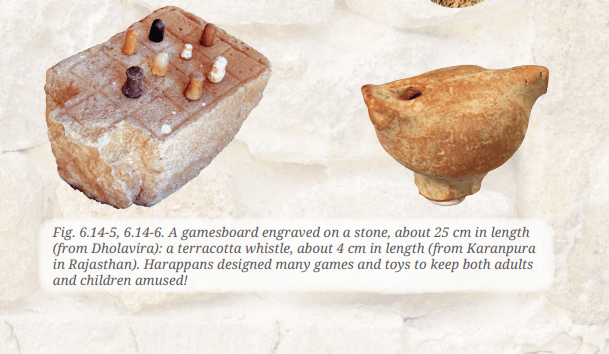
�
- Looking at the objects on pages 100 and 101 — or any
other pictured in this chapter — can you make out
what activities or aspects of life were important for the
Harappans?
LET’S EXPLORE
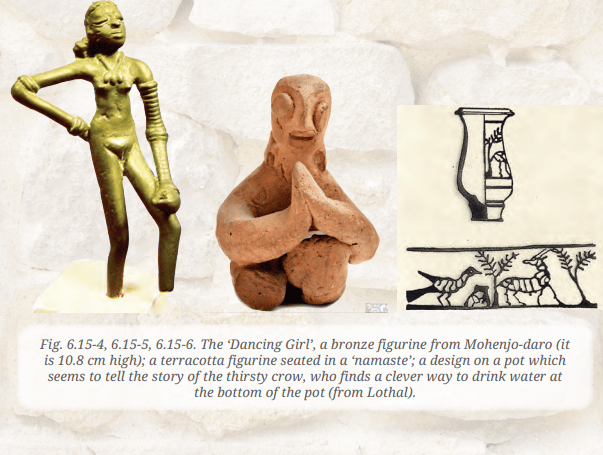
- Complete the story found on the Lothal pot. How was
such a story remembered for more than 4,000 years, in
your opinion?
- Consider the ‘Dancing Girl’ figurine. What do you make of
the attitude the figurine expresses? Observe her bangles
covering an entire arm, a practice still visible in parts of
Gujarat and Rajasthan. Where else in this chapter can
you spot bangles worn in this manner. What conclusion
should we draw from this?
The End or a New Beginning?
Around 1900 BCE, this Sindhu-Sarasvatī civilisation, despite
all its achievements, began to fall apart. The cities were
abandoned one by one. If any inhabitants remained, they
adopted a rural lifestyle in the changed environment — it
appears that the earlier government or administration no
longer existed. Gradually the Harappans scattered over
hundreds, if not thousands, of small rural settlements.
THINK ABOUT IT �
- The Harappans returned to rural settlements because a rural
lifestyle gives easier access to food and water than an urban
lifestyle. Then as now, cities depended on villages to provide
food, and sometimes water.
What caused this decline? Archaeologists have proposed
many factors. Long back, it was thought that warfare or invasions may have destroyed the cities, but there is no
trace of warfare or invasion. Indeed, the Harappans do not
seem to have kept any army or weapons of war; as far as the
evidence goes, it seems to have been a relatively peaceful
civilization.
Two factors are currently agreed upon. First, a climatic
change which affected much of the world from 2200 BCE
onward, causing reduced rainfall and a drier phase. This
would have made agriculture more difficult and could have
reduced food supply to the cities. Second, the Sarasvatī
River dried up in its central basin; suddenly, cities there,
such as Kalibangan or Banawali were abandoned. There
could have been other factors, but these two remind us of
how much we depend on climate and the environment for
our well-being
Although the cities disappeared, much of the Harappan
culture and technology survived and was passed on to the
next phase of Indian civilisation, which we will explore in
a future chapter
Before we move on …
- The Indus, Harappan or Sindhu-Sarasvatī civilisation
is one of the oldest of the world. Its inhabitants, the
Harappans, created planned cities with efficient water
management, diverse crafts and a brisk trade.
- A productive agriculture brought a variety of crops to the
cities .
- The civilisation eventually declined, probably because of
climatic and environmental changes; people returned to a
rural lifestyle.
Questions, activities and projects
1. Why does the civilisation studied in this chapter have
several names? Discuss their significance .
2. Write a brief report (150 to 200 words) summing up some
of the achievements of the Indus-Sarasvatī civilisation.
3. Imagine you have to travel from the city of Harappa to
Kalibangan. What are your different options? Can you
make a rough estimation of the amount of time each
option might take ?
4. Let us imagine a Harappan man or woman being
transported to an average kitchen in today’s India. What
are the four or five biggest surprises awaiting them?
5. Looking at all the pictures in this chapter, make a list of the
ornaments / gestures / objects that still feel familiar in our
21st century.
6. What mindset does the system of reservoirs at Dholavira
reflect?
7. In Mohenjo-daro, about 700 wells built with bricks
have been counted. They seem to have been regularly
maintained and used for several centuries. Discuss the
implications.
8. It is often said that the Harappans had a high civic sense.
Discuss the significance of this statement. Do you agree
with it? Compare with citizens in a large city of India
today.