The Big
Questions ?
1. What are the Vedas?
What is their message?
2. What new schools of thought
emerged in India in the 1st
millennium BCE? What are
their core principles?
3. What is the contribution of folk and
tribal traditions to Indian culture?
Indian culture, by any estimate, is several millenniums old.
Like any ancient tree, it has many roots and many branches.
The roots nurture a common trunk. And from the trunk
emerge many branches, which are different manifestations
of Indian culture, yet united by a common trunk.
Some of these branches are about art, literature, science,
medicine, religion, the art of governance, martial arts, and
so on. There are also ‘schools of thought’, by which we mean
groups of thinkers or spiritual seekers who share similar
ideas about human life, the world, etc.
Many archaeologists and scholars have pointed out that
some of India’s cultural roots go all the way to the Indus
or Harappan or Sindhu-Sarasvatī civilisation (which we
visit in Chapter 6). Later on, over time, hundreds of schools
of thought emerged in India. We will see here a few early
schools, which have shaped India into a country with a
unique personality. By understanding them and their roots,
we can understand ‘India, that is Bharat’ better.
Spiritual:
Concerned
with the spirit
or soul (ātman
in Sanskrit and
many Indian
languages).
Spirituality is
the search for a
deeper or higher
dimension
beyond
our current
personality.
Seeker:
Someone who
seeks the truths
of this world.
This could
be a sage, a
saint, a yogi, a
philosopher, etc
The Vedas and Vedic Culture
a. What are the Vedas?
The word “Veda” comes from the Sanskrit vid which
means ‘knowledge’ (hence vidyā, for instance). We briefly
mentioned the Ṛig Veda in earlier chapters. In fact, there
are four Vedas — the Ṛig Veda, the Yajur Veda, the Sāma
Veda and the Atharva Veda. They are the most ancient texts
of India, and indeed among the most ancient in the world.
The Vedas consist of thousands of hymns — prayers in the
form of poems and songs — that were recited orally, not
written. Those hymns were composed in the Sapta Sindhava
region (which we visit in Chapter 5). It is difficult to say
when exactly the Ṛig Veda, the most ancient of the four,
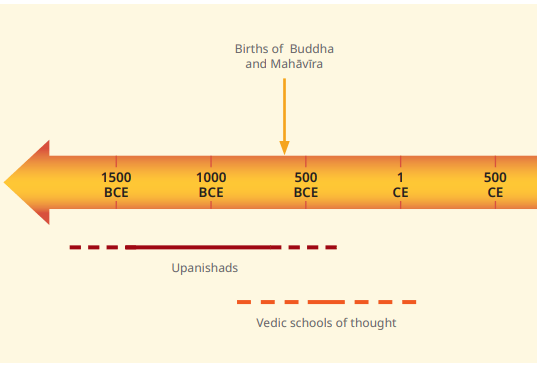
was composed; experts have proposed dates ranging from the 5th to the 2nd millennium BCE. So, for anything between
100 and 200 generations, these texts have been committed
to memory through rigorous training and passed on orally
with hardly any alterations!
DON’T MISS OUT
This meticulous transmission over thousands of years
explains why, in 2008, UNESCO recognised Vedic chanting as ‘a
masterpiece of the oral and intangible heritage of humanity’.
The Vedic hymns were composed by rishis (male seers or
sages) and rishikas (female ones) in an early form of the
Sanskrit language. They were addressed in poetical form
to many deities (gods or goddesses), such as Indra, Agni,
Varuṇa, Mitra, Sarasvatī, Uṣhas, and many more. Together
with the seers, these deities sustained ṛitam, or truth and
order in human life and in the cosmos’‘.
The early rishis and rishikas saw those gods and goddesses
as one, not separate beings. As one famous hymn puts it, In this worldview, some values were especially important,
beginning with ‘Truth’, which was often another name for
God. The last mantras (verses) of the Ṛig Veda also call for
unity among people:
UNESCO:
UNESCO
stands for
‘United Nations
Educational,
Scientific
and Cultural
Organization’.
It promotes
dialogue
between
people and
nations
through
education,
science and
culture.
Cosmos:
The world or
the universe as
an ordered and
harmonious
system .
Worldview:
A certain
view or
understanding of
the world, its
origin, or its
workings.
ekam sat viprā bahudhā vadanti ...
The Existent [that is, the supreme reality] is one,
but sages give it many names.
Come together, speak together;
common be your mind, may your thoughts agree ...
United be your purpose, united your heart ...
may your thoughts be united, so all may agree!
b. Vedic society
arly Vedic society was organised in different janas or
‘clans’, that is, larger groups of people. The Ṛig Veda alone
lists over 30 such janas — for instance, the Bharatas, the
Purus, the Kurus, the Yadus, the Turvaśhas etc. Each clan
was associated with a particular region of the northwest
part of the Subcontinent.
Not much is known of how these janas governed their
society. The Vedas only give us a few clues through words
like rājā (a king or ruler), sabhā and samiti, both of which
refer to a collective gathering or assembly.
Many professions are mentioned in the Vedic texts, such
as agriculturist, weaver, potter, builder, carpenter, healer,
dancer, barber, priest, etc.
LET’S EXPLORE
Do you know the term for a society where people select their
leaders? How do you think people can benefit from such a
situation? What could happen if they live under leaders that
they did not choose? (Hint: Think back to what you’re learning
in the theme ‘Governance and Democracy’!) Write your thoughts
in a paragraph of 100–150 words .
c. Vedic schools of thought
Vedic culture also developed many rituals (yajña, often
read as ‘yagya’) directed towards various deities (gods or
goddesses) for individual or collective benefit and wellbeing.
Daily rituals were generally in the form of prayers and
offerings to Agni, the deity associated with fire, but those
rituals became more and more complex in the course of
time .
A group of texts known as ‘Upaniṣhads’ built upon Vedic
concepts and introduced new ones, such as rebirth (taking
birth again and again) and karma (our actions or their
results). According to one school of thought, generally
known as ‘Vedanta’, everything — human life, nature and
the universe — is one divine essence called brahman (not
to be confused with the god Brahmā) or sometimes just tat
(‘that’). Two well-known mantras express this in a simple
but profound way:
aham brahmāsmi
“I am brahman” (that is to say, I am divine)
tat tvam asi...
“You are That”
The Upaniṣhads also introduced the concept of ātman or
Self — the divine essence that resides in every being but
is ultimately one with brahman. It follows that everything
in this world is connected and interdependent. This
explains a common prayer that begins with sarve bhavantu
sukhinah, or “May all creatures be happy”, and goes on to
wish them all to be free from disease and sorrow.
THINK ABOUT IT
Have you heard or read any other story that conveyed an
important message? What values did it teach you?
Early in the 1st millennium BCE, several more schools of
thought grew out of the Vedas. One of them was Yoga, which
developed methods intended to achieve the realisation
of brahman in one’s consciousness. Together, these schools
of thought became the foundations for what we call
‘Hinduism’ today.
Buddhism
Other schools of thought also emerged, which did not
accept the authority of the Vedas and developed their own
systems. One of them is Buddhism.
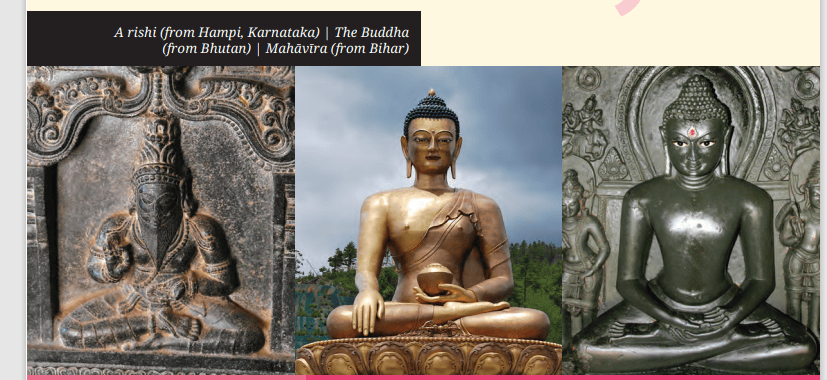
About two-and-a-half millenniums ago, a young prince
named Siddhārtha Gautama was born in Lumbini (today in Nepal). Depending on the sources they use, scholars have
come up with widely different conclusions as regards the
precise year of his birth. In Chapter 4, we chose 560 BCE as
an approximate year. In any case, it makes no difference to
our story here.
As the story goes, then, Siddhārtha Gautama grew up living
a protected life in the palace. One day, at the age of 29, he
asked to be driven through the city in a chariot, and for the
first time in his life came across an old man, a sick man, and
a dead body. He also saw an ascetic, who appeared to be
happy and at peace. Following this experience, Siddhārtha
decided to give up his palace life, leaving behind his wife
and son. Travelling on foot as an ascetic, meeting other
ascetics and scholars, he searched for the root cause
of suffering in human life. After meditating for many
days under a pipal tree at Bodh Gaya (today in Bihar), he
attained enlightenment; he realised that avidyā (ignorance)
and attachment are the source of human suffering and
conceived a method to remove these two causes.
Siddhārtha, then, became
known as the ‘Buddha’, which
means the ‘enlightened’ or
‘awakened’ one
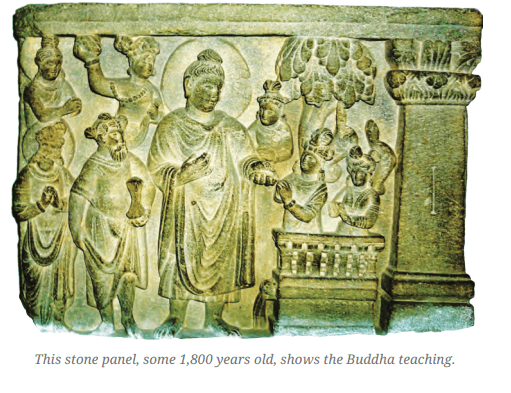
The Buddha started teaching
what he had realised, including
the idea of ahimsa, which is
generally translated as ‘nonviolence’, but originally means
‘non-hurting’ or ‘non-injuring’.
He also insisted on a sincere
inner discipline. The following
saying of his expresses this
simply:
Ascetic:
Someone
who engages
in a rigorous
discipline to
attain a higher
consciousness.
Attachment:
The condition of
having a bond
with someone
or something,
usually through
sentiment or
habit .
“Not by water is one made pure, though
many people may bathe here [in sacred
rivers]. But one is pure in whom truth and
dharma reside.
Conquering oneself is greater than
conquering a thousand men on the
battlefield a thousand times.”
The Buddha founded the Sangha, a community of bhikṣhus
or monks (and, later, bhikṣhuṇīs or nuns) who dedicated
themselves to practising and spreading his teachings. His
influence on India, and indeed the whole of Asia, was
enormous, as we will discover later; it is still perceptible
today.
Monk:
A man who,
giving up the
usual life in the
world, dedicates
himself to
religious or
spiritual pursuits.
A monk usually
takes vows,
that is, commits
himself to follow
strict rules for a
disciplined life.
Nun:
The female
equivalent
of a monk
LET’S EXPLORE
---> Discuss the way the Buddha is depicted in the above panel.
--->Can you name some states of India or some other countries
where Buddhism is a major religion even today? Try to plot
these on a world map.
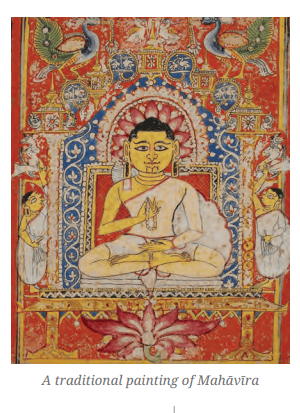
Jainism
Jainism is another important school
of thought that became widespread
at the same time, although its roots
are said to be much more ancient.
Just like Siddhārtha Gautama, Prince
Vardhamāna was born into a royal
family in the early 6th century BCE.
His birthplace was near the city of
Vaiśhālī, in modern-day Bihar. At
the age of 30, he decided to leave his
home and go in search of spiritual
knowledge. He practised an ascetic
discipline and, after 12 years, achieved
‘infinite knowledge’ or supreme wisdom.
He became known as ‘Mahāvīra’, or
‘great hero’, and started preaching what
he had realised.
DON’T MISS OUT
The word ‘Jain’ or jaina comes from jina, meaning ‘conqueror’.
This does not refer to the conquest of territory or enemies, but
to the conquest of ignorance and attachments, so as to reach
enlightenment.
Jain teachings include ahimsa, anekāntavāda and
aparigraha. These ideas, shared to a large extent with
Buddhism and the Vedantic school of thought, are central
to Indian culture. The first may be illustrated by this saying
of Mahāvīra:
“All breathing, existing, living, sentient
creatures should not be slain, nor treated
with violence, nor abused, nor tormented,
nor driven away.”
Let us define the last two in simple terms:
- Anekāntavāda means ‘not just one’ aspect or
perspective. That is, the truth has many aspects and
cannot be fully described by any single statement.
- Aparigraha means ‘non-possession’ and advises
detachment from material possessions, limiting
oneself to what is truly necessary in life.
Jainism also insists on the interconnectedness and
interdependence of all creatures, from humans to invisible
organisms, as they support each other and cannot live
without one another. Scientists studying nature, flora and
fauna, have again and again confirmed this deep truth.
The Jātaka tales, which have delighted generations of Indian
children and adults, tell stories of the Buddha’s former births
and express in simple terms the Buddhist values.
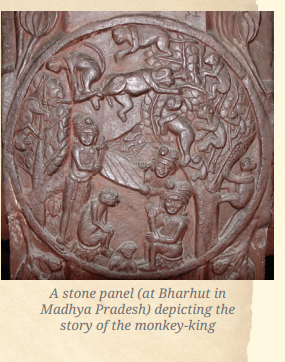
In a well-known tale, the Buddha was the king of a large
troop of monkeys. They lived near a huge tree which bore
fruit of divine fragrance and taste. Despite the monkeyking’s instructions that no fruit should escape, one day a ripe
fruit fell into the stream below. Carried by the current, it was caught in a net and taken to the palace. The king was so enchanted by
its taste that he ordered his soldiers to locate the tree it came from.
After a long search, they found the tree — and the monkeys enjoying
the tree’s fruits. The soldiers attacked
the monkeys. The only way for the
monkey-king to save his monkeys
was to help them cross the stream,
but they could not do so on their own.
Being much larger than them, the
monkey-king caught hold of a tree on
the other bank and let them use his
body as a bridge to cross the stream,
although he was severely bruised in
the process and eventually died.
The king, who watched the scene from
a distance, was greatly moved by the
monkey-king’s selfless sacrifice. He
thought about the role of a king with
respect to his subjects.
A Jain story
Rohineya was an extraordinarily skilled burglar who evaded all
attempts to catch him. On his way to a city, he accidentally heard
a few sentences from a sermon that Mahāvīra was giving about
achieving liberation from the ordinary life of ignorance. Reaching
the city, Rohineya was recognised and arrested. He pretended to be
a simple farmer. A minister devised a clever plan to force him to
confess his identity. But Rohineya, remembering Mahāvīra’s words,
was able to detect the minister’s plan and defeat it.
Feeling remorseful, Rohineya approached Mahāvīra, confessed his
crimes, returned the stolen treasures, and asked for forgiveness. He
became a monk, realised the illusion he was living in and focused on
acquiring higher knowledge.
The story illustrates the importance of right action and right
thinking, and also illustrates the fact that everyone should have a
second chance.
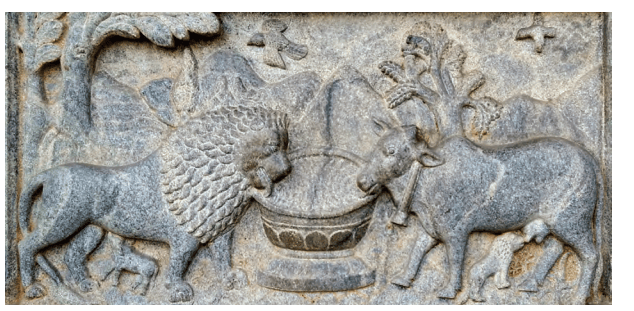
LET’S EXPLORE
Observe the above panel (from a Jain temple in New Delhi).
What is striking about it? What messages does it carry?
THINK ABOUT IT
In both Buddhism and Jainism, ahimsa means much more
than refraining from physical violence against a person or
an animal. It also means refraining from violence in thought,
such as having ill feelings towards anyone. If we observe
ourselves carefully, we may notice such negative thoughts and
learn to turn them into positive ones. Sometimes such negative
thoughts are even directed at ourselves!
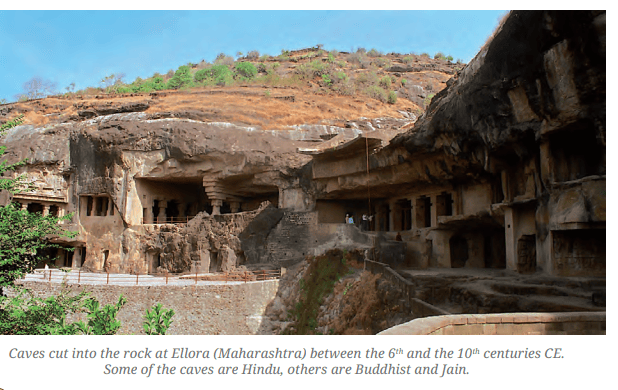
In both Buddhism and Jainism, monks, and sometimes
nuns too, began travelling across the land to spread their
respective teachings far and wide. Some of them created
new monasteries in faraway places, while others led ascetic
lives in caves cut in the rock. Archaeological findings have
revealed many traces of those monasteries, sometimes even
the names of the monks who lived in the rock-cut caves and
slept on the stone beds!
THINK ABOUT IT
In English, Hinduism, Buddhism, Jainism and Sikhism are often
labelled ‘religions’. You may notice that we have avoided this
term, preferring ‘schools of thought’ and (later in this chapter)
‘belief systems’. This is because there are many aspects to
those schools and systems, which we will explore gradually —
a philosophical aspect, a spiritual aspect, a religious aspect, an
ethical aspect, a social aspect, to name a few. Many scholars
agree that the word ‘religion’ is too limiting in the context of
the Indian civilisation.
There were yet other schools of thought at the time. For
example, one of them, known as the ‘Chārvāka’ school
(sometimes also ‘Lokāyata’), believed that this material
world is the only thing that exists, and therefore there can
be no life after death. This school does not seem to have
gained much popularity and it disappeared with time.
We mention it to show that there was a wide diversity of
intellectual or spiritual belief systems; people were free to
choose what suited them. Although the Vedic, Buddhist and Jain schools had important
differences, they also shared some common concepts,
such as dharma, karma, rebirth, the search for an end to
suffering and ignorance, and many important values. This
is the ‘trunk’ of the tree we started this chapter with.
Folk and Tribal Roots
The cultural roots we have seen so far are well documented
in many texts. India has also had rich ‘oral traditions’, that
is, teachings or practices transmitted through everyday
practice, without written texts (this is the case of the
Vedas). Among them are numerous folk traditions, that
is, transmitted by common people, and tribal traditions,
transmitted by tribes.
What is a tribe?
There are many definitions for this social entity. Today,
anthropologists usually consider a tribe to be a group of
families or clans sharing a tradition of common descent, a
culture and a language, living as a close-knit community
under a chief and holding no private property.
Interestingly, ancient India did not have a word for ‘tribe’
— tribes were just different janas that lived in a specific
environment, such as forests or mountains. The Constitution
of India uses the terms ‘tribes’ and ‘tribal communities’ in
English, and janjāti in Hindi.
According to official figures, in 2011 India had 705 tribes
spread over most States, amounting to a population of about
104 million people — more than the populations of Australia
and the United Kingdom together!
In the 19th century, anthropologists studying tribes often
described them as ‘primitive’ or ‘inferior’ to civilised people.
With deeper studies of tribal communities and their rich and
complex cultures, such biased judgments have been mostly
abandoned .
There has been a constant interaction
between folk and tribal traditions, and
the leading schools of thought such as
those we mentioned in this chapter.
Deities, concepts, legends and rituals
have been freely exchanged in both
directions. For instance, according to
tradition, Jagannath, worshipped at Puri
(Odisha), was originally a tribal deity;
this is also the case with various forms of
the mother-goddess worshipped across
India. Some tribes, on the other hand,
adopted Hindu deities long ago, and possess their own
versions of the Mahābhārata and the Rāmāyaṇa — this has
been well documented from India’s northeastern States, all
the way to Tamil Nadu.

How have such interactions taken place for so
long and so naturally? It is, in the end, because
folk, tribal and Hindu belief systems have
many similar concepts. For instance, in all
three, elements of nature such as mountains,
rivers, trees, plants and animals, and some
stones too, are regarded as sacred, because
there is consciousness behind all of them.
Indeed, tribes generally worship many deities
associated with those natural elements. For the
Toda tribals of the Nilgiris of Tamil Nadu, for
instance (one of them is pictured in the image on the right),
over thirty peaks of this mountain range are residences of
a god or a goddess; those peaks are so sacred that the Todas
avoid pointing to them with a finger.
But despite this multiplicity of deities, as with Hinduism,
many tribal groups have a concept of a higher divinity or
supreme being. For example, several tribes of Arunachal
Pradesh worship Donyipolo, a combined form of the Sun and the Moon who later rose to the higher status of a supreme god.
This is also the case of the god Khandoba in parts of central
India. In eastern India, the Munda and Santhal tribals, among
others, worship Singbonga, a supreme deity who created this
whole world. There are many more such examples
The Indian sociologist André Béteille summed up this
situation in these words :
“The thousands of castes and tribes on the Indian
subcontinent have influenced each other in their
religious beliefs and practices since the beginning of
history and before. That the tribal religions have been
influenced by Hinduism is widely accepted, but it is
equally true that Hinduism, not only in its formative
phase but throughout its evolution, has been influenced
by tribal religions.”
Clearly, the result of this long interaction has been mutual
enrichment. In this manner, folk and tribal beliefs and
practices also count among India’s cultural roots. We will
further develop this point in the next chapter.
Before we move on …
Before we move on …
-----> The Vedas, India’s earliest texts, gave rise to several schools
of thought. Vedanta and Yoga are among the best known.
----->Buddhism and Jainism departed from the authority of
the Vedas and laid emphasis on some specific values and
practices.
------>Although these schools had different principles and
methods, they also shared some important concepts; they
were all looking for the cause of suffering and the means
of removing ignorance.
------>Tribal belief systems and art have interacted for
millenniums with Hinduism. There was free borrowing
and giving from every side. Tribal belief systems generally
regard the land and its features as sacred; they often have,
at the same time, a higher concept of divinity.
Questions, activities and projects
1. If you were Nachiketa, what questions would you like to ask
Yama? Write them down in 100-150 words.
2. Explain a few central ideas of Buddhism. Briefly comment
upon them.
3. Discuss in class the quotation of the Buddha which begins with
“Not by water is one made pure, though many people may
bathe here [in sacred rivers]” to make sure that its meaning
has been understood by all.
4. Explain a few central ideas of Jainism. Briefly comment upon
them.
5. Consider and discuss in class André Béteille’s thought (see
page 122).
6. Make a list of popular gods and goddesses in your region
and the festivals they are associated with.
7. As a class activity, list two or three tribal groups from your
region or State. Document some of their art and belief systems .
True or false
1. The Vedic hymns were written on palm-leaf manuscripts.
2. The Vedas are India’s oldest texts.
3. The Vedic statement ekam sat viprā bahudhā vadanti reflects a
belief in the unity of cosmic powers.
4. Buddhism is older than the Vedas.
5. Jainism emerged as a branch of Buddhism.
6. Both Buddhism and Jainism advocated for peaceful
coexistence and the avoidance of harm to all living beings.
7. Tribal belief systems are limited to belief in spirits and minor
deities.
Class activity
1. Stage a small play with Yama, god of death, surrounded by
several Nachiketas asking him questions about life .