CHAPTER -9
Family and Community
Love and dharma are the flower and fruit of family life.
— Tiruvalluvar
The Big
Questions ?
1. Why is the family unit
important?
2. What is a community and what
is its role ?
Family
Almost all of us live in a family. The family is the fundamental
and most ancient unit of any society. In Indian society today,
there are several types of families — from joint families
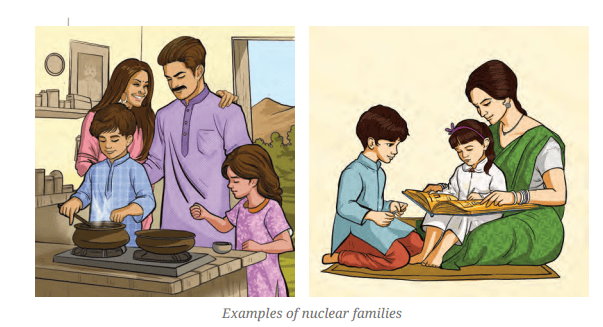
to nuclear families. A joint family has several generations
living together — grandparents, parents, uncles and aunts,
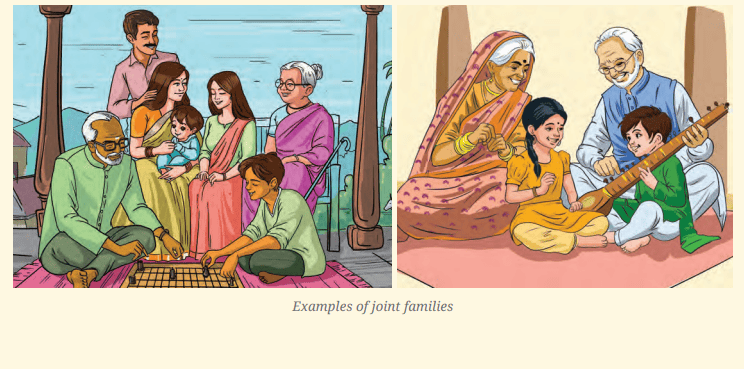
brothers, sisters and cousins. A nuclear family, on the
other hand, is limited to a couple and their children, and
sometimes one parent and children.
LET’S EXPLORE
---> What types of families do you see in your neighbourhood?
List the type with the number of households for each type.
--->What types are more frequent? Why do you think this is so?
--->As a class activity, compare with your classmates’ findings
and discuss .
In English, there are not many terms to describe family
relationships; we saw some of them in the first paragraph.
Indian languages have many more terms. For example,
in Hindi there is bua, tau, tai, chacha, mausi, nana, nani,
and many more. Some languages, such as Tamil, also have
different terms for elder brother / sister or younger brother
/ sister. But what is the word for ‘cousin’ in an Indian
language? In most Indian languages, you will find that there
is no such word! That is because cousins are only ‘brothers’
and ‘sisters’. This emphasises the deep bonds among all the
children in the family.
LET’S EXPLORE
--->Make a list of all the members of your family you can think
of, including a few distant relatives. List their terms in your
mother tongue or regional language and try to find the
equivalent in English. Two examples are below for Hindi:
Name Term in
Hindi Description / term in English
|
Rani
|
बहन |
mother's brother’s daughter
(cousin) (among other possible
meanings )
|
Sameer
|
चाचा |
father's younger brother (uncle)
|
---> Notice how, quite often, a single word in your mother
tongue or regional language requires several words in
English to give a precise definition.
Roles and Responsibilities
Relationships among family members are based on love,
care, cooperation and interdependence. ‘Cooperation’
means ‘working together’. Each member of the family
has a role and responsibility towards other members. For
instance, parents are responsible for raising their children
to become happy individuals and responsible members of
the society. But also, as children grow up, they take on more
responsibilities in the home to help other family members
— whether parents or a sister or a brother, etc. Through
daily practice, children learn to participate in the life of the
household. In many homes, children also learn some of the
traditions and practices their family has been following for
generations.
LET’S EXPLORE
Answer these questions and compare your answers with a
few classmates:
--->Who in your family decides what is to be bought from
the market?
--->Who cooks food in your home?
--->Who is the oldest person in your family?
---->Who cleans the floor in your home?
--->Who washes utensils in your house?
---->Who helps you to do your homeworke?
Following our dharma, or doing our duty, has been an
important principle of Indian culture. The family is also
a ‘school’, where children learn important values such as
ahimsa, dāna (giving), sevā (service) and tyāga (sacrifice).
Individuals in the family often give up their own needs to
take care of the family’s needs.
Let us see one such story.
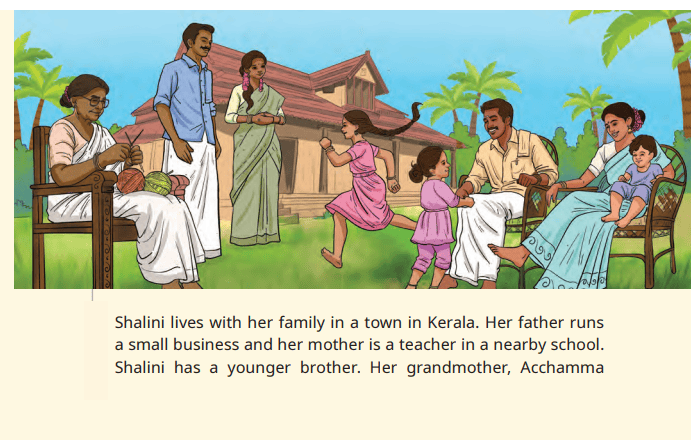
(father’s mother), Chittappa (father’s brother or paternal uncle)
and her Chitti (aunt or uncle’s wife) live with them. They have a
daughter, Shalini’s cousin, who she calls Chinni. Shalini’s uncle
has just lost his job and her aunt is a homemaker. The whole
family was preparing for the festival of Onam. Acchamma told
Shalini’s father that his brother was having financial difficulties,
so they were not able to buy new
clothes for the festival. When Shalini’s
parents took her and her brother
shopping, they bought new clothes
not only for themselves, but also for
Chittappa, Chitti and Chinni. As a
result, Shalini did not get the silk dress
she had expected; she had to settle
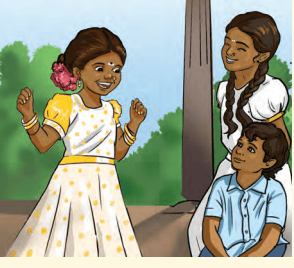
for a simple cotton one. Acchamma
explained to Shalini that this is how
families support each other and share
what they have. Shalini did not mind
her simpler dress. She was happy that
everyone could get some new clothes.
LET’S EXPLORE
---> Draw a simple tree of this family of seven members.
--->Why do you think Shalini’s parents bought clothes
for everyone?
--->What would you have done if you were in Shalini’s place?
That story was set in Kerala. Let us now travel northeast, to
a village in Meghalaya .
My name is Tenzing. I love the mountains we live in, though
life is sometimes hard. My father runs a small grocery
store. After my mother became busy in a local handicraft
cooperative, making our beautiful traditional fabrics,
wood carvings and other items for sale to tourists, my father joined
in cleaning the house, taking care of our small vegetable garden
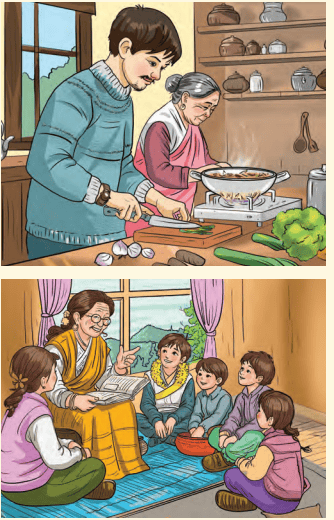
and other household chores.
Often, he helps my grandmother
prepare food for us all.
Grandmother always has all sorts
of interesting stories to tell me,
with humour and wisdom; no
one seems to understand people
better than her! Grandfather
helps me with my homework
and takes me to the school bus
stop. He is also actively involved
in social work in our colony
and is always offering his help
to others. For example, when
there is a power failure in our
area, he goes and registers a
complaint at the nearby office.
When our neighbours’ house got
damaged in a storm, he collected
some money from the whole
neighbourhood to help with
repairs.
We are lucky that my parents
can take care of our basic necessities like food and clothing.
When any special expenses come up, I have often seen that they
discuss them together. Mother says that we should always try to
save some money for any unexpected needs that may arise in the
future.
THINK ABOUT IT
---> Why does Tenzing’s father consult his wife for special
expenses?
---->How do you feel about his participation in household
chores?
----->What roles do the grandparents fulfil ?
LET’S EXPLORE
---->Create a story of a family somewhere in India, where we
see some family values practised. Share it with your class
either through writing or drawing.
---->Stage a small drama with all your classmates around two
or three families. The play you write could include some
challenging situations that the families faced, and show
how they are resolved.
---->In the stories of Shalini and Tenzing, we see examples of
joint families. What do you think are the aspects of modern
living that make some couples opt for a nuclear family (i.e.,
living apart from older generations or other relatives)?
What could be some advantages as well as disadvantages
of the two kinds of families?
Community
Families are connected not only within themselves, but
also with other families and the people around them. Such
a group of connected people may be called a ‘community’
(there are other meanings for ‘community’, depending on
the context). Members of a community come together for
various reasons, like celebrating festivals and organising
feasts, weddings and other events. In some villages, people
come together to support each other with agricultural
practices like land preparation, sowing and harvesting.
Over time, communities often agreed upon some practices
on the use of shared natural wealth and resources such
as water, grazing lands and forest produce. This is the case
with many tribal communities. To some extent, this remains
the case in village communities in rural India today. Such
practices — we may call them ‘rules’, though they were
rarely written down — have provided communities a secure
access to resources. But it also means that all families and individuals within the community have specific duties
to perform. Otherwise, the community will not function
smoothly.
DON’T MISS OUT
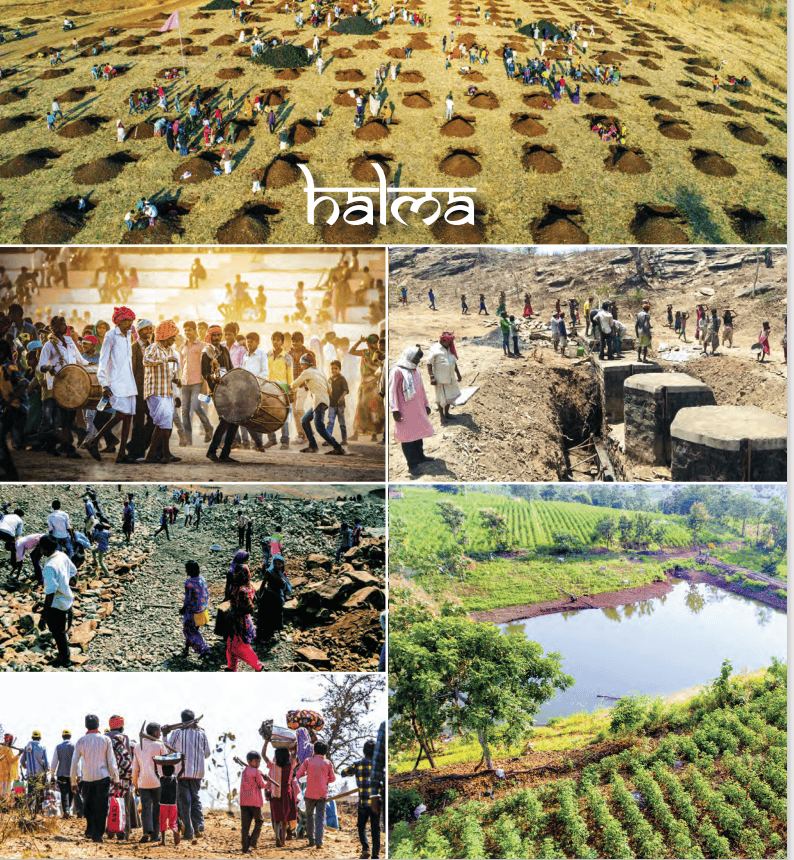
- Year after year, the region around the town of Jhabua,
in Madhya Pradesh, suffered from an acute water crisis.
Following their halma (see facing page) tradition of coming
together to support any individual or family in times of
crisis, the Bhil community decided to plant thousands of
trees in hundreds of villages. The Bhils also dug many
trenches to conserve rainwater and created other water
harvesting structures. They did not get paid for this work
but did it as their duty towards their community and
the environment. In the halma tradition, the objective is
to serve Mother Earth. In 2019, Shri Mahesh Sharma of
the Shivganga movement was honoured with the Padma
Shri award for his transformational work with the Bhil
communities.
- During the Chennai floods of 2015, roads turned to rivers
and people could no longer move around. Almost all
shops were closed and services interrupted. Many private
groups, in particular spiritual and religious organisations,
cooked large quantities of food and distributed it to people
who needed it.
- There are many more such examples of people coming
together to do something for the benefit of the community
without expecting anything in return. Have you heard
of any?
The real-life stories above illustrate community in a rural
context. Community is also present in an urban context,
although it may function a little differently. Let us see an
example from another real-life story.
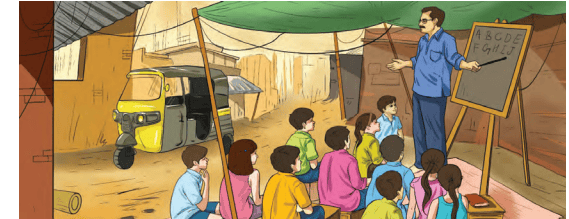
More than 20 years ago, in an area of Ahmedabad (Gujarat),
Kamal Parmar, owner of a small auto-fabrication workshop,
noticed a group of underprivileged children on the street.
Some had dropped out of school, while others had never
been to school. Kamal started giving them tuition from 5:30
to 9:30 pm every day, after his regular work hours. He also
provided the kids with a free dinner. Soon, 150 children
were attending those classes regularly and were deeply
interested in the lessons!
A few teachers from a local school noticed the classes and
joined the teaching for a while. One of them observed, “These
children don’t get proper benches to sit on, have no ‘silence
zone’ classrooms and the vehicles passing by make lots of
noise, yet they pay all their attention to what the teachers
tell them. This touched my heart. The love and affection I
got from them was unbelievable.” Some older children who
were attending regular schools also joined as volunteers to
teach in Kamal’s classes. One of them remarked, “We went
there to teach, instead we learnt a lot from them.”
- Discuss this story in your class. What kind of attitude
towards the community does it reveal?
- What values get reflected in Kamal Parmar’s
initiative?
-
- Think about those underprivileged children. Do you
think society has been unfair to them?
- What should society do to make sure that all children
get access to education?
New types of communities have also emerged in the last 30
or 40 years. Residents’ Welfare Associations in many urban
areas are examples of communities that make their own
rules and regulations. Those could be rules about waste
management, cleanliness of common areas, taking care of
pets, and so on. People living in the community participate
in making such rules and regulations.
Communities are ultimately interdependent. The same
Residents’ Welfare Associations, for instance, will depend
on the trading community for supplies and also on municipal
workers to handle waste. In our complex societies, everyone
depends on a number of other people and communities.
LET’S EXPLORE
Make a list of all people outside your family that are supporting
you through their work in one way or another.
- A jāti, or a subdivision of it, is also often called a
community.
- A group of people of a particular religion, region, common work or interest, especially a smaller group, may
also be called a community; for instance, ‘Mumbai’s
Parsi community’, ‘Chennai’s Sikh community’,
‘America’s Indian community’, ‘Kerala’s scientific
community’, ‘our school’s art community’, ‘the village’s
farming community’, and so on… The list is endless!
- In your school, you may be part of different communities
— your class, of course, but also the sports community,
the National Service Scheme, the National Cadet Corps,
a science or drama club, etc .
nities
— your class, of course, but also the sports community,
the National Service Scheme, the National Cadet Corps,
a science or drama club, etc. LET’S EXPLORE
---> What types of communities are you part of?
---> Is there a club that you are a part of in school? How does it
function ?
Before we move on ...
---> Family is the foundation of human society. Ideally, members
of a family support each other in their many duties and
tasks.
----->Community, a bigger unit, also implies that people do their
best to support each other. ‘Community’ can be defined in
several ways and there are many kinds of community.
----> Ultimately, communities are interdependent .
Questions, activities and projects
1. What are some of the rules you follow in your family and
neighbourhood? Why are they important?
2. Do you think some rules are unfair to a few people in the
family or community? Why?
3. Describe several situations that you have observed where
community support makes a difference. You can draw or
write about these .