CHAPTER -10
Grassroots Democracy – Part 1 Governance
“rājānam dharmagoptāram dharmo rakṣhati rakṣhitah” “The ruler protects dharma and dharma protects those who protect it.”
The Mahābhārata
“There is no peace without justice; no justice without equality; no equality without development; no democracy without respect to the identity and dignity of cultures and peoples
.” Rigoberta Menchú Tum
The Big
Questions ?
1. What is the meaning of
‘governance’?
2. Why do we need a government?
3. What is the meaning of
‘democracy’? Why is it
important?
Introduction
Human beings have been living in communities for a long
time. When a large number of people live together, there
can be disagreements and disorder, and rules become
necessary to maintain order and harmony in the society.
There are probably some simple rules at home that you are
expected to follow. The school where you study has rules too
— some for students, others for teachers. In higher classes,
students appearing for examinations must follow certain
rules. Drivers on the road are expected to obey traffic rules.
People employed in all kinds of jobs also need to follow the
rules set by their employer, while the employers must also
follow rules which they have committed to their employees.
What would happen if no one followed those rules? A
simple answer is that society would not be able to function.
LET’S EXPLORE
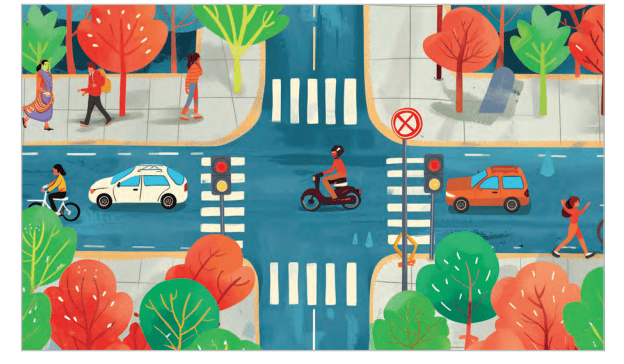
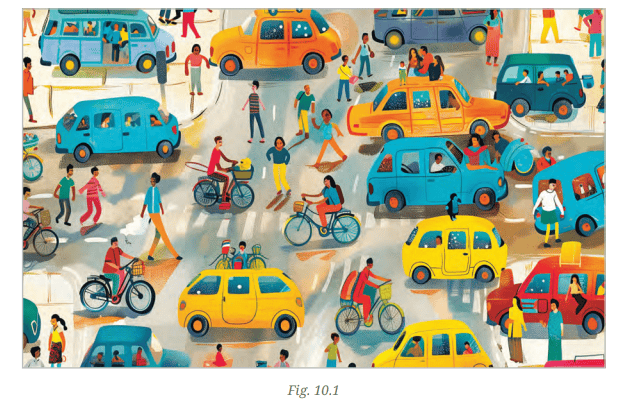
---> Describe the two pictures given in Fig. 10.1 on page 151 —
what differences do you see between them?
---> How do you connect this with our discussion on rules?
---->What are some of the rules in your school? Who made
them?
Who makes the rules and why? How are they made? These
are some of the questions we will explore in this chapter.
The process of taking decisions, organising the society’s
life with different sets of rules, and ensuring that they are
followed, is called governance. The group of individuals
or the system that makes the rules and ensures that they
are followed is called a government. Some of the more
important rules are called laws.
This does not mean that rules and laws are set once and for
all. Just as you might discuss a particular rule at home with
your parents, or as a student body might ask the school or university management to change a rule, citizens also have
a say in the laws and rules governing the society. We will
see how this takes place.
LET’S EXPLORE
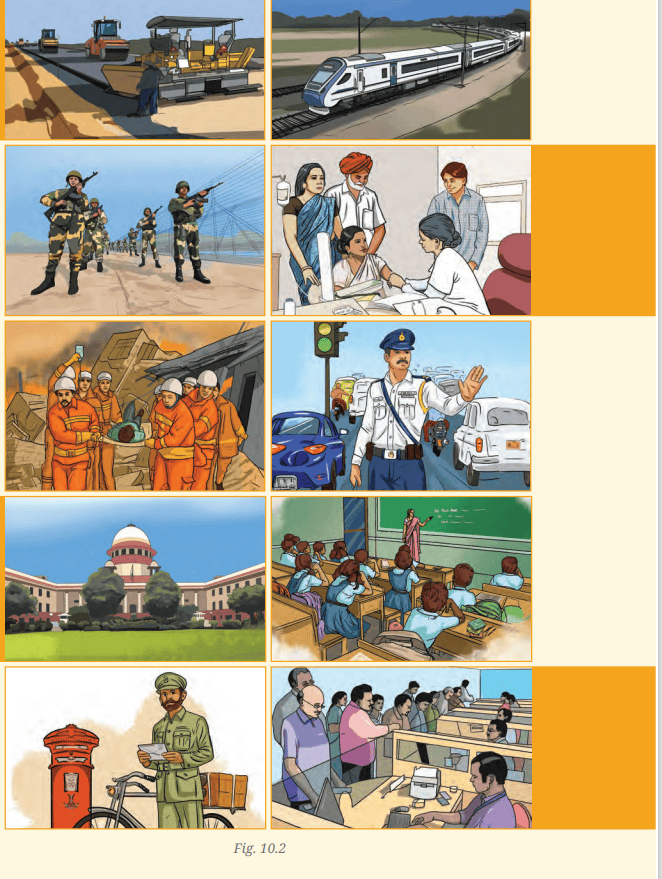
---> Can you identify the categories of public service or other
activities that are represented in the ten pictures in Fig. 10.2
on page 152?
---->What role do you think the government plays in each of
these activities?
---->Can you think of other aspects of your daily life where the
government plays an important role?
Three Organs of Government
All over the world, digital technologies have been
transforming the way societies function. In India, till about
30 years ago, people who wanted to transfer money to a
distant relative would have to queue up at the Post Office to
send a money order after filling up a form; or if they had to
send a payment to some business, they would queue up at
their bank to obtain a demand draft, which would then have
to be sent by post. You have probably never heard these
terms (‘money order’ or ‘demand draft’), because today we
have digital means of sending across money instantly!
However, this has also created a new class of criminals
who, without even leaving their desks, find digital ways of
stealing people’s money. This has led many governments
to pass new laws in order to fight such criminal activities
(called ‘cybercrime’). Some of those criminals, who believe
in robbing innocent people of their hard-earned money
instead of using their skills to contribute to the society,
have been arrested and convicted in court. They are usually
fined as well as jailed for some years .
Through this example, we can see how the three branches
or ‘organs’ of a government work together:
- The legislature is the organ that makes new laws (or
‘legislates’). Sometimes it also updates or removes
10-100724_v4.indd 153 11-Jul-24 3:59:01 PM
154Exploring Society: India and Beyond Governance and Democracy
existing laws. This is done by an assembly of representatives of the people. We will soon see how the Indian
system works .
- The executive is the organ that implements (or
‘executes’) the laws. This includes the head of state
(who may be a president, a prime minister or a chief
minister), the ministers and any agency responsible for
enforcing ‘law and order’. (In our example above, that
agency is the cyber police.)
- The judiciary is the system of courts which decides
whether someone has broken the law and, if so, what
course of action should be taken, including punishment
if necessary. Sometimes it also examines whether a
decision taken by the executive is right, or whether a
law passed by the legislature is well conceived and fair
to all.
LET’S EXPLORE
Explain how the three government organs are at work in
the case of the cybercriminals described above. How do they
intervene?
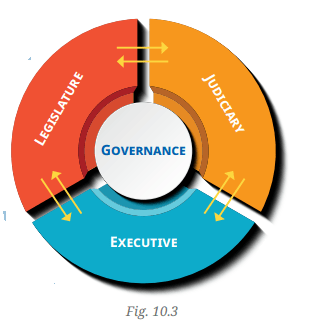
In any good system of governance,
these three organs must be
kept separate, although they
interact with each other
and work together. This
separation is called the
‘separation of powers’
(Fig. 10.3). It is intended
to provide a system of
checks and balances. This
means that each organ of the
government can check what the
other is doing and restore balance if
one organ acts beyond its expected role .
LET’S EXPLORE
As a class activity, can you imagine the sort of disorder we
might witness if all three organs were under the control of
the same group of people? Can you describe any such real-life
situation you may have heard of?
Three Levels of Government
Any government operates at two levels at the least —
local and national. In many countries, including India, it
functions at three levels or tiers — local, state or regional,
and national. Each level deals with different matters. To
use a comparison, if a bulb in your home is not lighting up,
you will first check the bulb, switch, fuse, etc. If that does
not work, you may call an electrician, and if it is found that
the problem is not within your home, you may need to go
to the Electricity Board and file a complaint. These are also
three levels of dealing with a problem.
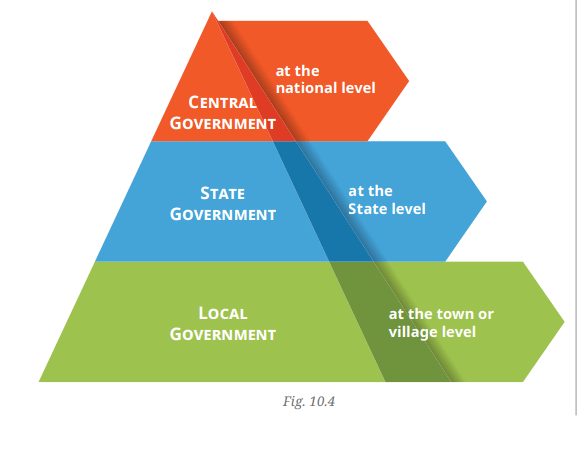
In India, we have local governments, State governments,
and Central or Union government (Fig. 10.4 on page 155).
Imagine that following heavy rain for a few days, there is a
flood in a part of a district. If it is not too severe, the local
authorities may be able to deal with it. If it involves several
towns and many villages, the State Government will step in
and send rescue teams to help affected people. But if it’s a
massive flood affecting vast areas, the Central Government
may also come to help by sending relief supplies, the army,
etc. These are the three levels again.
DON’T MISS OUT
Many of our institutions have mottos inspired by the wisdom
of our ancient texts. The Government of India’s motto, for
example, is Satyameva Jayate, which means “Truth alone
triumphs”. The Supreme Court’s motto is Yato Dharmastato
Jayah, or, “Where there is dharma, there is victory.”
The table on the facing page provides in summary a general
framework of the main functions of the government’s
three organs at the national and State levels. Their details
(including the precise role of the assemblies) will be
studied in greater depth in Grade 7. (Local government is
not mentioned here as we will look at it more closely in the
next two chapters.)
LET’S EXPLORE
----> Observe the table (Fig. 10.5). Highlight the functions and
responsibilities that affect your life the most.
---->Ask two or three adults about their connection or interaction
with the government ̶ at what levels does it take place and
for what purpose?
|
ALL INDIA
|
STATE LEVEL
|
Judiciary
|
Supreme Court
of India
|
High Court
|
|
NATIONAL LEVEL
|
STATE LEVEL
|
Legislature
|
Two houses ̶ Lok Sabha
and Rajya Sabha ̶
formulate national laws
|
One State Assembly
or Vidhan Sabha
(Note that most
States have a single
assembly; a few
States have two)
|
|
CENTRAL
GOVERNMENT
|
STATE
GOVERNMENT
|
Executive
|
Led by the President of
India (nominal head and
Supreme Commander of
the Indian Armed Forces),
Prime Minister as the
executive head
|
Led by the Governor
(nominal head),
Chief Minister as the
executive head
|
Functions
and
responsibilities
of the
Executive
(the list is not
exhaustive )
|
• Defence
• Foreign Affairs
• Atomic Energy
• Communications
• Currency
• Interstate Commerce
• Education
• Formulation of
National Policies
|
• Police, law and
order
• Adaptation and
implementation
of laws made
by the Central
government at the
State level.
• Public health
• Education
• Agriculture
• Irrigation
• Local governmen
|
House:
An assembly
where laws are
discussed or
passed.
Nominal: In
name only.
It means, in
our case, that
the President
of India and
the Governor
of a State are
not the actual
executive
heads. They
do have
certain powers
under special
circumstances,
but normally
do not
interfere in
the affairs of
the Central
or State
government.
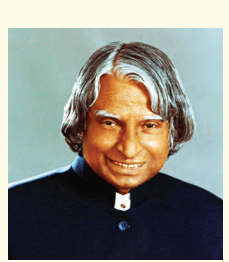
Dr. A.P.J. Abdul Kalam
Born in a humble family in Rameswaram, Tamil
Nadu, in 1931, Dr. A.P.J. Abdul Kalam was a
renowned scientist, nicknamed the ‘Missile Man
of India’ for his crucial role in the development
of India’s space programme, missile programme
and nuclear capabilities .
Dr. Abdul Kalam served as the 11th President
of India from 2002 to 2007. Despite his high
status, he remained deeply connected to the
people, and the youth in particular, through his passion for good
education and innovation. He inspired millions with his humility,
dedication to social causes and commitment to the nation. He
tirelessly encouraged young Indians to dream big and work hard
to achieve their goals.
Dr. Kalam showed that even though his position as the President
of India was nominal, he could play an important role, impacting
countless lives
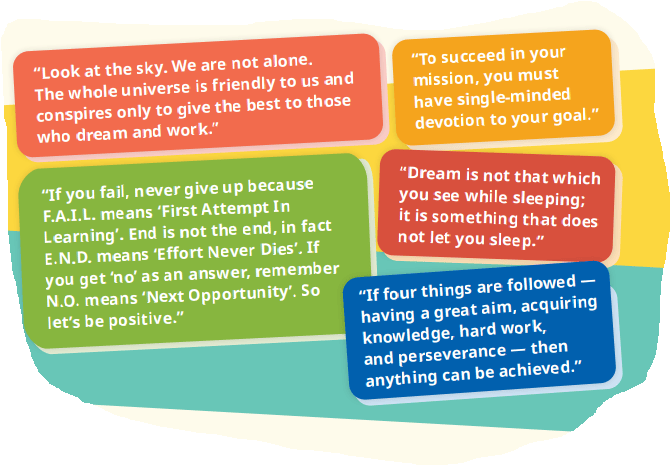
Let us meditate on a few of his inspiring thoughts:
S
Democracy
You may have noticed that we earlier mentioned
‘representatives of the people’. This is one of the foundation
stones of the system of governance adopted by most countries
of the world — democracy. The word ‘democracy’ comes
from two Greek words — dēmos meaning ‘people’, and
kratos meaning ‘rule’ or ‘power’; so ‘democracy’ literally
means the ‘rule of the people’.
But can all people actually rule? It is clearly not possible.
Imagine there is a problem that your class wants to bring
to the attention of your school’s principal — maybe there is
something wrong with the classroom, or with the school’s
infrastructure, or perhaps you would like to propose a
certain date for a field trip. Will the entire class go to the
principal? It would clearly not be practical. In many schools,
classes have a ‘class monitor’ or ‘class representative’,
whom the whole class elected; even if there is none, one
representative can be selected for this specific purpose. It
will be enough to send the representative to the principal.
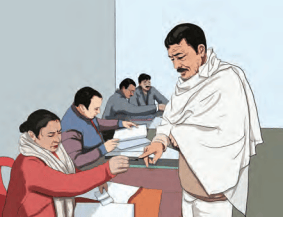
It is the same principle at the State or national levels ̶
through elections, people vote for representatives, who will
be the elected members of their respective assemblies. They
are generally called ‘Members of Legislative Assembly’
(or MLAs) at the State level, and ‘Member of Parliament’
(or MPs) at the national level.
All these members discuss laws,
problems and solutions in the
assemblies, and, through dialogue
and debate, try to convince each
other whenever there are different
opinions.
Like any modern democracy,
therefore, India is a representative
democracy. It is also the world’s
largest democracy, with some 970 million voters in 2024!
In principle, all Indian citizens above the age of 18 have the
right to participate in these elections.
Imagine that your class is planning to go for a picnic. There
are two possible places, A and B. The class discusses the
pros and cons — distance, time, cost, availability of basic
facilities, etc. It becomes difficult to arrive at a decision.
So your teacher decides that voting can solve the problem.
The number of students in favour of place A raise their
hands, then the number of students in favour of place B
raise theirs. The decision is taken by whichever option gets
a larger number of raised hands. (This process is called
voting.) This is a case of direct democracy where every
student’s opinion was taken to finalise the place.
The term grassroots democracy refers to a system that
enables and encourages the participation of ordinary
citizens — the base of the pyramid we saw in Fig. 10.4 on
page 155. In such a system, the citizens can have a say in
decisions which affect them.
We will study more features of Indian democracy in the
next two chapters and also in later grades.
Before we move on ...
----> No country can run without governance and government.
---->A modern government has three organs — legislative,
executive and judiciary — which need to work together.
---->The Indian government functions at three levels — Centre
or national, State and local.
---->Democracy is the overall framework for this system. It
functions through elected representatives, both at the State
and the national levels
Questions, activities and projects
1. Test yourself — What is the meaning of democracy?
What is the difference between direct democracy and
representative democracy?
2. Recall the three organs of government. What are their
different roles?
3. Why do we need three tiers of government?
4. Project: Many of you will remember the lockdown that
took place during the COVID-19 pandemic. Make a list of
all the actions that were taken at that time? Which tiers
of government were involved in managing the situation?
What was the role of each of the organs of government ?