Panchayati Raj System
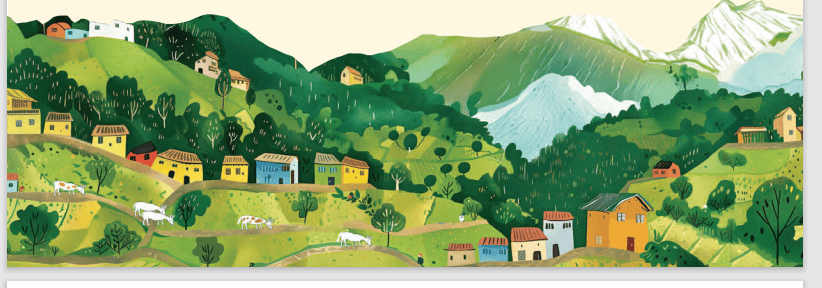
Like every village in India, the Lakshmanpur people have
a system of local government called ‘Panchayat’, which
refers to a village council. Panchayats bring governance
closer to the people, making it possible for them to actively
participate in decision-making processes. That is why
the Panchayat system, also known as Panchayati Raj, is
a form of self-government. Panchayats play a vital role
in addressing local issues, promoting development and
ensuring that the benefits of government schemes reach
the grassroots level.
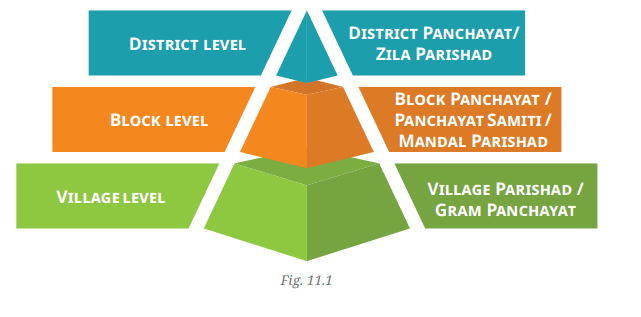
As is clear from the diagram, the Panchayati Raj system
works at three levels — from bottom up — the village, the
block and the district. This is called a ‘three-tier system’.
Together, these institutions’ responsibilities cover almost
all aspects of life in the district, from agriculture, housing,
maintenance of roads, management of water resources,
education, health care and social welfare to cultural
activities.
Gram Panchayat
Let us begin with the base of Fig. 11.1 on page 164 — the Gram
Panchayat, which is closest to the people in rural areas. Its
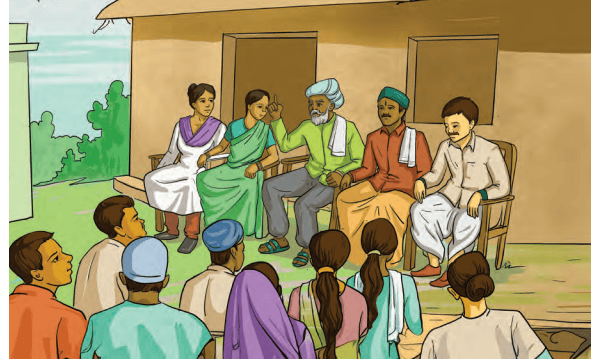
members are elected directly by the Gram Sabha, which is
a group of adults from a village (or group of neighbouring
villages) who are enrolled as voters. In the Gram Sabha,
women and men discuss all matters related to their area
and take decisions. Each Gram Panchayat elects a head
or president called the ‘Sarpanch’ or ‘Pradhan’. In recent
years, more and more women have become Sarpanchs
Exemplary Sarpanchs
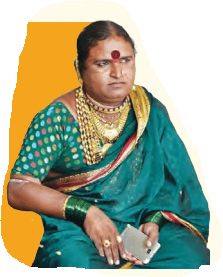
Dnyaneshwar Kamble is a transgender person who was
elected Sarpanch of Tarangfal village in the Solapur district of
Maharashtra in 2017. Kamble’s motto is lok seva, gram seva,
that is, ‘Service to the village is service to
the public.’ Kamble defeated six other
candidates to become the Sarpanch.
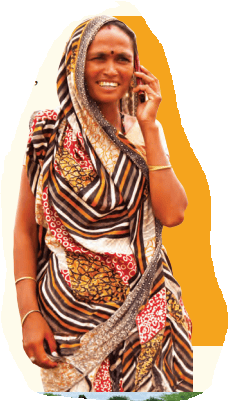
Vandana Bahadur Maida,
a member of the Bhil
commu-nity from the
village of Khankhandvi
in Madhya Pradesh, defied
patriarchal norms to become the first
female Sarpanch of her village. She
convinced women in the village to attend
the Sabha meetings and addressed critical
issues like education and sanitation,
earning recognition far and wide.
Vandana’s journey shows how women
can play a leading role in transforming rural India.
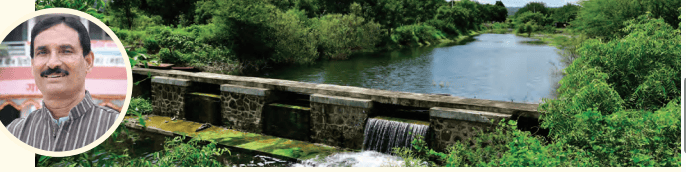
Hiware Bazar, a village in Ahmednagar district of Maharashtra, used
to be affected by frequent droughts and poor agricultural yield. After
Popatrao Baguji Pawar became its Sarpanch, he started applying
Anna Hazare’s model of rainwater harvesting, watershed conservation
and massive tree planting of lakhs of trees, all of which contributed to
the recharge of groundwater. With the collaboration of the villagers,
Hiware Bazar became a green and prosperous village in a few years.
Shri Popatrao Pawar was awarded the Padma Shri in 2020
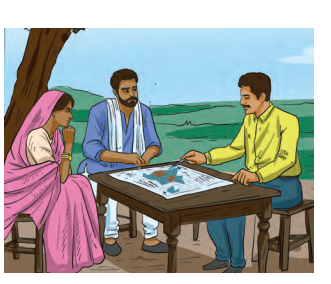
The Gram Panchayat is assisted by a
Panchayat Secretary who performs
administrative functions such as
calling meetings and maintaining
records. Most Gram Panchayats are
also assisted by an officer called
‘Patwari’ in many parts of India, who
maintains the villagers’ land records.
In some cases, the Patwari keeps
maps that are generations old!
THINK ABOUT IT
How do you think can these old maps be helpful for us?
Can they tell us something about the past and the present?
Child-Friendly Panchayat Initiative
Panchayats are supposed to listen to everyone’s voice
— including the voice of children. The Child-Friendly
Panchayat Initiative creates opportunities for children to
express their ideas and opinions on matters that concern
their wellbeing. Steps are being taken in several States to
encourage the participation of children in Bal Sabhas and
Bal Panchayats on a regular basis, while village elders try
to find solutions to their concerns.
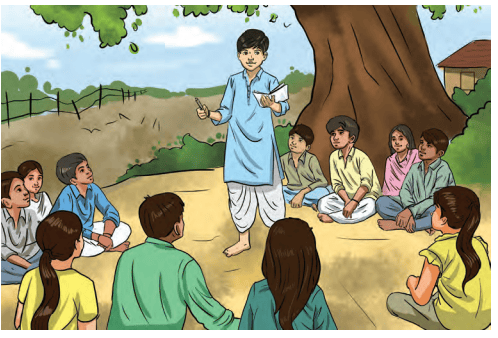
In Maharashtra, for example, a few Bal Panchayats have
worked to eliminate child labour and child marriage.
They have brought many children back to school. The Bal
Panchayat members get together to convince parents and
other adults to send their wards back to school, and not to
arrange marriages for girls who should be studying :
Several Gram Panchayats have won awards for taking
child-friendly initiatives. Here’s an example from Sikkim:
Sangkhu Radhu Khandu Gram Panchayat, in west Sikkim,
has given a lot of importance to children’s needs and rights.
The Panchayat has built compound walls for schools to
make them safer for children. To ensure that students get
hygienically cooked midday meals, the Gram Panchayat has
constructed kitchens in the schools. It is for these efforts
that Sangkhu Radhu Khandu has been declared a childfriendly Gram Panchayat.
Let us also look at another example from Rajasthan:
The ‘Children’s Parliament’, an offshoot of Bunker Roy’s
‘Barefoot College’ initiative a few decades ago, empowered
underprivileged children in Rajasthan’s rural areas
through education and democratic participation. Children
aged 8 to 14 are engaged in governance processes, learning
about democracy and social responsibility through night
schools and parliament-like elections. The ‘Parliament’
followed formal procedures, including voter ID cards
and campaigning. Elected representatives formed a
‘Cabinet’, overseeing school management and advocating
for community needs. The initiative fostered leadership
skills and social awareness, enabling children to challenge
societal norms and advocate for change. Children actively
addressed issues such as access to education, sanitation and
social equality, contributing to community development. The
Children’s Parliament initiative received many accolades,
including the World’s Children’s Honorary Award in 2001.
LET’S EXPLORE
As a class activity, let four or five students form a Bal Panchayat
and the rest of the class imagine they are the villagers. What
issues will the Gram Sabha discuss? What challenges could it
encounter? What solutions will it propose?
Panchayat Samiti and Zila Parishad
Similar institutions exist at the block level and the district
level, which are above the village level. Their names are
listed in the pyramidal diagram we saw in Fig. 11.1 on page
164. The Panchayat Samiti at the block level is the link
between the Gram Panchayat and the Zila Parishad at the
district level. The members of these institutions are elected
by the local people, but they may have other members like
Sarpanchs of the villages in the area and local members of
the State Legislative Assembly.
The composition of the Panchayat Samitis differs from State
to State, but their role in strengthening the participation
of local people remains the same. They coordinate matters
across Gram Panchayats, for instance, by collecting
development plans from all Gram Panchayats and putting
them together to present them at the District or State levels
respectively. This facilitates the allotment of funds for such
development projects and for government schemes such as
the Pradhan Mantri Gram Sadak Yojana, which promotes
the construction of all-weather roads in rural areas .
At all the three levels, special rules have been made so that
disadvantaged sections of the population can make their
needs and problems heard. These institutions also have a
provision for reserving one-third of the seats for women.
THINK ABOUT IT
Why do you think it is important for the government
to pay more attention to the needs and problems of the
disadvantaged sections of society?
LET’S EXPLORE
--->What similarities and differences do you notice between the
governance system at the Central level and at the Panchayat
level? (Hint: refer back to Chapter 10 if required.)
---> If you get an opportunity to meet a few Panchayat members,
what questions would you like to ask them? Discuss in
small groups to create a questionnaire. Meet some Gram
Panchayat members or invite them to your school. Ask them
the questions in your questionnaire and write a short report.
Let us remember that the structure and functions of
the Panchayati Raj institutions differ a little across
States. This is because the States have authority over
those institutions. But their objectives are the same
— it is to enable villagers to take an active part in the
management and development of their villages and
the local area.
The Arthaśhāstra is an ancient text of governance written
by Kauṭilya (later also known as Chāṇakya) some 2,300
years ago. Among other things, it describes how a state
should be structured and run, how the economy can be
made prosperous, what the duties of the ruler are and
how to conduct war. Kauṭilya, an expert in statecraft, also
explains how a whole administrative structure should be
put in place from the village to the regional capital :
“The king shall establish a sangrahaṇa (a sub-district head
quarters) for every 10 villages; a kārvaṭika (district headquarters)
for every 100 villages; a droṇamukha for every 400 villages; and
a sthānīya (provincial headquarters) for every 800 villages.”
In today’s language, what are the names we would give these
four categories? Is it not amazing that a similar structure was
thought of so long ago?
Before we move on ...
→ The local government in rural areas is organised into a
three-tier system.
→ Democracy in the Panchayati Raj system works both
through direct participation of people and through their
elected representatives.
→ The Panchayati Raj institutions give people in rural areas
a measure of self-governance, so they may manage their
issues and collaborate in development plans.
Questions, activities and projects
1. Test yourself — without looking at the text above, can you
name the three tiers of the Panchayati Raj system? What
are the key functions of each of the three tiers?
2. Write a letter to the Sarpanch regarding the issue of plastic
bags lying on the roadside in the village.
3. In your view, what type of person should be a Gram
Panchayat member?
4. Let us suppose that you study in a village school. The
school is located next to a highway and students find it
difficult to cross the road when they come to school or
leave at the end of the day. What are the options to solve
this issue? Which institutions in the Panchayati Raj can
help you? What can the students do ?