
1
PATTERNS IN MATHEMATICS
1.1 What is Mathematics?
Mathematics is, in large part, the search for patterns, and for
the explanations as to why those patterns exist.
Such patterns indeed exist all around us—in nature, in
our homes and schools, and in the motion of the sun, moon,
and stars. They occur in everything that we do and see, from
shopping and cooking, to throwing a ball and playing games, to
understanding weather patterns and using technology.
The search for patterns and their explanations can be a fun
and creative endeavour. It is for this reason that mathematicians
think of mathematics both as an art and as a science. This year, we
hope that you will get a chance to see the creativity and artistry
involved in discovering and understanding mathematical
patterns.
It is important to keep in mind that mathematics
aims to not just find out what patterns exist, but also the
explanations for why they exist. Such explanations can
often then be used in applications well beyond the context in
which they were discovered, which can then help to propel
humanity forward.
For example, the understanding of patterns in the motion of stars,
planets, and their satellites led humankind to develop the theory of
gravitation, allowing us to launch our own satellites and send rockets
to the Moon and to Mars; similarly, understanding patterns in genomes
has helped in diagnosing and curing diseases—among thousands of
other such examples.
 Figure it Out
- Can you think of other examples where mathematics helps us in our everyday lives?
- How has mathematics helped propel humanity forward? (You might think of examples involving: carrying out scientific experiments; running our economy and democracy; building bridges, houses or other complex structures; making TVs, mobile phones, computers, bicycles, trains, cars, planes, calendars, clocks, etc.)
1.2 Patterns in Numbers
Among the most basic patterns that occur in mathematics are
patterns of numbers, particularly patterns of whole numbers:
0, 1, 2, 3, 4, ...
The branch of Mathematics that studies patterns in whole
numbers is called number theory.
Number sequences are the most basic and among the most
fascinating types of patterns that mathematicians study.
Table 1 shows some key number sequences that are studied in
Mathematics.
Table 1 Examples of number sequences
1, 1, 1, 1, 1, 1, 1, ... (All 1’s)
1, 2, 3, 4, 5, 6, 7, ... (Counting numbers)
1, 3, 5, 7, 9, 11, 13, ... (Odd numbers)
2, 4, 6, 8, 10, 12, 14, ... (Even numbers)
1, 3, 6, 10, 15, 21, 28, ... (Triangular numbers)
1, 4, 9, 16, 25, 36, 49, ... (Squares)
1, 8, 27, 64, 125, 216, ... (Cubes)
1, 2, 3, 5, 8, 13, 21, ... (Virahānka numbers)
1, 2, 4, 8, 16, 32, 64, ... (Powers of 2)
1, 3, 9, 27, 81, 243, 729, ... (Powers of 3)
Figure it Out
- Can you recognize the pattern in each of the sequences in Table 1?
- Rewrite each sequence of Table 1 in your notebook, along
with the next three numbers in each sequence! After
each sequence, write in your own words what is the rule
for forming the numbers in the sequence.
1.3 Visualising Number Sequences
Many number sequences can be visualised using pictures.
Visualising mathematical objects through pictures or diagrams can
be a very fruitful way to understand mathematical patterns and
concepts.
Let us represent the first seven sequences in Table 1 using the
following pictures.
Table 2 Pictorial representation of some number sequences
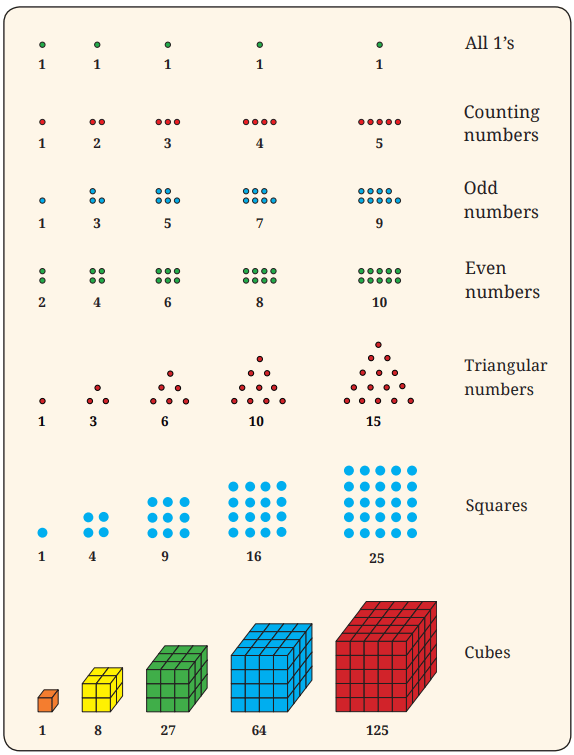
Figure it Out
- Copy the pictorial representations of the number sequences in Table 2 in your notebook, and draw the next picture for each sequence!
- Why are 1, 3, 6, 10, 15, … called triangular numbers? Why are 1, 4, 9, 16, 25, … called square numbers or squares? Why are 1, 8, 27, 64, 125, … called cubes?
- You will have noticed that 36 is both a triangular number and a square number! That is, 36 dots can be arranged perfectly both in a triangle and in a square. Make pictures in your notebook illustrating this! This shows that the same number can be represented differently, and play different roles, depending on the context. Try representing some other numbers pictorially in different ways!
- What would you call the following sequence of numbers?
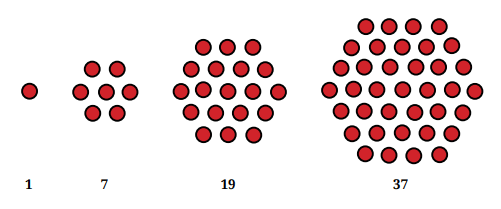
That’s right, they are called hexagonal numbers! Draw these in
your notebook. What is the next number in the sequence?
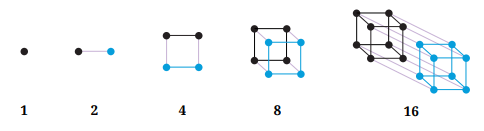
5. Can you think of pictorial ways to visualise the sequence of
Powers of 2? Powers of 3?
Here is one possible way of thinking about Powers of 2:
1.4 Relations among Number Sequences
Sometimes, number sequences can be related to each other in
surprising ways.
Example: What happens when we start adding up odd numbers?
1 = 1
1 + 3 = 4
1 + 3 + 5 = 9
1 + 3 + 5 + 7 = 16
1 + 3 + 5 + 7 + 9 = 25
1 + 3 + 5 + 7 + 9 + 11 = 36
This is a really beautiful pattern!
Why does this happen? Do you think it will happen forever?The answer is that the pattern does happen forever. But why?
As mentioned earlier, the reason why the pattern happens is just as
important and exciting as the pattern itself.
A picture can explain it
Visualising with a picture can help explain the phenomenon. Recall
that square numbers are made by counting the number of dots in a
square grid.
How can we partition the dots in a square grid into odd
numbers of dots: 1, 3, 5, 7,... ?Think about it for a moment before reading further!
Here is how it can be done:
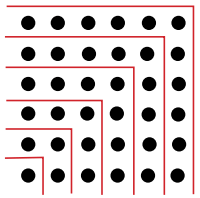
This picture now makes it evident that
1 + 3 + 5 + 7 + 9 + 11 = 36.
Because such a picture can be made for a square of any size, this
explains why adding up odd numbers gives square numbers.
By drawing a similar picture, can you say what is the sum of the
first 10 odd numbers? Now by imagining a similar picture, or by drawing it partially, as
needed, can you say what is the sum of the first 100 odd numbers?Another example of such a relation between sequences:
Adding up and down
Let us look at the following pattern:
1 = 1
1 + 2 + 1 = 4
1 + 2 + 3 + 2 + 1 = 9
1 + 2 + 3 + 4 + 3 + 2 + 1 = 16
1 + 2 + 3 + 4 + 5 + 4 + 3 + 2 + 1 = 25
1 + 2 + 3 + 4 + 5 + 6 + 5 + 4 + 3 + 2 + 1 = 36
This seems to be giving yet another way of getting the square numbers—
by adding the counting numbers up and then down!
Can you find a similar pictorial explanation? Figure it Out
- Can you find a similar pictorial explanation for why adding counting numbers up and down, i.e., 1, 1 + 2 + 1, 1 + 2 + 3 + 2 + 1, …, gives square numbers?
- By imagining a large version of your picture, or drawing it partially, as needed, can you see what will be tha value of 1 + 2 + 3 + ... + 99 + 100 + 99 + ... + 3 + 2 + 1?
- Which sequence do you get when you start to add the All 1’s sequence up? What sequence do you get when you add the All 1’s sequence up and down?
- Which sequence do you get when you start to add the Counting numbers up? Can you give a smaller pictorial explanation?
- What happens when you add up pairs of consecutive triangular numbers? That is, take 1 + 3, 3 + 6, 6 + 10, 10 + 15, … ? Which sequence do you get? Why? Can you explain it with a picture?
- What happens when you start to add up powers of 2 starting with
1, i.e., take 1, 1 + 2, 1 + 2 + 4, 1 + 2 + 4 + 8, … ? Now add 1 to each
of these numbers—what numbers do you get? Why does this
happen?
- What happens when you multiply the triangular numbers by 6 and add 1? Which sequence do you get? Can you explain it with a picture?
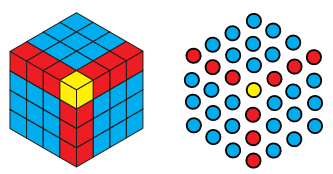
- What happens when you start to add up hexagonal numbers, i.e.,
take 1, 1 + 7, 1 + 7 + 19, 1 + 7 + 19 + 37, … ? Which sequence do you
get? Can you explain it using a picture of a cube?
9. Find your own patterns or relations in and among the sequences
in Table 1. Can you explain why they happen with a picture or
otherwise?
1.5 Patterns in Shapes
Other important and basic patterns that occur in Mathematics are
patterns of shapes. These shapes may be in one, two, or three
dimensions (1D, 2D, or 3D)—or in even more dimensions. The
branch of Mathematics that studies patterns in shapes is called
geometry.
Shape sequences are one important type of shape pattern that
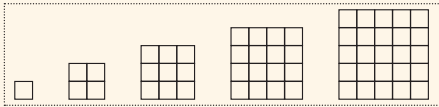
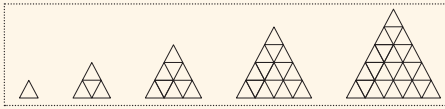
mathematicians study. Table 3 shows a few key shape sequences
that are studied in Mathematics.
Table 3 Examples of shape sequences
| Regular Polygons | |||
 Triangle
|
 Quadri-
lateral
|
 Penta-
gon
|
 Hexa-
gon
|
 Hepta-gon |
 Octa- gon |
 Nona-gon |
 Deca- gon |
| Complete Graphs | ||||
 K2
|
 K3
|
 K4
|
 K5
|
 K6
|
| Stacked Squares |
 |
| Stacked
Triangles |
 |
| Koch
Snowflake |
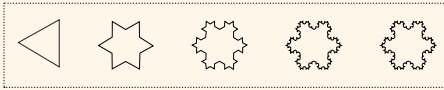 |
Figure it Out- Can you recognise the pattern in each of the sequences in Table 3?
- Try and redraw each sequence in Table 3 in your notebook.
Can you draw the next shape in each sequence? Why or why
not? After each sequence, describe in your own words what
is the rule or pattern for forming the shapes in the sequence.
1.6 Relation to Number Sequences
Often, shape sequences are related to number sequences in surprising
ways. Such relationships can be helpful in studying and understanding
both the shape sequence and the related number sequence.
Example: The number of sides in the shape sequence of Regular
Polygons is given by the counting numbers starting at 3, i.e., 3, 4, 5, 6,
7, 8, 9, 10, .... That is why these shapes are called, respectively, regular
triangle, quadrilateral (i.e., square), pentagon, hexagon, heptagon,
octagon, nonagon, decagon, etc., respectively.
The word ‘regular’ refers to the fact that these shapes have
equal-length sides and also equal ‘angles’ (i.e., the sides look the same
and the corners also look the same). We will discuss angles in more
depth in the next chapter.
The other shape sequences in Table 3 also have beautiful
relationships with number sequences.
Figure it Out- Count the number of sides in each shape in the sequence of Regular Polygons. Which number sequence do you get? What about the number of corners in each shape in the sequence of Regular Polygons? Do you get the same number sequence? Can you explain why this happens?
- Count the number of lines in each shape in the sequence
of Complete Graphs. Which number sequence do you get?
Can you explain why?
- How many little squares are there in each shape of the sequence of Stacked Squares? Which number sequence does this give? Can you explain why?
- How many little triangles are there in each shape of the sequence of Stacked Triangles? Which number sequence does this give? Can you explain why? (Hint: In each shape in the sequence, how many triangles are there in each row?)
- To get from one shape to the next shape in the Koch
Snowflake sequence, one replaces each line segment ‘—’
by a ‘speed bump’
 . As one does this more and more
times, the changes become tinier and tinier with very very
small line segments. How many total line segments are
there in each shape of the Koch Snowflake? What is the
corresponding number sequence? (The answer is 3, 12, 48, ...,
i.e. 3 times Powers of 4; this sequence is not shown in Table 1)
. As one does this more and more
times, the changes become tinier and tinier with very very
small line segments. How many total line segments are
there in each shape of the Koch Snowflake? What is the
corresponding number sequence? (The answer is 3, 12, 48, ...,
i.e. 3 times Powers of 4; this sequence is not shown in Table 1)
Summary
- Mathematics may be viewed as the search for patterns and for the
explanations as to why those patterns exist.
- Among the most basic patterns that occur in mathematics are number
sequences.
- Some important examples of number sequences include the counting
numbers, odd numbers, even numbers, square numbers, triangular
numbers, cube numbers, Virahānka numbers, and powers of 2.
- Sometimes number sequences can be related to each other in beautiful and remarkable ways. For example, adding up the sequence of odd numbers starting with 1 gives square numbers.
- Visualizing number sequences using pictures can help to understand
sequences and the relationships between them.
- Shape sequences are another basic type of pattern in mathematics.
Some important examples of shape sequences include regular polygons,
complete graphs, stacked triangles and squares, and Koch snowflake
iterations. Shape sequences also exhibit many interesting relationships
with number sequences.