

3
NUMBER PLAY
Numbers are used in different contexts and in many different ways
to organise our lives. We have used numbers to count, and have
applied the basic operations of addition, subtraction, multiplication
and division on them, to solve problems related to our daily lives.
In this chapter, we will continue this journey, by playing with
numbers, seeing numbers around us, noticing patterns, and learning
to use numbers and operations in new ways.
 Think about various situations where we use numbers. List
five different situations in which numbers are used. See what
your classmates have listed, share, and discuss.
Think about various situations where we use numbers. List
five different situations in which numbers are used. See what
your classmates have listed, share, and discuss.3.1 Numbers can Tell us Things
What are these numbers telling us?
Some children in a park are standing in a line. Each one says a number.
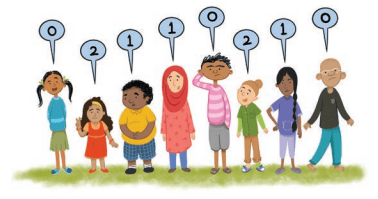 What do you think these numbers mean?
 The children now rearrange themselves, and again each one
says a number based on the arrangement.
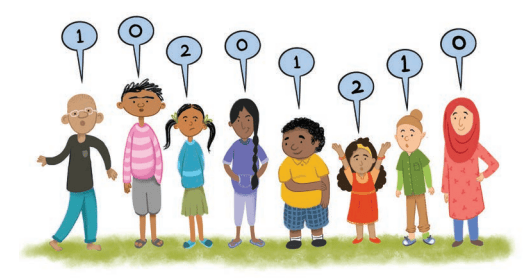
Did you figure out what these numbers represent?
Hint: Could their heights be playing a role?
A child says ‘1’ if there is only one taller child standing next to them.
A child says ‘2’ if both the children standing next to them are taller.
A child says ‘0’, if neither of the children standing next to them are taller.
That is each person says the number of taller neighbours they have.
Try answering the questions below and share your reasoning:- Can the children rearrange themselves so that the children standing at the ends say ‘2’?
- Can we arrange the children in a line so that all would say only 0s?
- Can two children standing next to each other say the same number?
- There are 5 children in a group, all of different heights. Can they stand such that four of them say ‘1’ and the last one says ‘0’? Why or why not?
- For this group of 5 children, is the sequence 1, 1, 1, 1, 1 possible?
- Is the sequence 0, 1, 2, 1, 0 possible? Why or why not?
- How would you rearrange the five children so that the
maximum number of children say ‘2’?
3.2 Supercells
Observe the numbers written in the table below. Why are some
numbers coloured? Discuss.
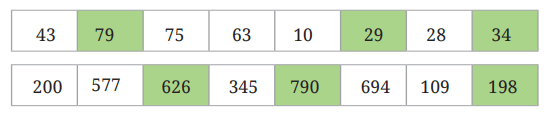
A cell is coloured if the number in it is larger than its adjacent
cells. 626 is coloured as it is larger than 577 and 345 whereas 200 is
not coloured as it is smaller than 577. The number 198 is coloured as
it has only one adjacent cell with 109 in it, and 198 is larger than 109.
Figure it Out1. Colour or mark the supercells in the table below.

2. Fill the table below with only 4-digit numbers such that the
supercells are exactly the coloured cells.

3. Fill the table below such that we get as many supercells as possible.
Use numbers between 100 and 1000 without repetitions.

4. Out of the 9 numbers, how many supercells are there in the table
above? ___________
5. Find out how many supercells are possible for different
numbers of cells.
Do you notice any pattern? What is the method to fill a given
table to get the maximum number of supercells? Explore and
share your strategy.
6. Can you fill a supercell table without repeating numbers such
that there are no supercells? Why or why not?
7. Will the cell having the largest number in a table always be a
supercell? Can the cell having the smallest number in a table
be a supercell? Why or why not?
8. Fill a table such that the cell having the second largest number
is not a supercell.
9. Fill a table such that the cell having the second largest
number is not a supercell but the second smallest number is
a supercell. Is it possible?
10. Make other variations of this puzzle and challenge your
classmates.
Let’s do the supercells activity with more rows.
Here the neighbouring cells are those that are immediately to the
left, right, top and bottom.
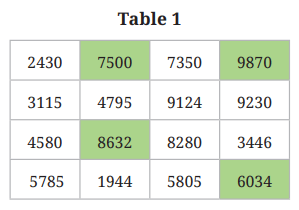
The rule remains the same: a
cell becomes a supercell if the
number in it is greater than all
the numbers in its neighbouring
cells. In Table 1, 8632 is greater
than all its neighbours 4580,
8280, 4795 and 1944.
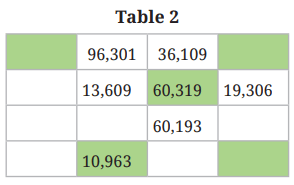
Complete Table 2 with 5-digit
numbers whose digits are ‘1’,
‘0’, ‘6’, ‘3’, and ‘9’ in some order.
Only a coloured cell should
have a number greater than all
its neighbours.
The biggest number in the table
is ____________ .The smallest even number in the table is ____________.
The smallest number greater than 50,000 in the table is ____________.
Once you have filled the table above, put commas appropriately
after the thousands digit.
3.3 Patterns of Numbers on the Number Line
We are quite familiar with number lines now. Let’s see if we can
place some numbers in their appropriate positions on the number
line. Here are the numbers: 2180, 2754, 1500, 3600, 9950, 9590, 1050,
3050, 5030, 5300 and 8400.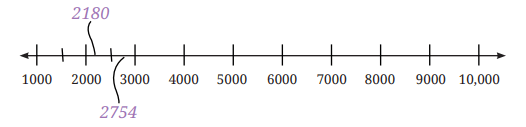 Figure it Out
Identify the numbers marked on the number lines below, and label
the remaining positions.
a. 
b. 
c. 
d. 
Put a circle around the smallest number and a box around the
largest number in each of the sequences above.
3.4 Playing with Digits
We start writing numbers from 1, 2, 3 … and so on. There are nine
1-digit numbers.
Find out how many numbers have two digits, three digits, four
digits, and five digits: 1-digit
numbers
From 1–9
------------------------
|
2-digit numbers ------------------------ |
3-digit numbers ------------------------ |
4-digit numbers ------------------------ |
5-digit numbers ------------------------ |
| 9 |
Digit Sums of Numbers
Komal observes that when she adds up
digits of certain numbers the sum is the
same.
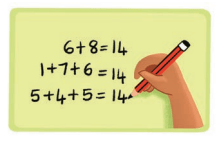
For example, adding the digits of the
number 68 will be same as adding the
digits of 176 or 545.
Figure it Out1. Digit sum 14
a. Write other numbers whose digits add up to 14.
b. What is the smallest number whose digit sum is 14?
c. What is the largest 5-digit whose digit sum is 14?
d. How big a number can you form having the digit sum
14? Can you make an even bigger number?
2. Find out the digit sums of all the numbers from 40 to 70.
Share your observations with the class.
3. Calculate the digit sums of 3-digit numbers whose digits are
consecutive (for example, 345). Do you see a pattern? Will this
pattern continue?
Digit Detectives
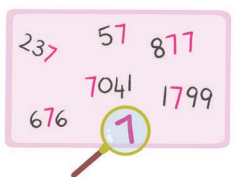
After writing numbers from 1 to 100,
Dinesh wondered how many times he
would have written the digit ‘7’!
Among the numbers 1–100, how
many times will the digit ‘7’ occur?
Among the numbers 1–1000, how
many times will the digit ‘7’ occur? 3.5 Pretty Palindromic Patterns
What pattern do you see in these numbers: 66, 848, 575, 797, 1111?
These numbers read the same from left to right and from right to left.
Try and see. Such numbers are called palindromes or palindromic
numbers.
All palindromes using 1, 2, 3
The numbers 121, 313, 222 are some examples of palindromes using
the digits ‘1’, ‘2’, 3’.
Write all possible 3-digit palindromes using these digits.
Reverse-and-add palindromes
Now look at these additions. Try to figure out what is happening.
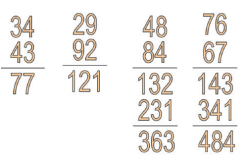
Steps to follow: Start with a
2-digit number. Add this number
to its reverse. Stop if you get a
palindrome; else repeat the steps
of reversing the digits and adding.
Try the same procedure
for some other numbers, and
perform the same steps. Stop if you get a palindrome. There are numbers for which you have to
repeat this a large number of times.
Are there numbers for which you do not reach a palindrome
at all?
ExploreWill reversing and adding numbers repeatedly, starting with
a 2-digit number, always give a palindrome? Explore and find
out.*
Puzzle time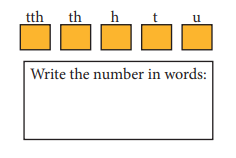
I am a 5-digit palindrome.
I am an odd number.
My ‘t’ digit is double of my ‘u’ digit.
My ‘h’ digit is double of my ‘t’ digit.
Who am I? _________________
3.6 The Magic Number of Kaprekar
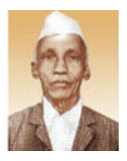
D.R. Kaprekar was a mathematics teacher in a
government school in Devlali, Maharashtra. He liked
playing with numbers very much and found many
beautiful patterns in numbers that were previously
unknown.
In 1949, he discovered a fascinating and magical
phenomenon when playing with 4-digit numbers.
*The answer is yes! For 3-digit numbers the answer is unknown. It is suspected that
starting with 196 never yields a palindrome!
Follow these steps and experience the magic for yourselves!
Pick any 4-digit number, say 6382.
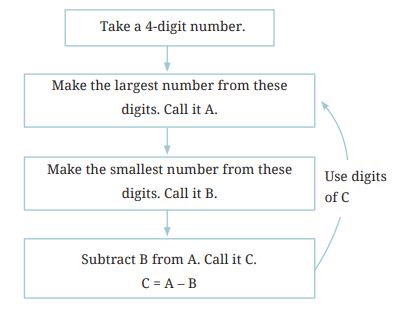
What happens if we continue
doing this?

Take different 4-digit numbers and try carrying out these steps. Find
out what happens. Check with your friends what they got.
You will always reach the magic number ‘6174’! The number
‘6174’ is now called the ‘Kaprekar constant’.
Carry out these same steps with a few 3-digit numbers. What number
will start repeating?
3.7 Clock and Calendar Numbers
On the usual 12-hour clock, there are timings with different patterns.
For example, 4:44, 10:10, 12:21.
 Try and find out all possible times on a 12-hour clock of each of
these types.
Try and find out all possible times on a 12-hour clock of each of
these types. Manish has his birthday on
20/12/2012 where the digits ‘2’, ‘0’, ‘1’,
and ‘2’ repeat in that order.
Find some other dates of this form
from the past. His sister Meghana has her birthday
on 11/02/2011 where the digits read
the same from left to right and from right to left.
Find all possible dates of this form from the past. Jeevan was looking at this year’s calendar. He started wondering,
“Why should we change the calendar every year! Can we not reuse a
calendar?” What do you think?
You might have noticed that last year’s calendar was different
from this year’s. Also, next year’s calendar is also different from the
previous years.
But, will any year’s calendar repeat again after some years?
Will all dates and days in a year match exactly with that of
another year? Figure it Out1. Pratibha uses the digits ‘4’, ‘7’, ‘3’ and ‘2’, and makes the smallest and
largest 4-digit numbers with them: 2347 and 7432. The difference
between these two numbers is 7432 – 2347 = 5085. The sum of these
two numbers is 9779. Choose 4–digits to make:
a. the difference between the largest and smallest numbers
greater than 5085.
b. the difference between the largest and smallest numbers less
than 5085.
c. the sum of the largest and smallest numbers greater than 9779.
d. the sum of the largest and smallest numbers less than 9779.
2. What is the sum of the smallest and largest 5-digit palindrome?
What is their difference?
3. The time now is 10:01. How many minutes until the clock shows
the next palindromic time? What about the one after that?
4. How many rounds does the number 5683 take to reach the Kaprekar
constant?
3.8 Mental Math
Observe the figure below. What can you say about the numbers and
the lines drawn?
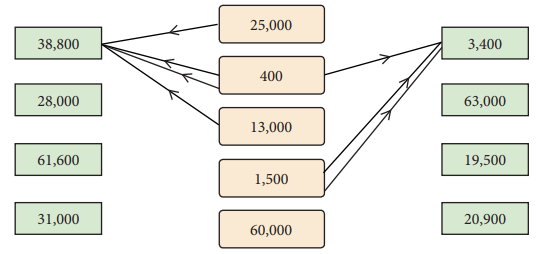
Numbers in the middle column are added in different ways to get
the numbers on the sides (1500 + 1500 + 400 = 3400). The numbers in
the middle can be used as many times as needed to get the desired
sum. Draw arrows from the middle to the numbers on the sides to
obtain the desired sums.
Two examples are given. It is simpler to do it mentally!
38,800 = 25,000 + 400 × 2 + 13,000
3400 = 1500 + 1500 + 400
Can we make 1,000 using the numbers in the middle? Why not?
What about 14,000, 15,000 and 16,000? Yes, it is possible. Explore how.
What thousands cannot be made?Adding and Subtracting
Here, using the numbers in the boxes, we are allowed to use both addition
and subtraction to get the required number. An example is shown.
| 40,000 | 7,000 |
| 300 | 1,500 |
| 12,000 | 800 |
39,800 = 40,000 – 800 + 300 + 300
45,000 =
5,900 =
17,500 =
21,400 =
Digits and Operations
An example of adding two 5-digit numbers to get another 5-digit
number is 12,350 + 24,545 = 36,895.
An example of subtracting two 5-digit numbers to get another
5-digit number is 48,952 – 24,547 = 24,405.
Figure it Out1. Write an example for each of the below scenarios whenever
possible.
| 5-digit + 5-digit to give a 5-digit sum more than 90,250 |
5-digit + 3-digit to give a 6-digit sum |
4-digit + 4-digit to give a 6-digit sum |
5-digit + 5-digit to give a 6-digit sum |
5-digit + 5-digit to give 18,500 |
| 5-digit – 5-digit to give a difference less than 56,503 |
5-digit – 3-digit to give a 4-digit difference |
5-digit − 4-digit to give a 4-digit difference |
5-digit − 5-digit to give a 3-digit difference |
5-digit − 5-digit to give 91,500 |
Could you find examples for all the cases? If not, think and
discuss what could be the reason. Make other such questions
and challenge your classmates.
2. Always, Sometimes, Never?
Below are some statements. Think, explore and find out if
each of the statement is ‘Always true’, ‘Only sometimes true’
or ‘Never true’. Why do you think so? Write yourreasoning;
discuss this with the class.
a. 5-digit number + 5-digit number gives a 5-digit number
b. 4-digit number + 2-digit number gives a 4-digit number
c. 4-digit number + 2-digit number gives a 6-digit number
d. 5-digit number – 5-digit number gives a 5-digit number
e. 5-digit number – 2-digit number gives a 3-digit number
3.9 Playing with Number Patterns
Here are some numbers arranged in some patterns. Find out the
sum of the numbers in each of the below figures. Should we add
them one by one or can we use a quicker way?
Share and discuss in class the different methods each of you used
to solve these questions. a. 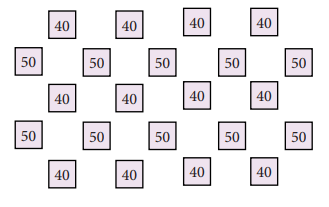
b. 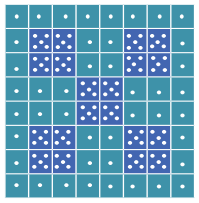
c. 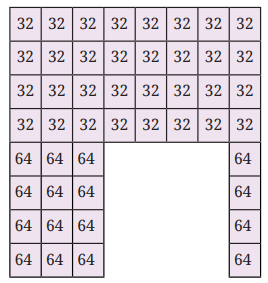
d. 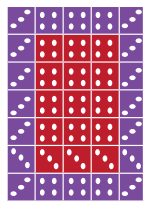
e. 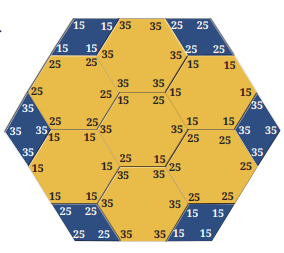
f. 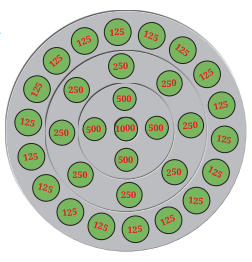
3.10 An Unsolved Mystery - the Collatz Conjecture!
Look at the sequences below—the same rule is applied in all the
sequences:
a. 12, 6, 3, 10, 5, 16, 8, 4, 2, 1
b. 17, 52, 26, 13, 40, 20, 10, 5, 16, 8, 4, 2, 1
c. 21, 64, 32, 16, 8, 4, 2, 1
d. 22, 11, 34, 17, 52, 26, 13, 40, 20, 10, 5, 16, 8, 4, 2, 1
Do you see how these sequences were formed?
The rule is: one starts with any number; if the number is even,
take half of it; if the number is odd, multiply it by 3 and add 1;
repeat.
Notice that all four sequences above eventually reached the
number 1. In 1937, the German mathematician Lothar Collatz
conjectured that the sequence will always reach 1, regardless of
the whole number you start with. Even today—despite many
mathematicians working on it — it remains an unsolved problem as
to whether Collatz’s conjecture is true! Collatz’s conjecture is one of
the most famous unsolved problems in mathematics.
Make some more Collatz sequences like those above, starting
with your favourite whole numbers. Do you always reach 1?
Do you believe the conjecture of Collatz that all such sequences
will eventually reach 1? Why or why not?
3.11 Simple Estimation
At times, we may not know or need an exact count of things and
an estimate is sufficient for the purpose at hand. For example,
your school headmaster might know the exact number of students
enrolled in your school, but you may only know an estimated
count. How many students are in your school? About 150? 400? A
thousand?
Paromita’s class section has 32 children. The other 2 sections of
her class have 29 and 35 children. So, she estimated the number of
children in her class to be about 100. Along with Class 6, her school
also has Classes 7–10 and each class has 3 sections each. She assumed
a similar number in each class and estimated the number of students
in her school to be around 500.
Figure it Out We shall do some simple estimates. It is a fun exercise, and you may
find it amusing to know the various numbers around us. Remember,
we are not interested in the exact numbers for the following questions.
Share your methods of estimation with the class.
1. Steps you would take to walk:
a. From the place you are sitting to the classroom door
b. Across the school ground from start to end
c. From your classroom door to the school gate
d. From your school to your home
2. Number of times you blink your eyes or number of breaths you
take:
a. In a minute
b. In an hour
c. In a day
3. Name some objects around you that are:
a. a few thousand in number
b. more than ten thousand in number
Estimate the answer Try to guess within 30 seconds. Check your guess with your friends.
1. Number of words in your maths textbook:
a. More than 5000
b. Less than 5000
2. Number of students in your school who travel to school by bus:
a. More than 200
b. Less than 200
3. Roshan wants to buy milk and 3 types of fruit to make fruit
custard for 5 people. He estimates the cost to be ₹ 100. Do you
agree with him? Why or why not?
4. Estimate the distance between Gandhinagar (in Gujarat) to
Kohima (in Nagaland).
[Hint: Look at the map of India to locate these cities.]
5. Sheetal is in Grade 6 and says she has spent around 13,000 hours
in school till date. Do you agree with her? Why or why not?
6. Earlier, people used to walk long distances as they had no other
means of transport. Suppose you walk at your normal pace.
Approximately how long would it take you to go from:
a. Your current location to one of your favourite places nearby.
b. Your current location to any neighbouring state’s capital city.
c. The southernmost point in India to the northernmost point in
India.
7. Make some estimation questions and challenge your classmates!
3.12 Games and Winning Strategies
Numbers can also be used to play games and develop winning
strategies.
Here is a famous game called 21. Play it with a classmate. Then
try it at home with your family!
Rules for Game #1: The first player says 1, 2 or 3. Then the two
players take turns adding 1, 2, or 3 to the previous number said. The
first player to reach 21 wins! Play this game several times with your classmate. Are you starting
to see the winning strategy?
Which player can always win if they play correctly? What is the
pattern of numbers that the winning player should say?
There are many variations of this game. Here is another common
variation:
Rules for Game #2: The first player says a number between 1 and
10. Then the two players take turns adding a number between 1 and
10 to the previous number said. The first player to reach 99 wins! Play this game several times with your classmate. See if you can
figure out the corresponding winning strategy in this case! Which player can always win? What is the pattern of numbers that the
winning player should say this time?
Make your own variations of this game — decide how much one
can add at each turn, and what number is the winning number. Then
play your game several times, and figure out the winning strategy
and which player can always win!
Figure it Out- There is only one supercell (number greater than all its neighbours) in this grid. If you exchange two digits of one of the numbers, there will be 4 supercells. Figure out which digits to swap.
- 2. How many rounds does your year of birth take to reach the Kaprekar constant?
- We are the group of 5-digit numbers between 35,000 and 75,000 such that all of our digits are odd. Who is the largest number in our group? Who is the smallest number in our group? Who among us is the closest to 50,000?
- Estimate the number of holidays you get in a year including weekends, festivals and vacation. Then try to get an exact number and see how close your estimate is.
- Estimate the number of liters a mug, a bucket and an overhead
tank can hold.
- Write one 5-digit number and two 3-digit numbers such that their sum is 18,670.
- Choose a number between 210 and 390. Create a number pattern similar to those shown in Section 3.9 that will sum up to this number.
- Recall the sequence of Powers of 2 from Chapter 1, Table 1. Why is the Collatz conjecture correct for all the starting numbers in this sequence?
- Check if the Collatz Conjecture holds for the starting number 100.
- Starting with 0, players alternate adding numbers between 1 and 3. The first person to reach 22 wins. What is the winning strategy now?
Summary
- Numbers can be used for many different purposes, including to convey
information, make and discover patterns, estimate magnitudes, pose
and solve puzzles, and play and win games.
- Thinking about and formulating set procedures to use numbers for
these purposes is a useful skill and capacity (called “computational
thinking”).
- Many problems about numbers can be very easy to pose, but very
difficult to solve. Indeed, numerous such problems are still unsolved
(e.g., Collatz’s Conjecture).