
9 SYMMETRY
Look around you — you may find many objects that catch your
attention. Some such things are shown below:
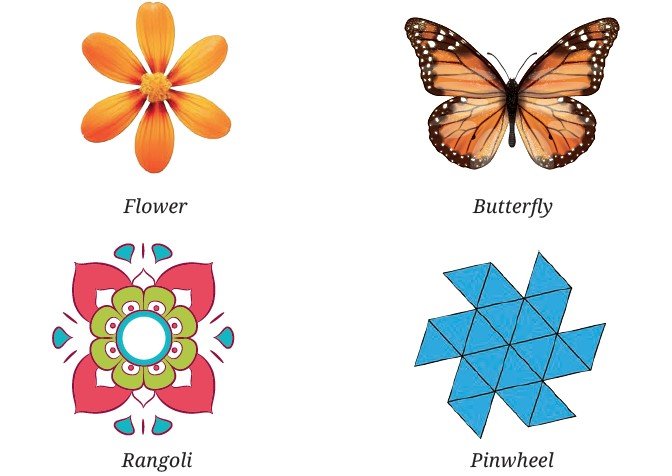
Flower, Butterfly, Rangoli, Pinwheel
There is something beautiful about the pictures above. The flower looks the same from many different angles. What about the butterfly? No doubt, the colours are very attractive. But what else about the butterfly appeals to you? In these pictures, it appears that some parts of the figure are repeated and these repetitions seem to occur in a definite pattern. Can you see what repeats in the beautiful rangoli figure? In the rangoli, the red petals come back onto themselves when the flower is rotated by 90˚ around the centre and so do the other parts of the rangoli. What about the pinwheel? Can you spot which pattern is repeating? Hint: Look at the hexagon first.


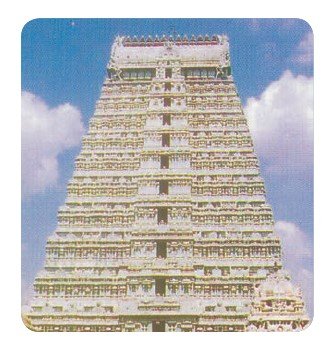
9.1 Line of Symmetry
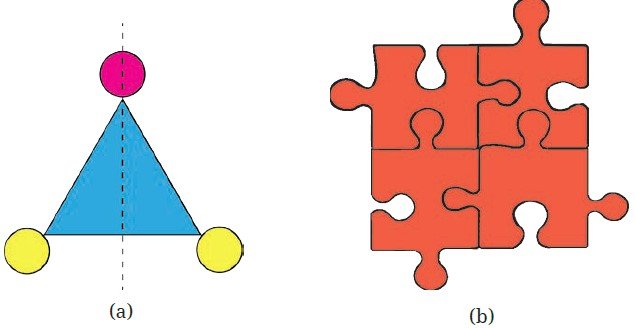
Figures with more than one line of symmetry
Does a square have only one line of symmetry?
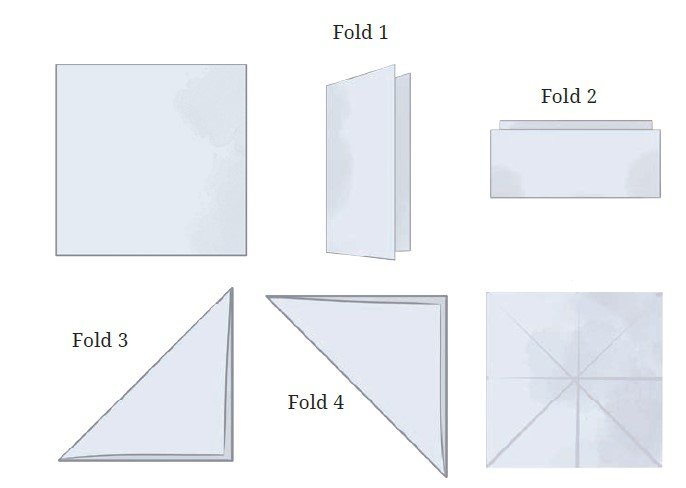
Take a square piece of paper. By folding, find all its lines of symmetry.
Vertical Fold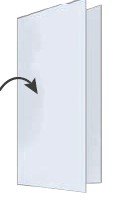
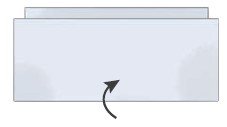 Horizontal Fold
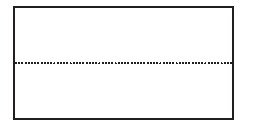
Reflection
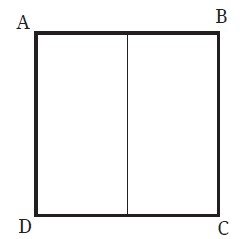
What if we reflect along the diagonal from A to C? Where do points A, B, C and D go? What if we reflect along the horizontal line of symmetry? A figure that has a line or lines of symmetry is thus also said to have reflection symmetry.
Generating Shapes having Lines of Symmetry
So far we have seen symmetrical figures and asymmetrical figures. How does one generate such symmetrical figures? Let us explore this.
Ink Blot Devils
You enjoyed doing this earlier in Class 5. Take a piece of paper. Fold it in half. Open the paper and spill a few drops of ink (or paint) on one half.
Now press the halves together and then open the paper again.
• What do you see?
• Is the resulting figure symmetric?
• If yes, where is the line of symmetry?
• Is there any other line along which it can be folded to produce two identical parts?
• Try making more such patterns.
Paper Folding and Cutting
Here is another way of making symmetric shapes! In these two figures, a sheet of paper is folded and a cut is made along the dotted line shown. Draw a sketch of how the paper will look when unfolded.
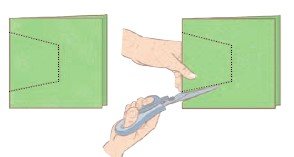
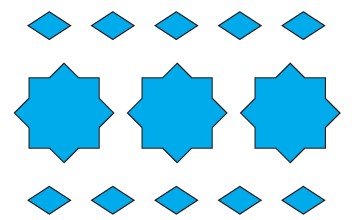
Figure it Out
Punching Game
The fold is a line of symmetry. Punch holes at different locations of a folded square sheet of paper using a punching machine and create different symmetric patterns.
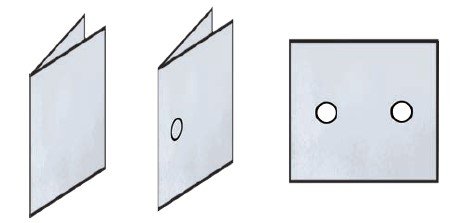
1. In each of the following figures, a hole was punched in a folded square sheet of paper and then the paper was unfolded. Identify the line along which the paper was folded.
Figure (d) was created by punching a single hole. How was the paper folded?
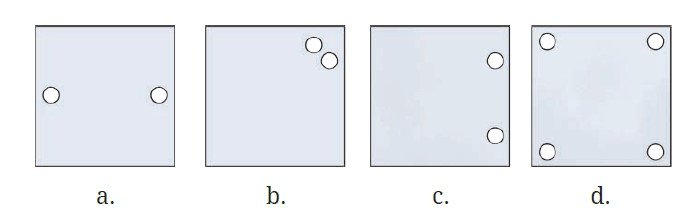
(a b c d)
2. Given the line(s) of symmetry, find the other hole(s):
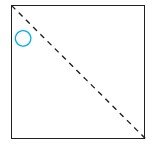
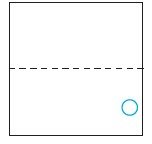
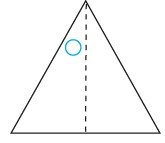
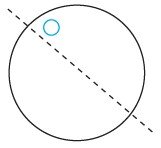
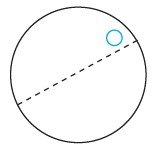
3. Here are some questions on paper cutting.
Consider a vertical fold. We represent it this way:
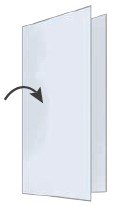
Vertical Fold
Similarly, a horizontal fold is represented as follows.
Vertical Fold
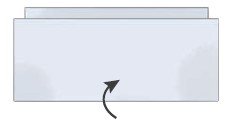
4. After each of the following cuts, predict the shape of the hole when the paper is opened. After you have made your prediction, make the cutouts and verify your answer.
a.
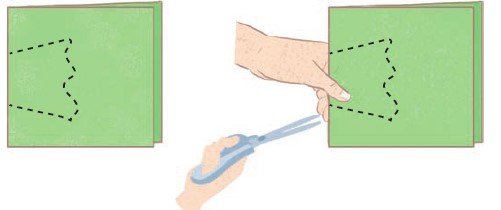
b.
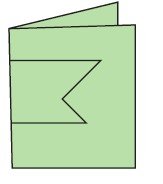
c.
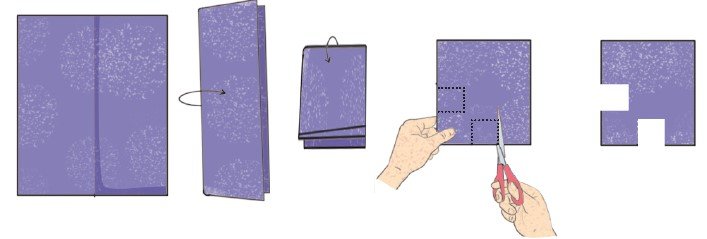
d.
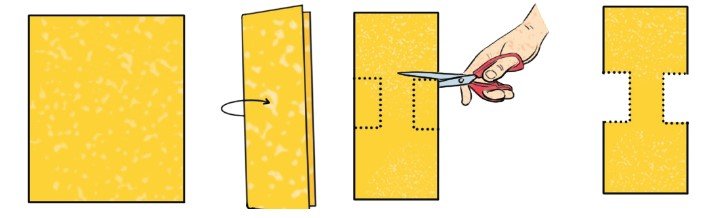
5 Suppose you have to get each of these shapes with some folds and a single straight cut. How will you do it?
a. The hole in the centre is a square.
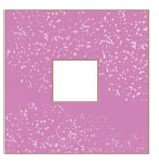
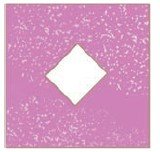
Note: For the above two questions, check if the 4-sided figures in the centre satisfy both the properties of a square.
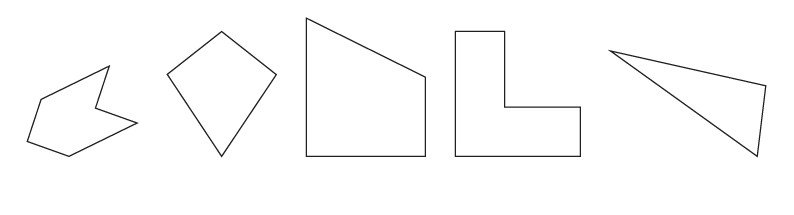
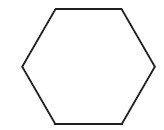
6. How many lines of symmetry do these shapes have? i.
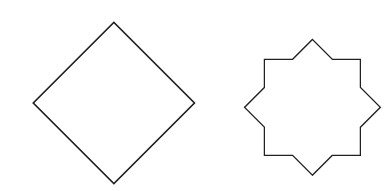
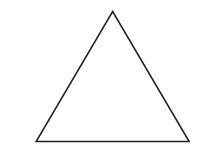
iii. A hexagon with equal sides and equal angles.
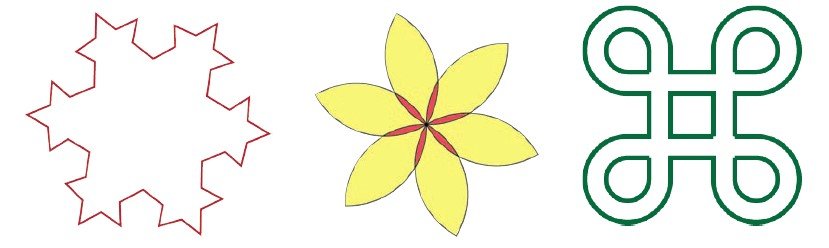
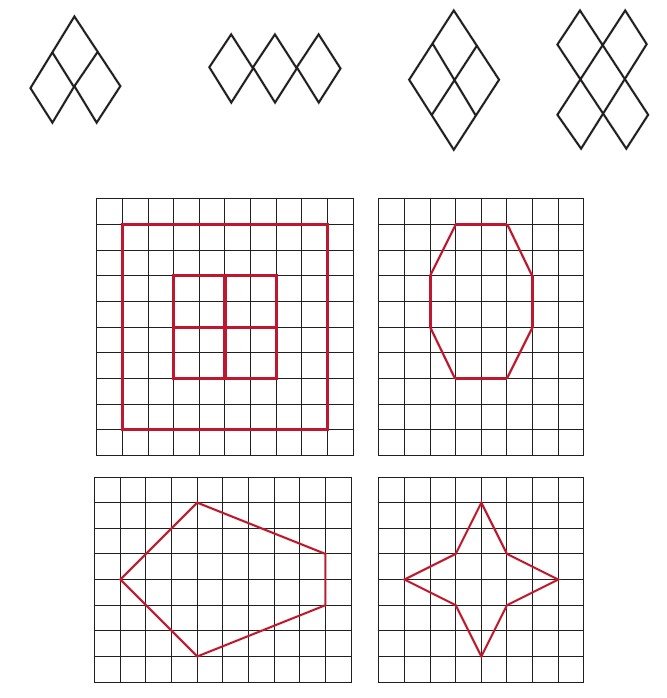
7. Trace each figure and draw the lines of symmetry, if any:
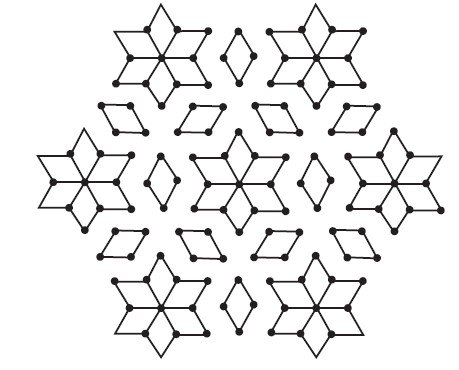
8. Find the lines of symmetry for the kolam below.
9. Draw the following. a. A triangle with exactly one line of symmetry b. A triangle with exactly three lines of symmetry c. A triangle with no line of symmetry Is it possible to draw a triangle with exactly two lines of symmetry?
10. Draw the following. In each case, the figure should contain at least one curved boundary. a. A figure with exactly one line of symmetry b. A figure with exactly two lines of symmetry c. A figure with exactly four lines of symmetry
11. Copy the following on squared paper. Complete them so that the
blue line is a line of symmetry. Problem (a) has been done for you.
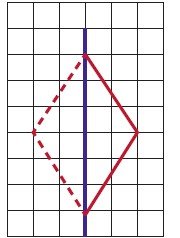
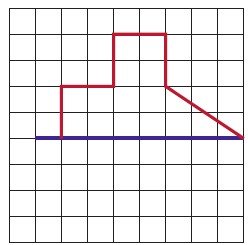
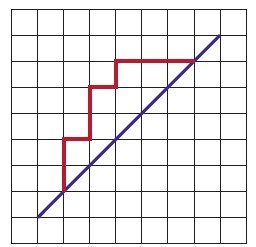
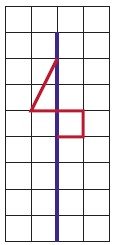
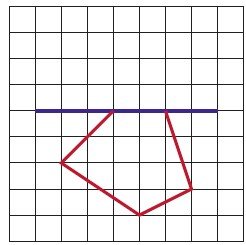
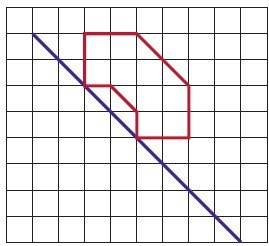
Hint: For (c) and (f ), see if rotating the book helps!
12. Copy the following drawing on squared paper. Complete each one of them so that the resulting figure has the two blue lines as lines of symmetry.
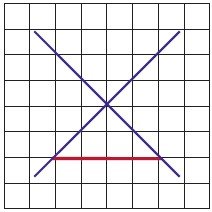
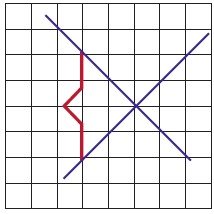
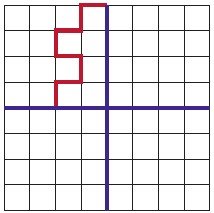
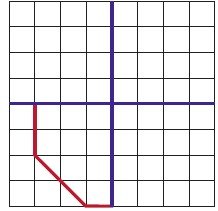
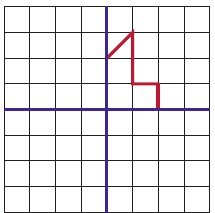
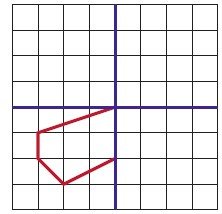
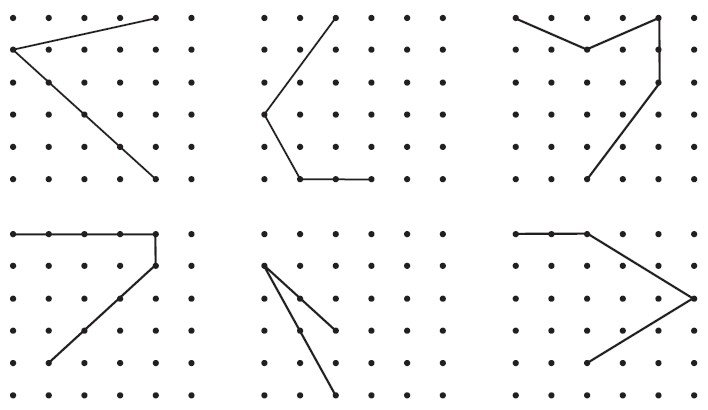
13. Copy the following on a dot grid. For each figure draw two more lines to make a shape that has a line of symmetry.
9.2 Rotational Symmetry
The paper windmill in the picture looks symmetrical but there is no line of symmetry! However you fold it, the two halves will not exactly overlap. On the other hand, if you rotate it by 90° about the red point at the centre, the windmill looks exactly the same.

We say that the windmill has rotational symmetry.
When talking of rotational symmetry, there is always a fixed point about which the object is rotated. This fixed point is called the centre of rotation.
Will the windmill above look exactly the same when rotated through an angle of less than 90°?
No!
An angle through which a figure can be rotated to look exactly the same is called an angle of rotational symmetry, or just an angle of symmetry, for short.
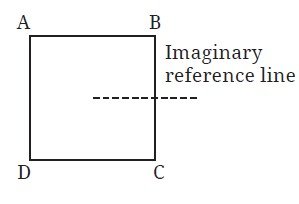
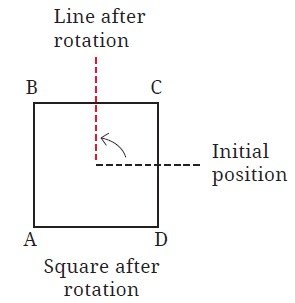
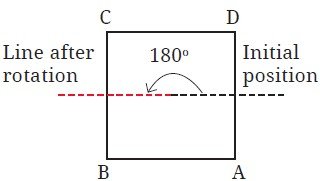
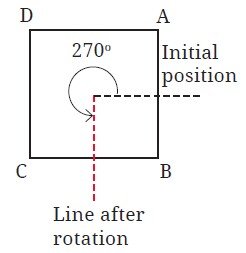
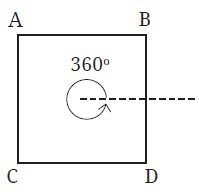
For the windmill, the angles of symmetry are 90° (quarter turn), 180° (half turn), 270° (three-quarter turn) and 360° (full turn). Observe that when any figure is rotated by 360°, it comes back to its original position, so 360° is always an angle of symmetry. Thus, we see that the windmill has 4 angles of symmetry. Do you know of any other shape that has exactly four angles of symmetry? How many angles of symmetry does a square have? How much rotation does it require to get the initial square? We get back a square overlapping with itself after 90° of rotation. This takes point A to the position of point B, point B to the position of point C, point C to the position of point D and point D back to the position of point A. Do you know where to mark the centre of rotation?
Example: Find the angles of symmetry of the following strip.

Solution: Let us rotate the strip in a clockwise direction about its centre.

A rotation of 180° results in the figure above. Does this overlap with the original figure. No. Why? Another rotation through 180° from this position gives the original shape. This figure comes back to its original shape only after one complete rotation through 360°. So we say that this figure does not have rotational symmetry
Rotational Symmetry of Figures with Radial Arms
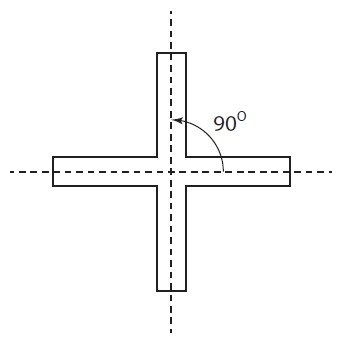
Consider this figure, a picture with 4 radial arms. How many angles of symmetry does it have? What are they?
Note that the angle between adjacent central dotted lines is 90°.
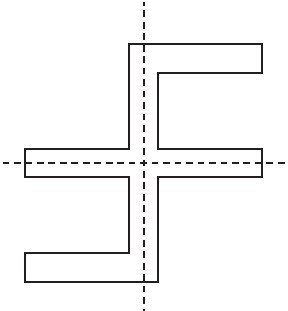
Can you change the angles between the radial arms so that the figure still has 4 angles of symmetry? Try drawing it. To check if the figure drawn indeed has 4 angles of symmetry, you could draw the figure on two different pieces of paper. Cut out the radial arms from one of the papers. Keep the figure on the paper fixed and rotate the cutout to check for rotational symmetry. How will you modify the figure above so that it has only two angles of symmetry?
Here is one way:
We have seen figures having 4 and 2 angles of symmetry. Can we
get a figure having exactly 3 angles of symmetry? Can you use
radial arms for this?
Let us try with 3 radial arms as in the figure below. How many
angles of symmetry does it have and what are they?
Here is a figure with three radial arms.
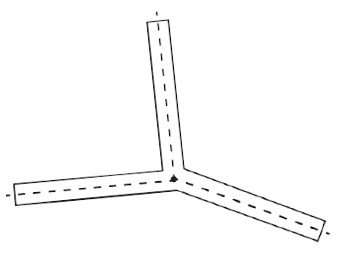
Trace and cut out a copy of this figure. By rotating the cutout over this figure determine its angles of rotation. We see that only a full turn or a rotation of 360° will bring the figure back into itself. So this figure does not have rotational symmetry as 360 degrees is its only angle of symmetry. However, can anything in the figure be changed to make it have 3 angles of symmetry?
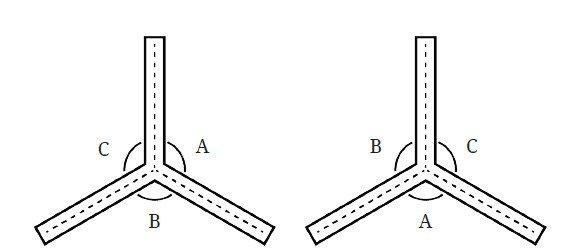
Can it be done by changing the angles between the dotted lines? If a figure with three radial arms should have rotational symmetry, then a rotated version of it should overlap with the original. Here are rough diagrams of both of them. If these two figures must overlap, what can you tell about the angles?
CBA BAC
Observe that ∠A must overlap ∠B, ∠B must overlap ∠C and ∠C must overlap ∠A.
So, ∠A = ∠B = ∠C. What must this angle be?
We know that a full turn has 360 degrees. This is equally distributed amongst these three angles. So each angle must be 360°/3= 120°.
So, the radial arms figure with 3 arms shows rotational symmetry when the angle between the adjacent dotted lines is 120 deg. Use paper cutouts to verify this observation.
Now how many angles of rotation does the figure have and what are they?
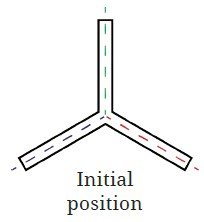
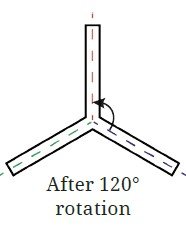
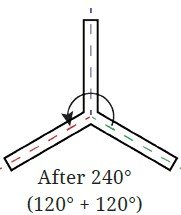
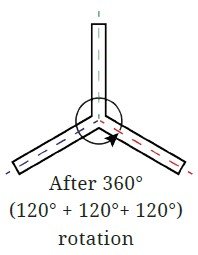
Note: The colours have been added to show the rotations.
Let us explore more figures. Can you draw a figure with radial arms that has a) exactly 5 angles of symmetry, b) 6 angles of symmetry? Also find the angles of symmetry in each case. Hint: Use 5 radial arms for the first case. What should the angle between two adjacent radial arms be? Consider a figure with radial arms having exactly 7 angles of symmetry. What will be its smallest angle of symmetry? Is the number of degrees a whole number in this case? If not, express it as a mixed faction. Let us find the angles of symmetry for other kinds of figures.
Figure it Out
1. Find the angles of symmetry for the given figures about the point marked •.
(a)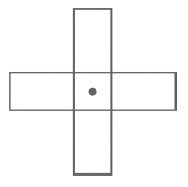 (b)
(b)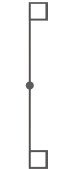 (c)
(c)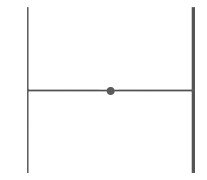
2. Which of the following figures have more than one angle of symmetry?
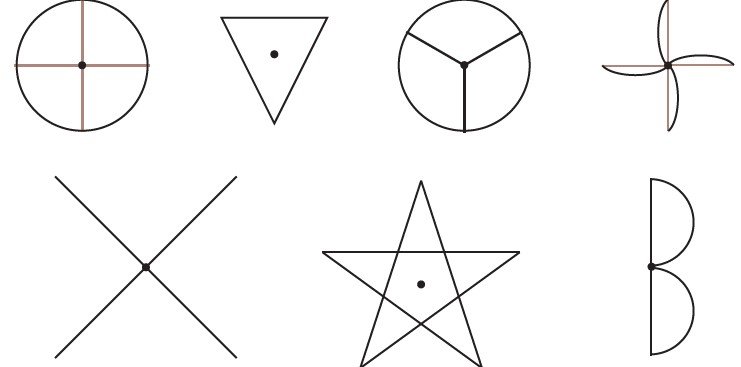
3. Give the order of rotational symmetry for each figure:
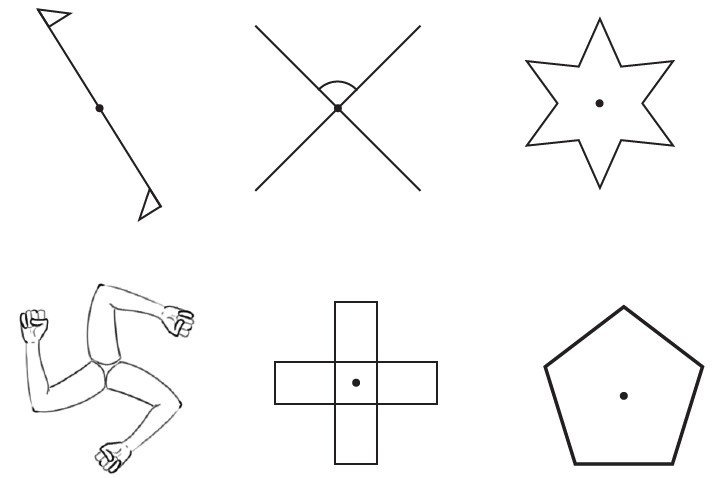
Let us list down the angles of symmetry for all the cases above .
• Angles of symmetry when there are exactly 2 of them: 180°, 360°.
• Angles of symmetry when there are exactly 3 of them: 120°, 240°, 360°.
• Angles of symmetry when there are exactly 4 of them: 90°, 180°, 270°, 360°.
Do you observe something common about the angles of symmetries in these cases? The first set of numbers are all multiples of 180. The second are all multiples of 120. The third are all multiples of 90.
In each case, the angles are the multiples of the smallest angle. You may wonder and ask if this will always happen. What do you think?
True or False
• Every figure will have 360 degrees as an angle of symmetry.
• If the smallest angle of symmetry of a figure is a natural number in degrees, then it is a factor of 360.
Is there a smallest angle of symmetry for all figures? It turns out that this is the case for most figures, except for the most symmetric shapes like the circle, whose symmetries we now discuss.
Symmetries of a circle
The circle is a fascinating figure. What happens when you rotate a circle clockwise about its centre? It coincides with itself. It does not matter what angle you rotate it by! So, for a circle, every angle is an angle of symmetry.
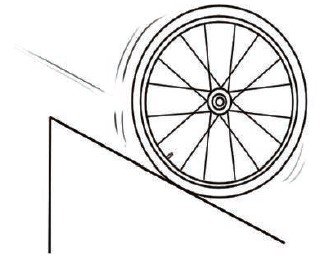
Now take a point on the rim of the circle and join it to the centre. Extend the segment to a diameter of the circle. Is that diameter a line of reflection symmetry? It is. Every diameter is a line of symmetry!
Like wheels, we can find other objects around us having rotational symmetry. Find them. Some of them are shown below:
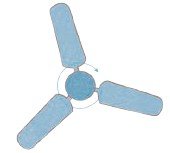
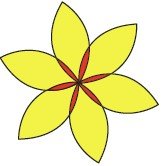
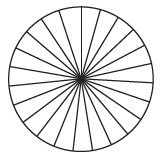
Figure it Out
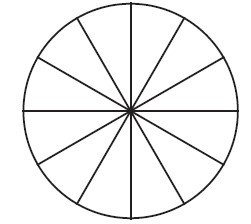
1. Color the sectors of the circle below so that the figure has i) 3 angles of symmetry, ii) 4 angles of symmetry, iii) what are the possible numbers of angles of symmetry you can obtain by coloring the sectors in different ways?
2. Draw two figures other than a circle and a square that have both reflection symmetry and rotational symmetry.
3. Draw, wherever possible, a rough sketch of
a. A triangle with at least two lines of symmetry and at least two angles of symmetry. b. A triangle with only one line of symmetry but not having rotational symmetry. c. A quadrilateral with rotational symmetry but no reflection symmetry. d. A quadrilateral with reflection symmetry but not having rotational symmetry.
4. In a figure, 60° is the smallest angle of symmetry. What are the other angles of symmetry of this figure?
5. In a figure, 60° is an angle of symmetry. The figure has two angles of symmetry less than 60°. What is its
smallest angle of symmetry?
6. Can we have a figure with rotational symmetry whose smallest angle of symmetry is
a. 45°?
b. 17°?
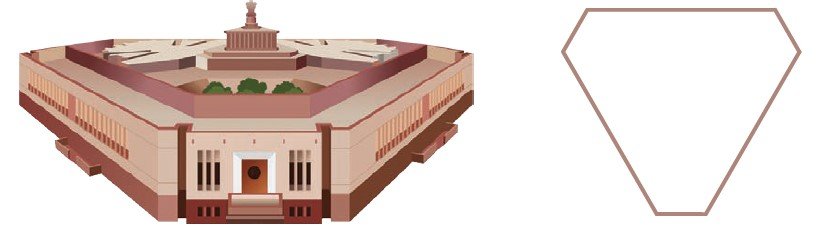
7. This is a picture of the new Parliament Building in Delhi.
8. How many lines of symmetry do the shapes in the first shape sequence in Chapter 1, Table 3, the Regular Polygons, have? What number sequence do you get? 9. How many angles of symmetry do the shapes in the first shape sequence in Chapter 1, Table 3, the Regular Polygons, have? What number sequence do you get? 10. How many lines of symmetry do the shapes in the last shape sequence in Chapter 1, Table 3, the Koch Snowflake sequence, have? How many angles of symmetry? 11. How many lines of symmetry and angles of symmetry does Ashoka Chakra have?

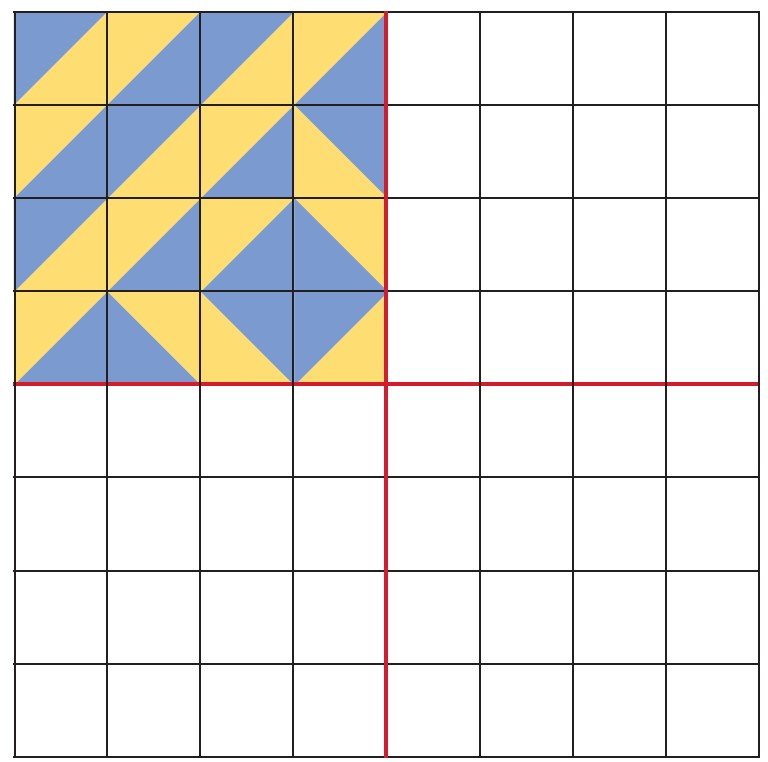
14. Playing with Tiles
a. Use the color tiles given at the end of the
book to complete the following figure so that it has exactly 2 lines of symmetry.
b. Use 16 such tiles to make figures that have exactly:
1 line of symmetry,
2 lines of symmetry
c. Use these tiles in making creative symmetric designs.
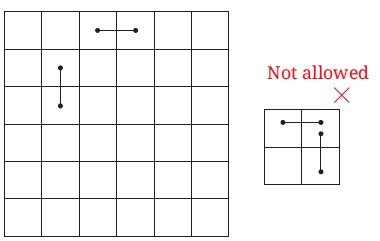
Game
Summary
• When a figure is made up of parts that repeat in a definite pattern, we say that the figure has symmetry. We say that such a figures is symmetrical.
• A line that cuts a plane figure into two parts that exactly overlap when folded along that line is called a line of symmetry or axis of symmetry of the figure.
• A figure may have multiple lines of symmetry.
• Sometimes a figure looks exactly the same when it is rotated by an angle about a fixed point. Such an angle is called an angle of symmetry of the figure. A figure that has an angle of symmetry strictly between 0 and 360 degrees is said to have rotational symmetry. The point of the figure about which the rotation occurs is called the centre of rotation.
• A figure may have multiple angles of symmetry.
• Some figures may have a line of symmetry but no angle of symmetry, while others may have angles of symmetry but no lines of symmetry. Some figures may have both lines of symmetry as well as angles of symmetry