Start from the Food Court and press + 2 in the lift. Where will you
reach? ___________
We can describe this using an expression:
Starting floor + Movement = Target floor.
The starting floor is + 1 (Food Court) and the number of button
presses is + 2. Therefore, you reach the target floor (+ 1) + (+ 2) = + 3
(Book Store) .
Figure it Out
1. You start from Floor +2 and press –3 in the lift. Where will you
reach? Write an expression for this movement.
2. Evaluate these expressions (you may think of them as Starting
Floor + Movement by referring to the Building of Fun).
a. (+1)+(+4) = _______
b. (+4)+(+1) = _______
c. (+4)+(– 3) = _______
d. (–1)+(+2) = _______
e. (–1)+(+1) = _______
f. 0+(+2) = _________
g. 0+(–2) = _________
3. Starting from different floors, find the movements required to
reach Floor –5. For example, if I start at Floor +2, I must press –7
to reach Floor –5. The expression is (+2) + (–7) = –5.
Find more such starting positions and the movements needed to
reach Floor –5 and write the expressions .
Combining button presses is also addition
Gurmit was in the Toy Store and wanted to go down two floors.
But by mistake he pressed the ‘+’ button two times. He realised his
mistake and quickly pressed the ‘–’ button three times. How many
floors below or above the Toy Store will Gurmit reach?
Gurmit will go one floor down. We can show the movement
resulting from combining button presses as an expression:
(+2)+(–3) = –1.
Figure it out
Evaluate these expressions by thinking of them as the resulting movement
of combining button presses:
a. (+1)+(+4) = _____________ b. (+4)+(+1) = _____________
c. (+4)+(– 3)+(–2) = _______ d. (–1)+(+2)+(–3) = _____________
Back to Zero!
On the ground floor, Basant is in a great hurry and by
mistake he presses +3. What can he do to cancel it and
stay on the ground floor? He can cancel it by pressing
– 3. That is, (+3) + (– 3) = 0.
We call – 3 the inverse of +3. Similarly, the inverse of
– 3 is +3.
If Basant now presses +4 and then presses – 4 in the
lift, where will he reach?
Here is another way to think of the concept of
inverse. If you are at Floor +4 and you press its inverse
– 4, then you are back to zero, the ground floor! If you
are at Floor – 2 and press its inverse +2, then you go to
(– 2) + (+2) = 0, again the ground floor!
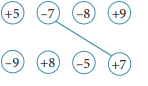
- Write the inverses of these numbers:
+4, –4, –3, 0, +2, –1.
- Connect the inverses by drawing lines .
Comparing numbers using floors
Who is on the lowest floor?
1. Jay is in the Art Centre. So, he is on Floor +2.
2. Asin is in the Sports Centre. So, she is on Floor ___.
3. Binnu is in the Cinema Centre. So, she is on Floor ____.
4. Aman is in the Toys Shop. So, he is on Floor ____ .
Floor +3 is lower than Floor +4. So, we write +3 < +4. We
also write +4 > +3.
- Should we write –3 < – 4 or – 4 < – 3?
Floor – 4 is lower than Floor – 3. So, – 4 < – 3. It is also
correct to write – 3 > –4
Figure it Out
1. Compare the following numbers using the Building of
Fun and fill in the boxes with
< or >.
a. –2------- +5
b. –5------- +4
c. –5 ------- –3
d. +6 -------- –6
e . 0 --------- –4
f. 0 --------- +4
Notice that all negative number floors are below
Floor 0. So, all negative numbers are less than 0. All
the positive number floors are above Floor 0. So, all
positive numbers are greater than 0.
2. Imagine the Building of Fun with more floors. Compare
the numbers and fill in the boxes with < or >:
(a.) –10 ------------- –12
(b. ) +17 -------------- –10
(c ) . 0 -------------- –20
(d. ) +9 -------------- –9
(e.) –25 -------------- –7
(f. ) +15 -------------- –17
3. If Floor A = –12, Floor D = –1 and Floor E = +1 in the
building shown on the right as a line, find the numbers
of Floors B, C, F, G and H.
4. Mark the following floors of the building shown on
the right.
a. –7
b. – 4
c. +3
d. – 10
Subtraction to Find which Button to Press
In earlier classes, we understood the meaning of subtraction as ‘take
away’. For example, “There are 10 books on the shelf. I take away 4
books. How many are left on the shelf?”
We can express the answer using subtraction: 10 – 4 = 6. Or ‘Ten
take away four is six.’
You may also be familiar with another meaning of subtraction which
is related to comparison or making quantities equal. For example,
consider this situation: “I have `10 with me and my sister has `6.”
Now, I can ask the question: ʻHow much more money should my
sister get in order to have the same amount as me?ʼ
We can write this in two ways: 6 + ? = 10 Or 10 – 6 = ?.
Here, we see the connection between ‘finding the missing number
to be added’ and subtraction.
For subtraction of positive and negative numbers, we will use
this meaning of subtraction as ‘making equal’ or ‘finding the missing
number to be added’.
- Evaluate 15 – 5, 100 – 10 and 74 – 34 from this perspective.
Teachers’ Note
In general, when there are two unequal quantities, subtraction can
indicate the change needed to make the quantities equal. Subtraction
shows how much the starting quantity should change in order to
become the target quantity. In the context of different floor levels,
what is the change required to reach the Target Floor from the Starting
Floor? Notice that the change needed may be positive (for an increase)
or negative (for a decrease).
Your starting floor is the Art Centre and your target floor is the
Sports Centre. What should be your button press?
You need to go three floors up, so you should press + 3. We can
write this as an expression using subtraction:
Target floor – Starting floor = Movement needed.
In the above example, the starting floor is + 2 (Art Centre) and
the target floor is + 5. The button press to get to + 5 from + 2 is + 3.
Therefore,
(+ 5) – (+ 2) = + 3.
Explanation:
Recall the connection between addition and subtraction. For
3+ ?=5, we can find the missing number using subtraction: 5–3=2. That
is, subtraction is the same as finding the missing number to be added.
We know that
Starting floor + Movement needed = Target Floor.
If the movement needed is to be found, then,
Starting floor + ? = Target Floor.
So
Target floor – Starting floor = ? = Movement needed.
More examples:
a. If the Target Floor is – 1 and Starting Floor is – 2, what button
should you press?
You need to go one floor up, so, you should press + 1.
Expression: (– 1) – (– 2) = (+1).
b. If the Target Floor is – 1 and Starting floor is +3, what button
should you press?
You need to go four floors down, so, you should press – 4.
Expression: (– 1) – (+ 3) = (– 4).
c. If the Target Floor is +2 and Starting Floor is – 2, what button
should you press?
You need to go four floors up, so, you should press +4.
Expression: (+ 2) – (– 2) = (+ 4).
Out
Complete these expressions. You may think of them as finding the
movement needed to reach the Target Floor from the Starting Floor.
a. (+1) –(+4) = _______
b . (0) –(+2) = _________
c. (+4) –(+1) = _______
d. (0)– (–2) = _________
e. (+4) – (–3) = _______
f. (–4)–(–3) = ________
g. (–1) –(+2) = _______
h. (–2) – (–2) = ________
i. (–1) – (+1) = _______
j. (+3)– (–3) = ________
Adding and subtracting larger numbers
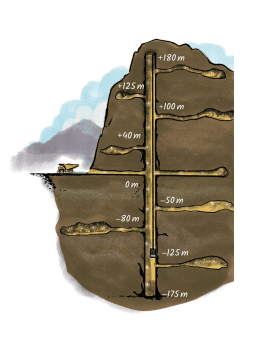
The picture shows a mine, a place where
minerals are extracted by digging into the
rock. The truck is at the ground level, but
the minerals are present both above and
below the ground level. There is a fast
moving lift which moves up and down in
a mineshaft carrying people and ore.
Some of the levels are marked in the
picture. The ground level is marked 0.
Levels above the ground are marked by
positive numbers and levels below the
ground are marked by negative numbers.
The number indicates how many meters
above or below the ground level it is.
In the mine, just like in the Building of Fun:
Starting level + Movement = Target level.
For example:
(+ 40) + (+ 60) = + 100 (– 90) + (– 55) = – 145
Target level – Starting level = Movement needed.
For example:
(+ 40) – (– 50) = + 90 (– 90) – (+ 40) = – 130
How many negative numbers are there?
Bela’s Building of Fun had only six floors above and five floors below.
That is numbers – 5 to + 6. In the mine above, we have numbers from
– 200 to + 180. But we can imagine larger buildings or mineshafts.
Just as positive numbers + 1, + 2, + 3, ... keep going up without an end,
similarly, negative numbers – 1, – 2, – 3, ... keep going down. Positive
and negative numbers, with zero, are called integers. They go both
ways from 0: … – 4, – 3, – 2, – 1, 0, 1, 2, 3, 4, …
Figure it Out
Complete these expressions.
a. (+40)+ ______ = +200
b. (+40)+_______=–200
c. (–50)+ ______ = +200
d. (–50)+_______=–200
e. (–200) – (–40) = _______
f. (+200) – (+40) = _______
g. (–200) – (+40) = _______
Check your answers by thinking about the movement in the
mineshaft.
Adding, Subtracting, and Comparing any Numbers
To add and subtract even larger integers, we can imagine even larger
lifts! In fact, we can imagine a lift that can extend forever upwards
and forever downwards, starting from Level 0. There does not even
have to be any building or mine around – just an ‘infinite lift’!
We can use this imagination to add and subtract any integers we like.
For example, suppose we want to carry out the subtraction + 2000
– (–200). We can imagine a lift with 2000 levels above the ground
and 200 below the ground. Recall that
Target level – Starting level = Movement needed.
To go from the Starting Floor –200 to the Target Floor + 2000, we
must press + 2200 (+ 200 to get to zero, and then + 2000 more after
that to get to + 2200). Therefore, (+ 2000) – (– 200) = + 2200.
Notice that (+ 2000) + (+ 200) is also + 2200.
--Try evaluating the following expressions by similarly drawing or
imagining a suitable lift:
(a.) –125+(–30)
(b.) +105–(–55)
(c. ) +105+(+55)
(d. ) +80–(–150)
(e. ) +80+(+150)
(f. ) –99– (–200)
(g. ) –99+(+200)
( h. ) +1500–(–1500)
In the above example, we saw that + 2000 – (– 200) = + 2000 + (+ 200)
= + 2200. In other words, subtracting a negative number is the same
as adding the corresponding positive number. That is, we can
replace subtraction of a negative number by addition of a positive
number!
- In the other exercises that you did above, did you notice
that subtracting a negative number was the same as adding
the corresponding positive number?
Take a look at the ‘infinite lift’ above. Does it remind you
of a number line? In what ways?
Back to the Number Line
The ‘infinite lift’ we saw above looked very much like a number line,
didn’t it? In fact, if we rotate it by 90°, it basically becomes a number
line. It also tells us how to complete the number ray to a number line,
answering the question that we had asked at the beginning of the
chapter. To the left of 0 are the negative numbers –1, –2, –3, …
Usually we drop the + signs on positive numbers, and simply
write them as 1, 2, 3, …
Instead of traveling along the number line using a lift, we can
simply imagine walking on it. To the right is the positive (forward)
direction, and to the left is the negative (backward) direction.
Smaller numbers are now to the left of bigger numbers, and
bigger numbers are to the right of smaller numbers. So 2 < 5;
–3 < 2; and –5 < –3.
- If, from 5 you wish to go over to 9, how far must you travel along
the number line?
You must travel 4 steps. That is why 5 + 4 = 9.
(Remember: Starting Number + Movement = Target Number.)
The corresponding subtraction statement is 9 –5 = 4.
(Remember: Target Number – Starting Number = Movement
Needed.)
- Now, from 9, if you wish to go to 3, how much must you travel
along the number line?
You must move 6 steps backward, i.e., you must move –6. Hence,
we write 9 + (–6) = 3.
(Remember again : Starting number + Movement = Target
number.)
The corresponding subtraction statement is 3–9=–6.
(Remember again: Target number – Starting number = Movement
needed.)
- Now, from 3, if you wish to go to –2, how far must you travel?
You must travel –5 steps, i.e., 5 steps backward. Thus 3+(–5)=–2.
The corresponding subtraction statement is: –2 –3=–5.
1. Mark 3 positive numbers and 3 negative numbers on the number
line above.
2. Write down the above 3 marked negative numbers in the following : ----- ------ --------
3. Is 2 > – 3? Why? Is –2 < 3? Why?
4. What are (i) –5+0 (ii)7+(–7) (iii) –10+20 (iv) 10 –20 (v)7–(–7)
(vi)–8–(–10)?
Using the unmarked number line to add and subtract
Just as you can do additions, subtractions and comparisons with small
numbers using the number line above, you can also do them with
large numbers by imagining an ‘infinite number line’, or drawing an
‘unmarked number line’ as follows:
This line shows only the position of zero. Other numbers are not
marked. It can be convenient to use this unmarked number line to
add and subtract integers. You can show, or simply imagine, the scale
of the number line and the positions of numbers on it.
For example, this unmarked number line (UNL) shows the
addition problem: 85 + (– 60) = ? :
We then can visualise that 85 + (– 60) = 25
The following UNL shows a subtraction problem which can also be
written as a missing addend problem: (–100)–(+250) = ? or 250 + ? = –100.
We can then visualise that ? = –350 in this problem.
In this way, you can carry out addition and subtraction problems,
with positive and negative numbers, on paper or in your head using an
unmarked number line.
Use unmarked number lines to evaluate these expressions:
a. –125 + (–30) = _______
b. +105 – (–55) = _______
c. +80 – (–150) = _______
d. –99 – (–200) = _______
Converting subtraction to addition and addition to subtraction
Recall that Target floor – Starting floor = Movement needed
or
Target floor = Starting floor + Movement needed
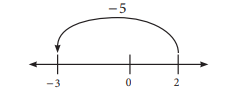
If we start at 2 and wish to go to –3, what is the movement needed?
First method: Looking at the number line, we see we need to move –5 (i.e., 5 in the backward direction). Therefore, – 3 – 2 = – 5. The movement needed is –5.
Second method: Break the journey from 2 to –3 into two parts.
a. From 2 to 0, the movement is 0–2=–2.
b. From 0 to –3, the movement is –3–0=–3.
The total movement is the sum of the two movements: – 3 + (– 2) = – 5.
Look at the two coloured expressions. There is no subtraction in
the second one!
In this way, we can always convert subtraction to addition. The number that is being subtracted can be replaced by its inverse and then added instead.
Similarly, a number that is being added can be replaced by its inverse and then subtracted. In this way, we can also always convert addition to subtraction.
Examples:
a. (+7) – (+5)=(+7)+(–5)
b. (–3) – (+8)=(–3)+(–8)
c. (+8) –(–2)=(+8)+(+2)
d. (+6)–(–9)=(+6)+(+9)
10.2 The Token Model
Using Tokens for Addition
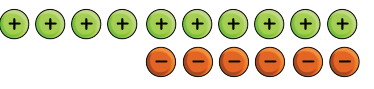
In Bela’s Building of Fun, the lift attendant is bored. To entertain
himself, he keeps a box containing lots of positive (red) and negative
(black) tokens. Each time he presses the ‘+’ button, he takes a
positive token from the box and puts it in his pocket. Similarly,
each time he presses the ‘–’ button, he takes a negative token and
puts it in his pocket.
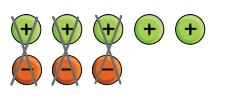
He starts on the ground floor (Floor 0) with an empty pocket. After
one hour, he checks his pocket and finds 5 positive and 3 negative
tokens. On which floor is he now? He must have pressed ‘+’ five times and ‘–’ 3 times and (+5)+(–3)=+2.
So he is at Floor +2 now.
Here is another way to do the calculation.
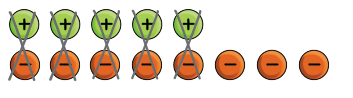
A positive token and a negative token cancel each other, because
the value of this pair of tokens together is zero. These two tokens in
his pocket meant that he pressed ‘+’ once and ‘–’ once, respectively,
and these cancel each other. We say that a positive and a negative
token make a ʻzero pairʼ. When you remove all the zero pairs, you are
left with two positive tokens, so (+5) + (–3) = +2.
We can perform any such addition using tokens!
Example: Add+ 5 and – 8.
From the picture, we see that we can remove five zero pairs, and we
are then left with – 3. Therefore (+ 5) + (– 8) = – 3.
Figure it Out
1. Complete the additions using tokens.
a. (+6)+(+4)
b. (–3) + (–2)
c. (+5)+(–7)
d. (–2) + (+6)
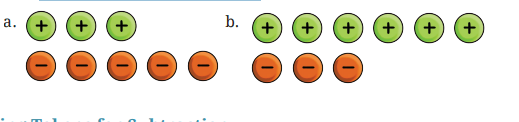
2. Cancel the zero pairs in the following two sets of tokens. On what
floor is the lift attendant in each case? What is the corresponding
addition statement in each case?
Using Tokens for Subtraction
We have seen how to perform addition of integers with positive tokens and negative tokens. We can also perform subtraction using tokens!
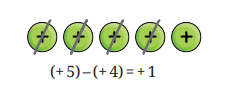
Example: Let us subtract:
(+5) – (+4).
This is easy to do. From 5 positives
take away 4 positives to see the result.
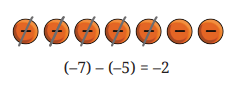
Example: Let us subtract:
(–7) – (–5).
Is (– 7) – (– 5) the same as (– 7)+(+5)?
Example: Let us subtract: (+5)–(+6).
Put down 5 positives.
But there are not enough tokens to take out 6 positives!
To get around this issue, we can put out an extra zero pair (a
positive and a negative), knowing that this does not change the value
of the set of tokens.
Now we can take out 6 positives!
See what is left:
We conclude that (+5) – (+6) =–1.
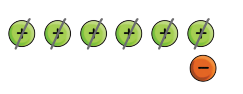
Figure it Out
1. Evaluate the following differences using tokens. Check that you get the same result as with other methods you now know:
a. (+10) –(+7)
b. (–8)– (–4)
c. (–9) –(–4)
d. (+9)–(+12)
e. (–5) –(–7) f. (–2)–(–6)
2. Complete the subtractions:
a. (–5)– (–7)
b. (+10) –(+13)
c. (–7) –(–9)
d. (+3)– (+8)
e. (–2) –(–7)
f. (+3)– (+15)
Example: + 4 – (–6).
Start with 4 positives.
We have to take out 6 negatives from these. But there are not enough negatives.This is not a problem. We add some zero pairs as this does not change the value of the set of tokens. But how many zero pairs? We have to take away 6 negatives so we put down 6 zero pairs:
Now we can take away 6 negatives:
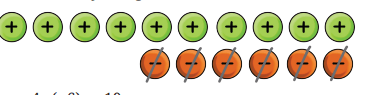
Therefore, +4– (–6)=+10.
Figure it Out
1. Try to subtract: –3– (+5).
How many zero pairs will you have to put in? What is the result?
2. Evaluate the following using tokens
. a. (–3)–(+10)
b. (+8)– (–7)
c. (–5)–(+9)
d. (–9) – (+10)
e. (+6) –(–4)
f . (–2)–(+7)
10.3 Integers in Other Places
Credits and Debits
Suppose you open a bank account at your local bank with the `100 that you had been saving over the last month. Your bank balance therefore starts at `100.
Then you make `60 at your job the next day and you deposit it in your account. This is shown in your bank passbook as a ‘credit’.
- Your new bank balance is _______.
The next day you pay your electric bill of `30 using your bank account. This is shown in your bank passbook as a ‘debit’.
- Your bank balance is now ______.
The next day you make a major purchase for your business of `150. Again this is shown as a debit.
- What is your bank balance now? ______
Is this possible?
(Yes, some banks do allow your account balance to become negative, temporarily! Some banks also charge you an additional amount if your balance becomes negative, in the form of ‘interest’ or a ‘fee’.)Your strategic large purchase the previous day allows you to make 200 rupees at your business the next day.
- What is your balance now? ______
You can think of ‘credits’ as positive numbers and ‘debits’ as negative
numbers. The total of all your credits (positive numbers) and debits
(negative numbers) is your total bank account balance. This can be
positive or negative!
In general, it is better to try to keep a positive balance in your
bank account!
Figure it Out
1. Suppose you start with 0 rupees in your bank account, and then
you have credits of `30, `40, and `50, and debits of `40, `50, and
`60. What is your bank account balance now?
2. Suppose you start with 0 rupees in your bank account, and then
you have debits of `1, 2, 4, 8, 16, 32, 64, and 128, and then a single
credit of `256. What is your bank account balance now?
3. Why is it generally better to try and maintain a positive balance in
your bank account? What are circumstances under which it may
be worthwhile to temporarily have a negative balance?
As you can see, positive and negative numbers along with zero are
extremely useful in the world of banking and accounting.
Geographical Cross-sections
We measure the height of geographical features like mountains,
plateaus, and deserts from ‘sea level’. The height at sea level is 0m.
Heights above sea level are represented using positive numbers and
heights below sea level are represented using negative numbers.
Figure it Out
1. Looking at the geographical cross section fill in the respective heights:
A ------------
B ------------
C ------------
D ------------
E ------------
F: ------------
G ------------
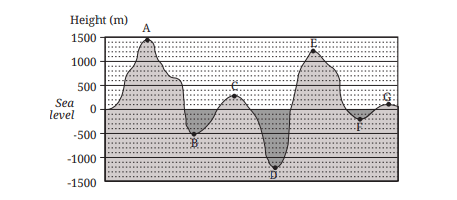
Teachers’ Note
Ask what a geographical cross-section is by showing the figure in this
page. It is like imagining a vertical slice taken out at some location on
the earth. This is what would be seen from a side view. Discuss the
notion of “sea level” for measuring heights and depths in geography
2. Which is the highest point in this geographical cross-section?
Which is the lowest point?
3. Can you write the points A, B, …, G in a sequence of decreasing order
of heights? Can you write the points in a sequence of increasing
order of heights?
4. What is the highest point above sea level on Earth? What is its
height?
5. What is the lowest point with respect to sea level on land or on the
ocean floor? What is its height? (This height should be negative) .