PART- 2
Biodiversity Register
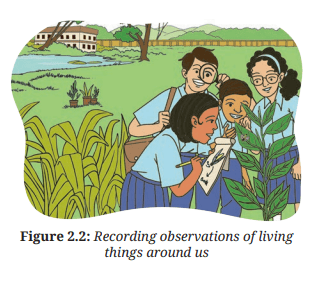
This project will help you to learn about biodiversity among
living things in the world around us (Figure 2.1). You will create
a biodiversity register based on your observations and the
information you gather.
As part of the project, you will be able to:

You have learnt about the diversity of living things around us in Science.
A biodiversity register is used for documenting the diversity of living things in an area. It contains information about habitat, which includes the landscape and types of soil, scientific and local names of living things, what animals eat, living things that may harm others, and other different kinds of information.
Recording biodiversity is crucial because as habitats transform due to factors, such as land clearance for construction or agriculture, or shifts in climate, many species face extinction or become endangered. This interconnectedness means that the loss of any plant or species affects the ecosystems, including humans.
Biodiversity registers also provide people with information that is useful, for example, local knowledge related to crop plants and animals, plants that can be used for their medicinal value, pests that affect plants, when to plant crops, and so on.
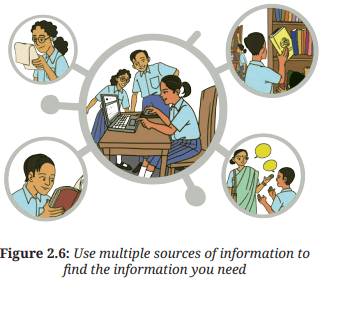
You can create your own ‘mini’ biodiversity register by systematically recording the biodiversity around youself. In case you come across a plant, insect, bird or animal that you are not familiar with, then you can get information by:
i. Talking to teachers/elders/family members/experts
ii. Looking up books in the library
iii. Searching for the infomation with the help of the Internet on the computer
iv. Using applications on mobile phones.
Terms used in the biodiversity register
Scientific name: A name given to living things that is the same across languages. Names differ across languages, but a scientific name ensures that people, especially scientists know that they are referring to the same living thing.
Variety refers to differences in a similar kind of plant, e.g., there are different varieties of mangoes, like Alphonso, Kesar, Ratnagiri, Totapuri, Chaunsa, Dasheri, Langra, Banganpalli, Anwar Ratol and Pairi.
Cropping season: It is the season in which a particular crop is grown.
Season of fruiting: This refers to the season when fruit trees produce
fruits
Season of fruiting: This refers to the season when fruit trees produce
fruits.
Source of seeds/plants: This refers to how new plants grow, whether
from seeds, seedlings, bulbs, stem cuttings or any other method.
Affected crop: Crop that had been damaged by pests, e.g., diseases that
affect plants, insects that eat the leaves or fruits, or any other reason.
Host: It is a plant or animal on which other plants or animals live. For
example, dogs are hosts for fleas, who suck their blood, and some plants
are hosts for caterpillars, who grow by eating leaves and fruits.
Pests: These are insects, birds or animals that are harmful to plants.
Pesticide: Pesticides are used to prevent or control harm to hosts by pests. They can be in the form of liquid, solid or gases.
Weedicide: Weedicides are used to prevent or control harm to plants by weeds.
GI tag: A Geographical Indication (GI) tag is given by the government and recognised all over the world. For plants, it means that the plant is grown in a specific geography and all the produce from that area is of a high standard. For example, we have many varieties of rice in our country – some with GI tags are Navara rice from Kerala, Basmati from Uttarakhand, and Gobind Bhog rice from West Bengal. Another example is of Jalgaon bananas from Maharashtra
What will I be able to do?
At the end of the project, you will be able to:
1. Systematically record the biodiversity that you observe around yourself;
2. Use different methods to collect information related to biodiversity; and
3. Analyse information to present your understanding of the biodiversity around yourself.
What will I need?
To carry out this project, you will need the following materials:
• A notebook, pen, pencil, eraser, measuring scale, pencil and sharpener.
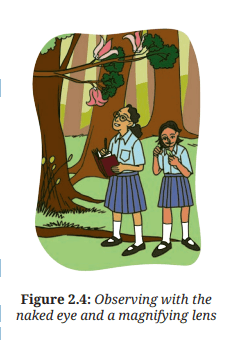
• You can use a handheld magnifying glass or lens in case you want to observe details of plants or insects.
• A camera or a smartphone (borrowed from your teacher or parents/guardians) can be used for taking photographs, and making video and audio recordings. However, you must make sketches of whatever you include in your biodiversity register
.
• You can also use a smartphone for identification of living things.
What do I need to know before I start?
Activity 1: What is around us?
Activity 2: Meet an expert
What do I have to do
Activity 3: Identify places to survey
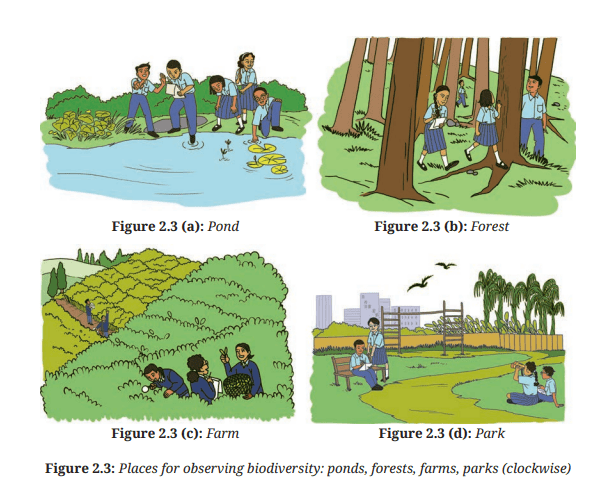
Activity 4: Scheduling visits for observing biodiversity
Activity 5: Filling in the biodiversity register
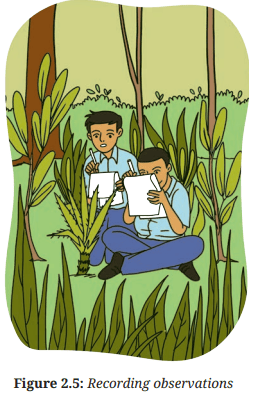
I. Observation of biodiversity in crop plants
1. Date of observation:
2. Location:
3. Habitat type:
4. Weather condition:
5. Observations:
II. Observation of biodiversity in fruit plants
III. Observation of biodiversity in fodder plants
IV. Observation of biodiversity in weed plants
Did you know?
You can visit the website of ‘Season Watch’ to register a tree in your neighbourhood and upload photographs every week. You can also track trees in other areas. Can you find any tree similar to those in your neighbourhood in Season Watch?
Did you get additional information about them?
Activity 6: Identifying ‘unknown’
Using AI tools to collect more information about plants/ crops/weeds/pests
Google Lens is an image recognition technology that uses something called machine learning and OCR (Optical Character Recognition) to analyse and provide information about objects, text, landmarks, and so on captured by a device’s camera. It can identify objects, read text, translate languages, scan barcodes and Quick Response (QR) codes, and integrate with various Google services. You can access Google Lens through the Google Photos app or as a standalone app, and pointing the camera at objects, you can get relevant information or even perform tasks like translation and web searches.
Google Lens analyses any image and provides information. You can
use Google Lens to identify scientific names, diseases, and other useful
information about plants/crops/weeds insects, and pests using photos. If
you have not taken the photos, you can capture them using Google Lens
itself.
1. Download and open the Google Lens app on the smartphone.
2. Locate the Google Lens icon in the search bar and tap on it. This activates Google Lens.
3. Point your camera at the plant/insect/image you want to identify
and tap the shutter button to search.
You can now add the missing information to the biodiversity register.
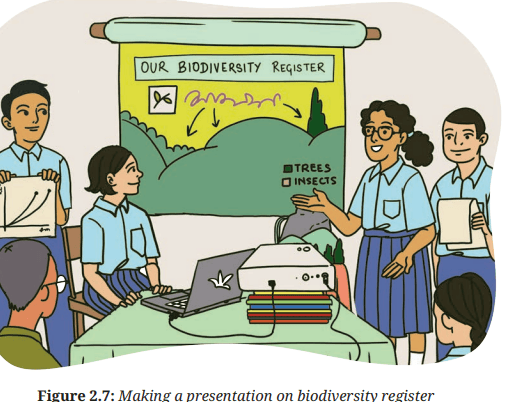
Activity 7: Presentation of biodiversity register
What did I learn from others?
Interaction with experts
You discussed with experts all the measures that can be taken to preserve biodiversity in the area. What do you think will work?
..........................
........................
........................
Interaction with members of the community
You might have spoken to a farmer in a rural area, a nursery worker or a gardener in the city or a community member in the rural or urban area.
Write about how the biodiversity changed over the years in the area, let us say in the last 10 or 20 years
. .................................
...............................
................................
..................................
What did I do and how long did it take?
It is important to understand how much time is required for an activity to be completed.
Calculate the approximate number of periods you spent on each activity. Mark them on the timeline below. If you did more than the activities suggested in the book, please add the number and time taken.
You might have gone to the same place more than once as per your schedule. It is also possible that you went back multiple times to gather information, try and calculate the total number of periods spent on each activity.
Activity 1 2 3 4 5 6 7
Time --- --- --- --- --- --- ---- ---
taken (Periods) ---------------------------->
Did you know?
India is home to several Biodiversity Heritage Sites (BHS),
which are areas recognised for their unique biodiversity. The
purpose of these sites is to protect biodiversity in the area and
recognise their importance in ensuring traditional cultural
practices related to the natural environment.
The following are some notable Biodiversity Heritage Sites in India:
• The Nallur Tamarind Grove in Karnataka has tamarind trees that are over 400 years old
. • Gogabeel in Bihar is a paradise for bird lovers with over 90 species of birds, including many that travel from faraway places like Central Asia.
• Tonglu in West Bengal has plants that you would not find anywhere else in the world
. • Ameenpur Lake in Hyderabad is home to over 200 bird species, even though it is in the middle of a busy city.
• Majuli in Assam is the biggest river island on the planet and has monasteries called ‘Satras’.
• The Myristica swamps in Kerala are home to ancient nutmeg (Jayafala) trees, which is a spice we use in cooking.
• The Kali Tiger Reserve in Karnataka is a safe heaven for Bengal tigers and other big animals like elephants
. • The Chilkigarh Kanak Durga Sacred Grove in West Bengal has special plants used in traditional medicine. This grove is protected by the local people
. • In Ziro Valley, Arunachal Pradesh, people grow rice and fish together in a unique way.
• The Mawphlang Sacred Grove in Meghalaya is protected by local tribes and is full of rare plants and medicinal herbs.