Note to the Teachers
Music holds the remarkable ability to evoke empathy, promote collaboration and facilitate self-expression. This book aims to motivate students to appreciate music and learn basic skills. It will be interesting to introduce specific songs and activities from the book which will encourage our students to participate enthusiastically and enjoy the process rather than solely focusing on specific outcomes, especially in the initial stages.
1. Practising at home helps to build skills like singing, playing of instrument, listening, creating, etc. It encourage students to do the same spontaneously.
2. Consider taking students to live musical performances for exposure.
3. Invite a musician to your school. Encourage children to ask questions and interact with the artist.
4. Learners love to sing songs that they hear at home, during religious and cultural celebrations. Encourage children to sing those songs in classroom that they learnt at home.
5. There are many opportunities to experience different genres of music in everyday life. In between classes, instead of ringing a school bell, consider playing a melody which will attract the attention of students.
6. There are many activities given in this section. You may add these activities for variations.
7. Most songs and activities in the book include an audio or video resource that can be accessed by scanning the QR code provided in the textbook.
This music curriculum desires that you and the students thoroughly enjoy the journey of making music. We aim to instill a lifelong love for music amongst them, fostering a deep appreciation that will grow beyond the classroom.
Resources for the Classroom
1. The classroom should be a place where the music learning is fun and comfortable. Both students and teachers should be able to sit comfortably and sing together. Sitting on the floor is the best arrangement for music classes. It helps the children to learn about good posture and proper breathing, similar to the exercises done in yoga. Teachers can also change the seating in different styles and designs based on the theme of the song. This makes the class more interesting and creative, and helps students to foster improvisation skills.
2. Computer with internet connection, provision of downloading app for tanpura and speakers for playing audio resources.
3. Provision of material to make simple instruments in class.
4. Provision of microphone and sound system for performances in school.
5. Provision of simple instruments such as harmonium, dholak, manjira, shakers, tambourine, mouth organ, electronic tanpura and tabla.
6. A map of India will be useful to show the students the locations of the states from where different compositions in various languages originate and are practiced regularly.

Chapter 6
Music and your Emotions
Objective: Listening to musical pieces to understand how they influence the moods and emotions, and learning to express your thoughts and feelings through musical elements.
Note to the Teachers
The Malayalam song given here is an example to let students understand that music can convey emotions through melody and rhythm, even if the lyrics are in a language that students may not understand. You can play a song in a language that is unfamiliar to the students, to illustrate this point.
Activity 1: Listen to this Song
Language: Malayalam
Kuttanadan Punjayile
Kochu Penne Kuyilale
Kottu Venam Kuzhal Venam, Kurava Venam
Kuttanadan Punjayile , Thithai Thaka Theithei Thom
Kochupenne Kuyilale, Thiti Thara Thei Thom
Kottu Venam Kuzhal Venam, Kurava Venam
(O … Thithithara Thithithai Thithai Thaka Thei Thom) × 4
Varavel Kanaaru Venam Kodi Thoranangal Venam
Vijayashree Laali Tharayi Varunnu Njangal
(O … Thithithara Thithithai Thithai Thaka Thei Thom) × 4
Karutha Chiraku Vachu Thithai Thaka Thei Thei Thom
Arayanna Kilipole Thitithara Thei Thom Karutha Chiraku Vechor Arayanna Kilipole
Kuthichu Kuthichu Payum Kuthira Pole (O … Thithithara Thithithai Thithai Thaka Thei Thei Thom) × 4
• What feelings do you associate with the song that was played?
• Do you have a song that brings back fond memories? Sing the song.
• Even if you don’t remember the words can you hum the melody?
Activity 2: Music and Our Memories
Music has the power to influence our thoughts and emotions. Listening and creating music can bring us joy.
A song can trigger memories of past events and the people who were part of them. This is known as music evoked memory!
Sing the Tracks
Listen to the different types of music played along the advertisements, and make a playlist in this book or on your computer.
Ask your parents and grandparents about their favourite song from their childhood. What memories do they associate these songs with?
Write any jingle or song in the following boxes which you can recall.
A festival song...
_________________________
_________________________
_________________________
_________________________
_________________________
_________________________
_________________________
_________________________
_________________________
_________________________
_________________________
_________________________
Activity 3: Listen and Feel
We are surrounded by various types of music from dawn till dusk. Consider, your feelings when you hear different types of musical sounds. Recall the sounds of the shehnai, nadhaswaram, dhol, damru, edaikka or a melodious song — what do you feel while listening to these melodies? Do they make you happy, inspire you to dance, instil a sense of peace that you want to enjoy in silence or compel you to sing along? These feelings that come to life while hearing these melodious sounds are called emotions. Emotion is a natural trait inherent in all humans. Let us experience the same by listening to some instrumental music! What did you feel while listening to the musical pieces? Write down your emotions.
1.______________________
2.______________________
3.______________________
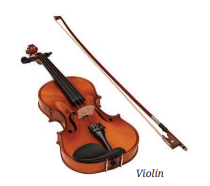
Violin
All the musical pieces here were played using the same instrument, a violin.
Similar to how your voice can convey various emotions and dynamics — happiness, sadness, loudness, and softness — an instrument has the capacity to evoke diverse emotions through different sounds.
You heard the sound of a violin. Now, try to listen to other musical instruments popularly played in our country. Like the flute, sitar, shehnai, tabla, etc., and try to understand how different sounds and tunes evoke diverse emotions.
Activity 4: Drawing Music
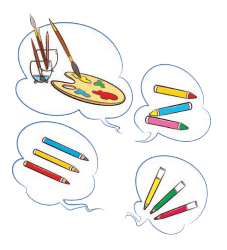
Each piece of music tells a story as we have been discussing till now. Now, let us try this; listen to a piece of music and represent it through your own art. You may draw and colour, using colour pencils, pens or paint. Give your drawing a caption or title.

Note to the Teachers
The class can be divided into groups and each group can be given a theme or a topic from any curricular area. The group has to musically express their ideas through beats and melody. They can also use the concepts of pitch and dynamics variation explained in the next page under Activity 6. Use the narration suggested or learners can come up with their own scenario.
Activity 5: Express your Emotions Through Music
Can you use your body to express any emotion through music without words?
When you are angry, what do you do? When you are happy, what do you do? When you are sad, what do you do?
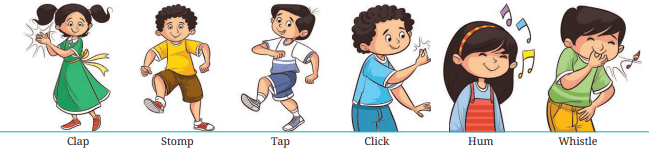
You can use your voice or body percussion (claps, stomp, snap, breath) to express these emotions.
Scene 1
I’m bubbling with excitement for our school’s upcoming field trip to a safari! Standing in my room, surrounded by the soft chirping of birds outside, I sift through my wardrobe. I try on various outfits until I discover the perfect one. “Yes! This is the one!” I exclaim happily, feeling ready to explore the wild.
Scene 2
After a long bus journey, we arrived at our destination. As we prepare to board the safari jeep, a gentle breeze sweeps through, causing the leaves to whisper and dance. The trees sway gracefully.
Scene 3
As we delve deeper into the forest, we encounter a myriad of creatures and plants. The forest pulsates with life, echoing with the sounds of insects, chirping of birds and calls of animals.
DO YOU KNOW
Animals have emotions like us. Have you observed that many birds and animals use sounds to communicate with each other? Birds use chirps to communicate. The Ganges river dolphin, the national aquatic animal of India, is blind, and uses a mixture of clicks and whistles to share messages. Male humpback whales are also famous for their long and intricate songs. Have you observed animals show their feelings through sounds? Share some examples.

Extended Activity
Narrate a regional folk story or stories from the Jataka tales and Panchatantra. Intersperse the narration with musical elements or songs that will help bring the story alive!
Activity 6: Learn about Musical Elements
Pitch and Dynamics
Have you ever noticed how you use different pitches and volume when you are happy, angry or sad? Pitch and dynamics are used to communicate emotions. Pitch tells us how high or low the note is and dynamics tells us how loud or soft a piece of music is.
Rhythm
Rhythm is everywhere. Have you ever listened to your heart beats? Note how your walking rhythm is different from that of your grandparents? In music, rhythm is the pattern which has symmetrical beats, played with a song.
The Swara Song
Watch the video and sing the ‘Swara Song’. This song is set to ragam shankarabharanam or raga bilawal. Pay attention to the variations in pitch while singing the song. Use your hands to keep the rhythm.
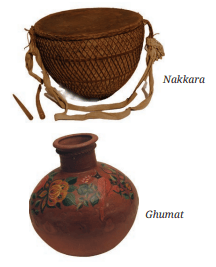
The two instruments have different pitches. nakkara has a loud volume while ghumat has a deep resonance.
DO YOU KNOW
Amongst the seven swaras only five have variations. Since, S and P do not have variations, hence called achal swaras. The rest of the swaras R, G, M, D, N are called chala swaras, as they have two variations each.
The pronunciation of notes in Hindustani and Carnatic music.
| Hindustani | Carnatic | |
| S | Sa | Sa |
| R | Re | Ri |
| G | Ga | Ga |
| M | Ma | Ma |
| p | Pa | Pa |
| D | Dha | Da |
| N | Nee | Nee |
While writing the notes, we will write as S, R, G, M, P, D, N.
Let us know the names of all the swaras sung in Carnatic and Hindustani music. There are 12 notes in total.
| Hindustani Music | Carnatic Music |
| Sa — Sadaj | Sa — Shadjam |
| Re — Rishabh Komal Rishabh, Shuddha Rishabh | Ri — Rishabham Shuddha Rishabham, Chatusruti Rishabham |
| Ga — Gandhar Komal Gandhar, Shuddha Gandhar | Ga — Gandharam Sadharana Gandharam, Antara Gandharam |
| Ma — Madhyam Shuddha Madhyam, Teevra Madhyam | Ma — Madhyamam Shuddha Madhyamam, Prati Madhyamam |
| Pa — Pancham | Pa — Panchamam |
| Dha — Dhaivat Komal Dhaivat, Shuddha Dhaivat | Da — Daivatam Shuddha Daivatam, Chatusruti Daivatam |
| Ni — Nishad Komal Nishad, Shuddha Nishad | Ni — Nishadham Kaisiki Nishadham, Kakali Nishadham |
Film songs, bhajan, regional songs, folk music, melodic instrumental music are all created with musical notes — S, R, G, M, P, D, N. All compositions or songs are created with these notes.
Indian music has many genres including classical music such as Hindustani and Carnatic, as well as genres such as folk, semi classical, devotional, patriotic and film music.
DO YOU KNOW
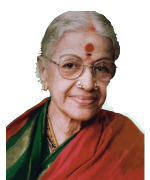
Smt M.S. Subbulakshmi is one of the most famous and inspirational Carnatic singers of all times. She was the first musician to receive the Bharat Ratna from the Government of India. Apart from Carnatic music, she also sang many bhajans and sanskrit shlokas. Amongst them, ‘Hari Tum Haro’ and ‘Vaishnava Janato’ were Gandhiji’s favourite bhajans. She is known for her originality, simplicity and purity of music. She sang with her magical voice which was filled with devotion.
Activity 7: Vocal Warmups
Vocal Warmups
The pattern of notes below is known as alankar or sargam.
Alankar means ornamentation or decoration. Just like jewellery is designed with gold and different arrangements of precious stones, the seven notes in music are arranged in patterns to create a melody that is pleasing and aesthetic. All music has to be pleasing to the ears, i.e., sruti madhur.
1.SR RG GM MP PD DN NṠ
ṠN ND DP PM MG GR RSM
2. SRG RGM GMP MPD PDN DNṠ
ṠND NDP DPM PMG MGR GRS
3. SRGM RGMP GMPD MPDN PDNṠ
ṠNDP NDPM DPMG PMGR MGRS
4. SR
SRG
SRGM
SRGMP
SRGMPD
SRGMPDN
SRGMPDNṠ
ṠN
ṠND
ṠNDP
ṠNDPM
ṠNDPMG
ṠNDPMGR
ṠNDPMGRS
5. SG RM GP MD PN DS
SD NP DM PG MR GS
6. SM RP GD MN PS
SP NM DG PR MS
DO YOU KNOW

Bharat Ratna awardee Lata Mangeshkar was one of India’s greatest playback singer in the world of Indian cinema. She has recorded songs in over 36 Indian languages and also in a few foreign languages. Her melodious voice spanned over three octaves. She sang the patriotic song ‘Aye Mere Watan Ke Logon’ and dedicated it to the Indian soldiers who lost their lives in the war of 1962.
Activity 8: Medley
A medley is a mix, or combination of different songs or tunes played together as one piece of music. Let us have fun.
1. Identify the mood that each song tries to convey. Even if you don’t know the language, do the musical elements help convey a certain emotion?
2. What does the rhythm in each of these pieces convey?
3. Identify the musical elements in each of the songs.
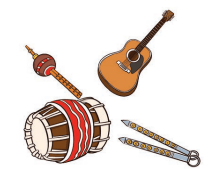
A song can be sung with the accompaniment of thavil, pungi, chimta, guitar, etc.
Let’s Learn to Sing a Medley
Learn the medley or a few songs in it. The class can be divided into groups with each group presenting one piece of the medley. This medley is a string of celebratory songs from different parts of India. Move, sway and keep the rhythm when singing these fun songs!
Learn to sing any medley with karaoke
Activity 9: Let’s Play Games on Dynamics, Melody and Rhythm
These games are designed to help students to achieve the objectives given. Teachers are encouraged to think and design their own games that reflect the local music cultures.
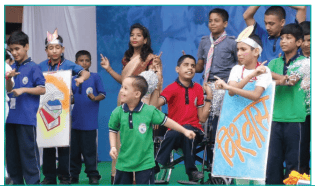
Activity I: Identifying the Voice (tone, texture, style). One student should be blind folded and other student can sing a song that is known or taught in the class. The blind folded student should be able to identify the student who sang it.
Note to the Teachers
• Every student has a difference in their tone, texture and style of speaking and singing. By doing this activity the class will be able to understand, and identify the voice textures, style and dynamics of their peers.
• Let the students also identify various voice textures and dynamics in the voices of families, or any person in the society. This will develop sensitivity towards identifying various sounds and their sources.
• Play any song on different instruments, and ask them to identify the instrument based on its sound and texture.
Activity II: Identifying the song based on the melody.
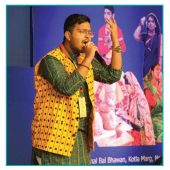
Select any student to hum a song that is known or taught in the class. By listening to the tune other children in the class should be able to identify the song.
Note to the Teachers
Such activities activate interest and confidence while presenting in a play way method.
Activity III: Rhythm Game: Students in groups of 3, 4, 5, 7, 9 in numbers can pronounce their names as below.
Group of three students will be given names Ta, Ki, Ta and the group name should be ‘Tishra’.
Group of four students will be given names Dh, Ge, Naa, Tee and the group name should be ‘Chaturashra’.
Group of five students will be given names Ta, Ka, Ta, Ki, Ta and the group name should be ‘Khanda’.
Group of seven students will be given names Ti, Ti, Naa, Dhee, Naa, Dhee, Naa and the group name should be ‘Mishra’.
Note to the Teachers
• This game is to enhance the sense of rhythm (speed, cycle, patterns) amongst the students.
• Teachers can design their own patterns and groups, and play any rhythm game among the students.
Make you own game which should have elements of swar and taal, vocal warm-ups, medley and any composition.
Group of nine students will be given names Ta, Ka, Di, Mi, Ta, Ka, Ta, Ki, Ta and the group name should be ‘Sankeerna’.