
Chapter 7
Musical Instruments
“Every musician is a storyteller, using melodies and rhythms to narrate the tales of the heart.”
— Pandit Ravishankar, Bharat Ratna, Sitar exponent
Objective: Understanding the relevance of instruments in a musical piece and exploring instrument families.
Instruments are used to create a layered and rich sound of notes and rhythm.
Activity 1: Role of Instruments in a Musical Piece
Listen to the song ‘Shyamale Meenakshi’. Now, try singing it by yourself.
Lyrics: Shyamale MeenakshiComposer: Muthuswami Dikshitar
Shyamale Meenakshi Sundareshvara Sakshi Shankari Guruguha Samudbhave Shiveva Paamara Mochani Pankaja Lochani Padmaasana Vaani Hari Lakshmi Vinute Shaambhavi Shyamale Meenakshi
| Activity | Discuss with the class |
| Sing this song with any musical instrument that is available in your classroom. Or, use body parts to clap, stamp, etc., to sing the song with rhythm. | How has using body parts helped you to sing the song? Did you enjoy it? |
| Now, sing with an audio track. The accompanying instruments are a violin and a mridangam. | How does an instrument affect the experience of a musical piece? |
| Now, sing with an audio track on a new set of instruments — a piano and drums. | What was your experience singing with a different set of instruments? Did you have a preference and why? |
DO YOU KNOW
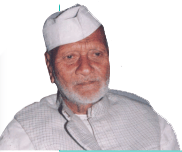
Ustad Bismillah Khan is one of the greatest shehnai players of India who is a recepient of Bharat Ratna. The woodwind instrument, shehnai, which was used mostly in folk music earlier, became popular in Hindustani classical music due to the efforts of this great musician. He was considered a symbol of religious harmony. He was invited to perform at the Red Fort on 15 August 1947, the day India got independence.
Activity 2: Listening and Responding
Listen to a story being told accompanied by an instrument. Explain how the instrument enhances the depth of the storytelling.
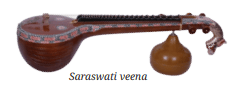
Saraswati veena
Try to listen to a story while playing this instrument and record your emotions.
Activity 3: Instrument Families
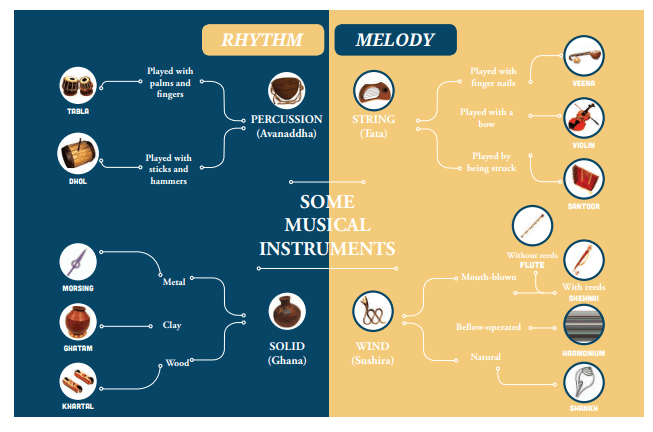
The two important components of music are melody and tempo. Based on these, instruments are classified as:
• Melody instruments
• Rhythm instruments
Instruments are further classified based on how they are played. Refer to the picture given in the next page to understand the classification of musical instruments.
Apart from the ones mentioned in the table, name two instruments that are used for rhythm?
1.___________________________
2.___________________________
Can you name two instruments that are used for melody?
1.___________________________
2.___________________________
Can you name two melody instruments that are played by plucking strings?
1.___________________________
2.___________________________
Can you name two rhythm instruments that are made with metal?
1.___________________________
2.___________________________
| QR Code | Instrument |
1. |
a. Sitar Sitar
|
2. |
b. Santoor Santoor
|
3. |
c. Harmonium Harmonium
|
4. |
d. Tanpura Tanpura
|
5. |
e. Violin Violin
|
6. |
f. Shehnai Shehnai
|
7. |
g. Tabla Tabla
|
8. |
h. Sarod Sarod
|
9. |
i. Flute Flute
|
10. |
j. Pakhawaj Pakhawaj
|
Activity 4: Make your own Instrument
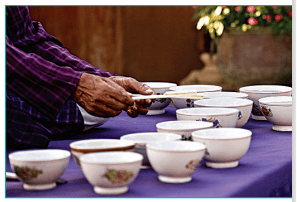
Jaltarang is an interesting instrument that consists of a set of glass, metal or clay bowls each having varying levels of water. The artist strikes the rim of each bowl with a wooden stick and produces music. It is a melody and a rhythm instrument. We can categorise it as a wind instrument because the air present above the water level in each bowl vibrates to produce sound. This is also a percussive instrument because the sound is produced by striking a membrane or a surface, which is the rim of the bowls.
Let us make a jaltarang with the bowls that are available in your kitchen.
You will need
Five sturdy bowls, a can of water, and two pencils or wooden sticks. Now, let us —
• Arrange the bowls on a table in a single row.
• Fill the bowls with varying amounts of water. You could fill the first bowl with one cup of water, the second one with three-fourths cup, the third bowl with one-half cup, and the fourth bowl with one-fourth cup of water.
• Your very own jaltarang is ready for use.
• Gently strike the rim of every bowl with the pencil or stick, and make your own music. Observe how the pitch is different when you strike different bowls.
Note to the Teachers
The school can invite local artists for a workshop and demonstration. Encourage the children to interact with the artist to find out how they learnt from their teachers. What type of life they lead and any other experience the artists are willing to share. Also encourage students to learn specific musical instrument and their basic playing techniques (as per the availability of the teacher).
Activity 5: Listen and Learn
Watch a visual and auditory introduction to instruments from India curated by Indian Music Experience Museum, Bengaluru. Which one of these instruments do you like and why? Take note of the different ways instruments can be classified.
Activity 6: Let’s Make a Project About
• Music and science.
• Life sketch of any local musician and their contirbution.
Magical World of Musical Instruments
Instruments create a rich musical experience. Instruments can be classified based on their utility and the material with which they are created. Listen to the songs that you enjoy. Identify the instruments used and classify them in different categories.
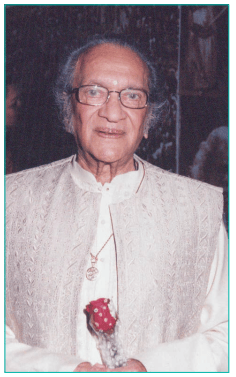
Pandit Ravishankar
(Bharat Ratna Awardee)